1990
A Portuguese Air Traffic Controllers strike saw 187 passengers stuck at Manchester and 140 in Gatwick. Their flights eventually departed 21 hours late. Other Dan-Air flights to the Canary Islands managed to circumnavigate flights into Moroccan airspace before landing. The Moroccan airspace soon became congested and couldn't cope with demand. A second day of strike action resulted in delays of up to 18 hours for 20 Dan-Air flights.
Thousands of holiday-makers faced a £10 per person surcharge on their summer holidays this year, imposed by Tour Operators who blamed the price hike on the soaring cost of aviation fuel. Currency fluctuation and the general increase in flying costs saw more than 40 Tour Operators apply to the Association of British Travel Agents (ABTA) for approval for the increase. The price of fuel had gone up by 30% during January alone. Dan-Air and Air Europe applied to the Civil Aviation Authority to increase air-fares. cut-throat competition saw several firms hold back from price increases in the hope of attracting new business, but the majority of holidays (80%) were taken using the main Tour Operators: Thomson, Intasun, Horizon, Cosmos and Airtours. ABTA said that because charter airlines were fighting for business many of them were expected to try to absorb the losses, a Dan-Air spokesman said: 'A sharp rise in fares looks inevitable, it seems certain that customers will be affected, but it is impossible to say by how much. Several ski customers have had to pay a surcharge after the pound fell against the Swiss Franc.'
Dan-Air announced that a record 6,275,000 were carried in 1989. There had been increases in charter passengers and scheduled service passengers. Peter Clegg said 'Many of our scheduled services have seen the introduction of jet aircraft which have almost double the capacity of the turboprop airliners that were used previously. We have also upgraded other popular scheduled services with larger jets. On top of that we had a very successful summer period. We have some exciting new plans that will hopefully mean lots more people choose to fly with Dan-Air this year.'
Joan Garnett who, at 59 years old, was believed to be Britain's oldest air stewardess retired this year after flying with Dan-Air for thirty years. Her last flight was a return trip to Paris.
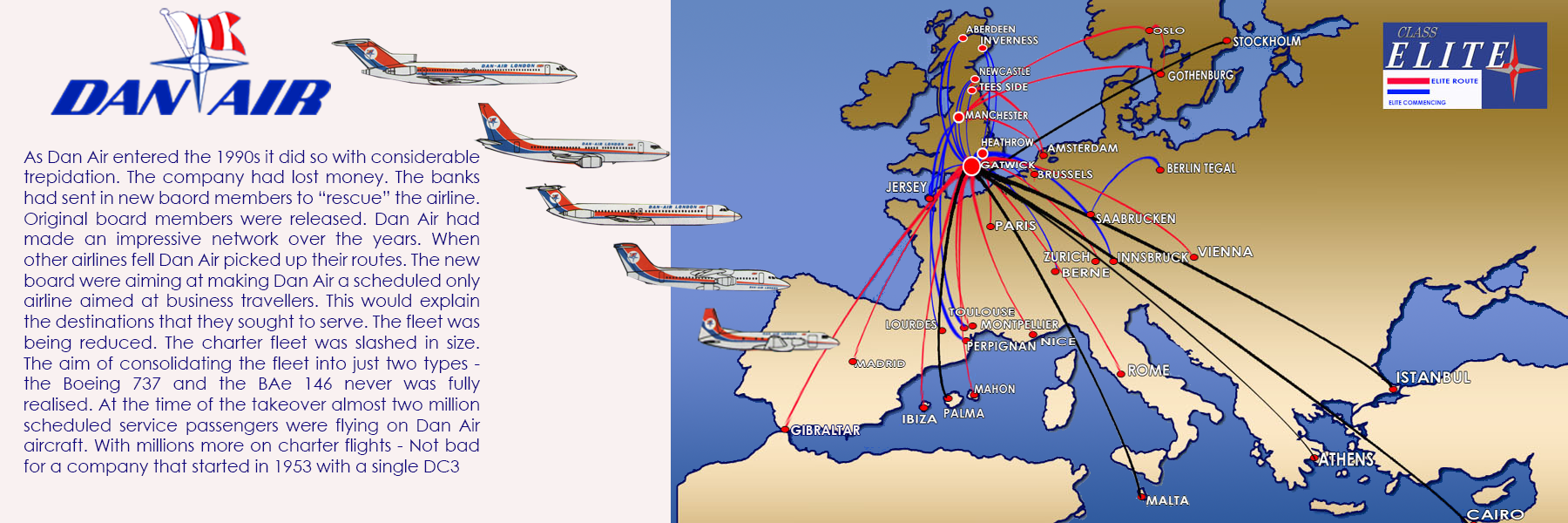
Dan-Air had successfully applied to provide scheduled services between Gatwick and Berlin with flights commencing in March this year. The daily flight would soon become a three times daily return service using Boeing 737 aircraft.
Rumours persisted that Dan-Air's parent company Davies and Newman planned to sell the airline to Air Europe, despite this uncertainty shares rose to 225 on February 21st. sources close to both companies said that Harry Goodman was about to make an offer for the airline. The previous year had seen Dan-Air's 4,000 seat charter capacity cut by 4% following a drop in 1989's package holiday bookings. Analysts had valued Dan-Air at £50,000,000 and they claimed that the majority of revenue came from charter flights. But scheduled traffic had increased and now more that 45 cities were served in eleven countries. The airline had more slot times than any carrier at Gatwick as well. It was speculated that Goodman was turning away from charter flights and wanted to concentrate more on inter-European scheduled flights, which he believed would be the growth market for the 1990s. A source said: 'Last year's bookings were a disaster and shows no signs of improving. D & N must be losing money hand over fist' Interim results showed a loss of £7.6 million in November, but the sale of two Airbus A300 gave D & N a profit over book value, adding a bright spot to what was expected to be a depressing full year result in April this year. The same analysts valued Air Europe at £220 million. ILG had been taken private in 1987 following am management buy-out of £150 million. (The analysis about Air Europe was wildly incorrect)
Two golfers were found guilty of endangering an aircraft after they placed fireworks inside luggage which went into the hold of a company Boeing 727. Some of the fireworks went off as baggage handlers removed the luggage at Gatwick. Eight more sets of fireworks were later found. The men appeared at Chichester Crown Court and were fined £200 each.
It was announced that Dan-Air was withdrawing from the Dublin - London route, citing over capacity from several carriers as the reason. Dan-Air were also under pressure to increase services on other, less populated routes where they could maximise revenue. Five staff at the Dublin office would be offered jobs elsewhere withing the company of made redundant and the office would also close in March.
The expansion of those other services was nowhere more evident than in Scotland. A second company BAC 1-11 was named 'Scottish Connection' in February at a special ceremony. The other BAC 1-11 based at Inverness was called 'Highlander'.
On February 2nd all flights of British Island Airways (BIA) were grounded after the airline went into receivership. A Gatwick spokesman refused to say if their aircraft had been impounded. The airline carried out several charter flights and had operated just three scheduled services, to Malta and Sicily. However, 4000 charter passengers had been booked to fly with BIA in the forthcoming months. The airline had a fleet of five BAC 1-11 and three MD 82 aircraft. The airline had made a loss in 1989 of £4 million against a turnover of £23 million, and increase of 25%. The airline told passengers to check-in as usual, and that they were doing their best to protect passengers.
In a dramatic statement, BIA said that they had instructed their bank, Lloyds to appoint Touche Ross as the official receiver. Lloyds were also the bankers for Dan-Air and Air Europe. The airline's 400 employees were effectively unemployed and passengers overseas would be flown home by another airline. This brought to an end three months of trying to save BIA from a heavy slump in the holiday charter market and high interest rates. In December of 1989 it was believed that BIA had been saved after the promise of a £30 million cash injection from banks, but the fate of the rescue money was now unclear. Touche Ross had arrived at BIA that afternoon and were said to be 'assessing the situation' No further information was given and their shares were suspended. BIA's chairman Peter Villa said he had hopes of a 'strong partner' but that alliance had never materialised.
BIA had debts of £10 Million. Two of the airline's BAC 1-11 jets had been sold off, in an attempt to raise capital. BIA had been profitable until 1988, and was even the chosen carrier for two of Mrs. Thatcher's Election tours. British Island Airways had been a stand alone carrier until they joined with other airlines to form Air UK. A few years later BIA broke away and had formed a second tier airline, based at Gatwick. The 89-seat One-Eleven 400s and 119-seat One-Eleven 500s operated by BIA mark two had filled a niche in the UK charter market, which at the time was dominated by 130-seat Boeing 737-200s, operated by BIA's much bigger, vertically integrated competitors. These smaller, second-hand BAC 1-11s had much lower acquisition costs (compared with the competition's bigger and newer 737-200s) but they enabled BIA to offer tour operators lower capacity aircraft at keener rates, giving them a competitive advantage on less dense routes. The One-Eleven 400's ability to match the 737-200's range, as well as both One-Eleven variants' ability to match the 737's fuel consumption and to comply with stricter, post-1985 noise abatement rules (as a result of having hush kits fitted to their engines), further enhanced BIA's competitiveness vis-à-vis its rivals. This helped attract business from the big tour operators that owned its rivals, especially to secondary European ski destinations served in winter where the lower trip costs of BIA's older planes outweighed the seat-mile cost advantage of the in-house airlines' technologically more advanced equipment. This in turn helped minimise the tour operators' risk, thereby representing a 'win-win' situation for both parties.
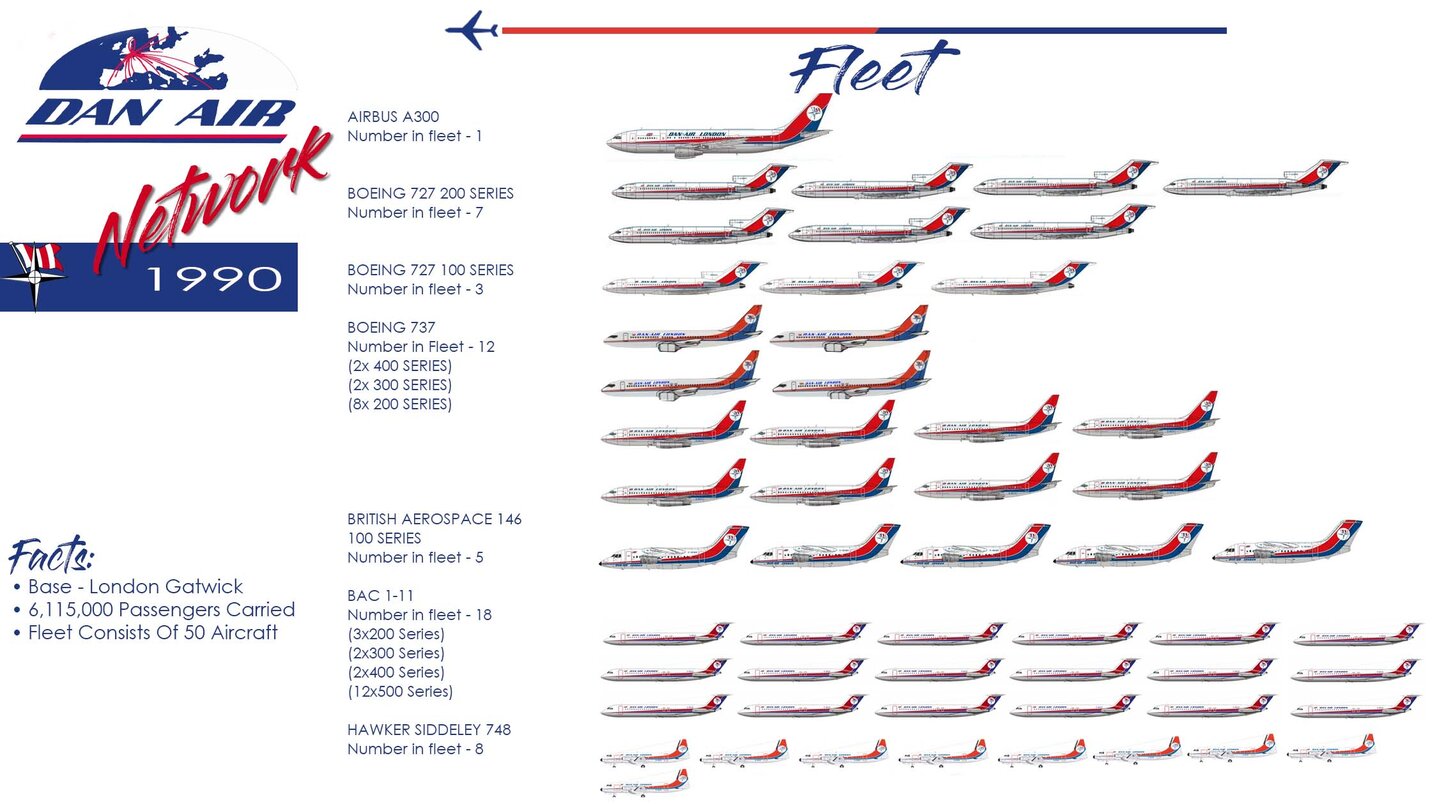
The One-Eleven, in a nut-shell was cheap to purchase and worked well on lower density routes. This could not be the long term aim of Dan-Air, who had eighteen of them in service. Newer, much more efficient regional aircraft such as the BAe 146 were available. As ever, the problem for Dan-Air would be how to get hold of them without financially draining the airline. To put this in context: Below is a list of how much fuel (in kilograms) is consumed per hour and the seating capacity on each type.
BAC 1-11 500 - Fuel Consumption 2,800 kg/h (119 passengers)
Boeing 737 200 - Fuel Consumption 2,800 kg/h (130 passengers)
Boeing 737 300 - Fuel Consumption 2,400 kg/h (149 passengers) (Dan-Air 30 Class Elite -40 Economy - Charter config 161)
Boeing 737 400 - Fuel Consumption 2,600 kg/h (156 Passengers) (Dan-Air 30 Class Elite - 66 Economy - Charter config 169)
BAe 146 100 - Fuel Consumption 1,700 kg/h (88 Passengers) (Dan-Air 12-40 Class Elite - 20-62 Economy)
BAe146 300 - Fuel Consumption 1,920 kg/h (96 Passengers) (Dan-Air 16-40 Class Elite - 46-82 Economy)
Boeing 727 100 - Fuel Consumption 4,140 kg/h (141 Passengers)
Boeing 727 200 - Fuel Consumption 4,500 kg/h (189 Passengers)
Boeing 757 200 - Fuel Consumption 3,320 kg/h (231 Passengers)
Boeing 767 200 - Fuel Consumption 4,500 kg/h (276 Passengers)
Airbus A300 - Fuel Consumption 5,000 kg/h (350 Passengers)
Tristar - Fuel Consumption 5,000 kg/h (350 Passengers)
TU 134 - Fuel Consumption 2,500 kg/h (85 Passengers)
TU154B - Fuel Consumption 6,200 kg/h (135 Passengers)
TU154M - Fuel Consumption 5,100 kg/h (152 Passengers)
As you can see, the BAC 1-11 compares quite badly. Dan-Air were also being hit hard by using the Boeing 727 on European charter flights, particularly the 100 series. There seemed little logic in using a Boeing 727 200 carrying 189 people, when a Boeing 767 could carry 276 people for the same amount of fuel. The Airbus A300 that Dan-Air used only slightly more fuel, but carried 74 more passengers than the Boeing 767. Yet still, Dan-Air chose to reduce the Airbus fleet, in an effort to raise cash. Dan-Air's 727 in both 100 and 200 series, used much more fuel than rival carrier's aircraft. Britannia, Air Europe and all the other charter carriers leased their aircraft; resulting in substantial monthly lease payments to the lessor or manufacturer. Whether the balance sheet tipped in favour of the fully owned aircraft was up for debate. One thing is for sure, if a would be Tour Operator came to Dan-Air requiring an aircraft, to match the competitor's price, Dan-Air would be operating on a vastly reduced profit margin. If there was a profit at all.
The British Airports Authority introduced major changes this year which saw wide ranging price increases, some as high as 45%. This led to Dan-Air announcing fare increases of up to 7% on scheduled services. A spokesman said: 'It's a sad fact of life that we have had to make these increases, but we reckon seven per cent isn't that bad when you consider some of the charges we have to pay. Fuel charges at over 35% and the interest rate increases haven't helped either. '
In 1990, the worldwide recession started to bite in the UK. One of the first things that people forgo, when times are hard, is their overseas holiday. UK bookings were down 40% on the previous year, at the time of the BIA collapse. Press reports said that 'Even industry giant ILG who own Air Europe were feeling the pinch.'
Following the collapse of BIA, Air Europe had jumped on the available Malta services and were soon operating Boeing 757 aircraft out of Manchester and Gatwick to the sunshine island. In April, Dan-Air announced that for only the second time in its history that it had made a loss. 1989's pre tax profits of £9.9 million dropped to a loss of £3.3 million. Share prices tumbled 50p to 355p (An all time high was last year's 570p) Fred Newman stated that high interest rates were partly to blame, as well as an exceptionally hot UK Summer. Newman also claimed the merger of BCal and BA had hurt the airline. Over-capacity on some services had not helped either, as this meant they were unable to increase fares. Their charter division was down 7%. Despite this, overall, Dan-Air had maintained their share of the charter market of between 15 and 20%. Turnover was up 11% at £376m. The sale of two Airbus aircraft had raised £5.1m and the company sold more than £1 million in surplus spare parts. Despite carrying 4.5 million passengers on the charter division, which was only 1% lower than last year. The airline was not able to increase revenue from those charter flights . the reason for this was because they were operating on the same margins as the previous year. This operation was carried out amidst much higher fuel costs. The cost of launching Class Elite had been costly, but almost two million passengers flew on Dan-Air's scheduled network, an increase of 40%.
Further Stories about a merger between Air Europe and Dan-Air resurfaced in March. Goodman was sourced as saying; acquiring Dan-Air would set him on the right path alongside his Air Europe. The source said that there appeared to be no sign that 1989's down-turn had been reversed and that Dan-Air was losing money. A few days later on March 6th, Dan-Air described the rumours as 'Codswallop' George Yeoman of Dan-Air said 'There is no truth in these rumours whatsoever. All airlines have been hit by the recent down-turn on holiday bookings. There is no reason why we should be taken over.'
The new Gatwick-Berlin daily service was launched in March, the same month that Pop Princess Kylie Minogue flew on Dan-Air. The airline offered to whisk the star through a quieter part of the airport, but Miss Minogue insisted on meeting fans saying 'They have been waiting all day to see me.'
Air Europe signed a contract 'of substantial value' with Dan-Air on April 30th. The contract was to carry out the maintenance of Air Europe's Boeing 757 fleet. The contract was to last three and a half years. This followed the contract signed the previous year for Dan-Air to maintain Air Europe's Boeing 737 400 series fleet. The bulk of the work on the twelve string fleet would be carried out at Dan-Air Engineering's new hanger at Gatwick. It would also apply for Air Europe's associate airlines. The engineering base at Lasham would also be involved. Mike Ellis associate Director of Dan-Air Engineering said; 'This is the first major contract where the majority of the work will be predominantly performed out of the new Dan-Air hanger complex at Gatwick Airport.' The engineering division was already involved in the maintenance of more than 100 aircraft of other carrier's fleet as well as the 51 aircraft in their own fleet.
May 1st would see the opening of the new daily (except Saturday) Gatwick -Vienna service. The route was destined to be a great success as it was the only flight between the Austrian capital and Gatwick. Class Elite would feature on all flights. A new innovation 'Space Generator' seats had now been installed on all aircraft with a 'Class Elite' cabin. Vienna was rapidly growing in importance as a commercial centre especially given its close location to eastern Europe. Flights would depart daily at 0800am and arrive in Vienna at 11:10 am. the return was 1202 arriving in Gatwick at 1315.
Secret talks that had taken place in May were leaked to the press. The talks had been between Dan-Air and several interested parties, resulted in a dramatic increase in the Davies and Newman share price, rising from 150p to settle at 575p. This increased the value of the stock market company from £10m to £40.3m. Exactly who was involved in the takeover talks was initially unclear. It was rumoured that both British Midland Airways and British Airways were not involved as they knew any such merger would be referred to the monopolies and mergers commission. Aviation insiders believed that a European or American airline would be most likely to buy Dan-Air, as it was the easiest way to get into the already congested airports of Gatwick and Heathrow. These carriers would also be aware that Dan-Air had massive hanger space at both Gatwick and Manchester. Dan Air went to great lengths to reassure passengers that any passengers booking with Dan-Air would in no way be at risk with contractual obligations. Dan-Air announced that they would be withdrawing from the Inverness-Manchester-Gatwick service, that had been in operation for only fourteen months. Instead, they would be concentrating on the Gatwick-Manchester route which had far better yields. The successful Inverness-Heathrow and the Aberdeen-Gatwick services would increase frequencies. Dan-Air revealed that only 7% of passengers at Inverness had opted for the Gatwick service over Heathrow. The Inverness-Heathrow route had been so successful, that not only had frequencies increased they were now increasing capacity on all flights. The flights would all now be carried out using the larger, 104 seat BAC 1-11 500, adding a further 20 seats to each flight.
A HS 748 prop-liner was involved in a near miss over Germany on 2nd May. The Captain was forced to take a violent nose-dive to avoid a collision with an American military jet. Captain Bob Dearling landed the aircraft safely with passengers lining up to shake his hand. Captain Dearling took violent evasive action to avoid the crash after the jet came within 50 feet of the 748. One of the 16 passengers on board, a German business man was concussed as he was thrown forward. The incident occurred over Saarbrucken which was the destination of the airliner which had departed Berlin. An investigation was launched by the West German authorities. A Dan-Air spokesman said Captain Dearling was under radar control of the US Air Force at the Ramstein Air Base. Two F-15 jets were in the same airspace as the Dan-Air aircraft.
A raft of new route licences were sought in May, with applications for Manchester, Tees-Side and Newcastle to Berlin. Tegal Airport in West Berlin had long been established as a charter base for Dan-Air who supplied flights for the majority of West German Tour Operators and the The GTF (German Tourist Facility.) Dan-Air executives thought it was a good idea to expand scheduled services out of West Berlin beyond the Saarbrucken, Amsterdam and London services. Applications were therefore submitted for licences from Berlin to Moscow, Budapest, Prague, Warsaw and Bucharest. The former Communist states had opened up to the west and Dan-Air was ideally placed to become a major player in the region. With George Yeomans of Dan-Air saying: 'It is our intention to capitalise on our Berlin Tegal base.' - Ultimately the applications were rejected.
Britannia Airways announced that there would be redundancies this year after a difficult twelve months trading for the entire industry. Dan-Air, keen to shake off rumours that they were about to go bankrupt, issued a statement saying; 'Consideration is being given to the possibility of greater co-operation between Dan-Air and other airlines. As part of this process the company is in discussion with a number of interested parties and those discussions may or may not lead to an offer being made for the company. It is emphasised that such an offer is only one of several possible outcomes from such discussions.'
There had been leaks to the press suggesting that the airline was about to be taken over, which Dan-air had initially denied. The airline had intentionally not disclosed which companies they were in talks with. Just days after the statement was released, another leak revealed that British Midland had been in talks with Davies And Newman. British Midland admitted they had been in talks, but stressed that they were 'inconclusive at the present time'. The press were unclear about why British Midland were in talks with Dan-Air, which, it said, was foundering because of the collapse in the package holiday market. Captain Alan Selby told us:
'Well they would say that wouldn't they? Dan-Air was a much larger airline than BMA. While the press were going on about them not being able to expand at Heathrow, they neglected to say that we had some very good routes out of Manchester, Newcastle and Gatwick. Our fleet was considerably bigger than theirs and our network dwarfed theirs. We carried six million passengers that year, two million of them on largely profitable scheduled routes. That was double those on BMA,. So, from my point of view it was obvious why they wanted us. If we had been making any mistakes in the late 1980s I believe that it was because we were diversifying into too many areas, we were also in the habit of keeping unprofitable routes going for far too long. Instead of just axing them. We did have profitable parts of the business, the engineering was profitable for most of its existence and so was Gatwick Handling. I also believe that a lot of the charter stuff should have been thrown out. It's perfectly acceptable to have a modern, efficient airliner flying good business, but I, and many others knew that operating the 727 came at a heavy price. I don't think they were making any money at all, and if they were not - then get rid of the jets and either replace them or operate the profitable ones only - using the most modern aircraft. I can't say for sure, but I believe that there might have been a bit of egomania in play. I think Dan-Air enjoyed being known as the second largest airline in the UK. But the bottom line was that anyone can have a shop selling ten pence apples at nine pence each. You can't do it for very long though. The charter scene had so much over capacity with new airlines all over the place. It was hard to get the contracts, you have to match all the new carriers' rates, and if you are doing that with a 727 and your competitor is using a 757, and you are using so much more resources on the same route - you will lose money.'
Within days the press was full of stories about how Dan-Air was about to be taken over by Air Europe, American Airlines or Lufthansa. Dan-Air were anxious to re-assure holiday-makers and the travelling public that it was 'business as usual'. Telling journalists that any talks they were involved in 'would in no-way jeopardise any contractual arrangements we have with any of our customers. We are a controlled company, in other words we have various family trusts and directors, who together, hold a majority shareholding in excess of 60%, so we are in control of our destiny.' It was rumoured that the airline was up for sale at £45 million. One of the senior management team told us, on condition of anonymity:
'Obviously, I was not involved in the actual discussions, but I was involved from the sidelines. The whole industry was in a pretty desperate state. The International Leisure Group and their airline, Air Europe, in public at least, did a good job of appearing to be able to withstand the economic forces that was exceptionally hostile to our business. During the year there had been war in the Gulf, involving two oil producing nations. This was bound to have an effect on fuel prices. It would also mean that travellers were anxious about flying in general. It didn't matter that the Gulf was a long way away, it did unsettle the travelling public. It is never good with a backdrop like that to have constant speculation that your company is about to be swallowed up. I can assure you that we were not, as it were, on the phone calling every airline in town and saying 'Will you buy us please?' Airlines do work together more than you would imagine and believe it or not, contacts are maintained. In this sort of scenario, there are discussions with banks, that are ongoing through the year. Several airlines may use the same banks. There are all sorts of formal and semi formal dialogues between these institutions. It was not as if we couldn't pay the electricity bills. Things at this time went on as usual. You cannot be perceived as cutting corners with standards as that leaves you open to other sets of accusations. The board were not sat there with their heads in their hands night and day. There was the business of running an airline and that is what we did. You never knew - maybe a huge contract was just around the corner and if it was, then you had to be seen to be professional and ready to meet the challenges. Some of the changes that were about to come, I was enthusiastic about - some not so much. Some of the things that new people did, I thought were the right call - and some were, frankly terrible decisions.'
On May 24th a packed Boeing 727 was racing down the runway at Manchester about to take off when an indicator in the flight deck alerted him that there was a fire in the jet's engines. Highly experienced pilot Captain Charles Nash brought the aircraft with 187 passengers on board to a halt on the runway, whilst at the same time issuing a 'Mayday' call to the tower. the aircraft stopped on the runway and Captain Nash was heard on radio saying 'I thought you had learned the lessons from the 1985 disaster.' In the incident Captain Nash did not know if there was a fire because the engines are at the back of the aircraft and he couldn't see them. Manchester Airport Operations said that the CAA had been asked to launch an investigation and that to comment would prejudice the inquiry. The tower stated that they could not see flames, only smoke and that fire services were on their way. The Captain was given a radio frequency to speak to the fire teams. Communications were lost and the Captain forced to re-tune to the tower.
Just one day later a company BAe146 suffered a burst tyre on take-off at Gatwick on a flight to Newcastle. The aircraft flew over the tower at Newcastle to see the extent of the damage, revealing that the starboard inner tyre had burst. Emergency services stood by as the airliner with a near full load of 72 passengers approached. The Captain landed the aircraft safely.
The nest day a BAC 1-11 charter flight from Palma to East Midlands landed and was informed by the tower that smoke was 'bellowing' from one of the rear mounted engines. The crew opened the rear air stair, smoke began to fill the aircraft and crew then decided to close the door, instructing passengers to exit by the front door. Several passengers chose to ignore the crew and opened over-wing emergency doors before clamouring onto the wing and jumping off. One of those passengers was a seventy year old woman who jumped off, breaking her ankle. The Dan-Air spokesman said:
'We checked the engine and there was no fault. We believe it was just a case of some oil dropping onto the hot engine and smoking. The wind must have been blowing in the wrong direction and took the smoke into the rear of the aircraft. So our crew very properly made the right decision in closing the door and instructing passengers to use the front door. There was no intention for it to be an emergency evacuation.'
Newspapers carried reports on May 26th that Dan-Air looked 'certain to be taken over by Lufthansa' A claim that was dismissed by Dan-Air with a spokesman saying: 'I don't know how many times we have to repeat this, but it is business as usual. There have been talks with other airlines about forming closer ties, this does not mean a take-over. We can't have a situation where every day the press announce another new airline is being lined up to take us over. Passengers have absolutely nothing to worry about.'
Inspirations East - a small Tour Operator chose to charter Dan-Air Boeing 737 400 series jets for a series of holiday flights from Gatwick to Goa in India. The flights would operate in 170 seat configuration and would be the first charter flights to India that Dan-Air had undertaken. There would be a refuelling stop at Sharjah in the United Arab Emirates. There would be a free bar and in flight catering. For an additional £95 passengers would enjoy extra leg-room seats and upgraded catering. The Sunday evening flights would operate from October through to March 1991.
Harry Goodman gave an interview to TV which was displayed a lot of his ambition.
'When we started as a small Tour Operator we soon realised we needed an airline, all the airline charter companies were owned by our rivals. So that was a necessity, after that, it became a fun business, it's very fun, very profitable. We like to win. We don't take great risks with the company, we take calculated risks, we like to be winners. You know it's fun to take on your rivals, and Governments and bureaucracies, and it's even more fun when you're winning.'
But winning hadn't come easy, Air Europe had started out as a charter company, carrying passengers for it's sister company Intasun. Not all of the charter airlines were owned by rival Tour Operators - Dan-Air for instance. It was only five years prior to this interview that Air Europe had gone into scheduled services, challenging the larger airlines head to head. Goodman continued;
'What you have got is a series of not likeable, fat cat European scheduled airlines. They have never had to face competition, their costs are sky high, and in a competitive environment they are finding it difficult. Now the only way that they can compete is by blocking facilities. Refusing to accept our tickets, refusing to inter-line, refusing to enable us to use facilities at airports, but we're cracking all of those.'
They claimed that the strategy was simple, that Air Europe were using brand new aeroplanes and offering an excellent on-board service for a much lower price. They said that established airlines fought tooth and nail to block the new upstart and Air Europe found themselves handicapped at every turn. Including denying them access to the European computer reservation system. Charles Powell, Air Europe's Scheduled Services Director said:
'We still have an outstanding issue with Alitalia who have been editing data that we want to put into those reservations systems. They refuse to show our fares for example. They pretend that we charged the same fares as Alitalia, all that kind of nonsense. All of that can be very damaging and it has the effect of reducing the consumer's choice in what is, otherwise, a developing market.'
Most airlines airlines had traditionally expanded cautiously, but Air Europe had a different approach. In 1989 they began to form partnerships with smaller airlines all over the continent, establishing a pan European network of scheduled routes, calling the concept 'Airlines of Europe'. This bold step saw the entire European airline industry watching their every move, but Air Europe were absolutely convinced that the next decade would be theirs for the taking, with Rod Lynch, Air Europe's Managing Director going on to say;
'The biggest barriers are the barriers in people's minds, about those people who see France as a totally foreign country, as opposed to somewhere that is around one hours flying time away. I think this country, which is very insular, is going to go through something of a revolution. The sheer access into Europe, and vice versa, is going to generate masses of traffic, and I fully intend that we are going to take advantage of those.
But as the market changes, so do the airlines. The next few years would see partnerships from some of the largest airlines in the world, with huge resources. Was Air Europe not worried that they might simply squeeze them to death Goodman said;
'Well they will try, but one thing is for sure, you don't gain anything by putting a series of inefficient companies together. You know, if you look at our costs compared to Air France, Lufthansa, Iberia even British Airways, our costs are 40% less. To get low fares, you have to have low costs, and all the cosmetics of putting all the monolithic giants together without addressing the basic problem of getting the cost base down will do them absolutely no good whatsoever. We compete every day of the week. If you look at how scheduled airlines have grown up, they have grown for instance, between British Airways and Air France with an agreed affair between London and Paris. There was no competition, the fare was agreed at which was the least efficient of those two carriers, so you didn't have to worry about costs, you know, if Air France had a strike and the unions wanted 30%, it was like 'no problem give them 30%' because who pays? You and I, the poor old passenger. But now that's gone out of the window, so they've gotta look at costs. But they've got a cost structure that's built up over twenty years as a monopoly. Very difficult to get rid of.'
Air Europe had made their mark at Gatwick. They were the second largest airline at the airport, behind Dan-Air, both were ahead of British Airways. In 1989 Air Europe had carried more than three and a half million passengers. Their business class and executive lounge, 'Premier Class' had been a hit with business commuters. Rod Lynch said;
'The airline business is absolutely infectious, once you've been bitten, it's completely incurable, I couldn't consider working anywhere else personally. I don't know any of my co-directors who would give tuppence to work in any other industry. Once you are in aviation it tends to stick permanently.'
Harry Goodman closed by saying;
'If you're asking me do I like flying? No, I hate flying, but that's a personal thing, I just hate getting on aeroplanes, on saying that, I do 200,000 miles a year, so I have to. But it's certainly not in my blood, you know, I don't fall in love with an aeroplane sitting there on the tarmac. I like to be successful, I like to take on challenges, I like to win, and here you see an opportunity, which is very rare a man gets. I was told at first, you will never get a scheduled service licence, and if I did I would't get the landing slots, and if you did, you would never get lower fares - we got all three. We run at satisfactory load slots, and if I look at our major competitors, they are more frightened of us than I am of them.
Sir Colin Marshall Chief Executive of British Airways said in response to Goodman;
'Well I think he will have another thought in due course. I saw him on the video, and there was, of course, a sprinkling of disinformation and half truths. It's hard to conceive that Harry's costs would be 40% lower than those of British Airways, after all, we buy our aircraft at the best possible prices on a high volume basis, we borrow money at a fine interest rate. We pay our pilots and engineers at a proper rate and I very much doubt that Harry is paying his pilots and engineers at 40% less than British Airways. I doubt that his insurance is less, and I know that his air traffic control and landing charges certainly won't be less than ours, so I think that Harry and we are going to be very strong competitors for the future, and that's a good thing..'
Marshall denied that there was any attempt by British Airways to squeeze smaller airports out of business by pointing out that Air Europe had more slots at Gatwick than British Airways and their charter carrier Caledonian combined. He neglected to say that Air Europe had no slots at Heathrow.
A baffled elderly couple were back in the UK on June 1st after setting off for a holiday in Norway and landing in Greece. Retired Pit official John Matthews aged 83 and his wife Jane aged 82 were looking forward to their usual holiday in Norway. But while their luggage was loaded on the Dan-Air flight to Oslo they were being ushered onto the flight to Lesbos, and five hours later instead of gazing at snow capped mountains they found themselves in a Greek hot-spot. Mr. Matthews of Sheffield said: 'We saw two Dan-Air planes side by side and we got on the first one.' The mistake came to light after the Greek bound aircraft took off and officials became aware that their Oslo flight had only 29 passengers on board instead of the 31 who had checked-in. The bemused Captain radioed saying he had two extra passengers, but by that time it was too late. Dan-Air put the two up in a hotel and flew them home to the UK. They would then fly to Oslo where the time lost would be made up at Dan-Air's expense. Mrs. Matthews said: 'We can't be angry at anyone at Dan-Air, they have been so good to us. In fact, Greece looked lovely,we are thinking of going there later in the year.'
In June, a Tour Operator conference spoke about how 1991 would see fewer holidays available. Prices would be fixed through a background of heavy losses, reduced demand a fewer aircraft. A total of 25 aircraft had been lost following the collapse of British Island Airways, Paramount Airways and the closure of Novair.
Air investigators began a probe on June 22nd into an air-miss involving a Dan-Air BAC 1-11 and a British Airways Boeing 747 over Sussex. A Dan-Air spokesman said 'Both aircraft were under the control of London Air Traffic Control and our pilot had been instructed to descend immediately to avoid collision with the British Midland aircraft. The CAA said they had referred the matter to the Independent Join Air-miss Group.
On June 24th another air miss was reported over Wales. The incident involved a company Boeing 727 with 170 passengers on board flying from Ibiza to Manchester and a Dublin bound British Midland Boeing 737 from Heathrow. The two aircraft narrowly avoided disaster at 28,000 feet over mid-Wales. The Dan-Air 727 took a dramatic dive to avoid a catastrophe. The two Captains prepared reports which would prove vital for the investigation. CAA said radar tapes would be studied to help find a solution. The two incidents came only days after a new computerised system had been installed to help cope with the increased Transatlantic flights. One of the major corridors was north of Swansea where up to 250 flights a day passed.
The airline said they would 'look again' at their decision to scrap the mid-morning flight from Inverness to Gatwick from October. Company Chairman Fred Newman promised to 'carefully reconsider' the move after pressure from Inverness M.P. Sir. Russell Johnston. The 1105 flight is one of only five daily air-links to London and is used mainly by businessmen from the north. Sir Russell said losing the flight could potentially cause damage to businesses and tourist prospects. Sir Russell said he very much welcomed the 'constructive approach' of Mr. Newman.
A furious row between a man and his wife sparked a mid-air alert on July 3rd. The couple started feuding shortly after take-off and five miles in the air, senior stewardess Annie Ball tried in vain to calm the couple down. But their noisy bickering carried on over Spain, France and across the English Channel. Passengers complained that the arguing was louder than the engines. As fellow travellers watched on anxiously the Captain, Graham Harradine vainly appealed for a truce. Then Captain Harradine radioed ahead asking for police to deal with the matter after landing the BAC 1-11 at Manchester. But just before touch-down the insults suddenly stopped flying. The row was over and the two police officers who went on board the aircraft to speak to the couple took no further action. The Airport Police Liaison Officer Ken Bettanay said: 'Holidays can be a testing time for couples.'
The incident was reported as a 'domestic situation on board'. The plane, from Alicante had 119 other passengers on board, including two infants.An airline spokesman said: 'In cases like this, the normal procedure is for the senior stewardess to try and calm things down, and if that fails the pilot is normally asked to talk to the passengers concerned.'
On July 11th an investigation was launched after a man travelling to Athens from Manchester Airport boarded a Dan-Air flight destined for the Canary Islands. It was the third time that a Manchester passenger had ended up on the wrong plane at the airport in six weeks. The man was put up in a hotel and boarded a scheduled services flight to Tenerife the next day, all at the airline's expense. The man had been flown back to Manchester on the return flight of the one he had boarded, he had a night at the airport hotel and flew to Tenerife the next morning. Britannia Airways had a similar mishap when a passenger boarded a Boeing 767 which was parked next to a Britannia 737. Monarch Airlines had an extra passenger to Turkey who should have been travelling to Ibiza, British Airways had a Milan passenger end up in Dublin and perhaps the worst example was when an Arab business man who should have boarded a KLM flight to Amsterdam, ended up on an Air Malta flight to Malta. Dan-Air said: 'It appears there has been a mix up on two occasions when gate staff have not supervised boarding adequately. But our cabin crew are instructed to check all boarding passes, as well as more than one crew member carrying out a head count before push-back. We will be fully investigating this matter.' Meanwhile, airport official at Ringway said: 'The problem of passengers getting on the wrong aircraft unfortunately does happen from time to time.'
Gatwick Airport upheld a ban on extra late night flights which had been imposed in 1988, following complaints by local residents and local environment groups. The Government ruled out additional flights for the foreseeable future. But the decision was condemned by airlines who used quieter aircraft types, who's noise levels, they said, were well below maximum noise thresholds. The restrictions had been imposed by the Department of Transport with a promise to review the situation after two years. Minister Patrick McLoughlan said that noise levels in the area had been greatly reduced since the introduction of the restrictions, and that the latest category of quiet aircraft show that the overall night noise climate can be improved. But he still refused to life the restrictions and ordered a two year research programme into how people's sleep was affected by aircraft noise at Heathrow, Gatwick and Stansted. Representatives from the Airports would sit on the committee. Gatwick Airport Consultative Committee agreed that it was not the right time to review the night quotas. The members suggestion of a survey of local residents be carried out was taken up by the Minister. McLoughlan said that an integrated noise and track system would be in place at Gatwick by 1992. As older, noisier aircraft are phased out, to make way for newer, quieter models, the amount of disturbance from aircraft noise should be reduced he said.
But Air Europe acted angrily at the decision, saying: 'At Air Europe we feel that those airlines like Dan-Air who operate noisy old aeroplanes should be penalised rather than companies like ours who have invested in new, quieter aircraft.'
A Dan-Air spokesman said: 'We are disappointed at the news, but not dismayed. We are buying quieter aircraft.'
A substantial portion of an unused hanger at Manchester was taken over by Dan-Air in July for their servicing and inspection crew. Local electricity firm Norweb had installed new state-of-the-art quartz ray heaters for what was the largest heated area of its kind in the UK. The installation,although costly vastly improved the electricity efficiency in the company with 50% of capital costs recouped within 15 months.
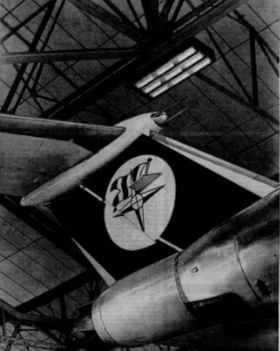
Above: The Quartz Ray Heaters at Manchester
Dan-Air were the recipient of the Tea Council's 'Best Airline Tea' in the world. They were chosen with a combination of presentation and leaf blend. The council flew 300,000 miles over 504 hours sampling the tea of airlines all around the world. Eventually a short list of thirty airlines were chosen, this was narrowed down to Austrian Airlines, British Airways, American Airlines and Dan-Air. Two professional tea tasters then selected the winner. Dan-Air said 'Of course we are delighted to have won this award and that our passengers can enjoy the brew, from the judges point of view, Dan-Air is obviously their cup of tea.'
Dan-Air were keeping the blend a secret, but it was believed to be a blend of Indian tea. The judges also felt that Dan-Air crew serving the tea with milk from a jug was also a factor int he taste, with the Dan-Air spokesman saying: 'I think they were impressed that we serve milk that way, not from a carton or a plastic jug and certainly not the little packs of UHT milk.'
One of the tasters, Jenny Wright who had travelled 80,000 miles tasting tea was also impressed with the enthusiasm of the Dan-Air cabin crews. She said 'Tea is undoubtedly my favourite drink, and whilst I am no expert, I know what I like.'
Services between Aberdeen and Manchester/Gatwick were to be stepped up to four return daily flights from the end of October, increasing frequency to 24 flights a week. There wold also be an extra one flight each way on weekdays to Manchester. Weekends would remain unchanged. At the time there would be increase in the number of seats available on the Inverness-Heathrow service which would see an increase of 600 seats a week following the introduction of the 104 seat BAC 1-11 500 series. Services from Inverness to Gatwick via Aberdeen and Manchester would be suspended from October in the light of the anticipated reduced demand on the route during the winter.
Dan-Air had issued a statement: 'The Inverness Member of Parliament Sir Russell Johnston had asked us to look again at the services, and we have. At present, only 7% of our Inverness passengers have opted for Gatwick. It was felt that the service could not go into profit if we took into account the very high landing and parking charges at Inverness. There isn't enough business to justify the service without landing at Aberdeen and Manchester, and the figures there are not high enough to sustain the service through the winter months. We will look once more at the service in the spring.'
But Inverness Airport bosses disagreed. Hugh Lawson denied that the airport fees played any part in the shutdown. 'Fees at Inverness are substantially lower than at Aberdeen or Gatwick.'
A near-miss involving a Dan-Air BAC 1-11 and a NATO F111 over Inverness in November 1989 had been kept hidden from the public a Scottish newspaper revealed. The bomber was carrying out a 'mock bombing attack' over Inverness Airport. The incident caused so much concern that the US Air Force was now questioning whether these tests should be carried out over civilian airports. Several F111 pilots had refused to carry out the practice that day, but the leading F111, travelling at 417 mph, and whose 'target' was on the periphery of the airfield, passed the Dan-Air BAC 1-11 on final approach, at a speed of just 108 mph, just yards apart. The Dan-Air pilot complained on the radio, saying: 'Not impressed with that fighter.' That jet went right over the top of us as we were just rounding out there. Are they supposed to do that sort of thing?' The controller replied in the negative. The pilot was of the intention that the move was carried out intentionally so as to give a close miss. This was backed up by the controller who thought the pilot of the F111 had 'aimed straight at him'. The pilot estimated that the F111 had come within 250 feet, but the controller said the distance was just 33 feet. The investigation by the Civil Aviation Authority air-miss working group said the discrepancy was 'hard to explain'. The report went on to claim that if the BAC 1-11 had been later in landing because of any hold-up the outcome could well have been very serious. Although the report had great sympathy with the controller, it say the final clearance given to the F111 to approach the airport, given that they were just two minutes away, put them into conflict with the Dan-Air flight. The controller had apparently thought the BAC 1-11 would be on the ground by the time the US war planes arrived. The report recommended that 'the undesirability of practice attacks in UK civilian airfields without proper clearance should be brought to the attention of NATO Taceval (Tactical Evaluation)' But it also notes that US Air Force opinion that 'the use of civilian airfields for practice aircraft should be discontinued.' The Captain noted that: 'It is not for us to say whether these flights should be carried out within civilian airspace or at civilian airfields, but they should never be carried out without the express knowledge and consent of pilot of the civilian aircraft. We in the flight-deck had absolutely no warning. We were unaware that such practice flights were being carried out in the area. We were not told anything at all during our approach. As far as we were concerned, we were on a standard approach, which requires a great deal of concentration at such a critical time. To look up and see a military jet heading directly towards us was terrifying. Our passengers had no knowledge of this and had certainly not agreed to take part in such tests. Who would have been to blame if we in the flight deck had reacted differently and made a catastrophic error? Members of the public who are ordinary fare-paying passengers should never be exposed to this sort of testing. Thank goodness we in the flight-deck were the only ones who saw what happened.'
A report issued several weeks later decided against stopping practice sorties at civilian airports but agreed that none would take place without the written consent of an airport manager. Sir Russell Johnston, the local M.P said he thought the report to be unsatisfactory. He said as far as he was aware these sort of missions were only to be carried out if six weeks notice had been given. He also called for the NATO pilots to face disciplinary proceedings.
A bereaved man told of his disgust at a major airline for losing the body of his 21-year-old brother, who had been killed in a checkpoint accident in Ulster. The family of Scots Guardsman Paul Brown went to Inverness Airport, Dalcross, on Saturday August 4th to receive his body off a Dan-Air flight. But they learned the coffin had been lost because of a blunder by cargo handlers. Paul’s brother, Allan, said: 'We just couldn’t believe it was happening. One of the Dan Air staff at the airport told us that he didn’t have a clue where Paul was, but that he would phone round a few place to see what he could find out. It was horrible. They seemed to be treating it as just another piece of lost luggage, not the body of a 21-year-old soldier.' After making inquiries, Dan-Air told the family the body was still in Ireland. But when the Browns contacted the Army for more information, they were told the coffin had definitely been put on a Dan-Air flight and they had the documentation to prove it. After a tense hour of waiting, the family learned Paul’s body had been found stranded at Gatwick Airport. Allan said Dan Air told them the body would have to stay there until arrangements could be made to fly him to Inverness on Monday. 'My Father was furious - disgusted at the idea that his son would have to lie alone in a cargo hold for two days.' He said. But Dan-Air decided that they would fly the body to Glasgow that day and transfer the coffin by hearse to Inverness. Allan said: 'As a mark of respect, and to make sure no more blunders took place, Paul's Uncle, who lives in Glasgow, met the plane and carried the coffin off themselves. The airline's handling of this was totally insensitive, they just didn't seem to care.'
On August 24th Davies And Newman share price suddenly fell from 175p to 150p a fall of 12% knocking £12 million off the value of the company. But a company spokesman said: 'Things are proceeding as normal. Absolutely nothing is happening at all - we are baffled by the speculation.'
Speculation about the airline's performance had been rife with analysts predicting that high fuel costs and the decrease in the number of package holidays being taken were to blame. The airline had been rocked by the setting up of an in-house airline for the fourth largest Tour Operator in the UK, Airtours, who were about to launch Airtours International. The new carriers would certainly have a negative effect on Dan-Air's charter sales. Airtours said that their new airline would operate 60% of their summer 1991 season and 90% of the winter programme. The charters that Dan-Air provided for Airtours was the equivalent of five aircraft that had been committed to Airtours. The top four Tour Operators in the UK now all had their own airline. The Dan-Air spokesman denied that recent talks with the CAA had been a 'crisis meeting' saying: 'It was a perfectly normal meeting that the CAA have with all airlines every year to keep them informed of their future plans.' The present share price compared with a price of 934p the same time a year before. The share price eventually recovered to 225p.
Davies and Newman Chairman Fred Newman said he believed that the fall in price was a result of press speculation and a result of minimal trading volume. He confirmed that the company was involved in talks with a number of airlines and was in the process of conducting a review of company operations. The process had begun with the news that the main company office was moving to Gatwick and that five aircraft would be sold. The review would not see any changes to the airline's scheduled operations in Scotland. For the first time, media reports claimed that Richard Branson's Virgin Atlantic was interested in Dan-Air. Captain Alan Selby told us:
'The review of company operations was vital I felt for all the reasons I mentioned earlier. What was as clear as a bell was that five aircraft would be joining Airtours fleet very soon with roughly the same capacity as the 727. In the end, a lot more aircraft went than I expected, and more joined the fleet than I thought would. My own notes read that the last of the A300s went, and three of the 727 200, we got rid of one each of the BAC 1-11 200/300 and 400, whilst keeping all the 500 series. We disposed of two HS 748. On the plus side we bought four Boeing 737s. So we were five down. Lots of activity was going on, which gave the impression that 'something' was afoot. I didn't like that atmosphere. But there was never a feeling that we would become part of an airline much smaller than us. My colleagues and myself always had an unshakeable belief that we would somehow get through it. We always had before, no matter how big the problems we faced were. I certainly agreed with Fred Newman that press speculation was impossible. Mainly because so many of them didn't understand the airline business and were just looking to write something that had an attention grabbing, gloomy headline.'
The review did indeed see many changes. Up to 150 staff would move from London to the Newman House complex in Horley to be nearer Gatwick. The recent fuel price hike would effectively add £1 per passenger, per hour on a Dan-Air flight. The poor efficiency of the BAC 1-11 2/3/400 series and the Boeing 727 had further hampered the airline. The base at Stansted looked certain to close as Airtours had made it known that their own airline would operate 60% of Airtours' summer programme and 90% of their winter one. The sale of the aircraft would bring in new revenue and the replacement aircraft would all be leased in and not purchased outright. The UK economy continued to struggle and by September two more airlines had folded, Capital Airlines and Air Dundee both went bankrupt.
September 15th saw a company BAe 146 en route from Manchester to Gatwick come face to face with a group of hang-gliders. The aircraft had climbed to 4,500 feet over Leek when the Captain noticed several gliders. Although the gliders were well below the height of the gliders, it appeared that the aircraft had flown directly through them. A company spokesman said: 'The pilot did not have to take any evasive action as he had passed through the group. There are no air traffic regulations for hang-gliders, but it is their responsibility to ensure that the area they are flying in is safe. There would considerable turbulence to a hang glider who flew into the trails of a four engine jet aircraft. Not to mention the unthinkable if they were to be in the direct line of an aircraft travelling at more than 400 miles an hour. Leek is quite near to Manchester when one is in an aircraft. Fortunately nothing happened..
It was revealed on September 18th that the company was planning to sell the Dan Air Engineering division in a deal that was believed to be worth £25 million. Parent company Davies and Newman confirmed that they had asked Merchant Bank Barings Brothers to contact potential buyers. The sale would include the recently opened £10 million hanger at Gatwick, the main Lasham Airfield, the Manchester base and eleven sub station engineering divisions. More the 1,600 people worked for Dan-Air Engineering and the company had been consistently profitable. Many people could not understand the decision with one former DAE manager telling this site.
'We never saw it coming. We had just signed a huge maintenance deal with Air Europe, and we had more than 100 aircraft that we maintained, besides our own fleet. We were pretty much fully engaged at all the bases. Besides which, we had recently made a sale of extra spare parts we held and that had raised a few million. If any part of the Dan-Air group was failing to make money, it was the charters. We didn't produce our own figures for the PLC thing, we were just one of the companies within the group, but it was widely known that we were profitable. I read about how much it was going to be sold for in the press and it didn't add up to me. £25 million....When the spares we sill had were worth about £10 million. That hanger at Gatwick was surely worth more or less what it had cost - and a fully functioning base at Lasham with its own runway! We had every bit of plant you could ever need. It was a bargain in my opinion. A bit too much of a bargain.'
A Davies and Newman spokesman said of the company: 'As part of our previously announced review of corporate strategy we have decided to seek expressions of interest in all or part of Dan-Air Engineering from parties capable of providing the resources to enable to division to achieve its full growth potential. The division employs a total of 1,625 people. Dan-air Engineering made a profit last year against a a turnover of £50 million. The division maintains our fleet of 51 aircraft and in the last year alone has serviced aircraft for more than 30 airlines. We plant to retain a 20% stake in the company which will continue to maintain our own fleet of aircraft.'
Analysts were predicting that Dan-Air would make a loss of £30 million this year, amid speculation that airlines were now reviewing their air charter links with the group. By September 18th shares fell 130p and stood at 205p. This bad news came at a time when it was announced that the company had carried a record number of scheduled service passengers during the first six months of the year. A total of 840,000 was 14% higher than the same period on 1989, with the business class 'Elite' showing the largest growth. This success in the scheduled field contrasts with the slump in charter traffic which was hitting all sectors of the travel industry. Dan-Air had a record turnover in 1990 of £380 million but by August fuel prices had rocketed again.
Charter flights were arranged to Sweden and Finland this year, when a record 17 flights would depart from Manchester on their way to see Santa.Scheduled flights from Newcastle to Amsterdam would be extended through to Berlin from October this year. The flights would be undertaken using BAC 1-11 aircraft.
There would be work for engineers on September 18th when a company Boeing 727 with 187 passengers on board suffered a tail strike on take-off at Manchester Airport on a flight to Tenerife. The aircraft (DA2726) returned to Manchester where passengers were put up in a hotel. Repairs were carried out at the airport and the aircraft took off for its destination 10 1/2 hours late.
Two passenger jets avoided a disaster over Hertfordshire on September 26th. a Dan-Air BAe146 jet from Gatwick to Newcastle with 74 passengers on board was forced to climb steeply to avoid a collision with a Scandinavian Airlines jet with 105 passengers. SAS said the aircraft were less far apart than the 300 metres safe minimum distance, but denied they were 90 metres apart. A Dan-Air spokesman said Captain Ted Espir was forced to take 'instinctive action' at 15,000 feet. 'He pulled back the stick sharply and went into a steep climb, passing 200-500 feet over the SAS aircraft. The CAA confirmed an air-miss has been reported and that Air Traffic Control had given avoiding instructions and the SAS passed below the BAe146.
A company pilot flying one of the BAC 1-11 fleet scraped the wing on the runway as he landed the jet at Inverness on October 15th. The un-named pilot was making a blind instrument landing due to low cloud on September 29th. The aircraft was grounded for 48 hours while repairs were carried out. Dan-Air said: 'The pilot was a very experienced pilot with no blemishes on his record. He is back flying again after losing his seniority.' An airport worker who witness the incident said: 'He really was lucky, if the wing tip had hit the soft ground at the side of the runway instead of the tarmac, the aircraft could have quite easily overturned.'
A further incident came occurred in October when two RAF Tornado jets sandwiched a civilian Dan-Air Boeing 737 on a flight to Kos. A Dan-Air spokesman said that both military jets passed within 500 feet of the 737 in a high-risk incident that forced the pilot to bank steeply. The double miss happened on Wednesday October 10th, the day after the Ministry of Defence announced the results of an enquiry into the January collision between RAF Tornado and Jaguar jets near a Northumberland village 12 miles away. The incident occurred minutes after the Boeing, carrying only its crew of seven, took off from Newcastle Airport to fly to the Greek Island of Kos to collect passengers. The spokesman said: 'Pilot, Captain Roger Jackson was climbing through 14,000 feet when Newcastle Air Traffic Control advised him of possible 'pop up traffic' below. At that moment he saw navigation lights of aircraft coming towards him on what he thought was a collision course. So he banked very steeply for an aircraft like a Boeing 737 and switched on all the lights to fully illuminate it. In view of the instructions given by Newcaslte Air Traffic Control, we suspect the RAF pilots were where they ought not to have been.'
Berwick M.P Alan Beith claimed the RAF jets should not have been in the area at all. But the following day a Ministry of Defence spokesman would not comment on whether Tornado jets were allowed in the area. He said the incident would be fully investigated by the independent joint air miss working group.
The very next day a company BAC 1-11 reported an air miss with two gliders in an unrestricted area of air-space over Aviemore. The BAC 1-11 with a crew of six and 68 passengers on board was climbing at an altitude of 10,000 from Inverness to Heathrow when it passed 500 feet over the two gliders. although no evasive action was needed the pilot had reported a small blip on his radar.
The Civil Aviation Authority said it would investigate. At the same time Dan-Air rejected claims that their pilots 'sometimes took unofficial short cuts' on flights between Inverness and Glasgow. Airline spokesman Peter Clegg was responding to allegations made by Cairngorm Gliding Club instructor Alan Mossman who said that Dan-air were well known for diverting from their proper routes.
Mr. Clegg said there were no mandatory air corridors for the Central Highlands for commercial aircraft. 'Although they are not legally restricted, our pilots always follow instructions given to them by Air Traffic Controllers. We don't blame the gliders for this incident, they are as entitled to use the air as much as anyone else. Legally the gliders can fly anywhere they like because it is not controlled air-space, it is in nobody's interest if the situation remains unresolved. Whilst we accept that it is more dangerous for the glider pilots than for our pilots, because in a near-miss the gliders could be in trouble because of the turbulence caused by an airliner, you never can tell. Clipping a glider can have an equally bad effect on a large jet.'
The area concerned was well known by gliders, who crossed the A9 road near Loch Garry. the gliding club the gliding club was at Fishiebridge Airfield near Kincraig where 15 gliders were kept. Mr. Mossman said that Dan-Air jets regularly overflew the airfield, sometimes 'directly'. 'The majority of Dan-Air flights into Inverness take a short-cut through unprotected air-space instead of using the air route provided for commercial aircraft. By flying into uncontrolled airspace where no separation from other aircraft can be guaranteed, they put passengers and other aircraft at risk - all to save a little time and some expensive fuel. Their complaint about gliders being dangerous and difficult to identify is over the top. We really have been slagged off for no reason at all.'
Mr. Clegg said: 'Perhaps some of our pilots are unaware of the location of the gliding club, but I know the manager of our BAC 1-11 fleet is going to discuss matter with Mr. Mossman. It is not in anybody's interest to leave matters as they are. Next time it could be a gliding club from Deeside, or a club from way outside the area that gets involved. Something has to be sorted out. Hopefully the joint air miss working group will consider this when it gets down to examining the detail.'
Davies and Newman promised to clear the air over speculation about the company. They said they would issue a statement “as soon as possible”. Press speculation throughout the two previous months had reached fever pitch with rumours that one of the City’s toughest troubleshooters, Mr. David James, was poised to move in to run the airline as part of a two-year plan. The stories that circulated hinted that bankers were insisting on top level management changes in the company as a condition of guaranteed backing. Davies and Newman issued a statement on October 18th which said, they would be 'making a statement concerning the company’s plans and prospects as soon as possible”. Shares in Davies' and Newman, which had plunged in the wake of previous Dan- Air speculation, were unchanged on October 18th at 140 p. This compares with a high this year of 760 p
Angry passengers on a flight from Gatwick to Aberdeen which was delayed for five hours on October 18th were demanding an explanation for the disruption. The flight had to be aborted when it was two-thirds down the runway on its take-off. Weary travellers, who were due to leave London at 11am, were asking why the flight was allowed to go ahead initially, when the plane was known to have faulty equipment. Passengers were informed minutes before the plane was due to take-off that the pilot had become aware of a faulty gauge on the plane. But they were left stranded for more than an hour while engineers checked whether to let the flight proceed or to call in a replacement aircraft. When they were eventually given the go-ahead to depart at 12.10pm, the flight had to be aborted when the fault recurred. However, the problems continued when passengers were transferred to a replacement plane, only to find that one traveller had left, and an hour long baggage search had to be carried out. Exhausted travellers on the packed flight which contained a higher proportion of children than normal eventually made it back to Aberdeen at around 6.15p.m. One Aberdeen passenger, Mr John Marshall, admitted the aborted take-off was 'quite scary' but said most passengers realised what had happened. He said: 'The feeling among most people was that the captain had done the right thing, but he should never bad been put in that position in the first place.' A Dan-Air spokesman last night apologised for the 'excessive delay', but said it could not have been avoided. He said: 'It is obviously far better to be safe than to fly to Aberdeen and have to shut down one of the engines. It’s just one of those mechanical things—we did our best.' The spokesman said the problem arose when a gauge on one of the plane’s four engines showed it was using an excessive quantity of oil. He said engineers had investigated the problem and decided the plane could depart. But during take-off the gauge was still showing high oil consumption and 'the pilot decided not to risk it any more.' The spokesman said the delay could have been avoided if the passengers had been transferred to another plane when the fault was first noticed, but said that another aircraft and crew may not have been available at that time. He admitted the plane had had the same problem before and said: 'The mechanics thought they had put it right and cleared it for this flight.’
City troubleshooter David James was announced as the new Chairman of Dan-Air on October 19th. His appointment which came with a rumoured salary of £30,000 per month, would guarantee the bank's backing until at least the end of 1991. Dan-Air had been profitable in every year of its existence until 1990. Fred Newman, Chairman of Davies And Newman would step down to make way for James, known in City circles as 'company doctor'. James was Chairman of Eagle Trust, a position he held when he was brought in as part of a rescue package. He would continue as Chairman and Chief Executive of Eagle Trust. Davies and Newman shares bounced up 15% ending at 155p on the news that James would become Executive Chairman on November 1st. James said:
'Most of the company's employees would keep their jobs. My appointment does not mean a threat to the established regional routes. I have no pre-conceived ideas about closing off any of the routes. One has to look at profits, you cannot go cherry picking and just keep the best routes, you have to look at the total.'
It was also revealed that the company was no longer up for sale. Earlier this year it had been speculated that a merger between Dan-Air and another airline was on the cards. But' Dan-Air Engineering, is still up for sale, with good progress being made.= with potential buyers.' said James.
A profit warning came with the news, results for the first half year to June 30th were expected to show a substantially larger loss than the £7.662 million for the same period in 1989. As part of the package, banks would boost the working capital from £40 million to £70 million. The credit limit was extended from the end of the month to the end of 1991. The Davies and Newman family, who owned 60% of the company agreed to suspend their voting rights while David James was Chairman. James said:
'I am encouraged at Dan-Air's present performance in having acquired 85% of its charter capacity for the 1991 season.
Dan-Air disclosed interim pre-tax losses on October 27th. They showed losses of more than double of those of last year. Losses for the six months to the end of June totalled £18.7 million compared with £7.7 million for the same period last year. Retiring Chairman Frederick Newman blamed rising costs, aircraft over-supply and fewer people taking holidays. At the operating level, Davies and Newman made losses of £2.2 million compared with a profit of £8.7 million the last year. Shares were cut by 35p to 115 p, wiping £2.5 million, or 23% off the company'’s stock market value. On top of the operating losses, the group had to weather aircraft hire charges of £6.7 million, depreciation of £5.6 million, and interest charges of more than £5 million. There is no interim dividend. The company said on October 26th that planned cost-cutting measures include cutting the number of charter aircraft, selling the engineering division and transferring Dan- Air's Headquarters to the parent company’s Horley office. On the positive side, the company says its ship-broking arm has been performing satisfactorily while its travel agency is continuing to maintain improved profits.
James' appointment was not without criticism. The innovatory refinancing package was approved with just hours to spare before the company was said to be placed in administration by its bankers led by Lloyds. Instead the company managed to negotiate a rollover of their existing credit facilities of £40 million whilst securing new lines worth a further £30 million. The new £70 million deal would not need to be renegotiated until January 1992. David James said:'The fuse was getting fairly close to the powder keg.'
In return for this further funding, the banks would get a 'success fee' equivalent to a percentage of the company's net asset value on a given date, certified by accountants. This was believed to be the first time that banks had been offered this kind of incentive to participate in a rescue deal.
David James said that the situation at Davies and Newman was 'unprecedented' and required an 'innovative solution'. The alternative, he said, was administration, a form of insolvency usually involving the break up of the company. In stepping down, Fred Newman, who's family owns 60% of Davies and Newman gave undertakings not to use his stakes not to block crucial changes to the board, except in the case of a bid for the contested company. The details between the company and its creditors were complex. Davies and Newman agreed to pay interest at 2% above LIBOR and the success fee would be based on the valuation of the company in December 1991. the payment would be one third above the net asset value - between £26.25 million and £45 million and 10% of anything above that. But the minimum was set at £8.75 million. Which would mean Davies and Newman having an NAV of £70 million. The fee was unsecured and subordinated to all other creditors. James said that he hoped that this deal would be a 'frontier breaker' Encouraging other companies to go for a similar deal rather than just go for insolvency.
James' appointment came with the reassurance that Dan-Air were no longer looking at selling the airline or joining up with another carrier. They were looking at returning the airline to profitability. One of James' first moves as Chairman, was to replace most of the Board of Directors at Dan-Air with people he had personally chosen. Many had no experience in aviation. He then told the press and the industry that he saw no reason why Dan Air could not be turned around. Dan-Air Engineering (DAE) would remain up for sale. But now James and his team would be giving instructions to Bearings Brothers, who were to oversea the sales should it happen. The price tag of £25 million would give a massive injection of cash to Dan-Air.
Dan-Air Engineering had MADE A PROFIT LAST YEAR. Davies and Newman hoped to retain 20% of the company and use the facilities to maintain their own aircraft. Air Europe then announced they would not be renewing their maintenance contract with Dan-Air and would not be chartering ANY of Dan-Air's aircraft this year.
James' idea revolved around Dan-Air securing a re-finance package and concentrating on becomming a stand alone scheduled airline. He said he wanted to commence a fleet renewal programme. The General Manager - Europe - Vic Sheppard announced that in 1990; 'Dan-Air would be phasing out our smaller aircraft and thinner routes'
Those aircraft would be replaced by newer, quieter and more economical jets on high density routes such as Gatwick - Paris, which would soon be offered up to nine times a day.
Sheppard said;
'I am well aware that people only see Dan-Air as a cheap and cheerful charter airline, and all that goes with that, but when people have tried our scheduled services, in particular the 'Class Elite' they are often pleasantly surprised at the level of service we offer. Our market research shows this, and it shows that they are highly likely to come back for more.'
In 1990, 24% of Dan-Air's scheduled passengers were travelling on business class and 40% of all flights operated flights were done so on the scheduled network. The new company strategy was to take that total to 60% in 1991. The six domestic services into Gatwick already offered interlining with with other airlines or their own flights. In particular, American carriers were impressed with Dan-Air's ability to bring passengers into Gatwick to join their flights Stateside. Dan-Air had no ambitions to enter the long haul market and the interlining agreements worked well. Interlining for those who might know might be include a Dan-Air flight from Newcastle to Gatwick which would be timed to land at Gatwick with enough time for the passenger to transit to an American flight with another carrier. The system worked particularly well for passengers whose regional airport had limited direct destinations. Successive Governments had refused to allow independent airlines access to Heathrow. Air Anglia, the small regional Norwich based carrier had tried in vain to access Heathrow to feed other passengers from several UK airports onto flights to worldwide destinations. Neither British Airways, the British Airport Authority nor the Civil Aviation Authority would permit access other than the most fought after slots. Dan-Air had waited almost thirty years to to gain access with one route and British Midland had less than a handful of services into Heathrow. Other than those two carriers not a single UK independent gained entry to the airport. No charter flights flew out of Heathrow either. Air Anglia were so incensed at being denied entry that they contacted KLM. An Air Anglia manager called David told us.
'I don't believe that people in aviation today could comprehend the regulatory bodies that restricted every part of airline activity. Economics, although sometimes given as a reason for declining an application, didn't really come into play. On paper our proposals would have worked. British Airways did not fly into Heathrow from every UK airport, and they certainly didn't fly from every regional airport to all their international destinations. So, what conceivable reason could anyone have for denying us the opportunity to provide feeder flights for them. I personally gave an example of a person walking into a travel agent in Norwich and wishing to purchase a ticket to fly to New York. The options were London Heathrow with BA and from Gatwick with another airline, or alternatively to fly direct from Manchester. If you look at a map of Britain you can see how remote Norfolk is. Travel by road and rail to London took hours. But the CAA would not hear of a link. So we approached KLM and they were most agreeable. The flying time to Amsterdam was around an hour and passengers could then join a KLM flight to anywhere in the world. So the CAA actually gave us a licence to operate into Amsterdam, knowing full well that we were providing a boost to KLM, Schipol, the Dutch economy and ourselves. We ended up replicating the service from Aberdeen, Newcastle, Tees-Side, Leeds/Bradford and Humberside. It worked incredibly well, KLM added us to their computerised system and we were working flat out providing them with passengers. This continued long after we joined other airlines to form Air UK, where the partnership continued. It took Air Anglia about five year to get into Gatwick, where we could interline with other airlines, but it was nowhere near as fruitful as the KLM set-up. We never could understand who to fully point the finger at, but it was protectionism at its very worst, but who was being protected and from what? I believe that many UK airlines would have grown if they were allowed the same opportunities. When we became Air UK we applied for about five international destinations, we said we would use the F28 jet, which carried about 60 people. we thought it would be easier to fill than the BAC 1-11 that Dan-Air were proposing on the same set of applications. In the end the CAA rejected both our applications and gave the routes to British Airways and British Caledonian, saying we didn't have the expertise to match their operation. I remember Dan-Air being most annoyed at that. They had been operating twenty years before either of the others were created. There is no wonder that there was so much resentment in aviation.'
There would be an second daily return flight between Aberdeen and Manchester added from October 29th. The low price of £69 return was hoped to directly compete with British Rail and a special off-peak fare of £50 return would be offered on the Manchester-Gatwick service through the winter months. The standard fare was £142.
Approval was granted by Horley Council for an expansion of Newman House. the property would undergo marked changes in design. the ground floor which was originally going to be a car park, and would now consist of offices with an underground car park constructed. Councillors had complained about the number of parked cars congesting the town already. Four shops and two maisonettes would also be constructed. It was not revealed at the time what the shops would be used for, but they would be larger than the ones submitted with the original planning application. Approval was only granted on the condition that the existing 124 car-parking spaces were provided elsewhere during the construction period.
Announcing pre tax losses of £18.7m on October 31st for the last six months trading, the figures made grim reading. A further 15p fell off the share price of Davies and Newman. Having increased by 20p at the announcement of David James' appointment. They now stood at 140p.
David James gave a press conference on November 1st, saying: 'The airline will continue fly despite selling off the engineering division. the core business Dan-Air is certain to survive in one form or another. The Board's first task is to give priority to addressing the corporate strategy for the future and deciding precisely what parts of the organisation should be developed and which may represent potential for realisation.' he confirmed that talks were taking place with Cathay Pacific and others with regard to the sale of Dan-Air Engineering.
As Europe announced they had prepared for the 'de-regulation of the airways' in 1992. A new division of their company Air Europe Express was given permission to operate scheduled flights from Gatwick to Jersey in direct competition with Dan-Air who also found itself having British Airways as a direct threat on its Gatwick-Toulouse route. British Airways wanted to get back onto the Gatwick-Paris service, but was told by the CAA that as Air Europe were already competing with Dan-Air, a third airline on the route could threaten their future. The CAA said that 'Passenger interests are best served by a number of British airlines strong enough to compete with each other. However, the policy has been formulated and adopted against a background where competition does not and cannot take place on equal grounds. On occasion therefore decisions might have to be taken which limit the actions of dominant airlines.'
The CAA's statement can be seen as ironic, when at the same round of applications where British Midland had made a formal complaint to the CAA about British Airways on the Heathrow-Belfast service which British Midland accused BA of flooding the route with unprofitable flights in an attempt to squeeze British Midland out. The CAA said they would not restrict BA's flights as it would be of no benefit to the passengers who wished to fly on the route - 'In this case, the authority found that on the whole, BA were acting in the interests of the passengers. The decisions reflected the commitment that the CAA has to maintaining a multi airline industry.'
BA's new service would be flown with Boeing 757 aircraft, whilst Dan-Air would use the BAC 1-11. It was announced that Air Europe were keen to operate flights between Aberdeen and Gatwick.
Rumours that Dan-Air were having trouble selling the engineering division set the share-price into a spin with the price settling down to 90p at one period the price fell by 10p. David James said: 'Stuff and nonsense, we have had a number of offers. Scheduled bookings have recovered since the airline was rescued.
Aer Lingus, the Irish national carrier publicly expressed an interest in buying Dan-Air Engineering. The engineering division did not produce trade figures of its own, but was widely believed to be one of the most profitable divisions within the group. David James then said that Cathay Pacific were interested. In the end neither purchased DAE.
Some of the older BAC 1-11s in the fleet would not meet the new noise reduction targets set by the EU. They were also lacking CAT III technology which prevented the types use in harsh weather. Some had been fitted to CAT I. The lack of CAT III had not been considered to be a problem on many charter routes, because they generally had good weather. When the 1-11s were placed on Northern European Scheduled Services some of them became problematic when weather was bad. The airline decided on a long term strategy of phasing out the BAC 1-11, HS 748, Boeing 727, and Airbus aircraft and consolidating the fleet on just two types. The Boeing 737 and the BAe146.
One the the seventeen charter flights to see Santa ended with tears on 19th December when the flight was cancelled. Cosmos holidays had arranged the flights which cost £229. Thick fog at Manchester meant that the aircraft, a BAC 1-11 could not take-off. The 119 passengers including 50 children had waited three hours to see if the fog would clear but to no avail. Dan-Air said they could provide an aircraft to take the party out, but not until Boxing Day. Parents complained that they had kept on the aircraft for three hours and were not let off to stretch their legs or have a drink. Cosmos' representative said: 'We will have to have a think if we take the Boxing Day flight as it might seem pointless going to see Santa after Christmas. All passengers are entitled to a full refund. We are sorry that the group had to stay on the aircraft, but that was because it was a one-off day trip flight and if the fog had lifted they needed to be able to take-off quickly. The Captain had decided that he was not prepared to risk lives.'
Dan-Air said that their Berlin flights were getting busier all the time. The service had started shortly before the fall of the notorious fall and tourists were keen to see the other side of the city. A company Boeing 737 flew to Moscow on a charity flight in December. Charities had managed to get a plane load of baby food and Dan-Air agreed to fly the food destined for hungry Soviet babies free of charge. The flight brought much needed good news to the company. As did the award 'Airline of the Year' awarded to Dan-Air by ILG. This was ironic as Air Europe were relentless in their campaign to smear Dan-Air;
In what seen as an attempt to finally finish Dan-Air, ILG said that it would not be chartering any Dan-Air aircraft beyond this year. Just two years prior, ILG had time chartered six aircraft. The following year only three.
ILG went on to say that they had no plans to use any Dan-Air aircraft at any time in future. Dan-Air Engineering had lost the contract to service Air Europe's aircraft the previous year.
Dan-Air, unlike Air Europe, was asset rich, with real estate that they actually owned, several aircraft in the fleet were owned outright and spare parts in store were valued at millions. The landing slots owned by Dan-Air were colossal. The sale of DAE was said to be 'progressing' by David James. The decision to sell off Dan Air Engineering is explained in great detail in the company history section of this site.
1990 had been a record year for the amount of passengers Dan-Air carried 6,276,000 passengers. 4,472,000 on charter flights and 1,804,000 on Scheduled Services. Their aircraft had flown 68,903 flights. Of those 35,560 were charter flights and 34,343 were scheduled flights. In terms of its network, all flights covered 72,666,000 aircraft km. Forty scheduled Service destinations had now been added to the network and in total 220 airports had been visited.
The HS 748 aircraft was seen to have reached the end of its use, they did not have the capacity nor efficiency of most of the jets in the fleet. The oil supply charter flights had dwindled to a mere trickle, and several HS 748s were sold, leaving the fleet total at just eight.
NEW ROUTES AND ROUTE CHANGES
- Gatwick - Amsterdam feeder route - March (Taken over from British Airways)
- 2 April - Gatwick-Berlin service commenced - April 2nd
- Gatwick-Dublin service discontinued - April 4th
- Gatwick-Vienna service started - May 2nd
- Gatwick - Ibiza - ‘Class Elite' introduced. May
- Connecting flights introduced between Manchester, Newcastle, Tees-side and West Berlin. October 29th
NETWORK & PRESS 1990
1991
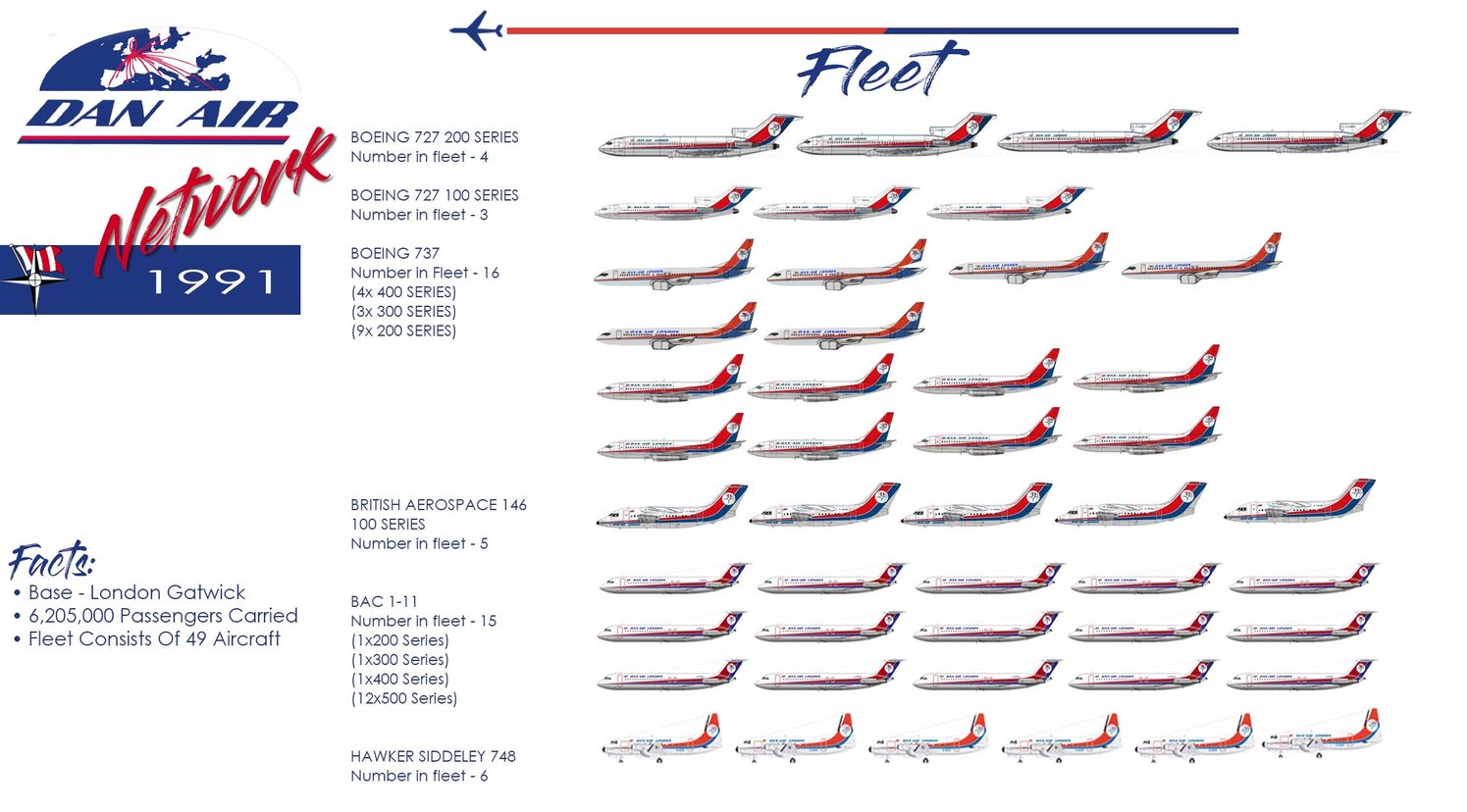
New Year brought much needed good cheer when Dan-Air was given the licence to fly Gatwick-Amsterdam after British Airways dropped the service. Dan-Air would commence operations in March. This was a premium route that was almost guaranteed to succeed. However, Dan-Air announced it would be scrapping routes from Newcastle and Tees Side to Norway in March. This was in response to a challenge from Norwegian airline Braathens Safe who announced they would be going head to head with Dan-Air. It was felt by many that they were not in the mood for a price war with another airline after being stung so heavily on the London-Dublin service.
The Inverness-Heathrow service continued to grow and for the second year in succession Dan-Air announced they would be upgrading the aircraft type on the route. A Boeing 727 200 series would now operate the flights providing 20 more seats that the BAC 1-11
Emergency services were put on full alert when a BAC 1-11 took off from Gatwick to Zurich on January 7th when the Captain reported a hydraulic leak. The aircraft was forced to turn back where fire crews were on standby, but the aircraft landed safely.
Dan-Air Engineering was sold to the Danish company FLS for £27.5 million, the employment of the 1,500 or so people looked to be secure. The company would now be the largest non airline owned engineering company in the UK. Its largest customer would be Dan-Air. The engineering division had spare parts worth millions of pounds and real estate at Manchester, Lasham and Gatwick. The sale brought a cash injection to the company and on January 10th the share-price climbed 35 pence to 200p.
Dan-Air Engineering was always a profitable division within Davies and Newman. Incoming Chairman of the group David James said;
'The sale of DAE will bring immediate financial benefits, it will generate a significant cash sum which will be used to reduce our present bank borrowings and strengthen the group balance sheet. Additionally Dan-Air will have the benefit of improvement in its trading performance in 1991 arising from the saving in bank interest and the elimination of the loss previously resulting from the under-utilisation of the engineering facility. Dan-Air will now be able to devote all its energies to the operation of its airline activities involving a current fleet of 40 aircraft.'
In other words - selling off a profit making division to pay for a loss making one...... That sentiment may not be easy to take, but as one engineer told us;
'We were not happy, we had been loyal, we had been profitable. We never had people coming to us saying that we had to make savings. We were praised for what we did. The vast majority of people loved what they did. We had some pretty impressive clients. There was a war on in the Gulf - yes things needed to change within the airline, things might well have been cut. But we should have been one of the divisions they left alone. Air Europe had signed a big contract for us to look after their 757 fleet. Then they said they weren't going to renew it. That wasn't that down to our work or the prices we were charging - that was down to ILG wanting the airline out of the way. All those new airlines that came out that took Dan-Air business - that had nothing to do with us either. Maybe the airline should have been looking to buy a Tour Operator years before....David James.....saying they would be able to concentrate on running an airline now we were out of the way. That is a laugh, the airline had been doing that for forty years nearly. I think they knew how to do that. They needed to just weather the storm of the war and the recession. We had done all of that before. It's so sad, I can't tell you how much of an inventory of spares we had. I have no-idea who worked out the sale price. I did later find that we had spares that were worth double figures in millions. Jesus, the hanger at Gatwick - you could just go on and on....'
This year saw a significant shift away from the traditional 'package tour' as more and more holidaymakers were buying a 'seat-only' ticket on charter flights instead of a fully inclusive tour package. In 1989 over two million flight-only deals were made compared with half a million in 1987. The bulk of the flight-only tickets especially to Spain are bought by villa or apartment owners, their friends or those in time-share schemes. With self-catering accommodation pre-arranged. A new breed of free-spirited travellers were taking advantage of last-minute greatly reduced fares. Those buyers seized the chance of a cheap holiday, with new computer technology travel agents could now make instant bookings at the lowest available price even a day before departure.Young back-packers who chose self-catering holidays on a camp site could enjoy a holiday for peanuts if they chose flight only deals. The biggest source of low-cost air tickets are the charter airlines selling seats through tour operators. Strictly speaking most of these seats may be sold only as part of a package holiday But ways have been found to slide past the rules — for instance by including nominal accommodation in the package or by featuring a leaseback. Flight-only deals were now available to many parts of the world, including long-haul routes, blocks of seats were bought by Tour Operators at the beginning of the season, but as the departure date comes closer with packages still unsold they became increasingly nervous about the empty seats which must be paid for. Hence the dumping of unsold seats on the flight-only market. Either the Tour Operators sold them direct themselves, through a travel agent or they off-loaded them to specialised agents who found customers through newspaper small ads. The end result was that when the charter flight finally takes off, virtually all the seats have been filled. The final seats would have been bought at rock-bottom prices by people whose main interest was that the price was right - almost regardless of where their flight is going to. In more orderly fashion charter seats are now marketed under various brand-names — Cosmos Travjet and Monarch Air Travel: Intasun Sky world: Thomson Air Fares own way Unijet Flairfares There was little difference in their prices, most of them 'guaranteed' that they would not be undercut by named competitors. The main advantage of early booking was that you have the certainty of a firm reservation and can go ahead with making your own ground arrangements. Meanwhile there’s was third way between straight charter flights and the scheduled services. Some chartered carriers operated flights on a regular frequency, even year-round Pilgrim Air for instance specialised in cheap flights to Italy. This greatly undercut the main scheduled airline services to West Germany and Vienna using charters by Dan-Air. Falcon offered regular services to Switzerland with flights to Geneva and Zurich using Dan-Air, and even the major scheduled airlines themselves were now competing more actively against the charters which have creamed so much holiday business. Iberia Spain's national airline produced a money saving 'Freedom of Spain' programme that permitted several Spanish stop-overs at different cities. British Airways did the same with their Pound Stretcher brochure. Air Europe both featured scheduled flights at fares close to charter levels. Scheduled airlines also offered a variety of weekend specials.
Dan-Air's aircraft capacity had expanded much more than the number of expense account business passengers who could afford to pay the full price fare. Those passengers are described on 'Class Elite' flew in a cabin with with many extras included in the price. Official fares could be greatly undercut by discounted tickets available from certain shops (bucket shops) and even through some ABTA travel agents
British Airways withdrew from the Gatwick-Amsterdam service in January this year. Dan-Air submitted an application to the Civil Aviation Authority to take-over the flights as soon as possible. Permission was granted to commence operations in March.
The consumer magazine Holiday Which delivered their annual report into the state of Britain's airlines and tour firms. The magazine had said that Britain's Tour Operators were sinking into a slough of mediocrity and 'needed to pull thier socks up'. The bottom of the pile was Airtours. No matter which way you looked at it the report had concluded that Airtours were that Basil Fawlty of Tour Operators. Holiday Which said: 'there remains a huge gulf between the top-rated and the bottom-rated operators.' The magazine said that the company provided the worst accommodation, the worst representatives, the worst brochures, it's travel arrangements were below standards. An under-cover reporter for the Sunday Express had booked an Airtours holiday and flew with Dan-Air. He described the experience as 'Good old Dan-Air on a good old Boeing 727 which was built like a brick outhouse, solid as a rock, and safe as houses. The flight was a little cramped for a four and a half hour flight but 'the food was really good and the drinks were cheap and plentiful.'
The public's choice of route and carrier on air and sea services to and from Northern Ireland was further reduced on January 19th when Dan Air announced that they were to axe services from Belfast to Gatwick, Newcastle, Cardiff and Bristol from April 8. The airline was the third to withdraw flights on the Belfast to Gatwick route and the decision followed the closure of the Liverpool car ferry service and the abandonment of all Eire routes by British Airways. The axe has been wielded in the name of cost cutting, high interest rates and increased fuel prices. The 23 staff based at Belfast would be offered other positions within the company. Vic Sheppard, Dan-Air's head of Scheduled Services told the staff:
'We regret the decision to withdraw from Belfast has been necessary - but a time of very tough conditions in the airline industry, we have to invest our resources where they will produce the best returns. Those people who do not wish to apply for positions elsewhere on our network will be offered severance pay and as much assistance as we can in finding alternative employment. Those who are wish to re-locate will be given re-location assistance.'
Air Europe immediately applied to the Civil Aviation Authority for a licence to fly between Gatwick and Belfast, four times a day with Fokker 100 aircraft, saying they were confident that they could make the route profitable
Passengers travelling to London from Newcastle would see more flight services. Flights between the two airports were to be increased to three round trips on weekdays from March 3rd., and an executive lounge would be opened at Newcastle Airport before the start of the summer season. To save time, passengers with hand baggage only, who need to make a single day round trip to London Gatwick airport could now choose their return seats and collect their return boarding passes when checking-in for the outbound flight. People holding return boarding passes were asked to report to the airport gate just 15 minutes prior to take-off time to ensure their seats were held, and people travelling from Newcastle to London Gatwick and onwards on a connecting flight by air from Gatwick could pick up onwards boarding passes at Newcastle. Flights from Newcastle to Oslo, Stavanger and Bergen would be suspended due to changing economic conditions. Scheduled Services Director, Vic Sheppard said:
'We remain fully committed to Newcastle Airport, but we will be concentrating our efforts on London Gatwick, where demand is growing strongly.'
Danny Bernstein the Commercial Director of Dan-Air, who was also a director of Davies and Newman Holdings PLC left the company after ten years. Danny, a chartered accountant and a man with cast aviation experience was to take up a position as joint Managing Director of Monarch Airlines. His responsibility would be centred on the financial and commercial aspects of Monarch.
The effects of the Gulf War saw many airlines suffer. In Scotland, the Aberdeen-Gatwick service had seen a down-turn of around 12% in passenger numbers. The prestigious Inverness-Heathrow route saw the first northbound flight cancelled on a Saturday, and the same the following Saturday. A Dan-Air spokesman said this route was also down by 12%, mainly as a result of a drop in the number of Japanese and Asian travellers visiting the Scottish distilleries. He added that the second half of January was traditionally the quietest part of the year and that given the circumstances, traffic was holding up rather well.
Davies and Newman shareholders were warned on February 2nd that a rights issue may be needed to get the troubled company flying high again.David James told a special meeting that the rights issue was one option that had been identified.
Air Europe commenced scheduled flight to Vienna from Gatwick in direct competition with Dan-Air. Their flights would include their business class 'Premier' where centre seats would be unsold. Air Europe used effective promotion to give the impression that they were withstanding any pressure from the struggling economy. It escaped press scrutiny when Intasun had cancelled half a million holidays the year before. Harry Goodman's own interview in 1990 had seen him say how much he liked to win His claim that Air Europe's operating costs were 40% lower than BA's was never placed under the microscope. He had said that Air Europe's scheduled services were flying with 'satisfactory load factors', with a strategy of low fares and economical aircraft
But amid Air Europe's expansion and boasts of success, at Gatwick, 150 of the carrier's staff were made redundant citing 'many factors' as the reason. 'We employ more than 2,300 people and the redundancies are mainly administrative. Air Europe has always kept overheads low and all the things came together. Two weeks ago everybody was glued to their televisions wondering if there was going to be a war. Now there are signs that the situation is improving, although there is a down-turn in traffic globally.'
This news gave no indication that the situation at Air Europe was anything more than what the rest of UK airlines were facing. Their aggressive marketing continued, as 'The second largest international UK airline'.
Rumours began to circulate that Lloyds Bank, who had a big stake in Air Europe's parent company International Leisure Group (ILG) and in Davies and Newman were planning to intervene and force the two airlines to merge and save themselves.
On February 5th Peter Smith who was Managing Director of ILG was reported to have left the company in a major shake up to save the conglomerate from receivership. Smith, who also served as an adviser to the Prince's Trust said 'I will now be able to give several hours to the Prince's Trust, there is no better place.' Price saw no paradox in this, even though ILG's own Chairman Harry Goodman lost his own Chief Executive role to Finance Director Bob Mackenzie. ILG only staved off the receiver with the help of Lloyds Bank. Smith said: 'For some time now I have wanted to be relieved of the job, I shall now take several weeks off and consider things.' Of the financial problems besetting ILG Smith said: 'As customers go out one door, white faced men in grey suits come in the other. But I still have 25% of management shares in the company. I am secure with or without them. Put it this way - I won't be asking the Trust for a grant.
Heavy snow brought chaos to Dan-Air passengers at Inverness and Aberdeen where flights were grounded. Patient travellers waited for several hours in the terminal until runways were cleared of heavy snow drifts.
Dan-Air announced on 13th February that they were withdrawing eight flights a week from the Aberdeen-Manchester-London service citing the Gulf War and recession as the main reasons. The airline said it was holding up well compared to some of the larger airlines, but that they had lost 15% of business passengers. The 10am DA133 daily flight from Aberdeen was cut both ways with the exception of Fridays. Other services between Manchester and London would still operate, as would direct flight between Aberdeen and Gatwick. A spokesman said the flights would definitely be back for Summer and possibly before, stating that they were constantly monitoring the situation.
in an effort to get people flying again Dan-Air reduced fares to 21 European destinations by 39%. ABTA said that businessmen and tourists were staying at home amid fears of terrorist attacks. Return flights from Newcastle and Tees Side to Amsterdam would be down 30% to £93 and Berlin was reduced 27% to £167. The Manchester-Gatwick flights would have a return fare of £50 return. The off-peak fare had been introduced last autumn as the airline predicted a fall in passenger numbers. But the flights were so successful that it was decided to keep the fares year-round. There would be an additional return flight daily, bringing the total to six flights each way.
What was unknown to most people, was the seriousness of Air Europe's financial position. Both Air Europe and Dan-Air used the same bank; Lloyds. It had largely gone unreported that the International Leisure Group (ILG) had received a rescue package earlier in the year. Lloyds Bank, and major creditor had agreed to swap the £50 million ILG owed into shareholdings. But the implementation of the deal depended on ILG putting together other elements of a package which involved Swiss financier Werner Rey. Mr. Rey's Omni Holdings owned a 49% share in ILG, and planned to inject £40 million into ILG. But serious doubts had been cast on the move since Omni had sought receivership from the Swiss courts while its own financial position was clarified. Air Europe carried on with business as usual in the short term, with the introduction of scheduled flights to Vienna from Gatwick.
David James had stated that whilst his relationship with the Civil Aviation Authority had improved, when he was at Dan-Air he felt them to be 'sticky'. He knew that both Dan-Air and Air Europe were having considerable difficulties, but felt that the CAA did not perceive the problems Air Europe had, when at the same time, they were very aware of the ones Dan-Air had. He felt that he was getting a raw deal from the CAA, feeling that the pressure that was being applied to him was not being applied to Air Europe. James felt that the CAA were very hard to deal with during the early part of 1991, feeling that not only were the CAA considering withdrawing licences that Dan-Air held, but that the CAA did not expect Dan-Air to be able to succeed with re-financing. James said;
'I was not in the least bit surprised when their problems surfaced, and it became clear that they had a far greater terminal risk of collapse than we did.'
For six weeks of the Gulf War Dan-Air suffered an outflow of funds amounting to £28 million. By Friday 8th March 1991 the amount of money that James had available to draw on was just £920,000.
What was not known to the general public was that the banks had to decide which airline they were going to offer the rescue package to. Dan-Air's strategic advantages included its 11 domestic routes and 36 European routes. James said flights on some of these routes had 'Been curtailed to save fuel and maximise payloads. Partly to offset the five fold increase in fuel costs since the Gulf War.'
Air Europe, and ILG had also been seeking assistance from banks and backers. In terms of product, the carrier was strong. It had a good brand image and their standards of service were highly regarded. In terms of assets, the company, as it happened, had very little. Office space had been rented, and the smart, shiny aircraft were, with the exception of three, all leased. Air Europe had made great headlines with their new aircraft orders. Whilst, at the same time, calling Dan-Air aircraft, old and gas guzzling. Effectively, Dan-Air was asset rich.
Whilst all of Dan-Air's troubles were being heard in public via the press, Air Europe themselves and with newspapers using tawdry headlines such as 'Ailing' or 'Struggling' Dan-Air, Air Europe's very real troubles were not mentioned. In the major research I have carried out, the first indication of anything awry came with an interview with Peter Smith on February 5th. Then, on February 7th, a regional newspaper in Surrey covered a story about Gatwick airport being praised for performance. At the foot of the piece, without any headline, the story read 'Air Europe has axed 150 administration jobs. This story was later covered in other newspapers with the editorial leaning towards a general slump in aviation. The redundancies were dismissed as 'administrative'. The second week in February Air Europe announced that they would operate a new service from Gatwick to Nice. Again in direct competition with Dan-Air. The two carriers were now in direct competition on Gatwick services to Paris, Nice, Jersey and Vienna. For two whole weeks Air Europe had been operating with nothing leaking to the press about any difficulties. There must have been high level talks with management. Yet none of them appeared in the press. The CAA continued to award Air Europe licences - so it is to be assumed that they were not aware of what was literally just around the corner. As you will find out in the following paragraphs the CAA WERE aware of Air Europe's troubles. As was the Secretary of State in the Department of Transport.
On Friday 8th March Air Europe collapsed. There hadn't been a single story in the press that Air Europe was in trouble. I have been researching this website for more than ten years and there is no website online more comprehensive about an airline than this one. This is a proud boast. I could find plenty of stories about the impending collapse and financial mess that British Eagle, British United, Court Line, Donaldson, Lloyd International, Laker, British Caledonian were all in at various stages of their history, and much of it is located on this website, as all of their problems were relevant to Dan-Air in some way or another. I was able to find masses of stories about Air Europe of course, for they never stopped saying how wonderful they were. Their aggressive style of operation was in direct contrast to that of Dan-Air who, if anything, were operating in a quite passive and gentlemanly manner. You can find stories, some subtle, some not, where Air Europe would say - 'We should be able to operate out of Gatwick at night because our aircraft are modern and quiet. Others are not......' Of Intasun not using any more of 'Dan-Air's old gas guzzling jets' whilst at the same time awarding Dan-Air 'Airline of the year'. You cannot find a story where Dan-Air decided to challenge Air Europe on a scheduled service, only the reverse. The fact that Air Europe had, for almost all of its existence used Dan-Air Engineering - and then publicly dropped them. The aircraft in Air Europe's fleet would still need to be maintained by someone. Dan-Air Engineering had lower rates for maintenance than almost anyone. I have had telephone conversations with senior staff at Dan-Air Engineering, who agreed rates were sometimes too low. Dan-Air was a proud airline. Not a ruthless one. There existed a co-operation between them and other carriers. They may have felt aggrieved at being overlooked on many things. But not once could Dan-Air be accused of being predatory. The closest it came to that was when Scottish institutions urged them to wrestle one domestic service from BA. From what I have been told, there was a collective sigh of relief when the shutters were pulled down at Air Europe. Captain Alan Selby noted:
'At first I was in shock - because they appeared so strong. Of course I knew that there would be thousands of holiday makers who would be stranded. That would involve a repatriation mission, and they would be covered by ABTA. Those who were on scheduled tickets would just be on their own. Immediately my mind started to think about the opportunities that it might present to us. Would we get any of their routes? I also knew that there wold be a lot less competition on some of the routes where they had deliberately decided to challenge us. I knew also that there would be a lot of people who would now need to re-book their holidays with another Tour Operator - and for once, there wouldn't be lots of airlines in a position to take all that work. We were in an ideal position in a lot of ways. I saw lots of staff that day and one could see the relief in their faces. I don't think anyone was happy that people had lost their jobs or that passengers had lost out. My own opinion is that Air Europe brought a lot of the damage on themselves. I also wished that all of this had happened before David James was thrust upon us. If the regular board had been able to get through the dreadful 1990 I think the outcome would have been totally different.'
With the collapse of ILG, the future holiday plans of 400,000 people were thrown into doubt. On the day of collapse 25,000 people were stranded abroad, and a further 12,000 were due to travel over the weekend. ILG went to the High Court to appoint a receiver, and announced that unless a buyer was found within a week, the company would fail. At the hearing, it was disclosed that ILG had lost £30 million in the three months to the end of January of 1991. It was also told that ILG had liabilities of £15.4 million. This was astonishing - nothing was reported until the day of the collapse. With one claiming newspaper that Air Europe had failed because of the problems now hitting Intasun. Goodman was described as 'flamboyant'. The Daily Mirror had carried out a major investigation into Goodman's personal life, mentioning his three failed marriages, and concentrating on his alleged three day binge of cocaine fuelled orgies with prostitutes. He was alleged to have paid sex workers in three addresses. None of that is of any importance to the ILG business. None of that need have been reported. How was it that so much of Dan-Air's business had been reported from the very beginning? It was obvious that someone was leaking the information about Dan-Air. But at what level was that happening?
It was unlikely that a secretary was photo-copying sensitive documents and then selling them to the press, but not impossible. Could the leaks have come from a much higher level? Was there an active campaign for Dan-Air to be highlighted as failing? It is worth pointing out that a World In Action programme had reported that Richard Branson's Virgin Atlantic had been victim to a campaign by British Airways to undercut the fares of Virgin, Air Europe and Dan-Air, the latter of which had a system that BA could not access. Both Virgin and Air Europe shared the same system giving them vital information. High ranking staff had even had private detectives go through rubbish and conduct smears in the press. None of that seemed to involve Dan-Air or Air Europe. The story led to Virgin's going to court in a high profile court case dubbed 'Dirty Tricks'.
On the day of the collapse one newspaper announced that a rescue package had been agreed a few weeks before (See previous paragraphs) with Omni, but the recession had meant they had also experienced financial difficulties. Not one newspaper carried the story about any rescue package.
The Association of British Travel agents reassured those booked on package deals that they would get their money back, saying: 'If a company does have to cease trading, then ABTA will protect those who are on, or have booked a holiday. But those booked on scheduled services with Air Europe might not be so successful as there is no automatic money back guarantee for them.'
There was a ray of hope for some. The Tour Operator organisation - the Tour Operator Study Group - said they would arrange for passengers stranded abroad to get home. They also pledged that ILG customers who were due to fly on other airlines and due to depart before midnight on Sunday 10th March would go ahead as planned, and that anyone who had booked and paid for a package holiday with an ILG brand could either have a full refund or an alternative holiday with another operator. Over the weekend, Dan-Air operated 41 rescue flights to meet that promise or to repatriate those abroad.
The administrators KPMG Peat Marwick McLintock said: 'There is a small margin of window, through which the airline could be sold as a going concern'. They went on to say that they were in talks with several people, including airlines, and that they hoped the suspension of flights would be lifted soon. The company continued to trade, with holiday-makers and passengers told to contact their travel agent for information. Holiday-makers would not lose money as ILG was a member of the bonded scheme, ATOL and ABTA. Those on scheduled services were told to contact their travel agent. Twelve of Air Europe's 36 aircraft fleet were impounded by an administrative receiver, appointed specifically for those aircraft. Other secured lendors tried to take possession of their aircraft.
Tim Heyward from KPMG said:
'What is hoped for ....is that we will be able to sell the business as a going concern, and that the airline will be flying again in a very short order.' Within days this had been updated to;
'The airline's only assets, as far as we could see were the routes, take-off and landing slots and the actual organisation, which consisted of a strong Tour Operation with Intasun, Global, Lancaster and 18-30. Sadly, even in that instance, the offices were rented. Overseas transfers were carried out on hired coaches and resort reps either used shared, rented office space or worked from hotels. It became clear very quickly that the company had very little of its own.'
Air Europe advised holidaymakers abroad to carry on as usual with their holidays, and that they were working with other carriers to arrange to get them back home. Mr. Heyward was tasked in finding a buyer for ILG
He said:
'Obviously I was very disappointed, but I certainly gave it a good try. The tour business as one combined operation was over. There were still some small assets that could be sold, but the companies were all placed in liquidation over the next few weeks. There was some interest in Air Europe, and the Civil Aviation Authority (CAA) extended their operating license a further 24 hours. I believed that any would be buyer could arrange for more favourable leasing terms on the 34 aircraft that Air Europe leased. If a buyer bought the carrier, they could sell the three aircraft that Air Europe owned or keep them. Once the Tour Operators were placed in liquidation they could be snapped up quite quickly. The value would drop significantly. There was a specialist school holiday company ILG owned called Quest Leisure Group, and there was a lot of interest in that, within a day of its liquidation talks were at an advance stage. Talks ultimately failed and Quest was closed down. We almost had a buyer for Air Europe and the press picked it up. I became less confident of an eleventh hour rescue. There was a lot of interest in Club 18-30 as well. I was shocked at how ruthless and swift the travel industry can be. ILG stopped flying on the Friday and Dan-Air had a special licence from the CAA to operate the Gatwick-Brussels service the next day. They were after eight of Air Europe's Gatwick flights.'
Quest Leisure had three Tour Operators, Hourmont Tours, Schools Abroad and School Plan. They had a market share of approximately 33% and carried 75,000 school children and teachers on holidays. Days after the collapse talks to buy it failed and administrators closed the operation. It was revealed that Intasun had debts overseas of £5.5 million in Spain alone, for coaches, hotels and other firms.
One air steward, called Danny told us:
'Oh the irony. Loads of us were on days off and standby, and then the phones rang saying to report for duty. Air Europe had gone bust and their staff were calling us to charter us to bring them home! I have to say, I had a spring in my step. Not at them losing their jobs - but at me keeping mine! There had been a heavy cloud over us for months, we knew what ILG were doing, they were out to destroy our company. One thing I had always felt at Dan-Air was a sense of family. We were a nice company, and I don't think ILG were the same. We never set about destroying another company to get what we wanted. A company isn't just a workplace. It is people who had rents and bills. Business shouldn't be so hard, and in a way, that lot at the top of their organisation got what they deserved. The saddest part was that their staff probably felt the same about ILG as we did about Dan. They were people too.'
Another stewardess called Helen said;
'I had been successful getting taken on at Dan-Air in 1990, and I was certain that we were going under. I knew a girl called Zena (Not her real name) at Air Europe and, although she usually said 'I'm only joking' afterwards, she would say 'You should come over to Air Europe, because Dan-Dare won't be around next year. I hated then - and now that Dan Dare thing, it is insulting. Even when used as a term of endearment - it makes me angry. She said things 'in jest' about our aircraft being clapped out old bangers. She even said to a group of friends once that 'after the safety demo Helen goes and sits next to the rear gunner on her aircraft'. I hadn't heard the Dan Dare tag until I started with them. I had been on lots of holidays, but actually never with Dan-Air. When I started working on them, I swear, I didn't see anything different about our aircraft than anyone else's that I had been on. I don't recall a single thing that made me think we were dodgy. On the day that it happened I had a phone call from Zena and she was in tears. She actually asked me if there were any jobs at Dan-Air! I joked and said 'Are you sure we would be good enough for you?' - I was a great feeling knowing that we were, for the time being at least, safe in our jobs. Zena, by the way, applied for Dan-Air and was rejected. I don't know if it was because she failed at something, or because she was from Air Europe!'
Dan-Air offered passengers standby tickets for passengers booked on Air Europe flights to Jersey, Vienna, Nice and Paris. On the back of this news Davies & Newman shares rose to 140p. With analysts saying that Dan-Air hoped to make capital of the crash of Air Europe. As well as ILG holidays, other Tour Operators had seats booked on Air Europe planes. Owners Abroad said they had about 1000 passengers abroad who had travelled on Falcon, Sunmed and Sovereign holidays. They would be flown home with other carriers. Travel agent Thomas Cook said any passengers booked on Intasun or Air Europe would be offered an alternative or a full refund. The crash of ILG sent shudders throughout the industry. Optimism after the Gulf War had ended so quickly - now evaporated at the thought that it was not just the small Tour Operators who were at risk of closure.
The Association of British Travel Agents (ABTA) said that they had £63 million in insurance bonds from ILG and that none of the package holiday-makers would be out of pocket. However those booked on scheduled flights would need to contact their travel agent. The sell off began immediately, with the sale of the 49% ILG had in German airline NFD being sold for an undisclosed sum.
Charles Newbould, the Managing Director of Thomson, the UK's largest Tour Operator said: 'As far as I am concerned Intasun and its companies are a dead duck. There is no salvation' - with another saying; 'Intasun is dead, as soon as customers get a whiff of trouble, the credibility goes.'
Meanwhile it was claimed that the Government had stopped the CAA from shutting the company down the day before because it would cause embarrassing questions being asked in the Transport debate in the House of Commons. The CAA had been ready to remove licences it was claimed. A rival Tour Operator stated that 'Harry Goodman flew too close to the Intasun'.
It was disclosed that 25,000 people were away on holiday and the process of bringing them all home would be a monumental task.
Goodman's deals had looked good on paper, but accumulating his relatively modern fleet over a short period from 1978 saw him incur large debts. Accountants would now have to pore over the books to find out what assets the company really did have, against liabilities of £480 million. The industry as a whole agreed that the ILG's loss, which accounted for 16% of the UK package tour business, would mean that demand may well outstrip supply in the coming summer. As prices were fixed in advance, it was unlikely that there would be increases to holiday prices, but also highly unlikely that there would be any wide spread discounting either. Tory MP Kenneth Warren of the all party Trade and Industry select committee carpeted the CAA, saying:
'The CAA is duty bound by law to have full information as to the financial viability of an airline. I think passengers who have lost their money have cause to find out if they can sue the CAA for neglecting their duty.' It was announced on Monday 11th March that ABTA had cancelled Air Europe's membership to the organisation. The Department of Transport revealed that the Secretary of State for Transport did have meetings with Air Europe, the most recent being days before the crash. 'He was told by the company of the difficulties it was facing, and we were kept informed.'
Webmaster Note* With accusations that the CAA and Government acted improperly being flung around, and responses about the silence about Air Europe being explained as protecting the company from collapse while rescue negotiations were underway, it seems incredible that Dan-Air were not given this same level of discretion. For well over a year, almost every detail of their own on-going financial struggle had been reported extensively in the press. Dan-Air's troubles were far less than those of ILG. It surely put pressure on the company to perform well in public. Confidence would have been very low with the travelling public, who would be fearful of Dan-Air going under. The whole organisation deserves credit for carrying on under this extreme scrutiny.
Within hours of the collapse becomming public knowledge, Dan-Air had applied for several of the routes that Air Europe had hitherto operated. David Lammy MP, chairman of the Labour Party's aviation sub committee said 'I blame organisations like the CAA for not putting restrictions on companies like Air Europe getting a license.' The Transport Secretary, Malcolm Rifkind was blasted in the media for not revealing he knew of Air Europe's troubles for two weeks. It is difficult to say whether he had made the right call. Had he revealed all he knew, he could have made the situation worse, with passengers and holiday-makers all rushing to cancel their holidays and flights.
Days before the collapse Harry Goodman, ILG's boss,checked himself into a £300 a night private hospital, saying he was suffering from delayed shock after a car crash a month previously. Then, after ILG went under, Goodman said:
'It's not a good day, it's a shame we can't take people on their holidays, but their money will be safe. The recession hit us harder than some. It all cost us more than £70 million.'
Dan-Air could also take a breath. Those 'old, gas guzzling, jets that ILG did not want to charter anymore, from an airline they wanted to consign to the history books, had helped save the day. Many of them were owned outright, and whilst they did not have the value or efficiency of Air Europe's aircraft, there is no value in a rented anything! Dan-Air had spare parts worth millions, offices and real estate, a small tour operation, a 50% share in Gatwick handling, cash from the sale of Dan-Air Engineering and a rescue package from the bank. But all was not good.
The decision to replace Dan-Air board members with people from none aviation sources was a great risk. People watched with interest and worry as new board members took their places. Board members who lost their seats included Danny Bernstein, who left Dan-Air to become Managing Director of Monarch Airlines. His great skill in the industry saw Monarch go from strength to strength and become one of the most successful UK airlines in the 90s. Also, Graham Hutchinson who was acknowledged as a supreme airline manager, respected the all over the World.
How could anyone take such a risk in removing these two people? Only three people on the new board had a background in aviation. Michael Newman, John Mayes and Peter Sommers. The new Davies and Newman Chairman himself, David James, was an accountant by profession and had been trained by Lloyds. James had saved companies from going under in the past, none of them were airlines. How could he be expected to know about this kind of industry? Others to come with James were Peter Ryan, a chartered engineer and Charles White, an engineer.
The new strategy, moving Dan-Air forward was to be a five featured plan; To concentrate on Dan-Air's operation and development as an independent airline - To develop the airline as a specialist, short haul, scheduled service provider within Europe and the UK, based at the Gatwick hub - To maintain subsidiary scheduled services, spoke centre based at Newcastle Manchester and Berlin - Progressively modernise the fleet of aircraft - and to continue a strong presence within the charter market, albeit with a reduced, but more flexible capacity than before.
David James said;
"Dan-Air needs a substantial injection of new funds." and "This might entail a 'rights' offer to shareholders" James continued, 'Significant new equity investors, would benefit in the enhancement of the overall corporate entity!" The other option was for Dan-Air to be sold as a going concern,' adding that 'No talks were taking place, but past expressions of interest might recur once market conditions began to improve.' The final option was to merge with a similar airline, stating 'Again this might require the approval of shareholders or new investors with additional funding.'
James announced that "Dan Air's strategic advantages were its 11 domestic and 36 European routes - but flights to some of these would have to be curtailed to save fuel and maximise payloads. Partly to offset the five fold increase in fuel costs and the Gulf War." Group losses were £30.4 million from £18.7 million in the first half of last year. This figure included £5 million in 'exceptional costs' to pay for 'special fees' to the banks for their lending lifeline, relocation of head office and 'professional fees' in forming the group's future strategy. In other words - bank charges and fees for management.
Just five days after the collapse of ILG it was announced that administrators had failed to find a buyer for the Tour Operator section of ILG, as they had not been able to sell it as one business. In total 800 UK and 750 overseas jobs would be lost. Resort representatives were flown home and dismissed. Talks would continue to find a rescuer for Air Europe with a deadline placed of seven days. Citibank had made many loans to Air Europe's parent company ILG on the security of their aircraft, and on March 7th 1991 they demanded that ILG had 24 hours to find new financing. Or they would call in all their loans. Lloyds Bank meanwhile, who had been surprisingly negative to Dan-Air, and had made the restrictions they placed on Dan-Air so wide ranging, were now trying to keep ILG afloat! This policy was understandable from Lloyds point of view. They were the Bank who ILG's owed the majority of their debts to, estimated at £100 million. So misguided were Lloyds by ILG that they had attempted to persuade ILG to take over Davies and Newman as part of the D & N rescue package. As if they were in a position to spend money! Over the previous three months alone, ILG had suffered losses approaching £50 million.
Tim Hayward from KPMG again:
'ILG's liabilities looked at being about £400 million, the whole organisation had assets that were likely to raise no more than £10 million. It was clear that the company was insolvent and had to be liquidated. The situation was quite bleak. It would be a long time before any dividend could be paid to any creditors. Sorting out the creditors was a lengthy and expensive task. The best that creditors were looking at was 2p in the pound.'
All was not lost. The brand Club 18-30 was taken over as a management buy-out backed by venture capitalists County NatWest Ventures, Grosvenor Capital and Causeway Capital, in a transaction valued at £167,000. After being briefly re-branded as 'The Club' due to regulatory rules precluding the use of the name for 3 years, it reverted to the original name in 1994. In 1995, the company was sold for around £9.75 million.
Anne Wilson of the insolvency Service told us:
'The problem with any company that goes into liquidation owing money is that those owed money either all get their money back- or no-one does. There was never an option to pay for example, for fuel, rent and not pay landing fees that would be unfair to decide whom to pay. There are primary creditors and secondary creditors. Taxes for instance would be first over rent on an office. Sadly, the receivers get their money and basically no-one else does.'
Time was running out for ILG. The extended licence the CAA had given them was about to expire. Tim Hayward from KPMG said;
'Selling the whole firm is looking less likely. We are now looking at splitting it up into a number of smaller companies, several other airlines and tour companies have expressed an interest. Time is not on our side and we only have a matter of days left.'
Captain Alan Selby told us:
'What a sorry mess. What was there to buy? There wasn't really an airline - as it stood it was a carrier with a number of leased aircraft, they didn't own hangar space or office space that wasn't rented. We had already applied for their scheduled services - for free! We could obtain aircraft ourselves on our terms. The only value of the airline was landing and take-off slots and their reputation, which was good, I admit. But that had taken a knock in the last week or so. So, you would be buying a Tour Operator who's name was now firmly in the mud. Let's face it Intasun and Global had a pretty rotten reputation in the first place. ILG boasted about Air Europe all the time. Then when they chartered our aircraft they were providing minimal catering for Intasun passengers. It was a step up from Airtours - but not much! It is no wonder no-one wanted to buy it.'
Air Europe and ILG's collapse in March left significant gaps in the travel market. Companies that had booked seats or whole aircraft from Air Europe would be looking for a replacement carrier. Dan-Air was ideally placed to swallow up not only this available business, but also many of the bankrupt airline's scheduled routes. It would mean that Dan-Air's Gatwick-Paris would now not face competition. All of this could have been the saving of Dan-Air. It is widely believed today, that had they done this, the airline would have gone into profit again that year, but the board chose not to do this. They had already announced that they wanted to be a scheduled services airline. In fact - instead of taking on all this available new work, the new board actually reduced the charter and IT work that year. Despite claiming that now they had refinanced the airline and that they were in a position to 'take advantage of market opportunities.'
Thomson Holidays alone added 300,000 extra holiday seats to their programme, in the same month that ILG went bust. Britannia Airways had planned to sell off aircraft and now said:
'We have gone from a situation where we faced a slump to one where we are having to increase dramatically.' ABTA announced that 95% of people who had booked a holiday with an ILG firm had now re-booked with other firms. Dan-Air had applied for ten of Air Europe's routes, with Brussels already operating under a special licence.
Holiday Which magazine declared that British Midland were the best domestic airline, with Dan-Air declared the worst. It was not clear whether the people who had carried out the survey had actually flown with Dan-Air on scheduled services as Air 2000 was on the list - and that carrier did not operate a single domestic service.
Administrators for Air Europe and ILG, KPMG Peat Marwick McLintock announced on March 14th that they had been unable to find a purchaser for any of the ILG's group of companies with the exception of Club 18-30. The tour company employees totalling 1750 people were dismissed. Of those, 750 were based overseas and would be flown home. The 800 UK based staff were let go whilst talks to save the airline and its 2,000 staff would continue. Tim Hayward of KPMG Peat Marwick McLintock said : 'Obviously were a disappointed, but we have certainly given it a good try. The tour business as one combined operation is over. There as still some good assets that might be sold, but the companies will be placed in liquidation in the course of the next few weeks. '
There had been interest in buying Air Europe and the CAA extended the licence deadline until March 19th. Meanwhile Dan-Air began operating flights to Brussels within 12 hours of Air Europe folding. On March 15th Tim Hayward said 'Talks are still ongoing with a number of other airlines and tour companies who have expressed an interest in acquiring Air Europe I remain hopeful that a going concern sale can be effected. The collapse of the ILG had damaged the business to the extent to which it is not possible to sell the tour group as a whole. We are clearly disappointed the companies will be placed into liquidation.'
A Gatwick Airport spokesman said that there was bound to be a short-term loss at the airport, but that in a short time he believed the effect would be 'broadly neutral' - 'Past experience has shown that the failure of an airline does not affect demands for air travel. Traffic will be picked up by other carriers. The collapse of Laker did not affect growth at Gatwick.'
Air Europe's less profitable routes were unlikely to be snapped up immediately by cost watching rivals, but the press were quick to call other airlines 'scavengers' who were keen to pick up the juiciest morsels. Jersey European Airways won a temporary license to operate Gatwick-Jersey. The collapsed Air Europe Express manager Brad Burgess announced the formation of a new company - Euroworld, and applied for routes from Gatwick to Birmingham, Guernsey, Antwerp and Rotterdam.
Dan-Air now declared that they had been watching the demise of Air Europe for a considerable time. Said Director of Scheduled Services Vic Sheppard: 'We have had a contingency plan ready for some weeks, and indeed, as far as Brussels is concerned we had an aircraft and crew already standing by to start the service. We have submitted license applications from Gatwick to provide scheduled flights to Rome, Dusseldorf, Stockholm, Oslo, Copenhagen, Malta, Gibraltar and Palma. We are urging the CAA to cut down the lengthy licensing procedures to allow us to start the flights on April 1st.'
The next day further applications were placed to serve Istanbul, Cairo and Athens from Gatwick and there would be new scheduled flights from Gatwick to Amsterdam which would start on March 23rd, the same date that co-incidentally British Airways were withdrawing from the route.
Dan-Air carried out 62 rescue flights which were funded by the £63.2 million bond scheme that ILG had paid into the Tour Operator Study Group (TOSG) by way of an insurance policy. The TOSG said: 'There would be further additional flights laid on the next weekend to bring back the 12,000 or so holiday-makers who were still at their resorts. The majority of them are in Southern Spain, Malta and Europe's ski resorts. TOSG has also ensured that ILG travel company representatives, hotels, coach holidays and other suppliers will honour the holidays of those people currently away.'
Lufthansa publicly declared that they were interested in buying Air Europe but Dan-Air, who had been rumoured to be discussing a merger with Air Europe, now distanced themselves from the company saying: 'We have applied for ten of the former airline's routes. We would not be interested in buying an airline for the sake of buying an airline. We have a perfectly good management structure of our own and we wouldn't want to repeat any of the former carriers mistakes.'
Jill Clunas and Sharon Orban were interviewed about life as an Air Stewardess after a company Boeing 727 was used as a set on a TV documentary - Suburbs in the Sky - They said that anyone who called them 'trolley dollies' should try doing thier job. 'Knowing a foreign language and having a good personality are the most important factors.' said Sharon. 'I could never imagine the reality of being a stewardess. It's a fantastic job and I could never go back to doing a nine to five job.' Jill had been working with Dan-Air for four years and was ranked senior. 'I was so naive about the safety of the job.' She says 'A lot of people think you are just there to serve the meals, but there is much more to it. Much of the safety equipment is concealed and we have always got to be thinking ahead. It is certainly not a glamorous job'
The girls had to complete a four week intensive training course covering safety and first-aid. 'Some people do not appreciate the range of qualifications we have.' Said Sharon 'We deal with everything from nursing a sick passenger to looking after a nervous person who has never flown before.'
Both girls said the Gulf War had made them more nervous about bomb threats, and were more aware of awkward parcels and luggage left behind in compartments and overhead lockers where items could be left behind. 'If it came to the stage where I was frightened to fly, then i would leave my job.' said Jill.
19th March, a new UK charter airline, Airtours International made its first departure from Manchester to Rhodes. The start up carrier baulked at being called the son of Air Europe. The parent company, Airtours said that they had increased capacity to try to plug the gap left by Intasun. Airtours was the third largest Tour Operator in the UK and were set to take 750,000 people on holiday. The increase in bookings might take them over the one million mark, they said at a press conference.
'Airtours has ordered five MD 83 aircraft and would base them at head office Manchester and Birmingham.' Airtours had been a regular client of Dan-Air's for many years. The company wanted to stress that they were not 'the son of Intasun' and that they believed that Thomsons believed they didn't have any competition. Airtours said 'We will give them a run for their money.'
One of our contributors says:
'It was a familiar story over the last few years. We would just about get over a Tour Operator who did big business with us setting up an airline, and then another came and the pattern repeated itself. Right back to the days of Air Europe starting. They would always start with just two aircraft....Then the Tour Operator would get bigger and for a while things would be good at Dan-Air because their two aircraft couldn't fly all their business. Within a year or two the new airline would have half a dozen aircraft and they wouldn't want to charter Dan-Air aircraft anymore. That was the case until they went bust!'
Later in the year a new Tour Operator sprung up - Sunworld. It had been born out of the ashes of ILG. Iberotours in Spain were its founders. By late Summer they had launched and carried a few thousand passengers. They said they would be launching a full package for the Summer of 1992. They would sell 360,000 holidays and would be using Dan-Air as their main charter airline. The irony of this is that Sunworld's managing director was the former Manager of Intasun, Peter Long.
Another of our contributors said
'All the discrediting ILG had done to Dan-Air, all the attempts to finish us - came from a company that grew too fast and were in debt up to their necks. Now, this new company was being formed, chartering Dan-Air aircraft!! You could not make the story up! Loads of people lost their holiday, or at least had it inconvenienced. Scheduled passengers who had paid by debit card lost money. All those people stuck in resort having to be repatriated. It stank! Then there were thousands of staff. Talented people, who had faith in their company, all out of a job. Some of the people working for Sunworld were previous contacts of ours. Sunworld were saying they were going to use us!
Sunworld advertised in the national press, and it is worth repeating the words on the adverts.
'YOU CAN BOOK A SUNWORLD HOLIDAY WITH COMPLETE CONFIDENCE. WE ARE PART OF AN EXPERIENCED TRAVEL GROUP WITH OVER SIXTY YEARS OF EXPERIENCE, A £200 MILLION TURNOVER AND TEN YEARS SUCCESSFUL TRADING IN THE UK. OUR AIM IS TO PROVIDE THE BEST HOLIDAYS AT THE BEST PRICES.... Just when you thought you might not get away to your favourite sun spot at this popular holiday time - Look again at SUNWORLD. '
Incidentally - the advert said 'We WON'T be beaten on price.'
Industry Observers noticed the lifeline thrown to Dan-Air from Sunworld. They suggested that the main reason Dan-Air had lost out on charter work was the lack of vertical integration with a Tour Operator. They urged Dan-Air to join forces with one or to start one of its own. Their advice was ignored. In a further twist, the new Dan-Air board had decided to concentrate on scheduled services AFTER the Air Europe/ILG collapse. Thomson holidays said that the crash had resulted in a 25% surge in bookings. Horizon's sales was up 30% and Airtours, who aimed at the cheaper end of the market had soared by 40%, which in real terms meant a million people would book an Airtours holiday. Airtours had decided to add three more aircraft to its fleet, it did so because it couldn't find any capacity with existing UK airlines. The Airtours fleet now stood at eight aircraft. Could Dan-Air not have leased a similar aircraft? If Sunworld was able to produce a full holiday programme immediately after ILG had gone bust - could Dan-Air have not done the same?
Airtours share price had rocketed to 795p. This enormous gap in the market seemed to be largely ignored by Dan-Air's management. They were hopeful that in 1992 they would break even. The following year have a profit of £20 million rising to £42 million by 1995.
The press could still not resist putting the boot into Dan-Air - The Engineering division which had been sold to FLS Aerospace, announced 400 redundancies in late March. The press reported that Dan-Air was in 'crisis again' and would be making the redundancies. The inaccuracies were left unchallenged.
A further special licence for Dan-Air to operate Air Europe's Gatwick-Amsterdam service was given. Daily scheduled flights from Gatwick to Gibraltar then commenced in June using Boeing 737 aircraft. The flights would operate two classes with Class Elite and economy cabins.
In April BBC TV's 'Money Programme' devoted an entire episode to the struggles facing Dan-Air. Captain Mike Ralph was interviewed on the programme and said: '
'Our aircraft are old....they were dirty...and the paint would be flaking off them. The ground equipment would be in a similar state....And....the image the projected wasn't a good one. We pressed the management to do something about this and we hope now that something will be done.''
He had said this whilst standing next to a gleaming BAC 1-11. His comments were not particularly helpful, nor particularly true. The sixteen Boeing 737 aircraft in the fleet were pretty new, in particular the 300 and 400 series models. Certainly of a comparable age to those in the Britannia Airways fleet. The BAe 146 fleet were brand new aircraft when introduced to the fleet, and they had been upgraded since their introduction. The fifteen strong BAC 1-11 fleet of varying models, were, it is true, older models. The type was the exact model to those in the British Airways fleet, as were the HS 748s. Only the seven Boeing 727s could be described as older, and they had already started to be phased out. The 727 was still in active service with Lufthansa, Air France, Alitalia, Iberia, TAP, Olympic and dozens of airlines outside of Europe.
The 727 aircraft were to be replaced by Boeing 737 and BAe146 aircraft. Even the older types were perfectly airworthy and maintained to an excellent standard. The 1-11s were profitable on both scheduled services.
The Boeing 727, despite its excellent pedigree was a terrible burden for the airline and their replacement was vital. Whilst the legacy carriers could use them on scheduled services and make a profit especially in two class layouts. But as a charter aircraft the type had fundamental flaws.
The Gatwick-Brussels licence had been hastily granted as there was no British airline operating the service. By May bookings had increased by 14%. The Gatwick-Paris service had seen an increase of 12% since Dan-Air became the sole airline on the route. Frequencies increased between Gatwick and Manchester, with the new service from Gatwick to Gibraltar performing exceptionally well. The Gatwick-Gibraltar application was approved on May 30th flights would commence on June 14th.
A company Boeing 737 jet closed a rival airport minutes after taking off from Manchester where it partly shredded a tyre. Debris had been found on the Manchester runway from the Dan-Air flight to Naples. Air traffic controllers notified the Captain who decided to divert to Gatwick. He flew near the control tower so a visual inspection could be made and was told the tyre was intact. He landed but at the end of the runway the nose tyre shredded. After the Captain brought the plane to a safe halt it was unable to be moved for an hour and the runway had to be closed. The 150 passengers continued their journey six hours later.
A BAC 1-11 carrying 49 passengers had to return to Gatwick on June 12th. A full emergency was reported which saw fire crews on standby. The pilot of the Aberdeen bound plane reported possible hydraulic problems. A Dan-Air spokesman said: 'The measure was purely standard The plane safely without any complications and passengers were put another plane to allow engineers to investigate.'
Manchester Airport went on full emergency alert on June 17th when a chartered jet came to land with burst tyre. The BAC 1-11 carrying 118 passengers from Malaga touched down safely. The Captain thought both nose wheel tyres had burst when he took off from Spain and after radioing ahead airport fire teams were put on full alert. When he touched down he realised that one of the nose wheel tyres was undamaged and was able to make a near normal landing. Passengers were taken by bus to the terminal and the runway was closed for 10 minutes for the burst tyre to be changed Passengers on jets circling overhead applauded after hearing the Dan Air aircraft had landed safely.
A full license was granted for the Gatwick-Brussels service was granted on June 21st and the airline was granted licences to fly to Malta, Athens, Gothenburg, Palma, Stockholm, Istanbul, Cairo, Rome and Oslo. Should these services be profitable, then there could be a way forward for Dan-Air. Some of these services would commence in 1992.
Ian Peddar and Captain John Mayes were the only two pre David James board members to remain on the board. One of James' appointees, James Ryan left the board to take up the post of chairman with another company.
On June 29th Company Chairman, David James summed up the previous year as: 'We survived'. James unveiled Davies and Newman losses of £38.7 million, largely due to poor performance of Dan-Air he said; 'Despite appalling difficulties including a deep recession and a war in the Gulf. Future profitability now depends on funding to support and develop the airline. We will be switching the bulk of our operations from charter to schedules to improve earnings. This combined with additional funding should put the airline back into profit in 1992.'
James ruled out job cuts saying that he was concentrating on funding in the city to fund re-organisation of the company and provide more scheduled services. Despite press rumours saying the airline had axed 2,000 jobs. A company spokesman said: 'This is quite untrue, we had sold our engineering division, and the reduction in workforce is simply because those employees are now working for another company. In fact we may be recruiting new staff for the eight extra routes we have applied for. We have started two routes already.'
Shetland oil related charters had now been reduced to a trickle and Shetland Council wished to mothball the airport at Scatsa. Dan-Air were the only airline using the airport on a contract with BP. The council said they would maintain the airport in such a way that it could open immediately if there was an exceptional incident such as an oil spill. The council said that Dan-Air could continue to operate from Sumburgh.
A holiday jet stowaway caused a high security row on June 15th when he boarded a Dan-Air Boeing 737 at Corfu and landed at Manchester. The man conned his way through security and boarded the aircraft without a boarding pass. The Foreign Secretary Douglas Hurd was notified and there would be an investigation into the matter with Greek authorities. The unemployed man from Cumbria was met at Manchester Airport and detained by police. Bury South MP David Sumberg said 'Manchester Airport spends vast amounts of money on security, but this money is down the drain if airports abroad such as Corfu do not match Ringway's level of care. I want a complete review of security at Corfu.'
The stowaway told police he arrived in Greece from Australia and met a group of ten youths while there on holiday. They helped him trick his way through security at Corfu by pretending to have the tickets and boarding cards. Cabin crew carried out a head count and discovered one more passenger than there should have been, but airport handling agents said they could not have made the mistake - then the plane took off. The Captain then made a personal check and the stowaway was revealed. The pilot radioed ahead and the police then detained the man who had been drinking heavily before he boarded the aircraft. Dan-Air said; 'We are taking the matter very seriously. There will be a full investigation to discover exactly what happened.'
Just a few days later on June 29th Captain John Wolff, who was in charge of the aircraft was found dead in his car. The engine was running and a pipe was fixed from the exhaust into the car's cabin. Only hours before Dan-Air had moved a step closer to bringing Captain Wolff's troubled 20 year career to an end. An airline spokesman said: 'Captain Wolff had received a series of several verbal and written warnings for a range of offences before the stowaway incident. Captain Wolff had received his final written warning not long before he was found dead in his car. He was aware that any further trouble would have led to his dismissal.' Captain Wolff had failed to remove 21 year old Colin Fox from the Corfu flight. Wolff had disregarded airline rules which had been strengthened in the wake of the Lockerbie bombing. Eager not to delay the flight, the 50 year old ex-RAF fighter pilot then took off and failed to report the extra passenger.
Dan-Air did not wish to prosecute the stowaway, saying nothing would be achieved from doing so. Fox, in a bid to avoid being seen by the press climbed over a six foot police wall to avoid being seen after he was cautioned. At the inquest into his death in November, his wife said that she didn't know that her ex-husband whom she had left five year previously had been in trouble with bosses. She knew, she said, that he didn't particularly like or get on with management at Dan-Air. A verdict of suicide was recorded in October after it was revealed that Wolff had died of carbon monoxide poisoning. He had also drunk one and a half times the legal limit. He had received a letter, dismissing him from his £45,000 a year job just 24 hours before he killed himself. He left three children.
On August 3rd travellers from Newcastle to Faro in Portugal were diverted to Gatwick after the First Officer became ill. The Boeing 727 with 100 passengers on board departed from Newcastle just after 5pm on the Saturday evening. After the aircraft had reached cruising altitude and passing over France the co-pilot complained of stomach pains and was running a high temperature. Fortunately there was a doctor on board who declared that the pilot should not continue the flight. A spokesman said: 'The First Officer got out of his own seat and was stretchered into the airport. He was taken to hospital and diagnosed with a viral infection. He stayed at the hospital overnight as a precaution.'
On August 19th crews at a Newcastle Airport went on full alert after a plane carrying 170 passengers developed undercarriage problems shortly after take-off. The full-scale operation was launched at about 2.30 pm yesterday when the eight-strong crew of the Dan Air Boeing 727 holiday charter flight, which was travelling from Newcastle Airport to Larnaca in Cyprus, reported the fault. Thirteen ambulances and the airport’s own rescue tenders and ambulances stood by for 20 minutes as experts decided whether to recall the plane, which had apparently burst a tyre on take-off. The flight was eventually diverted to Gatwick Airport. where it circled the South-East to allow ground engineers to inspect the damage before allowing it to land. The passengers were transferred to a waiting Boeing 727 to complete their journey.
August saw the completion of a twelve month crackdown by airlines to prevent tipsy travellers giving pilots and cabin crews difficulties. Charter airlines had suffered years of loutish behaviour mainly from young men. One drunk had been ordered to pay a £1,400 fine by courts. The strongest action this year taken on group of from the Midlands when Monarch refused to bring them home from the Greek island of Kos. They had allegedly abused staff and upset other passengers on their flight from Birmingham Because these incidents were passed on to all other carriers no charter airline would honour their tickets and man had pay fly on a scheduled service from Athens. A spokesman for Dan-Air said: 'There has real improvement in the standard of behaviour. We have far refused to carry five passengers this summer and this time last year the figure well over twice that amount.' Our staff have been trained on the ground and in the air on how to spot and cope with potential drunken passengers, and we would simply refuse to serve anyone with drink who appeared to be drunk.'
Flights were to be improved from September 24th. Gatwick would from then on be providing day-return facilities for services to Amsterdam and better timings to Gatwick from both Newcastle and Tees side Airports.
Davies and Newman plunged further into the red on October 1st. The half-year losses had increased from £187 million to £304 million and the company, headed by new chairman and company doctor David James announced he was to raise £493 million through a placing of 10750000 new ordinary shares at 50 pence. There was to be no interim dividend. James said he needed the cash to continue the strategy which would enable the company to return to 'significant profitability'. He said: 'In the past twelve months the company's prospects have, in many ways, improved considerably despite the continuing recession and the serious impact of the Gulf War on aviation and tourism. Management changes had been accompanied by a detailed reappraisal of strategy. There had already been substantial benefits in cash control. The has been a reduction of excess charter capacity and the elimination of uneconomic scheduled routes.' James said.
In October, A pressure group who campaigned about Manchester Airport noise levels awarded Air 2000 an award for being the quietest airline at the airport. Airtours achieved the second place. This group went on to say that they hoped 'it would encourage the withdrawal of older jets such as Dan-Air's Boeing 727 and BAC 1-11, and also their Boeing 737 200s.' Why did this group feel the need to say the airline's name at its presentation? The same BAC 1-11 were operated by British Airways and other carriers. The same Boeing 727 were used by Lufthansa, Air France, and a host of other airlines. The 737s were operated by dozens of airlines in Europe, and in the UK alone Dan-Air, Monarch, Britannia, Air UK Leisure and British Airways had fleets of the 200 series. Dan-Air's comment? 'We have been investing in new, quieter aircraft since before those airlines even appeared. The BAe146 remains the quietest airliner in the world in its class. We use the same equipment as most airlines at Manchester. Our older BAC 1-11 have been fitted with hush kits in an attempt to comply with noise regulations.'
According to press reports on October 25th, Dan-Air was on the way back to financial health. On the 24th at a meeting of shareholders of parent company Davies & Newman. The assembled approved a £50 million rescue rights issue, allowing the company to go ahead with applications for more air routes. Dealings in the new Davies & Newman shares start on November 4. Davies & Newman’s old shares closed 3 pence down at 54 pence
In late October Dan-Air agreed to pay fifteen of its most senior cabin crew 50% of their wages to stay at home for the winter months, giving them permission to fly with other airlines to earn extra cash. The airline had already laid off 50 temporary cabin crew for the winter, as was standard practice. For the winter months Dan-Air would only operate one of the four strong Manchester charter fleet. The airline blamed a fall in the number of passengers, but at the same time several other airlines were reporting a much busier winter period than in previous years. Dan-Air's spokesman said: 'Our winter charter programme at Manchester is being reduced because we don't have the demand, but it does come at a time when we are increasing the number of scheduled flights from Manchester to Gatwick increasing from six flights a day to eight.' Manchester Airport's publicity department refused to comment on Dan-Air's flights but said that winter flights from Manchester were set to increase by 25% with the number of passengers travelling to Cyprus almost doubling. One former senior manager told us:
'It was all good saying that we wanted to be this scheduled airline with all the best routes that earn money. The reality was that we had always relied on charter flights as our bread and butter. I know that many people, myself including were exasperated at the board's insistence that we try to avoid charter contracts. With what had happened with ILG I thought it made perfect sense to reap those rewards of grabbing all the available work. If other airlines had increased their capacity by as much as 300,000 it made no sense at all not to do so. Those cancelled Intasun passengers got their money back and they still wanted a holiday. Air Europe were not around to take them and we had the effing aircraft to do the job. I told several board members that I agreed with the long-term aim of where we were hoping to be, but in the meantime, in the middle of a recession, we take whatever comes our way. What did seem strange was that on a day to day basis we didn't seem to be any different. Not a lot seemed to be happening. All these years after, I still have the nagging suspicion in my mind that if their plan didn't happen that they were making us an attractive proposition for a take-over. Nothing was said, but I just felt it.'
The former managing director of Dan-Air, Graham Hutchinson was appointed as chairman of a drug rehabilitation centre in Berkshire.
Siddeley 748 aircraft carrying 32 passengers burst a tyre as it landed at Scatsta Airport on November 4th. The regular Dan-Air flight from Aberdeen, chartered by BP, touched down just after noon and was rolling to a stop when the tyre burst. Airport manager William Inkster said on Tuesday: ‘'It was just like a car tyre bursting. After it was inspected we decided to turn the aircraft into the wind and get the passengers off.' The plane, which was due to take off again at 2.15 pm, was delayed for nearly three hours while the tyre was changed.
There was an emergency full-scale alert at Inverness Airport on November 11th after a Boeing 737 jet suffered a multiple bird strike. Police, fire and ambulance services raced to the airport, eight miles from Inverness, after the alarm was raised at 7.15 am. The Boeing 737, with 85 people on board, heading for Heathrow when it hit the birds just after take-off from Inverness. Although the strike caused damage to one engine, the plane touched down safely at Inverness Airport at 7.32 am A replacement aircraft was due in from Aberdeen at 10.15 am
High flying Santa proved to be a big hit from Manchester this December when Cosmos Holidays chartered Dan-Air Boeing 737s for a series of flights that would see 900 passengers travel to Finland. The flights were so popular that the 737 was replaced with a bigger Boeing 727 enabling a further 250 people to travel. Other flights would take-off from Gatwick. Scheduled flights from Gatwick to Oslo took to the skies in November. The CAA granted Dan-Air the licences for several other major routes. Captain Alan Selby takes up the story:
'This was not as simple as it first appears. We were not carrying out as many charter flights this winter and I am sure the powers that be had already decided on the same status the following year. It was relatively straightforward with Amsterdam and Paris, those flights could operate with BAC 1-11 which could easily reach the destination and would work admirably on them with an altered cabin configuration. It starts to get problematic when one want to fly to Cairo or Istanbul, and to some extent Malta, which is more or less at the far end of range capability of the 1-11. Even with a reduced load of passengers. It may not have been economical to fly that distance. Some of the newer Boeing 737s would be ideal for those services. The problem was that we didn't have enough of them. There's all sorts of paperwork way beyond my pay-grade that goes into obtaining a 737 on lease. There is also the issue of training pilots who may not have ever flown a 737, the same goes, but to a lesser extent, with cabin crew. We would also need in most cases, to establish a base, with either a handling agent or to have our own handling, which was certainly needed in Paris because we would be flying there so frequently. Not so much in Istanbul, but I believe many of those destinations would have been successful. Gibraltar was working out well, and I knew that business travellers and tourists would benefit from what we had to offer. The CAA had a very slow approach to not only approving things, but to actually hearing applications. You might apply for something in January and be told that you would have the hearing in April. You might, if you were lucky, get to start flights in June. If Air Europe had already operated the services and were now no longer doing them, and not because they were unprofitable, but simply because Air Europe wasn't around any more. Then it made sense to allow Dan-Air to carry them out, as they did with Brussels. I saw a documentary on TV where non aviation executives were arguing the toss about why they should get a business model together before getting an aircraft. They often assumed that if you had an aircraft it was just good to go. That was not the case. The 727 could have easily flown those longer routes, and I know because I was a Captain on them, that they could make a profit on a scheduled flight. If we were to operate them on scheduled services they were more likely to succeed. We would have far fewer seats, with passengers paying substantially more for their tickets. There would be a business class cabin which would be much more expensive. We would be permitted to carry cargo on those flights as well and there would be ancillary sales such as duty free, with passengers with a larger budget. The 727 usually made a loss on charter flights, even when we crammed so many people in them. Those extra people made the aircraft heavier, using more fuel. We couldn't charge any more per passenger mile than any of our rivals - because Tour Operators would turn their back on us and go to a another airline. We could only hope that bar and duty free sales would be healthy. The 737 would be even more profitable. Others may have a different opinion, but Alitalia, Turkish Airlines and Egyptair were flying the 727 to and from the cities we aimed to fly to, and one would assume they were profitable. What I don't think they were aware of is that the charter fleet was a separate entity to the scheduled fleet. It wasn't about how comfortable you could make a cabin, it was about how much it cost to fly it - land it and how much you were selling tickets for. I think they learned a lot, very quickly.'
In December work was well underway for new check-in desks at Gatwick including 22 to be used by Gatwick Handling, mainly for Dan-Air. The new desks would have a computerised system capable of printing baggage labels, with passengers details on bar codes. The system could issue boarding cards and was linked directly to Gatwick Handling and Dan-Air offices, giving up to the minute information in real time.
December saw the introduction of scheduled flights to Oslo. The introductory flights were 30% cheaper than those offered by SAS and British Airways.
All but six of the HS 748 aircraft had been sold by the end of the year. Of the forty nine aircraft in the fleet, nineteen were in the charter division and 30 aircraft were now carrying scheduled service passengers. Chairman David James envisaged Dan-Air flying two million charter passengers in 1991 and two million scheduled passengers. There were plenty of airlines that were successfully operating as scheduled carriers that carried two million passengers and indeed less. James had managed to refinance Dan-Air with the sale of the engineering division, aircraft and a share offer. The shares had raised just over £50 million. Total losses for the year were £35 million of which £5 million was accounted for with the relocation of the head office.
James said the cash would be used to balance the bank accounts and to go towards financing new aircraft. Dan-Air replaced BAC One-Eleven 500 series aircraft with Boeing 737 aircraft on many new routes. From this period on, Dan-Air carried more scheduled passengers than British Caledonian had ever carried in any single year throughout its existence.
It was a year of many changes and the following year would, at best, be a testing one for the airline.
NEW ROUTES & ROUTE CHANGES
- Gatwick - Brussels - Route commenced - April
- Gatwick - Oslo - Route commenced - Twice daily except Saturday - November
- Gatwick - Paris Charles De Gaulle - Increased to nine flights daily - May
- Gatwick - Manchester - Increased frequency to eight flights daily. - May
- Gatwick - Gibraltar - June
- Gatwick - Rome - (Proposed Route - CAA Granted Licences)
- Manchester - Gothenburg (Proposed Route - CAA Granted Licences)
- Gatwick - Athens (Proposed Route - CAA Granted Licences)
- Gatwick - Cairo (Proposed Route - CAA Granted Licences)
- Gatwick - Malta (Proposed Route - CAA Granted Licences)
- Gatwick - Palma (Proposed Route - CAA Granted Licences)
- Gtwick - Istanbul (Proposed Route - CAA Granted Licences)
- Gatwick - Stockholm (Proposed Route - CAA Granted Licences)
NETWORK & PRESS 1991
1992
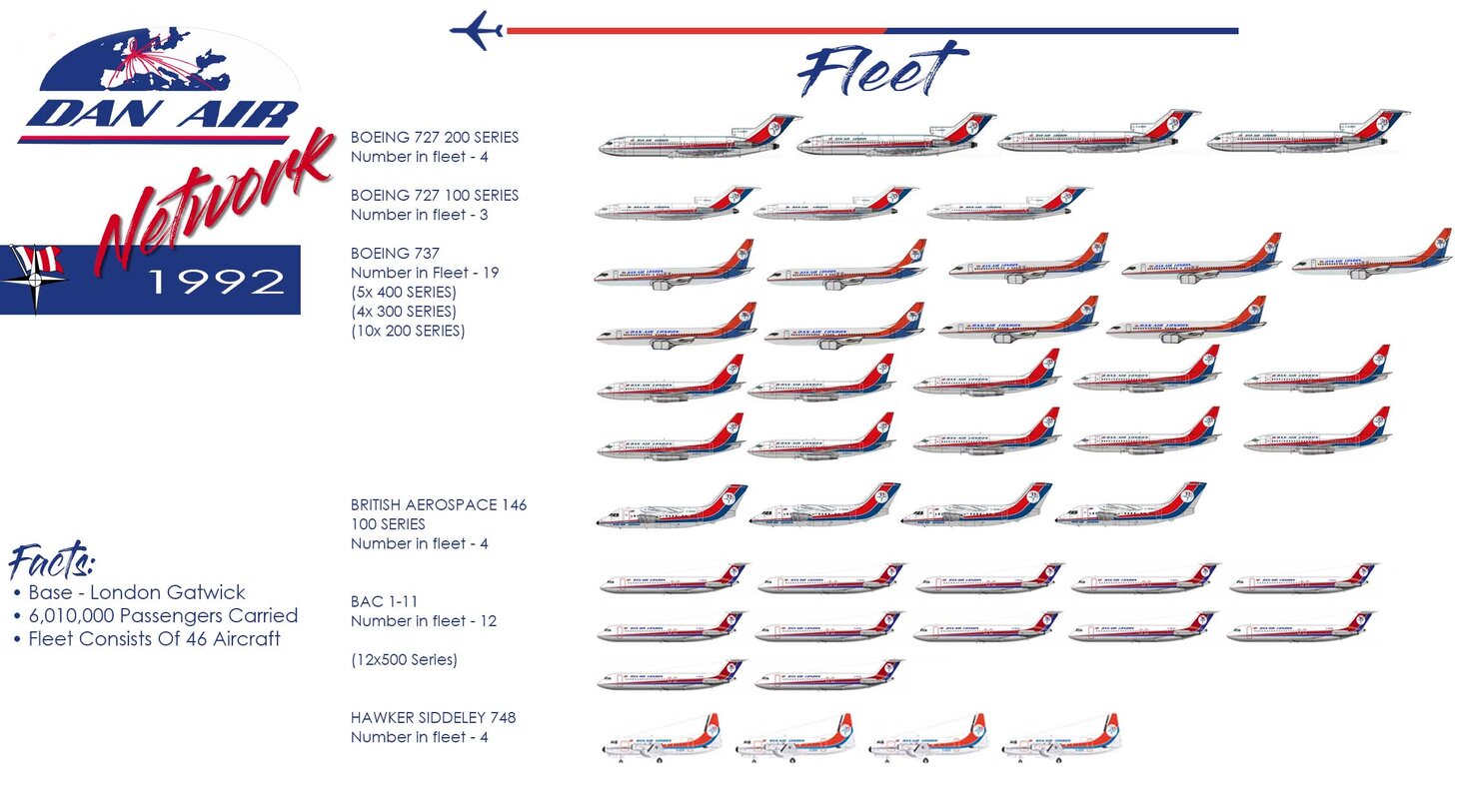
The previous year had been a terrible year for the whole airline industry. Two British carriers had gone bankrupt and the country's second largest Tour Operator had collapsed. Dan-Air had been saved, but there would be no room for complacency, 1992 looked set to be equally tough, perhaps even more so than 1991.
Dan-Air decided to relax several dress code rules that had hitherto applied to cabin crew. The ban on married cabin crew had been dropped a few years ago, and from this year, the maximum age of cabin crew was scrapped. There had been a magazine article that criticised UK airlines for only employing younger staff to work as cabin crew. Dan-Air had responded that they did in fact employ older crew members. One such stewardess had retired aged 60. It was true that most airlines had a ceiling for flight attendants, certainly at the application stage. Those that had been employed already had a much greater chance of staying on as cabin crew than a middle aged just starting out would have. This is in total contrast to Easy Jet in 2024 who were actively seeking cabin crew aged 50 plus to commence duties, even those who had never flown as crew before.
From January the wearing of some jewellery was permitted, a watch had been permitted and a wedding ring. From now stewardesses could wear pearl earrings and a pearl necklace. Hair ribbons would still have to match the company uniform though! One uniform change was welcomed by many of the stewardesses. The latest Dan-Air hat would now be optional. There had been many changes in uniforms over the years, the most recent hat had never been popular. Management said that the wearing of the company hat 'is up to the individual' - A spokesman said 'The type of hat the girls are wearing is a bit outdated, we couldn't just change the hat, but when we eventually change the uniform, probably next year, we will look at the question of hats again.'
One Ringway based stewardess said:
'It's wonderful news, the hats made us look stupid. If they were pulled tight over your eyes to stop them blowing off, it messed up you hair, and passengers would always be making derogatory remarks. Passengers used to say they looked like potties when stored upside down.'

Dan-Air were fined £1,000 on January 29th for not transporting a live animal in the correct manner. The dog was being transported from Nice to Gatwick. Agents acting on behalf of the airline had placed the dog inside the hold. Upon unloading an RSPCA inspector discovered that all but one side of the crate was surrounded by luggage and therefore ventilation was restricted. The crate was also seven inches too short and one inch too low for the breed. Trading standards had also found that the crate had ventilation holes that were seven times larger that the International Air Transport Association (IATA) permitted, which would allow the dog to put a paw or even its nose through. This broke IATA rules. Trading Standards had brought the prosecution fo which Dan-Air pleaded guilty. Company Secretary for Dan-Air David Quinn said: 'We consider this matter extremely seriously and have issued instructions to all our agents with fresh information.' and he pledged that Dan-Air would no longer transport animals from Nice. As well as the fine, Dan-Air were ordered to pay £80 costs.
John Olsen, the Company Manager of Cathay Pacific Europe was appointed as Director of the Dan-Air Group Of Companies. He took over from David James who became Chairman of Dan-Air and the Group Chairman. The company had been looking for a new chief executive since October 1991. Olsen, aged 49 when shareholders agreed to a new rescue plan which involved a virtual re-flotation of the company with the issue of 107.5 million new shares. The share issue enabled Dan-Air to raise £49.4 million to pay off debts and fund operations. The firm had announced a loss of £35 million 1991 but expected to be back in the black this year. Peter Ryan Group Deputy Chairman would stay with the company and Charles Whyte, Group Managing Director would remain in place until Olsen started work in April.
The press carried a story about Dan-Air 'amazing turnaround' in February. The article said ''Once troubled' Dan-Air would be recruiting 100 new staff in preparation for the six new routes the company would be flying to from Gatwick this year. From April Stockholm, Athens, Rome and Barcelona would be added to the network with Istanbul, Cairo and Malta added later in the year. The re-financing of the airline enabled the company to apply for new routes. A company spokesman said: 'Despite the recession, it is the right time for the airline to start new routes. Recruitment for ground staff and cabin crew is already underway.'
In a refreshing piece, one Crawley newspaper said of Dan-Air's new routes: 'Established in 1953 Dan-Air has gone from strength to strength in superb style.' The same newspaper had called the airline 'Ailing' only months previously.
The new Gatwick-Athens service was launched on Monday 2nd March. The flights would be operated using Boeing 737 aircraft with 'Class Elite' offered as well as economy class. The airline took delivery of another Boeing 737 400 series, one of six on order as part of a fleet renewal process.
David James would move to his next 'rescue' the revival of the international transport group LEP. James said that his appointment would not affect his determination to go through with the litigation he had begun for Eagle Trust. Previously James had always refused to take on more than two 'rescues' at any time, saying; 'Normally, I take on one new one a year. That last one was Dan-Air which I took on in October 1990. That has now been re-financed and is very orderly. A new chief executive is taking over in five weeks. I will stay on as conventional chairman. Eagle Trust still takes two days a week. We are now getting to the interesting part of the litigation.'
Meanwhile, Dan-Air's Chairman, Peter Ryan was to rush in to help out at the Newcastle based engineering and signs company; Torday and Carlisle. The firm had experienced a torrid time in 1991. Peter Ryan would be the non executive chairman of the group, leaving Paul Torday free to concentrate on his duties as chief executive.
On March 10th three “utterly offensive” oil rig workers who reduced an airline stewardess to tears with sexual remarks were ordered off a plane at Manchester Airport The trio who had been drinking, upset all the cabin crew aboard a Dan Air Boeing 737 flying from Aberdeen to Manchester and then on to Gatwick. Stewardesses complained and refused to travel onwards with the men on board. The three men eventually got to London Heathrow after paying £81 each and giving British Airways a promise that they would behave themselves.
Members of Inverness and District Chamber of Commerce agreed to write to Dan Air about increased air fares between Heathrow and Heathrow. Chamber president Captain Eric Milne said: 'It would appear to us that the business traveller is being penalised yet again with the cheapest air return to London for a day at £180. There are cheaper fares available but it entails an overnight stay of a Saturday night. We would suggest to Dan Air that this should be extended to cover weekday nights. It should be remembered that the Inverness schedule route is one of their most profitable.'
Gatwick Airport’s mixed fortunes continued into the third week of March with two catering firms announcing they were to axe jobs after losing several airline contracts. Some 40 jobs are to go at Caterair which had lost its contract with Continental Airways Giant catering suppliers Trusthouse Forte Airport Services say a few employees may lose their jobs after Dan-Air decided to end its three year association with the company. Despite this setback Forte had two flight kitchens at Gatwick which are both recruiting staff The company also has a number of different businesses in the area to which staff could be re-deployed. A spokesman for Forte said that if jobs did have to go at the end of the day they may be able to find placements with other companies. The new contractor will need staff 'Hopefully they will be interested our highly trained and professional employees.'
Twinkling lights in the air lured pensioner Ria Guest a bit off-course on her first ever flight. Airport staff were waiting at the domestic passenger terminal to escort VIP (Very Inexperienced Passenger) Ria on a flight to Gatwick But Ria, 85 had diverted her chauffeur-driven Rolls to the main terminal so she could see the airport’s famous Italian-made chandeliers. Staff caught up with her and settled her into a seat on a company BAC 1-11 jet. Ria said: 'Villagers at home had said I must be sure to see the chandeliers They are so beautiful and twinkly.' Villagers of Cowpe near Rawtenstall raised £160 to pay for her air-fare as a birthday present and handed the ticket to her at a pub party. But Dan Air went one better and waived the cost.
A General Election was called for April 9th this year. The campaign began six weeks before the poll. The Liberal Democrats chartered a Dan-Air Hawker Siddeley 748 (G-BUIV) for the use of their leader, Paddy Ashdown. The aircraft would be in use for the whole campaign. The aircraft was given a slight change of livery, with the 'Dan Air London' titles replaced with 'Liberal Democrats'. The compass and flag logo on the tail was pasted over with a giant yellow circle with the legend 'My Vote'. Ashdown had to switch planes after a bumpy landing at Newcaslte Airport on March 27th. As the aircraft landed it was buffeted by fierce winds in circumstances which the pilot described as 'difficult'. A Dan-Air spokesman said there were technical problems with the plane, although he would not link these with the landing. The campaign team were switched to the comparative luxury of a 100 seat BAC 1-11 jet. A former pilot mentioned:
'The HS 748 was as rugged as an airliner could be. They flew for years into the Shetlands when no other aircraft could even attempt to land there, so the technical difficulties it had would not be have been caused by the wind. From what I understood, the Liberal Democrats did not have the funds that the Conservatives and Labour had. They had chartered jets for their campaign. Kinnock used a British Air Ferries 146 and John Major went for a British Midland 737. The Lib-Dems could only afford a 748. Still, it would have served them in splendid fashion, nipping from one part of the UK to another.'
The aircraft made several appearances on the TV news.
Errol Cossey one of the leading executives at Dan-Air in the 1970s was interviewed this year. He, along with Martin O'Regan and Alan Snudden had left Dan-Air after disagreements with Fred Newman's refusal to re-equip Dan-Air's fleet with the Boeing 737 200 ADV in 1978. Cossey had gone to Harry Goodman and became a leading figure in the launch of Air Europe. A few years later he was the founder of Air 2000. His interview shed light on some of the thoughts about his time with other airlines, without naming them! After training to be a chemist he realised he wasn't cut out for it, but also that he had to eat. He thought he had a chance of work at Southend Airport, where he was taken on as part of the operations staff: 'Until that time, I'd never even had the remotest interest in aircraft - or airlines, I had a foot on the ladder and I applied for a job with Dan-Air in the sales department. I was there for seventeen years. I had gone as far as commercial director, and I really knew the aviation business by then.'
In 1979 his big break came when he was a founding director of Air Europe. 'It was owned by Harry Goodman's International Leisure Group, and was soon the darling of the holiday charter business. I had parted company long before the ILG collapse in 1991. I wanted to put into practice my view of the future of Tour Operators. I believe that they should be vertically integrated with their own charter airline. So I approached Owners Abroad, now the second largest Tour Operator, which has brands such as Falcon and Enterprise. I suggested that they should think about their own airline, and in 1987 Air 2000 was launched with two Boeing 757 jets. It was almost like watching a video of my own life, using the same basic concepts - using very modern equipment, a dedication to the leisure market, without any aspirations without any aspirations to go into scheduled services, and coming up with high quality passenger services. I've modelled this on the Marks and Spencer and Sainsbury's business approach. Having a good product, being the best in your market and giving good value for money. And I'm glad to say it really works. I ensured we had a good product, marketed it well and that's it. What we don't do is make the mistake of offering too many variations on a successful theme. In a big business, that's where overheads and complications creep in, and costs increase. Aviation is an exciting business, but paradoxically, you have to keep both feet on the ground if you are going to succeed. The business is littered with the tombstones of flamboyant characters who got carried away. They smelled the kerosene, heard the roar of the jet engines and believed their own PR. I couldn't be further from that mode. I've got no interest in seeing my name on the side of an aeroplane. I'm not an aircraft buff, I see myself as a commercial chap. A good salesman, who has got to know the cost of the business he is selling. We can all go out and sell dollar notes for 90 cents, that's not very clever. There's no magic to this business, you've just got to work to get the product right, and getting the right team to operate it.'
The Aberdeen-Scatsa charter flights operated on behalf of BP would come to an end this year. Dan-Air had been the sole operator into Scatsa for several years. The Hawker Siddeley 748 had carried out thousands of flights for the company to the remote airport. Tenders were invited and Loganair were successful with their bid. They would carry out flights using Jetstream prop-liners.
In April, Davies and Newman posted full year results that indicated the company was on the right track. Turnover was £317 million which was an improvement on the forecast £312 million - with losses of £18.9 million against an expected £19.1 million. David James said: 'The board believes that it has made excellent progress overall in implementing the key elements of the strategy.' On the charter side, James said he shared the concern of other airlines that certain Tour Operators had applied to the Civil Aviation Authority (CAA) for permission to use an eastern European airline saying 'As the CAA have the same control over such airlines the company has made representations to the relevant Government departments, urging them not to grant an operating licence.' Davies and Newman expected to make a loss last year because of the Gulf war and the impact of the recession, but it did cut its losses from £38.7 million to £35.4 million. James said the continuing recession, General Election uncertainty and terrorism had combined to depress the market this year, adding: 'With the election out of the way and expectations of more general economic optimism, there may be indications that market growth is beginning to be re-established. Dan-Air is continuing to increase it market share, giving it considerable encouragement that the company's strategy would prove to be well-founded in the longer term.' James did not see shareholders receiving any dividend until 1994.
The share scheme had raised £50 million which would be used as part of the rescue strategy which would see a switch of emphasis from charter to scheduled flights. An upgrade of the fleet and the move of head office from London to Gatwick.
British Rail announced new rail fares from Newcastle to London with an APEX fare of £25. Train times were intended to lure away air travellers. Dan-Air dismissed the train operator's cheaper prices, saying that airline attracted a different kind of passenger and that they didn't foresee their services being affected.
The airline announced in April that four of the older BAe146 aircraft (100 series) were being sent back to British Aerospace along with two BAC 1-11 jets. They would be replaced with four of the latest variant of the 146 - The 300 series. The jets were eight years old and the newer models would bring down the average age of the fleet. The cost was explained as negligible. In addition to these changes, there would be a further two BAe146 300 series brought into the fleet at a cost of £20 million. The twelve strong BAC 1-11 fleet now had ten aircraft operating scheduled flights in a 99 seat layout and just two were flying charter flights with a 119 seat layout.
The new Group Managing Director, John Olsen officially started working for Dan-Air in April. His salary was a reported £150,000. The recruitment of Olsen was seen as a positive appointment. No one had thought for a single second that Olsen would have left such a successful airline to work for one that was predicted to fold.
In May, Dan-Air rolled out what was announced as its largest ever expansion at Gatwick with flights to Rome now operating daily. To celebrate the launch of new services Dan-Air offered passengers the chance to fly two for the price of one to ten destinations. The offer would be rolled out as each route opened, plus a few of established routes would feature the offer. From May 18th Barcelona, Madrid and Gibraltar would see the special fare. It would apply on both economy and Class Elite cabins, subject to availability. Effectively this meant half price tickets. With the Super Pex fare passengers had to book at least seven days in advance, staying at least one Saturday night. At the other end of the scale, Dan-Air offered Super Pex fares to Barcelona from only £137 for two and Class Elite at £430. There would be Dan-Air flights from regional airports to Gatwick to connect to the new services with fares on Manchester-Barcelona being £249 and Aberdeen-Barcelona at £295 Madrid and central Spain fares were to be £160 for two Super Pex tickets, and £476 in Class Elite. Travel from Newcastle is from £288, from Inverness, £318, Gibraltar was on offer at £185 for two Super-Pex tickets up to £506 in Class Elite.
May 7th saw drama when a company Boeing 737 took off from Newcastle on a flight to Lanzarote and flew into a flock of seagulls. The aircraft with 125 passengers on board was forced to return to the airport where shaken passengers were taken to a lounge and given refreshments. No-one was injured, but the aircraft nose was badly damaged. Eight fire engines were on standby as the aircraft landed safely.A spokesman said: 'The aircraft was on its climb at 8:15 am this morning when it struck the birds. The aircraft was handling normally, but the Captain returned the aircraft as a precautionary measure. The passengers were perfectly safe and would not have been aware of the impact. The real danger is when a bird is sucked into an engine - that can cause real damage, but this didn't happen. The passengers were understandably shook up and we apologise for that. They boarded a second aircraft and took off at 10 a.m'. The CAA were informed. Newcastle Airport said that they took measures to prevent birds being in the area, but that they did occasionally get struck by aircraft. The passengers continued their journey later that day.
Elaine Padgett who was on the flight with her husband Paul said:
'I am a nervous flier, so we had watched the safety demonstration like hawks. The aircraft roared down the runway and we took off smoothly. Shortly after becomming airborne I heard the thumps at the front it was really loud. There was no doubt we had hit something. The pilot came on the tannoy and told us we had hit some seagulls, but it sounded like we had knocked over a load of deer. My husband saw something whizz by the window. Thankfully I didn't see that. The stewardesses went over the safety again and told us what to do if there was to be an evacuation. Luckily it was very smooth. The Captain was marvellous. I was apprehensive about catching the second aircraft, but I guess if you are in the sky there is a chance you will be sharing it with birds. It's a shame they couldn't fly out of the way as fast as we were flying.'
On May 14th David James said that Dan-Air had 'Made excellent progress overall. The airline is one of the few who have weathered the worst year in aviation. We have been able to achieve these figures under very difficult circumstances. I am confident the company will improve performance as the economy picks up.'
At the end of May, David James stated that the sustained increase in passengers that was needed to lift the airline back into profit had failed to materialise. He said bookings from April to May had shown no recovery, but that bookings over the last two weeks had shown a marked improvement. This was despite him saying two weeks prior that the airline had been performing better. The airline had posted slightly higher turnover and slightly less losses than forecast. Now James was saying:
'This erratic and unpredictable pattern does underline the difficulty of accurate forecasting in the present conditions." He had told the Annual General Meeting that "by adding just two business class passengers on every Dan-Air flight they would add £20 million to annual profits."
James said that the airline's survival plan was 'on course'.
Bags checked in at Gatwick from May 14th would be speeded up by new technology installed at the airport in a new £25 million upgrade of passenger facilities. Baggage tag printing would now be automated and integrated into the computerised check-in system. This resulted in tags now storing more details than before. In addition to the passenger name, flight number and routing details, the tags would now carry codes that could be read two ways; both infra red scanners and the newly installed optical character reading system. As the passenger checks-in the tags are added by check-in staff and read by computer controlled scanners as they travelled along the conveyor belt. The scanners used technology similar to those in supermarkets could then direct the luggage automatically to the correct aircraft. The scanners could handle 60 bags a minute which would give staff ample time even at peak periods.
The war in Yugoslavia saw thousands of British Holiday-makers having holidays cancelled. The Yugoslavian airline JAT had been chartered to fly British travellers to many other locations and UK carriers had suffered as a result. The British Government placed sanctions on the former Yugoslav country, Serbia which meant that JAT could no longer operate in the UK. This would benefit Dan-Air as the JAT flight to Gerona would now be with a Dan-Air Boeing 727. The 187 seat aircraft could accommodate all the passengers booked on the JAT example where the Airtours MD 80 had only seats for 165.
Dan-Air joined the Air Miles scheme in June. This was seen as a positive move as it would complement their frequent flier programme, run jointly with Virgin Atlantic. Leaked information disclosed that Dan-Air were looking for a partner company to formally merge with. This further unsettled staff and passengers.
The airline had been a sponsor of a southern England football league for many years, and in June the sponsorship ended. The new sponsor Parasol Portraits Ltd did not come with mega-bucks. The team Dan-Air sponsored had worn a strip with the Dan-Air logo emblazoned on the front. The new sponsor requested that a patch with the new sponsor's logo be sewn on the strip. The team complained that the strip was already a year old and needed to be replaced. Members of the team - Ditton F &SC resigned in protest of the lack of support from their new sponsors.
The last restrictions on air travel in the European Community were swept away on June 23rd in a historic deal which will eventually mean cheaper fares for all. The Transport Secretary, John McGregor, described the agreement in Luxembourg as the final clincher in a 10-year battle for an open skies policy. But while. airlines and passenger groups generally welcomed the deal which comes into force on 1 January, there was a warning that lower fares ‘may be some way off.' The agreement does away with the controversial airline cartels in Europe and subject only to meeting financial and safety regulations, any airline can compete freely on any air route within the EC. It meant airlines like Dan-Air, Air UK and British Midland will be protected from any predatory behaviour of the big carriers. - Mr McGregor emphasised that the EC’s transport ministers had no power to decide air fares or conditions. But he said: 'Our agreement has put in place all the right mechanisms. The market will do the rest.' Restrictions - which have irritated passengers for years, such as a requirement for a Saturday night stop-over to qualify for low fares, will disappear. The chairman of Virgin Atlantic, Richard Branson, said last night: 'This is good news for the consumers and for airlines and it should have happened 50 years ago.' John Parr, director general of the Air Transport Users’ Committee, was more cautious, and said: 'We cannot realistically look for big cuts at the moment. You only have to look at the financial results of airlines to see that they cannot afford to cut fares.'
Captain Alan Selby recalls:
'If this had happened years before it could have been the greatest thing for Dan-Air. For so many years we were repeatedly told by the Civil Aviation Authority that we couldn't fly between A and B because another airline operated that route, or a similar one. We had to ask if we wanted to put a fare up or down. We even had to have permission for an aircraft type and the frequency we wished to operate the service. It was absolutely ridiculous. If this had been done a decade before when we were falling over charters and had ambitions to get onto more high profile scheduled services, we could have made a real impact at Gatwick, Manchester and Newcaslte. British Airways were financially weak then, and they were a state run organisation. No other UK independent carriers had the muscle, equipment and knowledge to provide a real network. Now we were embarking on what we always wanted to, when we were ourselves in a weak position, and rival airlines were in some respects, better placed to become a major force.'
A fundraising event was held via UK television channel ITV on July 18th raised millions for various charities. A call was made from a Dan-Air captain en route to Gatwick from Majorca. Captain Bryn Wyatt had sold trips around the flight deck and had raised £300. the Captain and crew were invited to Redhill to present the cash on air.
Passengers numbers on flights from the, North-East to Amsterdam have ‘gone into free- fall' forcing the airline to suspend the service. Daily return flights from Newcastle and Tees-side airports - used mainly by businessmen - would be grounded from July 31 in a move blamed on falling demand and the recession. Dan-Air would continue to run its twice daily weekday service between. Newcastle. and Gatwick, but flights to the capital on Saturdays and Sundays would be halted as the company put the squeeze on unprofitable routes. Dan-Air pledged that all passengers already holding Amsterdam tickets would be offered alternative other carriers or flights via Gatwick. The cuts would mean 13 temporary cabin staff would have their contracts terminated two months earlier than expected. Chief Executive John Olsen said: 'The continued effects of the recession have led to a drop in demand, and this has forced us to take this action. Like all airlines in the current economic climate we consistently review our routes to remain competitive. Despite all our earlier efforts to safeguard the route the continued effects of the recession has meant a lack of demand to support the service profitably.'
There was increased speculation that the Newcastle-Jersey service was at risk of closure following a drop in demand. There had been fierce competition from Air UK on the Amsterdam route, with the airline saying their four times daily flight was the fastest growing route in Air UK's network, rising 7% - which amounted to 75,000 passengers.
The Shetland oil charter situation further deteriorated in June when the local council refused an application for the runway at Scatsa to be lengthened. This would stop Loganair's proposed scheduled service into the airport with Jetstream pop-liners. Loganair had planned to take not only oil workers, but paying passengers on the service. They would no longer need to seek approval for the service. Dan-Air said they would now no longer provide a month by month rolling contract with BP, instead they would terminate the charter contract when it ran out in September as they were in the process of phasing out their HS 748 fleet.
For a second time Dan-Air were found guilty in court over the poor carriage of animals. The airline was charged with cruelty to four dogs. Two of the dogs were flown into the South Terminal in boxes that were too small, and all four were not tied down correctly. Mr. Brian Stone, prosecuting said: 'Dan-Air had broken its own code of practice to end injury and distress to animals in aeroplanes. the dogs which included a Collie, a mongrel and two cross-bred Collies were being flown all the way from Africa. A customs official told Crawley Magistrates Court that the dogs were in danger of being tossed about and after the flight had landed one of the dog boxes was found on its side.' Ms. Marilyn Scantlebury, Dan-Air's assistant company secretary said the airline had carried more than 1,000 animals in the last 18 months. She said that the company had now placed a total ban on animals flying into the United Kingdom. Dan-Air were found guilty of seven charges and were fined £4,800 and ordered to pay £80 costs.
Dan-Air's advertisement for the Newcastle-Gatwick service was brought to the attention of the Advertising Standards Authority - who ruled that the airline had misled the public with the advert. The Authority found that Dan-Air didn't operate the service at weekends and demanded that they make it clear that the service ran from Monday-Friday only.
Hearts fans had been given an amazing cut-price chance to fly to Czechoslovakia with their favourites for the UEFA Cup-tie against Slavia Prague on September 16th Tynecastle chiefs were facing a loss of up to £30,000 on the price of chartering a Dan Air Boeing 727 jet to the Czech capital after only 80 of the 180 seats were booked - 30 of which were taken by the Hearts travelling party of players, coaches and officials. The club chairman Wallace Mercer announced that Hearts would cut the price of flying to support Hearts in Europe by almost half in an attempt to offset the cost of the charter. Prices had been advertised at £380, but the price were reduced and would include flights, hotels, transfers and entry into the arena for the bargain-basement price of £200. Club Chairman Wallace Mercer said: 'This is thank you to all our fans for following us in times of difficulty. But it is also a practical step because 100 empty seats on that aircraft would have cost us between £20,000 and £30,000. The fans and executives would be getting a better deal as they would be upgraded to club class at no extra cost to them.'
Vic Sheppard who had been a manager with British Caledonian before joining Dan-Air had recently left the company and went public with his ambitions to start a new airline - First European Airways - Sheppard had been responsible for Dan-Air's operation to Paris and Nice from Gatwick. He claimed to have raised £6.5 million of the £8 million he needed to start the airline. They would be operating to Nice and Paris from Gatwick he told press. His company comprised of an experienced ex-British Caledonian and Dan-Air staff. David James, Dan-Air's Chairman was furious when Sheppard's plans were revealed. He argued that First European would make a loss forcing Dan-Air into making losses too. Sheppard argued that the lights will merely restore the competition that had been missing since the demise of Air Europe. The CAA awarded First European Airways a licence, but our research indicates that the airline never got off the ground and Vic Sheppard moved to Emirates airline.
Dan-Air's much anticipated Gatwick-Cairo service was given the green light for January 1993 following lengthy negotiations between the two national Governments. The initial flights would be three flights a week using Boeing 737 400 aircraft in a two class configuration. Dan-Air claimed the demand for Egypt had bounced back following the Gulf War. The two for the price of one ticket offer was rolled out for Jersey and Paris flights on July 13th.
On September 16th Virgin Atlantic announced that they were looking into expanding their flights into Europe and providing domestic services to feed their Gatwick flights to America, prompting rumours of a link-up with Dan-Air. Virgin had applied to operate flights from Inverness to Heathrow and Gatwick. Virgin also applied to fly from Heathrow and Gatwick to Maastricht, Amsterdam and Athens. This sent alarm bells to Dan-Air whose Inverness service was among their most profitable routes. They also flew from Gatwick to Amsterdam and Athens. Virgin had previously operated into Maastricht but withdrew from it in 1989. They had provided flights using an ageing Viscount and passenger numbers were poor. They had tried to upgrade the service by sub chartering British Island Airways' BAC 1-11 jets. A Virgin Atlantic spokesman refused to comment on why the airline had applied for the licenses: 'It's too early to comment.' said Wilf Whitehorn, but he added: 'We have been approached by a number of operators to start new short-haul part charter scheduled services and we are looking at a number of routes. Dan-Air's Chief Executive John Olsen said: 'If anyone else wants to operate it, they are free to try, but I don't think they will find it expandable to that degree.' The move was seen by industry analysts as a possible way to bring the two airlines closer together. 'Dan-Air are looking for an injection of cash and Virgin are looking for an airline to feed their flights into Gatwick.' said one.
On September 21st it was reported that Virgin Atlantic had been involved in preliminary talks with Davies and Newman. It was claimed that the talks had taken place after talks between Davies and Newman and British Airways had taken place in August, but had broken down.
Bristol Airport director Mr. Les Wilson went public with his knowledge and said he was keen for the two carriers to merge. He said: 'Dan-Air used to run the bulk of our scheduled flights to Europe but gradually the reduced their flights. They are still responsible for about 50% of the check-in desks here and they look after Air 2000, Air UK, Brymon, Jersey European and KLM.'
The next day, Virgin issued a statement saying: 'The have been no talks between Davies and Newman - Dan-Air's parent company - and ourselves with regard to a merger. Nor has Virgin received any proposal regarding such a merger or other equity partnership.' But the statement went on: 'Following an approach by Davies and Newman a preliminary discussion has taken place between the two airline groups about further possible opportunities for marketing and promotional links at Dan-Air's Gatwick base.'
Hunky police sergeant Paul Drake went to a Dan-Air office for help in tracing a villain - and was greeted by cries of 'Get 'em off!' - Staff thought he was the stripogram they had booked for a stewardess's farewell party. Paul, 28, was at Gatwick to see if workers recognised a picture of a gunman. He knew it was a, case of mistaken identity when they urged him to bare all. But the personnel manageress said later: 'We may ask him to appear as the real thing next time.'
On the 24th September Virgin Atlantic's boss, Richard Branson disclosed that he was looking for a joint operation with Dan-Air's extensive European network to give travellers to and from the USA better connections for onward travel. The link-up would initially be a matter of the two airlines using a joint reservations systems, but the possibility of a single new airline has not been ruled out. Dan-Air had until the end of October to renegotiate loans from its bankers or face questions about its future.
Manchester based Airtours bought the Pickfords chain of travel agents on September 23rd in a deal worth £16 million. The deal would see Airtours in a similar position to Thomsons with their Lunn Poly shops. Pickfords had 316 shops throughout the country and would give priority to Airtours programme.
On September 24th worries that British Airways would be hit by news that Richard Branson was negotiating a rescue package with Dan-Air proved unfounded. Shares in Davies & Newman were suspended at 23p before trading started while talks were being held. While BA remained virtually unchanged at 299p despite dipping 1p earlier that day.
Davies and Newman shares had dropped as low as 21p which was a far cry from the 550p price just two years prior. David James denied that the Civil Aviation Authority (CAA) were on the verge of closing down Dan-Air. Saying that the company needed funds for future expenditure. Virgin's shareholders would be given the option to invest and the aircraft in Dan-Air's fleet would be used primarily as feeder flights for Virgin Atlantic flights worldwide. In return Virgin would re-brand Dan-Air as Virgin European Airways and provide operational and marketing support. The Dan-Air name would disappear. Meanwhile it was revealed that Peter Ryan, Dan-Air's Deputy Chairman was found to have seven other jobs as a none executive director. Dan-Air said of the merger talks that there were no plans for Dan-Air and Virgin to merge or for Dan-Air to be taken over. They were, they explained, 'Talks aimed at getting financial backing. Flying operations would continue as normal.'
Regional airline Gill Air won BP’s five-year contract to operate charter flights between Scatsta and Aberdeen. Dan-Air, who had the contract to fly personnel to and from Sullom Voe Oil Terminal for the last nine years, made their last flight on September 30th. According to terminal spokesman Peter Guy, Dan-Air would soon be selling all their 748 aircraft, which is the largest aircraft that can use the airstrip. This would mean the company would have no other aircraft able to land at Scatsta. Gill Air, who begin their contract on Thursday, will be using the smaller Shorts 330 aircraft for the journey. These can seat 22 passengers, 26 fewer than the 748 aircraft. For this reason, said Mr Guy, Gill Air would be making eight weekly round trips, compared with Dan Air’s five. Gill Air beat five other companies for the contract and Mr Guy said that they had 'offered a service which is compatible with the industry’s requirements'.
On September 28th David James issued a message to shareholders to say that "Talks of a merger between the two airlines was untrue - they were to result in co-operation between the marketing and operational activities of the airline." He strongly denied reports that Dan-Air had been threatened with the loss of its licences. He also described talk of the loss of hundreds of jobs as 'pure speculation'. Losses for this year were now forecast at £60 million.
James denied that the airline was about to close that same day, claiming that the airline needed financing to 'meet anticipated expenditure'. The proposed deal would see the Virgin name on Dan-Air's fleet of aircraft, but would stop short of a merger. Rumours had suggested that the new Dan-Air would be called Virgin Elite.
Analyst said that an alternative would be for Virgin to run Dan-Air’s services in return for a management fee: 'The outcome of the talks By Richard Shackleton will depend on shareholder approval for Branson taking a stake in Davies & Newman. Baring’s Bank - the company’s - adviser, said the talks. would also need . to involve the banking syndicate led by Lloyds, which is finalising the company’s annual cash requirements. The City believes: a deal with Virgin would help persuade large. investors to: provide funds. David James denied City reports that Virgin’s involvement came as the Civil Aviation Authority 'There is no “question of' creditor pressure: All I ask for is a period of peace and quiet to get on with the business.
Before Mr. Branson came forward on September 24th with advanced proposals, James was set to ask shareholders for £30 million by way of a rights issue. Despite there already being two refinancing packages.
It was rumoured that Tour Operators were holding back chartering Dan-Air aircraft for the 1993 season, as they awaited the results of the Virgin meetings.
The last Scatsa flight departed on 30th September. A BP spokesman said: 'It's a sad day, we have worked with Dan-Air for nine years. We had no intention of ending our working relationship. It was a fact that Dan-air said they were selling the aircraft and wouldn't be able to carry out the flights any more'
A former BP manager who wished to remain anonymous, told this site: 'I can't say what went off word for word in our dealings, but they were very dismissive of our plans, which firmly included Dan-Air. We had worked together for nine years and there is no doubt that they were exceptional with their ability in this very unique field. We had been told in a fairly informal meeting that it was unlikely that they would renew our contract. But a meeting was scheduled, before we met with Dan-Air the final time, we at BP had a few suggestions. One included them leasing new aircraft for the role and the other was the formation of a separate division within the airline, called something like Dan-Air Oil Supply. It would be a fairly straight-forward thing for them to do. They had everything apart from training the flight deck on a new aircraft type. The stewardesses would also need a familiarisation we supposed. For all of those nine years Dan-Air had made a large profit on these services. You don't have upwards of thirteen aircraft based in one place for nothing. If a new airline was being guaranteed five flights a week with one aircraft, at a rate that was profitable for them, they would normally have bitten the clients hand off. Dan-Air didn't - they just went on about them being a scheduled service airline operating a jet only fleet, and that these charters were not in line with their plans. You could have knocked us all over with a single feather. We just couldn't see why any airline would refuse work that was 100% sure to make them money. The aircraft would have been able to undertake normal flights outside of its work for us. We had talks with five other airlines and they didn't have what we needed. The Gill Air flights would actually be worse for us than before, but it was the best of what was on offer. There was a relatively new type of British regional airliner called the ATP which was very similar to the 748, but it was far more efficient and carried more passengers. British Airways were using it. We could not understand why when we mentioned this to Dan-Air, that they said they wouldn't consider introducing it into their fleet. We all knew that the Shetland flights were going to be phased out eventually, and this would have been a final, very profitable hurrah.'
British Midland Airways applied to the Civil Aviation Authority to take over Dan-Air's Inverness-Heathrow service on September 30th. The local council were keen that Heathrow remain as the preferred Inverness-London link and wanted to maintain the number of daily return flights and times. The council's Director of Roads Philip Shimmin and Transport said: 'Since Dan-Air took this route over, the business community and travelling public have received a first class service. They established a high load-factor which was impressive indeed and high-lighted the importance of maintaining current levels of service. Over the years the public have demonstrated their wish to use Heathrow, and this will be foremost when we are speaking to airlines.' It has to be said that Dan-Air had not left the route, and were still operating normally.
On 10th October it was rumoured that Branson was only willing to invest £10 million in Dan-Air and even then he would like to see Dan-Air stripped back to a core network of highly profitable routes and feeder routes for Virgin Atlantic. Dan-Air were looking for heavier investment of up to £40 million. David James said "One way or another, some sort of proposal will come out to try and save Dan-Air." Industry analysts speculated on TV that Dan-Air would need up to £60 million investment. This was in total contrast to the statements James had made last year that spoke of the 'certainly Dan-Air would be saved'.
The talks between Branson and Dan-Air broke down on 13th October with Dan-Air saying they were 'Greatly appreciative of Virgin's interest, but an agreement could not be reached. Davies & Newman announces that it no longer in talks with Mr Branson. The board also advises it is now in discussions with another party but is unable to disclose the identity at this stage.'
Virgin said that if Dan-Air remained an independent airline then they would be happy to work with it as a feeder carrier and they would not enter the short haul market to compete against it. But that if Dan-Air tied up with a mega carrier then Virgin European would be borne. It was reported that the Government was keen to see Dan-Air taken over by British Airways as it would avoid a repeat of the Air Europe collapse the year before. It was highly unlikely that British Airways would be interested in Dan-Air's charter operations.
A company Boeing 737 suffered a loss of cabin pressure on October 12th. Passengers clung on as the Captain of the jet dived 17,000 feet in a minute because of a pressurisation fault. A seal fault caused decompression in the luggage hold on the flight to Turkey. Holiday-maker John Pilliner from Chester said: 'One minute we were at 27,000 feet and the next we dropped to 10,000 feet.' The jet returned to Manchester where an official said: 'The passengers were never in any danger.'
New talks were indeed proceeding with several other carriers, with the speculation that the most serous of talks were with British Airways, which turned out to be true. A second round of secret in-depth talks was convened in late October. These talks went on late into the night. Rival airlines went on to point out that a merger between the two largest UK airlines would see them refer the deal to the Monopolies and Mergers Commission. There had been a general surprise in the industry when British Airways and Dan-Air were involved in further talks - three weeks after they had broken down. It was speculated that British Airways had walked away after realising that Dan-Air was poised to make losses of £30 million more than triple what had been forecast.
On October 30th a picture began to emerge of what British Airways were planning should the talks be successful. Should British Airways sign a deal with Dan-Air, the national carrier was expected to take over Dan-Air's main European routes flying into Gatwick, as well as purchase around a third of its fleet of aircraft. Whilst several hundred jobs would be saved, the package holiday side appeared likely to be closed or sold. Dan-Air’s share in Gatwick Handling. was also up for grabs. David James was said to be making a last desperate attempt on October 19th to salvage as much of the airline and the almost 3,000 jobs as possible. It was not clear whether the deal with British Airways would be a straight takeover or a face-saving new venture, keeping the Dan-Air name. British Airways, headed by chairman Lord King were said to be anxious to get back several of their former routes to places such as Rome, Paris. Brussels, Amsterdam, Athens and Nice, from Gatwick, which it had been forced to give up after the takeover of British Caledonian. The Government were eager to avoid another announcement of mass redundancies, was believed to have given the move its tacit blessing and indicated there would be no reference to the Monopolies and Mergers Commission. Total closure of Dan-Air would have a devastating effect on the Gatwick area. Dan-Air as Britain's second biggest airline and Gatwick's biggest user handled over 18 per cent of the airport's traffic. Other smaller airlines, such as British Midland, Brymon Air, and City Flyer Express would be competing to snap up other routes. British Airways had always had trouble at Gatwick because of the lack of connection between their long haul flights arriving at the airport and onward European routes. Both British Airways and Dan-Air refused to comment on any deal. Meanwhile major travel agents have started holding back tickets booked on Dan-Air flights until the last minute to prevent customers being hit if the airline went under. Travel Agent Michael Croft told us:
'It was not hidden within our office that I was a Dan-Air fan, I was gutted at what was happening. We could sometimes see this happen with airlines long before the public got wind of it - with the exception of Air Europe! But with Dan-Air it was plastered everywhere. I have never seen anything like it, before or since. For about three years it was never out of the newspapers. Dan-Air often had an image problem, and I really don't know where that came from. Charter passengers would often reject flights with Dan-Air, but I always urged them to fly Dan-Air, and their European scheduled services were second to none. The last year of Dan-Air was hard for us. The public were well aware of their troubles and were actively avoiding booking tickets on schedules. It must have been an impossible situation for staff to carry out their duties in the face of such uncertainty.'
Rumours began to swirl that British Airways was poised to rescue Dan-Air on October 21st. The press claimed that British Airways would pay £3 million for Dan-Air's scheduled network and that the 2,400 staff would be secure in employment. Another newspaper 'revealed' that Dan-Air would stop charter flights and 1,600 of the staff would be made redundant. The paper said of the 400-600 people would be retained, and that of the rest, those aged 50 and over would be offered 'early retirement'. Davies and Newman said: 'Without the BA deal the company would almost certainly be in receivership.'
The announcement that British Airways had bought Dan-Air was made on 23rd October 1992. British Airways had purchased the entire airline, along with liabilities (and assets) for £1.
In total 1600 jobs would go at Dan-Air. The entire charter division would close. The only aircraft to be taken over by BA would be the Boeing 737 fleet. It was discovered that almost all the Dan Air Scheduled Services were in profit. All of the 171 staff at Manchester were expected to be made redundant. The Aberdeen-Manchester service was axed and all charter flights from Manchester would be given to other airlines. British Airways would take over only twelve of the current scheduled services. A Dan-Air spokesman said: 'The board has been compelled to concede that it would not be possible to continue. All tickets and reservations on Dan-Air routes will remain valid.'
Sir Colin Marshall, the Chief Executive of BA said: 'We regret the circumstances which made the future so uncertain for Dan-Air - It has been bad news for a good airline.'
After the British Airways take over, James claimed to have got the best deal for Dan-Air, saying that he had been in talks with twenty other carriers, none of which had been able to match the one BA offered.The majority of the Dan-Air fleet would be sold with just 12 of the 19 Boeing 737s would join the BA fleet. The BAC 1-11, the Boeing 727, HS 748 and BAe 146 would all be disposed of.
Dan-Air had sold its share of the profitable Manchester Handling in January with David James, the Chairman of the company saying: 'From now on Dan Air will be an airline - just an airline.' That was another profitable company that was sold, the other being Dan-Air Engineering. The new board had stated that every route Dan-Air flew should be a high density, business or leisure route. Their plans included greater frequency on the most popular routes, a much more scheduled service approach and a fleet that was to be consolidated to two types; the Boeing 737 and the BAe146. The Gatwick - Stockholm / Rome / Athens / Barcelona routes had all commenced. Dan-Air faced massive competition. The Barcelona route closed after just six months operation. The expansion of Dan-Air's scheduled operation at Gatwick had continued throughout 1992, resulting in the resumption of the former Air Europe route to Stockholm Arlanda in February and Rome Fiumicino in April. In addition, a Gatwick - Athens was launched in March and Gatwick - Barcelona was re-launched in May. During that period, Dan-Air became Gatwick's largest resident scheduled operator controlling 18% of all slots, and 21% of all morning peak time slots between 8 am and 9 am.
The take-off and landing slots were worth a fortune. The spare parts housed in Dan-Air Engineering's three bases that had been sold at a price many people said thought 'under value'. The spares at DAE had a value of £20 million alone - With the slots at Gatwick being worth millions. Dan-Air's and office space and headquarters in Horley and London City were owned outright. Gatwick Handling was a major company with large profits. When Air Europe collapsed not only were its scheduled routes up for grab, but a substantial charter programme. The board at Dan-Air had rejected some of the opportunities that might have been presented to take on some of that charter work. Instead choosing to concentrate mainly on the scheduled services. in many cases charter contracts were rejected. Including the lucrative Shetlands oil charters. The funds raised through new shares had been massively insufficient to standardise Dan-Air's fleet on the Boeing 737 300/400 series and the Avro RJ115 (marketed but never built). The funds were also insufficient to finance transformation from a cheap-and-cheerful charter carrier with a collection of poorly performing, 'low visibility' regional scheduled routes into a top quality, 'high visibility' mainline short-haul scheduled operator plying trunk routes.
Dan-Air's Chairman, David James, said: 'weak marketing and its charter mentality, even after the decision to make high-profile scheduled services the focus of commercial activities, was the reason it failed to achieve results.'
That meant that instead of making Dan-Air the airline of choice for high-yield business travellers on prime scheduled routes, where it had become a major force in the wake of the demise of British Caledonian and Air Europe - such as Gatwick to Paris Charles de Gaulle - through carefully targeted marketing and publicity, Dan-Air continued selling the bulk of its scheduled inventory to consolidators and discount travel agencies, in the way it had sold its charter inventory to package tour operators.
The airline saw this as risk minimisation to fill seats on scheduled services. However, Dan-Air surrendered control over its scheduled seats to third parties whose sales were volume-driven. This deprived Dan-Air of the opportunity to boost the profitability of its scheduled operation by concentrating on maximising revenues from high-yield travellers. British Airways paid a nominal £1 for Dan-Air - in return taking on financial commitments of £50 million which included debts of £37 million. For its part, British Airways got 12 of Dan-Air's most modern Boeing 737s, a similar number of short-haul scheduled routes from Gatwick, the Heathrow-Inverness feeder service and about one-fifth of its 2,500 workers. Dan-Air was absorbed into British Airways' Gatwick operation. On November 27th, the company's name was changed from Dan-Air Services Ltd to British Airways (European Operations at Gatwick) Ltd. This rump of the former Dan-Air formed the nucleus of what British Airways intended to be a low-cost short-haul feeder for its Gatwick long-haul scheduled services, with the aim of helping to return British Airways' loss-making Gatwick operation to sustained profitability.
ROUTES AND ROUTE CHANGES
- Gatwick - Stockholm - Twice daily, except Saturday. February 24th
- Gatwick - Rome - Daily service commences February 24th
- Gatwick - Athens Daily service commences - March 26th
- Gatwick - Barcelona - Daily service commences - May 18th
- Gatwick - Barcelona service closed. October 2nd
- Gatwick - Oslo
- Gatwick - Istanbul
- Gatwick - Malta
- Gatwick - Cairo
NETWORK & PRESS 1992
SPECIAL ARTICLE
Causes of decline
Among the reasons for Dan-Air's decline was the lack of vertical integration with a UK Tour Operator. The company had contracts with 130 Tour Operators, many of whom did not charter a full aircraft. The company claimed that this suited them, as they could offer the spare capacity to other, smaller, Tour Operators, who also could not justify chartering a full aircraft. Dan-Air was the last major independent provider of charter airline seats to numerous large, medium-sized and small tour companies in the UK and overseas. This was at a time when most UK Tour Operators had set up their own airlines. From the late 1970s Tour Operators had been aware that by having a dedicated in-house airline, they could save costs with that vertical integration. Each time one of these carriers started up. It was with a small fleet of new aircraft. With a dedicated Tour Operator using those aircraft there would be no negotiating lower rates with various airlines. They could give the best flights to thier own carriers. As their own airlines grew - the need to charter other airlines' aircraft would diminish. Fortunately, the number of British people taking overseas holidays continued to increase. Nevertheless, Dan-Air's own growth in the charter market was stunted. These airlines included Court Line (Clarkson's) Britannia (Thomson) Air Europe (Intasun, ILG) Monarch (Cosmos) Orion Airways (Horizon) Air UK Leisure (Unijet) Air 2000 (Owners Abroad) Airtours International (Airtours) Inter European Airways (Aspro) and British Airtours/Caledonian (Inspirations). Those carriers subsequently merged with others or simply went out of business. It is not without credit that Dan-Air managed to retain any market share at all. In the early 1970s Dan-Air accounted for almost 40% of the charter market. By 1992 this figure had dropped to 16%. Having said that 16% of the market in the 1990s dwarfed 40% of the 1970s share.
This competition had resulted in a decline in Dan-Air's importance as a business partner for these Tour Operators, reducing its status from main to marginal provider. Air Europe even dropped Dan-Air Engineering as its preferred engineering company. It appeared that Dan-Air was being attacked on all fronts. The privatisation of the hitherto state owned British Airways was a tremendous blow to all airlines. Especially in a pre-deregulated environment. British Airways had not only a huge network and fleet, but, when privatised, got it all for free. A share option to the public then gave BA an even bigger cash injection.
Another reason for failure was that the fleet contained too many different, incompatible aircraft types. Some of these aircraft were older and less efficient than those operated by competitors such as Air Europe. Consequently, the Dan-Air fleet was costlier to operate and maintain. The Boeing 727s, which Dan-Air continued to acquire throughout the 1980s, including some on unfavourable leases, proved a financial millstone. Air Europe had made disparaging comments to the press that they would not be using Dan-Air's aircraft in future as they were 'old, gas guzzling jets.' To some extent this was true. However, newer types had been introduced at the beginning of the 1980s. The Boeing 737 and BAe146 aircraft performed well and were comparable to any similar aircraft operated by rival airlines. Britannia and Air Europe had purchased newer, larger Boeing 757 and 767 by 1984. A time when the long-haul charter market really took off. This left Dan-Air without a compatible type, and unable to enter that arena. the introduction of the A300, whilst important, saw them match their rivals only with capacity, not range. Fred Newman had expressed an interest in the Boeing 757, but went public saying the aircraft was as large as they would ever contemplate using. The interest did not go further than that.
It was said by Dan-Air's last chairman David James 'The Boeing 727s were a terrible burden. They were so expensive to fly. We were flying them just to pay to keep them flying.' - Why then were seven of them kept for the entire time James was in charge? Several Boeing 737 300/400 had become available as soon as Air Europe was grounded. They were leased and Dan-Air could have taken the leases on, or leased others. The Boeing 727 may have had a lower book price, but if they were bringing zero into the company purse - why keep them?
The huge variety of different aircraft had, in the 1970s and 90s been a major selling point. No other airline could offer clients such varied capacity from 44 seats (HS 748), 70 (Viscount) 89-119 (BAC 1-11) 88-102 (BAe 146) 99-119 (Comet) 130-169 (Boeing 737) 142-189 Boeing 727) 336 (Airbus A300). Charter airlines had grown in sophistication by 1980, realising that a 130 seat Boeing 737 would pretty much cover all the popular Mediterranean resorts in terms of range and its size was ideal. Especially after Government regulations allowed more than one Tour Operator to charter the same aircraft. Dan-Air reliance on the Comet for the whole of the 1970s was a poor choice. Not only was it grossly inefficient, it was also lacking in passenger appeal as the decade wore on. Tour Operators have told me several times that their own managers would charter them only when nothing else was available.
Dan-Air's decision to embark on a major expansion into scheduled services from Gatwick at a time when the UK economy was still mired in the early 1990s recession made their own financial position worse. The economic conditions in the UK meant that actual revenues fell short of budget in the 1991–1995 business plan, which aimed at sustained profitability by 1995 with a £42 million profit. This meant an injection of £49 million of additional working capital into Dan-Air's parent company from a successful share issue in 1990 was insufficient to fund the airline's needs. The funds raised through new shares were insufficient to standardise Dan-Air's fleet on the Boeing 737 300/400 series and the Avro RJ115 (marketed but never built). The funds were also insufficient to finance transformation from a perceived cheap-and-cheerful charter carrier (with a motley collection of poorly performing, 'low visibility' regional scheduled routes) into a top quality, 'high visibility' mainline short-haul scheduled operator plying trunk routes.
Dan-Air's last chairman, David James, said 'Weak marketing and its charter mentality, even after the decision to make high-profile scheduled services the focus of commercial activities, was a reason it failed to achieve results.' As Chairman of the company - who might have been to blame for that? If the carrier had that mentality as he saw it. The Chairman had the power to stop this and change any company practices. The weak marketing could have been improved at the Chairman's behest.
This 'weak marketing and charter mentality' meant that instead of making Dan-Air an airline of choice for high-yield business travellers on prime scheduled routes where it had become a major force in the wake of the demise of British Caledonian and Air Europe – such as Gatwick to Paris Charles de Gaulle – through carefully targeted marketing and publicity, Dan-Air continued selling the bulk of its scheduled inventory to consolidators and discount travel agencies, in the way it had sold its charter inventory to package tour operators. The airline saw this as risk minimisation to fill seats on scheduled services. However, Dan-Air surrendered control over its scheduled seats to third parties whose sales were volume-driven. This deprived Dan-Air of the opportunity to boost the profitability of its scheduled operation by concentrating on maximising revenues from high-yield travellers.
The Failure Of Air Europe - Major Changes And Disaster
The original board members had started to turn the airline into a predominantly scheduled services carrier as early as 1988. Its scheduled services had been increasing steadily, loss making routes were dropped in favour of higher yield trunk routes. Dan-Air had capitalised on routes taken away from British Caledonian and British Airways at the time of their merger. Several Gatwick routes were up for taking and Dan-Air were awarded six of them. Dan-Air's 'Class Elite' was also launched in 1988. A business class cabin that meant aircraft had to be refurbished. Where aircraft had six abreast eating the centre seat would not be sold, but instead a table would be placed. On five abreast the row with three seats would also see the centre seat unsold. Arthur Larkman, a senior board member who had recently retired was not impressed with the business class name. He had reservations about the cost too. Drinks would be free, passengers would have improved in flight catering with glass ware and china crockery as standard. The use of airport lounges would also be included in the fare. Larkman is entitled to his opinion, but Dan-Air had to have a business class cabin with those features, all of the company's main rivals had a similar product and without one - Dan-Air would never be able to compete. The name of the product was largely irrelevant.
The cost of refitting cabins may well have been high, but it was vital - even with the charter fleet. In the 1980s Air Europe, Britannia and Monarch had all installed audio ad video In Flight Entertainment (IFE) in their cabins. Some carriers had chosen to offer this for free, some charged for headsets to rent or take away - a valuable income. The IFE was instantly popular with passengers. Dan-Air chose not to have this, even on the latest additions to the fleet. I cannot say if Dan-Air had lost some of their aviation antennae, but as the world embraced modernity, were the board guilty of complacency?
Many experienced board members had retired or passed away in 1990. Newer members came in their place. Dan-Air invested heavily into a computer reservation system that was way ahead of anything that its competitors had. The 1989 results were published in 1990 and did not make good reading. Out of a turnover of £376,000,000 a loss of £3,340,000 was recorded. In a damage limitation exercise the airline sold two Airbus A300 aircraft. This off set the loss to £1,856,000. Selling the aircraft at approximately £700,000 each. By 1990 the figure was even more alarming; a record turnover of £380,745,000 was recorded. The airline had carried more passengers than ever. Had a wider network and had met challenges that the Gulf War had presented. Fuel prices had increased however to alarming prices at $90 a barrel from a pre war price of $40. The Summer months of 1990 were looking positive. However, the Gulf War broke out in August - the busiest month of the year. Several people cancelled their holidays and many decided against flying altogether. August was also the month that airlines made requests to banks for funding to cushion them from the Winter downturn in business.
In August 1990 Dan-Air's request was turned down. It was a stunning rejection. Davies and Newman had banked with Lloyds since 1922. Dan-Air had been in profit in all but two years of its existence. At the time of the request, Dan-Air was in debt to the tune of £26,000,000 which was normal for the time of year. These debts were widely known to be secured against the group's assets, of which there were many.
In a twist of fate, Air Europe's bankers were also Lloyds, As were British Island Airways - Air Europe's debt at this time was £90,000,000. Although, somehow, the industry were not aware of this. Dan-Air had to endure a year of constant press speculation about their troubles. Newspaper columns were full of stories about Dan-Air's impending failure, or that they were about to be taken over. This cannot have helped with confidence in the company. Air Europe had escaped any such chatter. Was this because Dan-Air was the victim of leaks to the press? Air Europe's massive debt was of course known to the banks. They had financed their impressive fleet through lease arrangements and had little in the way of assets. Furthermore, all of their office space was rented. In an attempt to save their business, their first action was to waste no time trying to destroy the reputation of Dan-Air.
1990 was the year Air Europe announced that they would not be chartering ANY Dan-Air aircraft or using their maintenance services. Air Europe announced an operating profit of £35 million. This was all because of an increase in the value of their aircraft, because of this they were able to refinance the aircraft several times. Air Europe had actually placed orders for their planes before the American operators had. This made their aircraft more valuable.
In the negotiations that followed a further loan of £30,000,000 was indeed secured to Dan-Air, bringing the debt to a total of £56,000,000. However this loan came with a wide range of heavy conditions. Firstly the company would have to have a new Chairman. This meant that Fred Newman would have to step down. The New Chairman, David James would have the freedom to choose who he wanted on the board. He quickly recruited his own team. Several Dan-Air directors would be leaving, they had agreed to stay until replacements were found. David James said on BBC's Money Programme:
'I will not have, or accept the responsibility for a rescue, unless I also have the total authority to see the job through. If I'm going to put my reputation, and indeed, in some cases, my own financial substance on the line then I'm darn well going to have the authority to back up that responsibility'.
Fred Newman and his family on the board even gave assurances that they would not use their voting rights. James was seen on camera saying:
'Operationally Dan-Air was heading in broadly the right direction.' However, he claimed that they 'didn't have a financial strategy to take it towards the future.' It was, he said: 'Essential that Dan-Air recapitalise.'
As 1991 approached it and it looked like the war was almost at its conclusion. Fuel prices had begun falling and people were once again flying. The directors who had left the board had been astonished to find their services were no longer required. Between them they had years of experience in running a highly successful airline. The industry is known to be particularly specialised and it is not without dangers. Margins are low and competition is fierce. To replace board members with people from non aviation sources was a risk. Some of the outgoing directors were not even given a formal farewell party. There was to be no formal recognition of these people from senior management in the new board room.
Danny Bernstein had left to become Managing Director of Monarch Airlines. His great skill in the industry saw Monarch go from strength to strength and become one of the most successful UK airlines of the 1990s. Graham Hutchinson was acknowledged as a supreme airline manager, respected all over the World. Was it a wise move to let these two, outstanding people leave the company? Only a few people on the new board had a background in aviation. Michael Newman, John Mayes and Peter Sommers. The new Davies and Newman Chairman himself, David James was well known in the business world. He had earned the moniker 'The Company Doctor' Banks the World over had recruited him to save ailing businesses. He was an accountant by profession and had been trained by Lloyds. James had saved companies from going under in the past, none of them however, were airlines. Others to come with James were Peter Ryan, a chartered engineer and Charles Whyte, an engineer.
On the board would be Roger Payton, Sir Ian Pedder and David Herbert. Herbert was a solicitor and had been deputy chairman of Dan-Air for six years. He would lose that role and instead be responsible for legal affairs, pensions and insurance. Sir Ian Peddar who had, prior to the changes, been Chairman and Director of Dan-Air Services. Peddar would be removed from his current position and given the role of overseeing operational and engineering aspects on behalf of the Dan-Air board. A newcomer to the board was Roger Payton, who came from the collapsed Barings Bank. John Mayes was promoted to 'Director - Airline Services'. After a period. Fred Newman, the man who was respected throughout the aviation world bowed out and issued a statement. He was a man known to shun away from courting publicity. He was graceful in handing power over to James and his team. Newman must have been devastated at what was happening around him. He was widely known to have been a major force in shaping the airline. Not a soft touch by any means, but a kind hearted, decent and honourable man. By 1991 nine of the senior directors of the company had been removed.
The next move surprised everyone in the aviation world. On January 11th 1991 it was announced that a Danish engineering company called FLS Aerospace had bought Dan-Air Engineering for £27,500,000. Lasham Airfield had been leased by Dan-Air since 1954. It had several hangers and state-of-the-art testing equipment, ground equipment and spares. There was a second large base at Manchester with similar equipment. The newly built hanger space at Gatwick had cost more than £10 million and was able to handle the very largest of aircraft. Any debts Dan_Air had would be almost all wiped out and all creditors would be paid. The deal had secured, for three years, the maintenance of Dan-Air's fleet. This was with a guaranteed payment of £15 million annually. In November 1990 a valuation of Dan-Air's spares in stock (ALONE) was carried out - The figure - £30,000,000! The business, equipment, spares, stock, hangers, the job lot went for £27 million!! The sale had seemed to happen very quickly. Dan-Air Engineering did not publish its own figures because they were wholly owned by Davies & Newman. The company was however profitable. It may be an opinion - but if one has two companies, one in profit, one in loss, why sell the profitable one to help keep the loss making one afloat? DAE gave top priority to Dan-Air aircraft but serviced aircraft of some thirty other operators.
James announced that the sale of Dan-Air Engineering was a "Happy Occasion, where both parties achieve something of major benefit." He claimed that the sale would open the way for the new Davies and Newman board to concentrate on the development in future strategy.
Was Dan-Air Engineering a millstone around the company's neck? In short - no! In any case. The 1,600 employees would have to wait to hear their fate when new owners moved in. Within months the new owner FLS announced redundancies of 300 engineering staff.
James was reportedly paid £30,000 a month. He stated at the time that his work at Dan-Air was a short term appointment. The advisers who would put together the new route applications following Air Europe's collapse, cost the airline HALF A MILLION POUNDS. Bank loans secured by James also came with a heavy price tag. After selling Dan-Air Engineering and refinancing the airline, Dan-Air would owe NINE MILLION POUNDS to them alone.
Citibank had made many loans to Air Europe's parent company, ILG, on the security of their aircraft, and on March 7th 1991 they demanded that ILG had 24 hours to find new financing. Or they would call in all their loans. Lloyds Bank meanwhile, who had been surprisingly negative to Dan-Air, and had made restrictions so wide ranging, were now trying desperately to keep ILG afloat. This policy was understandable from Lloyds point of view. They were the Bank who ILG's owed the majority of their debts to. So misguided were Lloyds by ILG that they had attempted to persuade ILG to take over Davies and Newman as part of the Davies & Newman rescue package. As it happened, no financing came. Air Europe owned just three aircraft in its fleet. (These were usually procured on highly favourable terms from the manufacturers and then sold upon delivery to ILG's in-house leasing subsidiaries, such as AE Finance or AE Norsk, or to third party lessors, such as Guinness Peat Aviation (GPA), from whom the airline subsequently leased them back. If you remember, Air Europe had placed their orders first, and so the aircraft were particularly valuable as they were new on the market. This enabled AE to keep the aircraft off its balance sheet, thereby being relieved of the financial burden resulting from the aircraft's depreciation, while keeping a substantial interest in the aircraft's residual values, which were booked as profits. This sale-and-lease-back activity was a central plank of ILG's corporate strategy. It also constituted a major part of ILG's business and accounted for a large slice of its profits.
Neither did the group hold the titles to the freehold of any of the properties that housed its offices and other facilities that formed an integral part of the business. Consequently the airline went bankrupt with 4,000 jobs lost. What was breathtaking at this point to observers, was that a huge gap in charter business had opened up, with Dan-Air was ideally placed to swallow up not only this available business, but also many of the bankrupt airline's scheduled routes. It would mean that Gatwick-Paris would now not face any competition from Air Europe. This could have been the saving of Dan-Air. It is widely regarded now that had they done this the airline would have gone into profit that year. The decision was taken not to do this. Dan-Air had already announced that they wanted to be a scheduled services airline. In fact - instead of taking on this available work they actually reduced the charter and IT work that year. After ILG had collapsed, Tour Operator, Sunworld was formed by former ILG bosses. They wanted to charter Dan-Air aircraft for their entire programme.
The question has to be asked: If our business is losing money and lucrative work comes your way - even it is work you would rather not do - do you reject it? Two expressions spring to mind - 'Beggars can't be choosers' and 'If the word throws lemons at you - make lemonade'.
In the midst of all this chaos, more changes took place in the board room in 1991. Vic Sheppard was appointed to lead a large team at the Traffic department. This would cover every aspect of in flight service. Meanwhile, David James addressed shareholders who had recently been invited to buy shares in a new share offer, aimed at giving the company a further cash injection. He stated that his prime objective was to bring a 'return to profitability' which he saw as being 'feasible'. He also pointed out that all of the board had come to that same conclusion. Furthermore he reiterated his intention to concentrate on making the airline a scheduled services operator. Just one month later, he announced that the company needed more funds. This time to the tune of £40 million. The vision the board had could only be achieved with this additional funding. He stated that the 'professional team of professional advisers' he had assembled in the board room were going to assist in the process.
The majority of the new routes Dan-Air had applied to operate were ex Air Europe destinations. They had acquired some of British Airways and British Caledonian's routes at the time of their merger in 1987. Dan-Air had also benefited from this, when the Government had only allowed the merger to go ahead if some of their routes were released. Dan-Air had gained Madrid, Lisbon and Mahon as a result.
The ex Air Europe destinations Dan-Air were given rights to operate from Gatwick, were Cairo, Athens, Istanbul, Rome, Malta, Stockholm, Gibraltar, Ibiza and Brussels. Some of these had started and some were set to commence in late 1992 - early 1993. Route proving is a costly exercise, airlines would research the route with viability studies. There may be route proving flights to find optimum departure times and frequencies, all of this takes time. In addition, an airline would need to establish a base at the destination airport. With that, a base manager and ground handling staff. Or at least a handling agent. Office space and equipment would be required, signage, and training of locally recruited staff members. There should also be a period of advertising at both airports well in advance to make the public aware of prices, offers, times and contact information.
Profitable routes can, and often do, supplement loss making routes until the correct load factors are achieved. Or dropped altogether should the route fail. In the case of Dan-Air, charter work was usually a safe way of ensuring this could happen. Charter flights had fewer risks. The airline was not responsible for selling seats. Tour Operators carried all the responsibility. If a flight is empty that is the tour operator's problem and the cost is theirs to bear. They have hired an aircraft, which provided catering, level of service and entertainment as the Tour Operator sees fit. The airline in return provide a serviceable aircraft with the correct flight crew. The airport provide assistance to passengers. It is a much easier operation from an airline's point of view. Not that this airline ever took their duties lightly. Dan-Air's standard of service was the same whatever flight you happened to be travelling on. By reducing charter flights that cushion of support was missing. Those new scheduled services would need to be hit profitable load factors from the get go.
By now just two members of Dan-Air's board had an aviation background. Sir Ian Peddar and Captain John Mayes. No-one on the board made any significant noise opposing this policy of rapid, mass expansion. There had been disagreement over whether to obtain aircraft first or secure the route first. It had been Dan-Air's usual policy to make sure that if you were flying a route, that you made sure you had the equipment to operate it. James and his board didn't agree, insisting aircraft were easy to get hold of. Not all aircraft were so easy. This disagreement was aired on TV as part of a documentary.
All airlines know about route proving and implementation and how risky and expensive it is. It was a simple fact that Dan-Air did not, at that time, have the financial muscle or flexibility to expand in this way. Dan-Air had, at times, tried to establish routes that had failed. Either because of poor load factors or aggressive competition from other carriers. All airlines had been through that. It was sometimes a case of 'Some you win, some you lose'.
The decision was taken to consolidate the Dan-Air fleet into just two types. The Boeing 737 300/400 and the BAe146 was a good one. It was not clear how long this would take. The fleet had 19 aircraft that were not of either type. Of the Boeing 737 fleet; a further ten aircraft were the 200 series that the board had decided needed to be replaced. In total then, 29 aircraft out - leaving THIRTEEN that were suitable.
The £30 million loan that had been taken out had almost been paid off. Things should have began to improve on the balance sheets. Sadly, new services and new management structures with many new departments and initiatives had proved to be costly. The debt had now risen again, this time to £11,250,000, although this included the £8,750,000 arrangement fee that Lloyds had arranged! Without the charges, the losses would be £2.5 million - maybe less if the charters had been approved!
Although Fred Newman had been ousted from his role of Chairman of Davies and Newman he could take some comfort from the sale of the ship broking company which David James now sold to Fred and Michael Newman. Through all of this, the company carried on as professionally as it always had been. This professionalism irked British Airways who had been losing money on its scheduled services out of Gatwick. Various attempts were made by BA to strengthen its position at London's second airport. Long haul flights were trialled without success. The intention of turning Gatwick into a hub for UK and European feeder flights was not realised. Where it competed with Dan-Air at Gatwick BA was not successful either. Talks between BA's management and some of Dan-Air's board took place in October with a view of using Dan-Air as a franchise airline similar to what had been tried with success with Manx Airlines in the Isle Of Man and Loganair in Scotland. Not only would Dan-Air operate its own schedules, but those of British Airways short haul flights from Gatwick. This was a real lifeline to Dan-Air. Talks seemed to be going well. Dan-Air would have the added advantage of having surplus aircraft that could fly its charter programme simultaneously. At the late stages the Dan-Air team withdrew, to the shock of all involved. With all this uncertainly, an Extraordinary General Meeting was called in late October 1991. David James formally introduced John Mayes to the board stating that "He came with a wealth of experience in aviation."
James insisted that he was working towards bringing the company back to profitability. He went on to point out that the board had been examining all aspects of the company with 'intensive analysis and research.' He also pointed out that 'both Barings Bank and County Natwest had required the company to appoint separate independent external professional advisers, specialising in civil aviation matters' Looking back, this seems an odd decision. A board of extremely qualified, experts in aviation had been released of their positions only the year before. They had been replaced by men who were highly skilled in business, but had little or no knowledge of the airline industry. If these experts were to be recruited, what was the price of their remuneration? The figures were jaw dropping. From £400,000 in 1989, rising to £2,500,000 in 1990 and a slight reduction to £2,300,000 in 1991 - This was made even more disturbing when one sees that that figure was for only SIX MONTHS! Expertise does not come cheap! The fact that Dan-Air's existing board already had all the knowledge that ANY airline could possibly need, and had been relieved of their duties cannot be overlooked. David James announced at that time that he had: 'Never been more certain about the wisdom and validity of any rescue in my life as this one.....I think that what has happened in the last year has been one of the best demonstrations I have sever seen of a company getting off its butt end.'
With substantial charter availability suddenly available, a new airline sprang up. Air World came onto the scene from the ashes of ILG and Intasun's successor, Sunworld. Airlines grabbed all the spare capacity, leaving Dan-Air with its new scheduled routes. During the Summer months, the airline reported a loss of £5 million, at a time when it had always made a profit from charter work. The Rights Issue offer in October was for 107,500,000 shares. A paltry 2,500,000 would be available to Dan-Air employees. Priced at 50p per share, David James was convinced of a surge in shareholders and he claimed it 'would immediately return the airline to profit'. The reverse happened. As aviation analysts would point out - The Summer months were the most profitable for airlines. The share offer was made in the Autumn. The employees raised £1,250,000 and the share issue was a success raising £40 million - but the writing was clearly on the wall.
Further expense came when the new board recruited John Olsen as the airline's new Group Chief Executive, David James would now be group chairman. Fred Olsen did have an aviation background, working for Cathay Pacific for 23 years. His expertise was hoped to save the company. With him came a raft of new departments and managers. The question was whether an executive used to working with a large, international airline, flying long haul flights on super sized aircraft would be able to produce results with an airline with a mixed fleet of smaller aircraft and a European only operation?
The company was struggling for survival, and by June 1992 James once more claimed that he thought: ''(It)reasonable to expect a return to profit for the 1992 year.' He claimed that there was: 'No diminution of the board's confidence in the future of the company' Just three months later, he announced that Dan-Air would run out of money by 'The third week of October' All the money that the airline had made during the Summer months had been passed to the banks. On top of that, two BAe146 aircraft and six HS 748 prop-liners were sold. Shortly after this sale, all of the company's BAC 1-11 aircraft were sold, thus reducing the debt to £22 million. The bank would not be at any major risk with this debt as the airline still had considerable assets. By comparison Air Europe had crashed with debts reported, by the Guardian to be, £500 million.
Another lifeline appeared to be thrown by Virgin Atlantic. Richard Branson was quoted as saying that 'Dan-Air mustn't go bust'. As the final round of negotiations began with Virgin in October. The two sides indicated that there would be no statement until early the next week. There were growing fears, however, that the deteriorating financial position of Dan-Air might make it impossible to agree terms. Dan-Air was rumoured to be heading for losses of between £30 million and £40 million in 1992, compared with the £20 million profit forecast at the time of its recapitalisation the previous year. 'It certainly isn't a pretty picture,' One source, close to the talks was quoted as saying. However, suddenly Dan-Air withdrew from the talks. British Airways were now more than ever, aware of Dan-Air's weakened position, and for a second time, approached Dan-Air, this time with a revised offer. Now they wished to purchase 14 routes from Dan-Air and their fleet of Boeing 737 400 aircraft. Dan-Air rejected the offer. Despite heavy debts, the airline actually made a profit, as they usually did, during the peak summer months. Assets for the company totalled almost £20 million. Was the company really in such a bad position? One must challenge that assumption.
Government Ministers were invited to help with the European Commissioner for competition declining to get involved as the company was 'too small'' It would be fair to say that despite debts, the company was more or less sound. If emphasis were placed on the charter market once more, then perhaps it could have returned to profitability. Even more so if the risky scheduled services had paid off. On the 8th November 1992 Dan-Air was sold to British Airways for the nominal sum of £1. Negotiations had been going on for several days behind closed doors. Often late into the night. For the purchase price of £1, British Airways would take on Dan-Air's financial commitments of £50 million which included debts of £37 million. For its part, British Airways got 12 of Dan-Air's most modern Boeing 737s, all of the airline's short-haul scheduled routes from Gatwick, the Heathrow–Inverness feeder service and about one-fifth of its 2,500 workers. The rest of the aircraft would be sold. Dan-Air was absorbed into British Airways's Gatwick operation. On 27 November 1992, the company's name was changed from Dan Air Services Ltd to British Airways (European Operations at Gatwick) Ltd.
This rump of the former Dan-Air formed the nucleus of what British Airways intended to be a low-cost short-haul feeder for its Gatwick long-haul scheduled services, with the aim of helping to return British Airways' loss-making Gatwick operation to sustained profitability. But was that all that British Airways would get? The short answer is 'No' - Gatwick Handling was a success story in its own right. From its inception, Dan-Air owned 50% of it. Initially with Laker Airways being the other 50% shareholder. After Laker's demise, Delta and Northwest Orient bought 25% each. They would have one member each on the board. The vast majority of airlines at Gatwick used Gatwick Handling - it was a precious asset. Then the landing slots at UK airports, and for that matter, European airports were of tremendous value. Particularly the daytime slots at Gatwick. People outside the industry would be unlikely to know how valuable they are. Dan-Air owned prime real estate in the shape of their purpose built headquarters in Horley - 'Newman House' as well as Norway House in London, new offices at New City Court in the centre of the capital. Bilbao House was a large property of great value. Dan-Air also had travel companies, an insurance firm, leasing companies, bonded stores, and a catering company. What's more, the pension fund of £20,000,000 was transferred to British Airways. All of that for £1. All of the airline's flight crew had trained on specific aircraft. Only those qualified to fly Boeing 737 aircraft would go on to British Airways. Most of the Dan-Air staff were made redundant. The pilots who found themselves unemployed would have to train on other types to find work. Dan-Air were the only UK airline to use the Boeing 727. Fortunately for them, Sabre Airways was founded shortly after Dan-Air's sale to grab some of the available charter work. They used ex Dan-Air 727s and some crews found work. It is interesting to note that Sabre Airways would become XL airways and have many years of profitable flying. Meanwhile, the ex Dan-Air pilots had to pay for their own training to qualify on new types. Redundancy payments were not large for most people. With pilots receiving only two weeks basic pay for each year they had served in the company. In contrast, the severance pay for the former board members who were in charge of the airline for the last two years received a figures totalling £742,233. Having sold aircraft and the airline along with its assets, David James issued a statement.
As the Company now has no assets, the Board is of the opinion that if the resolution of the voluntary winding up is not passed, the Board will have no alternative but to petition the court to wind up the Company - Yours Faithfully David N James." He later went on to say "I think what has happened is an unfortunate outcome, but it is an infinitely better solution than the awful alternative of receivership"
The Company has no assets? if that really was the case, then someone had sold them!
Was that the end of the story?
Some time after the event is was disclosed that British Airways was set to inherit a tax credit of between £50 million and £100 million. Even the worst case scenario would mean that by taking on Dan-Air's debt of £55 million it would benefit to the tune of £15 million for a £1 investment. The rebate was only to apply if and when Dan-Air or the new subsidiary makes a profit. The British Airways plan was to run the Gatwick arm of its company as an independent holding company known as European Operations At Gatwick (EOAG) Dan-Air explained that this was known at the time of the takeover, but Dan-Air had no hope of making a profit so it could not claim the cash.
Whilst the company folded and charter flights were grabbed by the charter carriers, staff that had transferred to the BA's new British Airways European Aviation At Gatwick would have different contracts to the ones that they held with Dan-Air. Some would be transferred to Heathrow and many contractual obligations were now disregarded and the unions seemed powerless to intervene. Shortly after the takeover many former flight deck crew got together and with a combined effort and with huge legal fees mounting, the crew took British Airways to a tribunal. BA was accused of corporate arrogance. The Dan-Air crews won their case. This meant that British Airways was looking at a huge bill of up to £8 million. The tribunal heard that:
'The criteria adopted to make the pilots redundant was unreasonable' Michael Ingle, solicitor, representing the Dan-Air Pilots' Action Group said: "British Airways had been disingenuous in portraying itself as Dan-Air's saviour, when in fact, it stood to gain several lucrative routes in the deal.' It was claimed that 'BA made much of the fact that it rescued Dan-Air when it completed the purchase in November 1992. It now appears rather disingenuous when British Airways achieved significant benefits from the way it structured the purchase.' Lawyers claimed that it had acquired some very large tax losses but gained valuable new routes with which to boost its loss making operation at Gatwick. 'There was a complete failure', the tribunal heard. 'To inform the pilots about their redundancies or tell them it was likely. There was also a complete failure to implement redundancies on the basis of seniority, which is traditional throughout the airline industry, including British Airways. There was also a complete failure by BA to consider if it had any alternative jobs for pilots throughout the whole group.' This successful claim was only the first hurdle in the pilots battle for compensation. On February 27th 1993 the group returned to Croydon to make a claim for the maximum compensation the tribunal could award, £10,000 each. After that, the airline staff planned to take their case to the High Court where they could claim up to £40,000 each which would take the BA bill to £8,000,000. One pilot claimed he was 100% sure that a former pilot, who he refused to name, had taken his life because of the upset. Several families, the pilots claimed, had split up, with pilots being forced to work overseas. It was claimed that most of the pilots who had found alternative jobs were paid far less than when they were at Dan-Air because of the seniority system. Having to work for another airline meant that any seniority accrued would be wiped out on commencement of service with another carrier. The pilots union BALPA was criticised by pilots for advising pilots to accept the redundancies. British Airways said that at the time of the takeover, because of Dan-Air's troubled financial status, it was not obliged to follow normal redundancy procedures, an argument rejected by the tribunal. Lawyers said afterwards that 'The landmark decision would allow workers rights to prevail'. The press had a field day calling British Airways "Brutish Airways" and one claimed that David James had treated Dan-Air like a horse with a broken leg.
On December 8th David James said he was donating £100,000 to a hardship fund set up to help unemployed staff of the defunct Dan-Air. But his act of magnanimity failed to impress Dan-Air shareholders and employees, as they turned out in droves to attack the deal. Shareholder after shareholder stood up to criticise the sale and the performance of Mr. James during a rowdy meeting to approve the voluntary winding up of Davies & Newman, Dan-Air's parent company. Faced with the barrage of dissent, Mr James, chairman of Davies & Newman, disclosed that he was contributing £60,000 severance pay and £40,000 of fees to a trust to support hardship cases.
But this was not enough to placate shareholders, including a former Dan-Air Captain with 22 years' service who was receiving just £4,000 in redundancy pay. 'Shareholders had been treated with contempt.' - one small investor said to loud cheers, while another accused James of having 'conned' staff about the prospects of saving the airline. Some accused the banks of 'shamefully helping destroy another business' but others laid the blame squarely at the door of Mr. James and fellow board members. There were gasps when James disclosed that severance payments to directors of Davies & Newman totalled £742,233. James conceded that the situation for pilots was not satisfactory but said their severance payments had to be seen in terms of the 'overall aggregate cost to make the deal possible at all'.
Maintaining an urbane delivery throughout, James explained that Dan-Air had fallen foul of the vicissitudes of the charter market, its own image, the banks and an ageing, expensive aircraft fleet. The deal with BA was not a pretty one but it had more merits than the 'awful alternative' of receivership. But his critics were not persuaded. 'At the moment there are three losers - Britain, the employees and the shareholders,' pronounced Peter Frankel, one of the latter group. Although the resolution to wind up Davies & Newman was defeated overwhelmingly on a show of hands it went through on a poll with a 97.23 per cent vote in favour after proxy votes from institutions had been counted. Dan-Air was no more.
A PERSONAL VIEW
There is still tremendous affection for the company throughout the World. This website has had more than one and a half million individual visits in the years it has been running. I have worked for perhaps too many hours to make the website current and modern. The research I undertake had become a passion of mine. Digging up old news is fascinating. Talking, as I have with former staff is great fun - hearing some of the sadly unprintable stuff is often hysterical. There is a great deal of mystery in the UK aviation world. At ground level staff are happy to talk about theories as to why things happen - Some theories, may well be true - but cannot be put on the site for obvious reasons. The higher one gets whilst researching - the tighter the lips get to full disclosure. Some people did talk off record and their views are often shocking. Rival airline staff have also been part of my research. Some of them reserve utter contempt for people within their industry. Whatever the politics of the airline world used to be, it is a fascinating industry. I am not always 100% sure when I write what I research, if anyone is interested. Then, when I do an update on the site I get a raft of people e-mailing me to debate the matter. So I hope the 2024 updates will bring you a whole set of topics to discuss.
The fact is - I don't really mind at this stage if I am the only one who is interested in my writing. I just love doing it. My only sadness is that I was not able to continue writing about the airline in what would be its 72nd year this year. I wonder if the board would have got in touch to say 'Well done - will you come and run our website for us?' or if I would be getting a call telling me to take it down as they don't approve. Perhaps something half way! Recently I was contacted by the brother of a board member who died in the early 1970s. He was very complimentary thankfully. If you have anything you would like to see on the site - please get in touch and let me know. admin@danairremembered.com
The site was never set up to make money, or to point the finger at David James and the 1990 onwards board. It was to tell the story as accurately as it could be told. The aim was to celebrate the wonderful memories and history of this incredible airline. To pay tribute to the staff - of all departments. To show what flying with Dan-Air was like. This is the 71st anniversary of Dan-Air's taking to the air, I wanted to say 'Thank You' - you may be gone - but you are not forgotten.
October 2024



DISCUSS THIS SUBJECT
1
review

Mike Hearn
Saturday 25 Sep 2021
Absolutely brilliant!
.....................love the fleet summaries showing the individual aircraft!!!!
...............................should be done for other 'long gone airlines' including overseas ones like Pan Am!
.....................love the fleet summaries showing the individual aircraft!!!!
...............................should be done for other 'long gone airlines' including overseas ones like Pan Am!