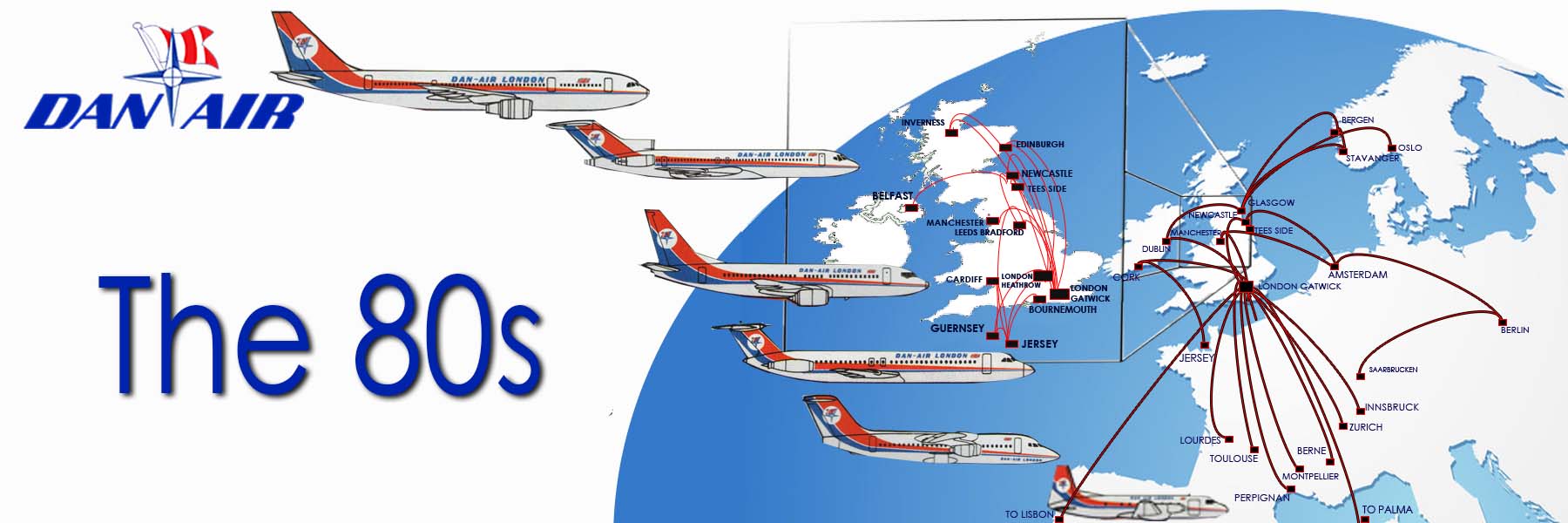
1980
The decision to scrap all remaining services flown from Lydd into the Channel Islands was completed this year. the runways were not up to standards and the load factors were unsatisfactory. All of the Lydd operation would transfer to Gatwick. The Civil Aviation Authority (CAA) had to approve this, along with an application to offer Advance Purchase Excursion Fares (APEX) on the Aberdeen-Gatwick service, which had been a runaway success since its inception. The APEX fare would be just ten pence more than the second class rail fare between the two cities. It was also £10 cheaper than British Airways' flight between Heathrow and Aberdeen. Dan-Air were also pleased to be secure a two year deal with Shell UK for the charter of two HS-748 aircraft. Strengthening the position as the number one airline for oil related charter flights.
Air Anglia, British Island Airways Air Westward and Air Wales completed their merger and commenced operations at the end of January. The new carrier was called Air UK their combined fleet consisted of 36 aircraft. The airline styled itself as the 'third force' in British aviation. Air UK had no ambition to join the charter market, but expressed a desire to increase their share of domestic air services in the UK.
In January a new service was announced, that of Newcaslte-Dublin which British Airways had recently dropped. There would be no change in the fare at £68 one-way. The Aberdeen-Gatwick service saw a link with British Caledonian who would interline flights at Gatwick with onwards flights to Freetown and Houston.
The Isle of Man was now served from nine UK airports by Dan-Air. The nine airports - Aberdeen - Birmingham - Bournemouth - Bristol -Cardiff - East Midlands - London - Newcastle - Tees-Side were all deemed profitable. Five airports had seen cancelled services due to poor loads.
A new livery had begun to appear on aircraft from 1979. As each aircraft underwent regular maintenance the new colours were applied. Several aircraft, including BAC 1-11, HS-748 and Viscount had the livery applied. Some of the last Comets that were scheduled to leave the fleet no later than the end of 1980 were seen wearing it. There remained just four Comets at the start of the year, the aircraft were seen less and less and were mainly used as replacement aircraft when a regular airliner had technical issues.
One such Comet was bought by RAF and went on to become the first RAF Nimrod.
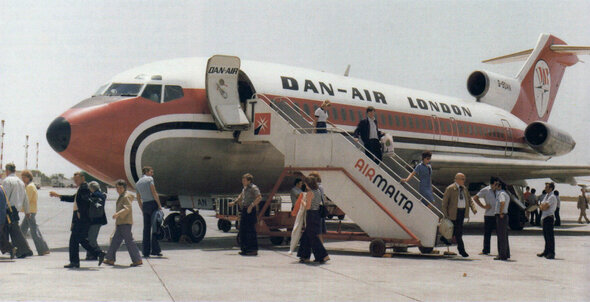
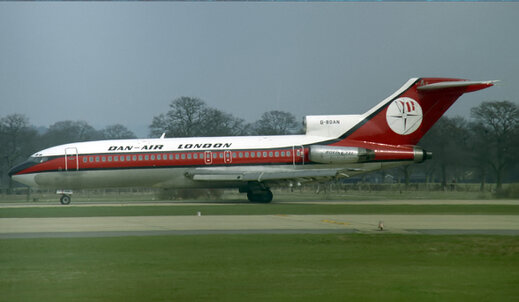
G-BDAN in 1978 (left) and with its new livery in 1980
In 1980 it was finally decided that the Boeing 737 would join the fleet. It is not without some irony that its introduction came less than a year after Fred Newman had flatly refused to purchase the aircraft which had seen three senior boardroom members leaving the company in protest. With Martin O'Regan and Errol Cossey now running Air Europe which had got off to a flying start using the 737 and Alan Snudden now Managing Director at Monarch who also ordered the aircraft, it became imperative that Dan-Air operate the type. Negotiations with Air Quebec in Canada, and Norway's Maersk Air were underway in early 1980 with a view to acquiring second-hand 737s . The Maersk Air jet was more suitable to the airline's requirements and a deal was arranged to finance the purchase. The 'new' aircraft was due to enter service in the Summer, but arrived several months early, Dan-Air found extra revenue leasing it short-term to Nigeria Airways. Once the aircraft joined the Dan-Air fleet full-time, it would be chartered for the whole season by Thomas Cook. A second example was also quickly sourced.
The inquiry into the Sumburgh accident in 1979 was to be held at Aberdeen in April this year. the announcement in February said that more that a hundred people would be making statements at the inquiry, this resulted in the location being moved from Shetland to the mainland city in order to be able to accommodate those attending.
The Civil Aviation Authority relaxed the rules on fares this year. From now on, there would also be less restrictions on overseas flights, allowing greater liberalisation of flights between any two countries. Something Dan-Air were keen to take advantage of. Lower fares were introduced on many flights, which finally broke the strangle-hold that legacy carriers had enjoyed with air-fares in Europe. - Dan-Air introduced Super Saver Fares - Excursion Fares - Latesaver and Last Minute Fares.
Dan-Air were able to offer 20% reductions on off season fares. The CAA then imposed an increase in fares of 28% for all UK carriers, which was a terrible blow for them all. To counter balance this Dan-Air offered half price tickets for husbands and wives of business travellers, the new fares were known as 'Souse Fares' - The increase in fares led to a barrage of criticism from Travel Agents aimed at Dan-Air for not giving 'add on' discounts. The airline said it would look at fare structures with a view to including them.
The standard fare from Bristol and Cardiff was £114 return. The travel agents said the public wouldn't or couldn't pay this. The agents suggested a fare of £78. Dan-Air had negotiated with the CAA and were approved to offer 'Latesaver' fares (June 1980). The Latesaver could only be purchased after 1pm on the day before travel. the fare from Belfast to Newcastle would be £22 single. To Cardiff or Bristol £27.
Prices from the UK to Ireland were notoriously expensive. Mile for mile it was the most expensive sea crossing in the World. It was Dan-Air's hope that they could break the stranglehold enjoyed by British Airways and Aer Lingus. Links between the two countries had always been an exceptionally strong, consequently the air routes and sea routes were also extremely busy. The two nations are important trading partners. With a Conservative government it was felt there would be less restriction on competition and protectionism of the state owned airline. As things stood, by far the cheapest way to cross the Irish sea was by ferry - Dan-Air was about to change that. The Aberdeen-Gatwick service was extended to include a Plymouth link which quickly became a success. Aberdeen Interline connections provided from Gatwick by British Caledonian were improved with flights connecting Atlanta ans well as Houston and several South American cities. There would be links with Pan Am and Delta for flights to New York and Atlanta. A partnership with Braniff was enabled for passengers wishing to travel to Texas.
The two new rival charter airlines on the scene had created quite an impact. Air Europe were flying charter flights primarily for Intasun, who this year released their biggest ever Summer programme. Intasun was still Dan-Air's largest client, chartering six aircraft. Air Europe were not only carrying Intasun passengers, 30% of their flights were operated for other Tour Operators. In one example, Exchange Travel's twice weekly flights to Gibraltar would use Air Europe, this was a contract that Dan-Air had undertaken for several years prior.
Within the boardroom the Air Europe/Orion matter was discussed at length. Press reports claimed that Fred Newman had been told that new operators were effectively taking their food from their mouths. It was alleged that he 'faced a barrage of criticism from directors for not acting more swiftly. As a result, a new strategy was adopted to meet the challenges of the 80s and rivals head on. The slightly modified livery which had begun to appear on aircraft sine 1979 was shelved. The new Boeing 727s due to arrive in spring, would have a completely new livery and interiors that would be applied fleet-wide over the next year. Interiors would feature new 'wide-body' seats as well as New carpeting, lighting, cabin walls, ceilings, galleys and toilets. This was a costly project, set to cost millions. The striking new livery comprised of red, white and blue was first applied to the 727 200. Over the next few weeks the artwork began to appear on tickets, letters and airport signs. The corporate makeover would give the company a more contemporary look.
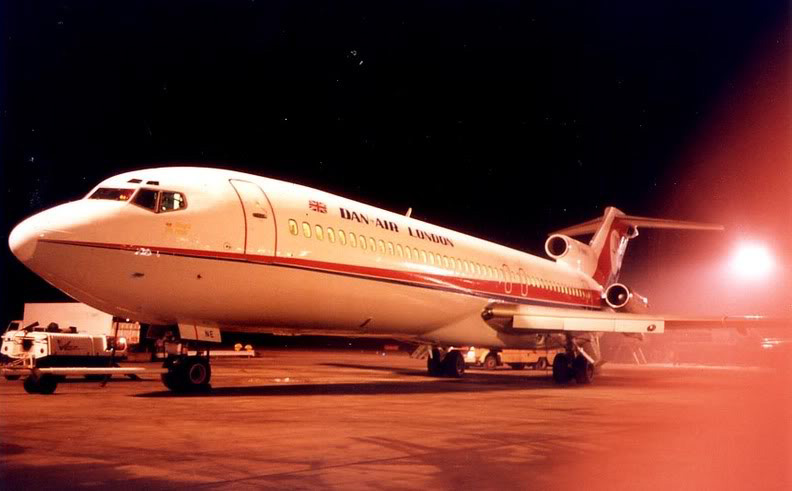
Three Boeing 727 200 joined the fleet in March, the first two were acquired from Sterling Airways and third from Singapore Airlines. The 200 series was a much improved model with increased seating for up to 189 passengers. It was announced that the type could fly further than any other type in the fleet. These would eventually replace the last three Comets which still remained in the fleet.
The Belfast timetable was released in March which would see fifteen flights a week operating from the city commencing in April. there would be five flights each to and from Cardiff, Bristol and Newcastle. Hawker Siddeley 748s would carry out the flights.The Newcastle-Dublin service was also launched in April with fares as low as £69 return.
Captain Tony Leach who was flying 35 passengers from Leeds/Bradford to Glasgow on board a HS 748 was shocked when two RAF Jaguar aircraft, flying at 500 mph buzzed past him over Keighley in Yorkshire on March 5th. Captain Leach said they came within 300 feet of him: 'One flashed past from behind, one beneath and one at the same level. I was climbing at 180 miles per hour. the passengers didn't realise anything had happened, it all happened in the blink of an eye.' Captain Lech reported the near-miss to the Civil Aviation Authority (CAA). The RAF said that they could not find the aircraft on their records, as all their Jaguars were 'tucked up' on the ground. A spokesman said they could have been test Jaguars, American aircraft, NATO aircraft, or 'God Forbid' foreign aircraft.
Gatwick to Strasbourg flights plus car-hire in conjunction with Europcar were being offered this summer for £135:50. The offer was extended to include Cork from Bristol/Cardiff for £117:50. The flights would be using BAC 1-11 aircraft. There was an economy return fare without car-hire for £80.
The British Airways services from Bristol to Paris, Belfast and the Channel Islands would stop on March 30th when the baton would pass on to Dan-Air. There would be nineteen redundancies at the Western airport, only two of the former BA staff went on to join Dan-Air. The new services had received plenty of press exposure. Vivian Donnelly took part in a traditional swords dance at Newcastle City Hall to march the change over on the Newcastle-Bristol service.
The inquiry into the Sumburgh accident of 1979 opened in early April. Several people took the stand to tell their story. The investigation had found that the 'gust lock' had been fitted with non standard parts. In the most basic of terms, the gust lock is a control which, when engaged, stops the elevator flaps on the wings moving, in particular in windy conditions. The very kind of conditions found at Sumburgh. When the device was only half engaged, the elevator flaps would work. The non standard parts prevented this from happening. The flight crew believed the gust lock had been disabled and their instruments told them that it was. This prevented the aircraft becomming airborne. The aircraft that was lost had been purchased from an Argentinian airline, and one other 748 had been fitted with a non-standard part. Since the accident Dan-Air had replaced the gust lock system on all of their HS 748 fleet. When questioned about this Dan-Air engineers explained that whenever they found non-standard parts on aircraft that were undergoing routine maintenance, those parts would be replaced with the most up to date approved parts. When asked if it was a regular practice to use non-standard parts, engineers said that 'they would never ever do that'.
Survivors of the crash recalled that rescue attempts had been hampered with a helicopter flying above, trying to winch people to safety. The down-wind from the rotor blades caused waved and soaked passengers in aviation fuel and sea water. The stewardess had indicated from the scene that the helicopter should leave the area. Rescuers had difficulty hauling survivors from rocks as they were slippy and the helicopter had sprayed them with fuel.
The impact had caused storage at the rear of the aircraft to shift, blocking the aisle. The stewardess had seen only half of the passengers wearing life jackets.
More than a hundred witnesses and experts spoke at the hearing. Counsel representing the families of the victims blamed pilot error for the crash. Advocate Donald Booker-Millburn asked the Sheriff Alistair MacDonald to find the person handling the plane responsible, saying: 'Indications are very strong, in my suspicions, that there was a failure by the person handling the aircraft to adopt normal procedure for abandoning the take-off' He said it was not for him to speculate who was handling the aircraft at the time. Other legal representatives, including Advocate Depute Mr. Andrew Hardie for the Crown, asked for a formal verdict of drowning. He said it would be inappropriate to name a cause for the accident as there was currently an investigation by the Department of Trade that was currently running. But Counsel for the deceased said that there was nothing likely to come from any further investigation to prove that the handler didn't do what he ought to have in the circumstances. In his submission the accident occurred due to pilot error.
In asking for a formal verdict, the Advocate Depute said no criticism should be levelled at the rescue services or emergency agencies who attended the crash emergency: 'The is absolutely nothing to justify criticism of anyone who went assist in the unfortunate accident.'
Lord McClusky, representing Dan-Air, went on to praise the heroism of stewardess Liz Cowe. He went on to say that Booker-Millburn had based his assessment on hearsay evidence, and that it would be wholly unacceptable to blame pilot error on that evidence.
Mr. Noel McPartlin counsel for Captain Watson's widow said it would not be appropriate to lay the blame at the door of a dead man. It would not be appropriate, he said, for the Sheriff to make a finding of pilot error. He added that although there had been the suggestion of pilot error, this had been contradicted by the evidence of two practising airline pilots. The circumstances of the accident were such, that a pilot could not have expected them. That was to say, Mr. McPartlin went on, that despite a full check of the aircraft before take-off, the elevator had locked. Earlier the enquiry had heard that Dan-Air's prescribed policy for short runways was that pilots should take a problem aircraft into the air, rather than abandon a take-off in certain circumstances. For abandoning take-off is considered the most critical exercise on the runway. Dan-Air's chief pilot on the HS 748 claimed that day.
Captain John Ryder who joined Dan-Air in 1977 was called to the witness box by counsel for the company. Captain Ryder was a former test and training pilot on the HS 748. In evidence he said: 'The most critical exercise on the runway is abandoning take-off. For that reason we have a policy when operating on short runways to select a low V1 to give us maximum possible time in which to stop if a take-off is abandoned.' He added: If a pilot could go on even with a malfunction or engine failure, he would rather take the plane into the air where there are procedures to cope with such things, rather than continue accelerating to high speed and face having to stop in a shorter area.' He argued when questioned by Lord McClusky QC, that assuming there was no malfunction, once V1 had been reached the pilot of the aircraft had decided to take-off and subsequent problems would have been taken to the air. He said he knew of no subsequent drill to abandoning take-off.
Engineers could find no trace of braking on the runways. Senior Department of Trade Accident and Investigation Branch, Peter Coombs told the inquiry that he traced the aircraft's tyre marks from the over-run area of the runway over 190 metres down the runway. But he said the marks were similar to the marks left by aircraft doing up and down the runway without using brakes. He said he could not account for survivors evidence which said they had felt brakes being applied before the aircraft hit the sea. Mr. Coombs told the inquiry that his investigation had shown that there was positive evidence that an engine control slowing the aircraft had not been operated. Although this control had not been used there was further evidence that the engines had been throttled back two seconds or more before impact. The only anomaly that he could find was that the gust-lock lever, controlling wing flaps and the rudder had non-standard parts fitted, and that the cause of the accident would have been known if Dan-Air had carried a cockpit voice recorder. But only the flight recorder was carried in the tail. Expert Mr. Peter Shepherd said he would support any move to have cockpit voice recorded installed on any passenger aircraft. Mr. Shepherd said that the recorded had produced a computer tape which had been analysed and had produced in graphs. The initial recording detailed that the aircraft had accelerated at normal speed and had no appreciable roll. A second analysis was being carried out, but Mr. Shepherd said he did not expect to find any significant difference. But he agreed with Lord McClusky representing Dan-Air that taking into account the short runway involved, that there may be a difference, which could turn out to be significant.
The pilot of the aircraft, Christopher Watson, was a 'professional aviator' and was 'technically sound with the aircraft' the inquiry was told. Giving evidence was Captain William Hanton, who said he had flown between 200 and 300 hours with Captain Watson. When asked by Noel McPartlin about the dead man's reaction time, Captain Hanton said; 'It would take him probably four or five seconds to make various control checks once something had gone wrong.' Sheriff Alistair MacDonald would give his finding at a later date.
Solicitors acting for the families of the victims intimated that they were considering making a claim for damage against the airline, and were investigating the possibility of raising court action in America where settlements are huge. The firm said; 'It is not obvious to me, what basis the American courts have jurisdiction, but it has been suggested that they do. On that basis, the various solicitors acting on behalf of the relatives of the dead will be looking into that.'
Just one day later, on April 25th when a company Boeing 727 100 was reported missing. Spanish aviation authorities said that the weather and winds were good when they last had radio contact with the aircraft at 1319 GMT. At first, Spanish Air Traffic Controllers believed the aircraft had gone down into the sea, just north of Tenerife. It was not until 2000 GMT, some seven hours after the last message had been retrieved, that Spanish authorities reported that wreckage had been located and that there didn't appear to be any survivors. The crash site, on the side of a mountain was in a wooded area some sixteen miles south of Los Rodeos airport. First reports at the scene said that the area was completely covered in cloud. Initial findings said that some of the bodies were completely burned whilst the remains of others were hanging form the pine trees. Rescuers said that the main parts of the aircraft had still not been located and it was speculated (wrongly) that some parts of the airliner may have been in the sea. A ten year old girl reported that she had seen the aircraft hit the sea and there were unconfirmed reports of suitcases floating in the sea. A statement from the Secretariat of State for Civil Aviation said that six aircraft had used the airport normally at the time of the incident.
Dan-Air's Publicity Director, George Yeomans said; 'Last night we heard a report that there were several survivors, but we are discounting this at this stage. when an aircraft hits a mountain we would not like to speculate on any survivors. We still understand there were no survivors. The Boeing 727 has a crew' of three and five stewardesses.The aircraft was carrying 138 passengers.
A VIP lounge was set up at Manchester Airport and the Queen sent a message of sympathy to Dan-Air's Chairman saying: 'I have been greatly distressed to hear of the accident. My Husband joins me in sending my most sincere sympathy. We deeply regret the tragic loss of lives and would be grateful of you could convey our sympathy to the relatives of those who have died.'
The aircraft, call sign G-BDAN had crashed with the loss of all of those on board. It remains the worst accident on the UK register in terms of lives lost. Full details.
The Captain of the doomed aircraft John 'Red' Whelan was at the centre of a Mayday mystery the next day as experts probed the disaster. Government and Dan-Air officials say he made a desperate plea for help minutes before the crash. But air traffic controllers say they only received messages asking for landing instructions.
A Dan-Air spokesman said: 'Red had 14,000 flying experience and was a very experienced pilot.' The Island's civil Governor Senor Jesus Javier Rebollo said he believed the crash could be cause by pilot error. But Dan-Air said Mr. Whelan had flown to Tenerife 'scores of times.'
Rescue teams including 300 soldiers and ten helicopters were involved in searching for bodies and the aircraft's 'black box' which was hoped would give vital clues of events leading up to the accident. Air traffic controllers said they couldn't understand why the aircraft was in the location it was, and had crashed as visibility was good. George Yeoman said he believed the Mayday message had been sent ten minutes before the crash. But was unable to verify this as communication with the island was difficult. A team of experts from the British Board of Trade and Dan-Air flew overnight to Tenerife to help the Spanish Authorities establish the cause of the tragedy.
Passengers who had been waiting in Tenerife to board the doomed airliner on its return flight home landed at Liverpool airport several hours late after a replacement aircraft was sent to pick them up. Passengers were visibly shaken and some refused to comment. The British Airline Pilots Association said they hoped that the airport at Los Rodeos would now be closed. Several airlines had moved to Tenerife South Airport, including Britannia, Iberia and British Airways. But Monarch and Dan-Air used both. Michael Croft, a Travel Agent said:
'There were issues. The newer, more equipped Tenerife South was a lot further away from the island's main resorts and that meant a much longer coach ride for holiday-makers. Which would cost more in fuel etc. Then many of the staff at the northern airport didn't want to move as it meant more travel time for getting to and from work, or a re-location. The landing fees were also higher, and that was passed on to holiday-makers. But Los Rodeos had its own problems. It was more than 2000 feet above sea level and was prone to fog coming in from nowhere. Being so exposed gave it strange winds from the Atlantic, and it was a lot closer to the mountains, the largest being Mount Teide. Only three years before this crash there had been a two aircraft crash on the runway, which remains the worst crash in history in terms of loss of life. Some of the Spanish airports were very poorly equipped with modern radar and beacons. If you look through the records there have been a lot - a lot - of accidents in Spain. I was told by an airline employee in the 1980s that in a lot of European airports, airlines only flew to them because other airlines did. This was truly awful.'
The majority of passengers came from Greater Manchester, but reports came in detailing people from Liverpool, Yorkshire, the Midlands and Leicestershire, Lincolnshire and Wales. The aircraft was carrying passengers on behalf of four Tour Operators, Swedish firm Tjaeborg, Paloma Travel of London, Thomas Cook Manchester and Martin Rookes.
Dan-Air's George Yeomans said they would release a passenger list on the Saturday and not before all next-of-kin had been contacted through the police. There had been three babies among the passengers. Yeomans said that there had been absolutely no problems at any stage of the flight, with the crew maintaining contact with Dan-Air Operations during the journey. When asked about speculation that the jet had run out of fuel he replied 'That is quite wrong- he had about 2 1/2 hours of extra fuel on board.' He answered further questions, commenting that the airliner was about 10 or 12 years old, had been bought from a Japanese domestic airline and it had about performed about 25,000 flying hours. Yeomans addressed concerns that there had been problems with the approach after the pilots association said Tenerife was hazardous, saying: 'Tenerife North was no more hazardous than any other airport.' On Saturday 27th April the 'Black Box' flight recorder was recovered and specialists from Boeing arrived on the island.
Aviation experts said that they were looking into reports that the aircraft had been caught in the down draught of a thunderstorm - a massive movement of air. Tenerife Airport repeated their claim that the pilot had messaged with 'a perfectly normal request for permission to land.' An early theory began to spread that the aircraft had stalled.
George Yeomans appeared at a second press conference on April 27th and detailed that Captain Whelan was a single man who was one of Dan-Air's best pilots. Captain Whelan had been with the comapny since 1971 and had piloted Comets before joining the 727 fleet .He also announced that the aircraft had been given a Civil Aviation Authority annual airworthiness certificate on February 12th. Bob Aulton, Dan-Air's deputy base engineer said that the Boeing 727 was 'extremely reliable' and with only 25,000 flying hours, the jet had only flown half its expected lifetime hours.
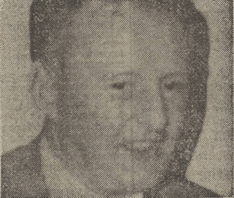
Above: Captain Arthur 'Red' Whelan (51) Halesowen West Midlands.
Captain Whelan's Sister, Mrs. Pat Mullins said: 'My Brother had flown jets onto aircraft carriers when he was in the RAF - he could land anywhere. But he dreaded going to Tenerife North. He said before he flew there that he hated it. He didn't seem at all happy with the airport, but I don't know exactly what it was that he didn't like. He only said a few days before the crash that it would take another crash on the island for them to change to the southern airport.'
His Brother, Dave Whelan said: 'I know in my heart and mind that he and the other 145 people on board that plane would still be alive if they had flown into the southern airport.' He said he could not accept that the crash was the result of pilot error:
'The black box flight recorder had not even been found when the accusations started. The airport has a bad safety record and pilots, including my Brother, feared it. I have seen the new airport at Medano, which is at sea level and much easier to land at. But the northern airport is closer to hotels, it's 60 kilometres to the other airport. I just hope that the pilot's union BALPA will really put pressure on the Spanish to change airports. it may be a longer journey, but it will be safer. My Brother was very calm and collected and had over thirty years flying experience - he had completed many trips to Tenerife an island he liked and had holidayed there. If there had been a mechanical fault on the aircraft it would have been far easier to have landed at the new airport. If it was too cloudy, he would have had the presence of mind to have found an alternative airport. It was possible that the Spanish controllers had difficulty understanding English - hence the confusion over whether a Mayday warning had been sent, and Tenerife is not up to the standard of British equipment. The fact that they started the search for the aircraft in the sea and did not know where the aircraft was amazes me. The same thing happened when Dan-air lost an aircraft in Spain a decade ago. They didn't know where that was either. My Brother was fit and had passed a rigorous medical check only weeks ago.'
Whelan's friend Reg Poploe 'So precise, 'Red' would never have made a mistake, I will not accept that he was capable of any human error.'
The 'Black Box' flight recorder was supposed to be flown to Britain on Monday 28th April. Press reports began to circulate that the Spanish and British Authorities were not in full agreement. In England, Dan-Air said: 'The plane was being handled by Spanish Air Traffic Controllers minutes before it ploughed into the mountain. The plane was travelling with its flaps up, undercarriage up and all engines normal, which would indicate it was NOT on an approach. It was either being stacked or diverted to the island's other airport.'
In Tenerife, Dan-Air's Chief Pilot Bob Atkins said: 'That's totally untrue, we know it was not being diverted.'
Spanish chief investigator Don Miguel Garcia said 'I can't understand why the crash happened, the plane was far away from its usual flight path. If the plane had been only 150 higher it would have cleared the mountain.'
The cockpit voice recorder was recovered on 28th April and would be investigated closely. It contained details of the last eleven crucial moments of the flight. The last of the bodies had been recovered and the grim task of identifying them would now begin. It was claimed that evening that the aircraft was travelling at between 300 and 500 miles an hour and was heading int he direction of Tenerife South Airport. With the inference being that the Spanish had diverted the aircraft.
Dan-Air said on the 29th April that the 'Black Box' was being held by a Spanish Judge in Tenerife who was also holding tape recorded messages between the pane and the control tower, that should be handed back 'on the spot' that evening. Following comments that the airport was unsafe, George Yeomans said: 'We do not feel in any way that the airport is unsafe. We are only operating night flights into the new one at the request of the Spanish authorities.'
One of the stewardesses, Kerry Worthington, should have been enjoying a day off and agreed to swap her shift with another girl. She was the cousin of Theatre Producer Bill Kenwright who said 'That was Kerry, she was always very helpful - she loved every minute of her job, she was so full of life and vitality.'
The Secretary of State for Transport, John Nott promised a 'searching inquiry' into the accident and said that Spanish authorities had released the necessary recordings. While the House of Commons debated the matter a simple service was held in Tenerife for those killed. In the Commons David Mellor, the MP for Putney made claims about Dan-Air having the worst safety record in the UK or any comparable European airline. The Minister concerned Jon Nott, rebuked him stating that Dan-Air was fully regulated by the CAA, who issued their Air Operator's Certificate. That was the standard procedure and he saw no reason to change it. He told MPs that the aircraft was not about to land, but recognised that there needed to be an international improvement of standards of landing equipment and directional aids. The Spanish admitted that there were no precision radar facilities at Los Rodeos, though they claimed that didn't matter as there was only a handful of bad weather days a year. Dan-Air's spokesman said that there had been a delay in returning the bodies back to the UK as Spanish law prohibited bodies leaving Spain until they had been positively identified. This had been hampered because the impact of the crash had caused bodies to be scattered over a large distance. The black box had been recovered and was believed to be in Madrid. The voice recorder would reveal whether the crew had sent a 'Mayday' message and also whether the aircraft had taken any steps to avoid the crash. Conversations between the flight deck and the air traffic controllers had all been recorded. The last communication from the air traffic control was at 2:19 pm local time and that the airliner made contact with the tower at 2:21 pm which contradicted earlier Spanish announcements.
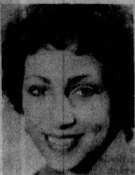
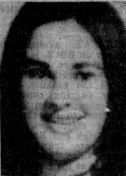
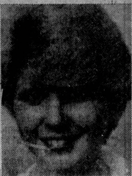
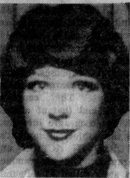
Left-Right Kerry Worthington (24) (Heswell) - Pat Sergeant (28) (Wakefield) - Margaret Royal (30) (Manchester) - Melanie French (21) (Manchester) - Jane Dalton (21) (Alsager)
The news that Davies and Newman's profits had jumped by £1.3 million did nothing to affect the news headlines or improve the mood of the company. Turnover had increased from £117,505,000 to £129,487,000. There was also an insurance surplus on the 727 that had been lost in Tenerife. Some of the heavy taxes that had been in place in the last few years had began to be reduced or abolished entirely. This was to be important to the airline's growth. It is worth noting that only two UK airlines had made a profit this year. Before tax the profit rose from £2,010,000 to £3,375,000 shareholders would see their dividends rise from 8.15 to 10 pence, and were to be given one new share for every six they held. Dan-Air claimed to be the biggest in the business, larger than Laker and British Caledonian combined. They said that the profits benefited from increased efficiency and a booming demand for charter seats for package holidays. A Dan-Air man said: 'Britain may be good at talking itself into depression, but the British family still expects its holiday abroad.' The airline had also increased its share of the oil related charters from Aberdeen. Air Europe also announced profits of £2,000,000 - It is remarkable that an airline with more than fifty aircraft posted a pre-tax profit of £3.6 million and that an airline with three aircraft had posted six month pre-tax profits of £2 million.
Following the loss of several aircraft and lives, the CAA decide to examine the company in depth. Over a two month period, representatives from nine airlines probed every aspect of the airline's operation. Dan-Air was noted as being exceptional in how they managed to operate such a diverse business. Few airlines could handle, not only the different types of aircraft, but the variants within each type. For example. The BAC 1-11 had 200, 300, 400 and 500 series. Within the 400 series Dan-Air had the 470 version. HS 748s had three variations and so on. When the Boeing 737 joined the fleet, there had been recommendations that the cabin interiors should be consolidated, so that they would all have exactly the same layout. This was rejected as Dan-Air's cabin crew were not only trained on one type, but variations within it! Dan-Air operated both charter and scheduled fleets. Each aircraft type operated within its own costed operation, as did each base. Engineering was carried out in three bases with a world class reputation. The CAA probe found nothing out of the ordinary and the airline was able to continue as it already was.
The mass funeral for 120 of the victims of the Tenerife crash was held on 12th May at Manchester's Southern Cemetery. The funeral was paid for by Dan-Air and it was understood that the other twenty six victims had decided to make their own arrangements. The memorial service was held at Manchester Cathedral the day before and was attended by 800 friends and relatives. Also attending were senior management from Dan-Air. Stewardesses sobbed in memory for their colleagues. The address was made by the Right Rev. Stanley Booth Clibborn.
It was revealed on May 20th that the ill fated Boeing 727 Captain was using a different set of flight charts than those of Spanish controllers. Captain Whelan,like all Dan-Air pilots had been issued with a chart printed from the Aerad flight guide. This did not give a set holding pattern for aircraft who's west to east landing is delayed at Los Rodeos Airport, a runway which is 2,549 feet above sea level. Spanish Ministry of Civil Aviation issues its air controllers with the Jepperson Airways Manual, a rival guide, which did have a standard holding pattern for the rare west to east landing - used by the Boeing because of wind conditions. Captain Whelan was not able to land immediately because the runway was being used by an Iberia F27 prop-liner on an inter-island flight. Investigators now believed Whelan was put on makeshift holding pattern when he was told by control to 'drop to 5,000 feet, turn 302 degrees and come in to land.' With a Jepperson manual, it would have been clear that he should have then turned to the right and circled over the sea. But it now seemed certain that he turned to the left on a circuit into the cloud covered mountains. This was borne out by the message 'We have had a ground proximity warning.'
This was challenged the next day when Dan-Air and British Airways issued a joint statement, that the two charts are identical in every relevant detail. The spokesman for the two airlines said 'There are minor differences in the two manuals, but nothing that would affect air safety. There were set holding patterns on the charts for when aircraft are unable to land immediately. But air traffic controllers are free to use every bit of the sky that is available. The Aerad charts issued to Dan-Air pilots are more detailed than some other charts that are available, but all relevant information is the same.'
The Spanish investigation was underway in May, but it was indicated that a final report would be months away from being completed.
A few days later on May 22nd, Trade Under Secretary Norman Tebbitt told the Commons that the investigation into the accident now centred on the conversations that were held between air traffic control and the pilot. He said that the Spanish Authorities and UK officials agreed on the manner in which the flight was conducted by the aircraft crew, but he added:
'There is not yet full agreement about certain aspects of the air traffic control system. There is no dispute about the sequence of events between the time the plane passed over the beacon at the north end of the island and the time of the crash. In assessing the cause of the accident, it is assessing the relationship between the air traffic control system and the actions of the pilot and crew, which are being considered by the Spanish Authorities who are responsible for the inquiry and officials at my Department who are assisting them. The cockpit voice recorder and the flight data recorder are yielding useful information.'
Aberdeen's base appointed a new base manager. Manchester born Andy Handford had been with Dan-Air for seven years and had held a similar post at Berlin and would take over from Geoff Fischer who went onto Dan-Air's public relations department at the London head office.
Susan Green who had only recently fulfilled her lifelong ambition to be an air hostess was killed on the eve of her 26th birthday. Her car burst into flames when she collided with a lorry on the A33 in Hampshire. Susan of Bournemouth was based at Gatwick and was on her way home when the accident occurred. Colleagues described her as a pretty, good looking girl who always seemed happy.
The were fears about diplomatic relations between the UK and Spain when m ember of Parliament began asking questions about the Tenerife accident in June. MP Robert Adley demanded to know if the Deputy Foreign Secretary and Lord Privy Seal had had discussions with the Spanish Foreign Secretary or his Ministry over the crash. Other members called for official statements to be released about the cause of the tragedy. Alf Morris MP who represented Wythenshawe in Greater Manchester said that the efficiency of Los Rodeos Airport was of 'great concern' He went on to say that an increasing number of his constituents were flying into the airport and a the release of a statement from the Trade Secretary was 'clear an compelling' Another MP said 'i have reason to believe that discussions have taken place between the British and Spanish Authorities over and above the normal exchanges that you would expect in these cases. There is a very strong effort by the Spanish Government at diplomatic level to keep the wraps on this report during this holiday season and to put the blame on the pilot for the disaster. All I am concerned about is that no diplomatic agreement between the two governments is made to keep the whole thing quiet. If Los Rodeos Airport is inadequate,we must know about it and they must put it right. The Spanish are very sensitive about their air traffic control, and with good reason, in view of this disaster and the world's worse crash of two jumbos on the runway there - as well as several others. '
The airline fares revolution that started in the United States a few years ago, began hotting up into the fertile, but highly-charged battle ground Europe. Several independent airlines launched a two parallel drives into what they considered a fixed-price stranglehold the European legacy carriers had. In once action 16 airlines announced that they had formed the L'association Des Compagnies Aeriennes De La Communaute Europeenne (Common Marker Airlines Association) The group's declared mission was to lobby against the big airlines of Europe, and their association - The International Air Transport Association (IATA) In the hope of carving out a larger place for its own airlines, and to bring a larger degree of competitive pricing. It was headed by Britannia Airways, Dan-Air and Air UK, all based in London. Sterling Airways of Denmark and Hapag Lloyd and LTU of Germany were also members. One conspicuous absence was Laker Airways which was often credited as heralding the era of cheaper airline fares, at least across the busy North Atlantic. Freddie Laker said he wanted 'no part' in the organisation an instead lent his name and support to a new 'Freedom of the Skies of Europe' campaign which was evoking article 85 of the Treaty of Rome who's competition clauses formed the basis for the evolution of tariff free trade within Europe. The article prohibited two or more parties combining or fixing prices for products or services, from sharing markets charging discriminatory prices. This would go the heart of the problem that caused Europe to have the highest air-fares in the world. This was the complex set of agreements that had evolved since the end of the Second World War, which linked together the various counties of Europe. With their own evolution a pattern of operations emerged that limited pairing of cities with schedued air services almost exclusively to the National Flag Carrier of each one of the pairing. The independents, who came into existence largely as a result of charter flights, were now finding that many doors were closed to them as they sought to expand into scheduled air services. Nowhere were the examples more strikingly obvious than in the recent decisions that largely retarded the aspirations of UK independent airlines. Following an unexpectedly severe announcement in March, the Civil Aviation Authority (CAA), considered to be the most reform-minded of all the European Government aviation agencies, rejected ALL 666 route applications proposed by Laker Airways. That's right - each and every of the 666 applications! It rejected all of Britannia Airways applications and only a very small number of those applied for by Dan-Air and Air UK. The CAA approved just SIX of the twenty applications submitted by British Caledonian. The CAA gave a variety of reasons for rejecting all but a few of these proposals, the understanding for many was that they would be unlikely to receive reciprocal approval from the from the other countries involved in the route applications. The Authority finally conceded that public opinion might soon change political circumstances and this climate of optimism that Dan-Air wanted to change. The Travel Trade Gazette would be publishing an EEC complaint form that they invited members to sign in the hope that the matter may be raised at the highest level.
Trade Secretary John Nott told the House of Commons in a statement in June that the pilot of G-BDAN John 'Red' Whelan 'Took a wrong turn and turned to the left and headed to the south east when he should have gone north west. And although ground proximity warming systems came into operation the pilot ordered over-shoot proceedings, a steep turn to the right failed to avoid a collision with the mountainside.'
Mr. Nott who was making an interim statement refused to blame the pilot of the aircraft for the crash. He also refused to calls from MPs for tougher regulation on airlines using the island's northern airport, saying there was no-way that the Government could regulate holiday flights 'this year'. Following calls from Tory and Labour members, Nott agreed to refer their concerns to the CAA and to look into the mandatory carriage of radio facility charts on all civil aircraft.
Captain Whelan's Brother ,David slammed the statement saying:
'I would like to hear the full conversation between the people in the control tower and the plane to see which flight path he was put on. Planes just don't turn left or right. they change course on compass bearings. In my own mind I know my Brother isn't to blame.'
A Trade Department spokesman said: 'We are eager to set the record straight about the crash, and content of the Minister's statement has been agreed with the Spanish accident commission. There is general acceptance that the pilot was going the wrong way, the question is, why? We don't expect the result soon. It is painstaking work placing the little pieces of data together.'
Fares on the Aberdeen-Gatwick service were reduced with £28 'late-saver' one-way being offered. The only condition was that the traveller would have to book the flight no earlier than 1300 the day before travel. The flights had been so successful that the twice daily in each direction would be boosted to three times daily from November 1st. Since taking the Aberdeen-Gatwick service from BA last year, Dan-Air had doubled the amount of passengers carried on the service. In April alone more than 5,000 people travelled on the route, which operated eleven flights a week. So popular was that service, it was noted that several passengers deserted BA's Aberdeen-Heathrow route in favour of the Gatwick service. In an attempt to stop the drainage of their passengers, British Airways said they would match Dan-Air's prices. The CAA thwarted Dan-Air's proposal for 'spouse fares' saying they were not looking for a proliferation of these kinds of reductions. Dan-Air said that the relatively stable price of fuel at the time could see further reductions on many of their fares. The 'Latesaver' fare would be introduced on all Channel Islands routes with prices to Jersey from Gatwick from as little as £24 one way.
The Scheduled services that were carried out to major UK cities would be flown using BAC 1-11 200 and 300 series aircraft. Each one had reduced their seating capacity to 79, a loss of ten seats. This gave the carrier the chance to boast of unprecedented leg room on their jet flights. British Airways' decision to drop their Newcastle to Belfast, Bristol and Cardiff proved successful with Dan-Air being awarded licenses on the routes. There would be five flights a week on each of the services. Discounts would be offered.
The repainting of aircraft into the new colour scheme was going well with the roll out expected to take two years. The cost of repainting was thousands of pounds for each plane. A spokesman said that all aircraft had to be repainted, even without a new livery and the cost was already within maintenance budgets. The priority was for aircraft that were most visible to be completed first. As of July this year only one of the HS 748 aircraft wore the new livery.
The local Tyneside Council paid Dan-Air £25,000 in July to subsidise some of its Norwegian flights from Newcastle-Bergen for a second year. The council wanted to keep exactly the same flights as the previous years. The costs in the UK for hotels and currency exchange problems had led to a fall in business. The Tyneside tourism chiefs were keen to attract more visitors. Dan-Air had asked for £40,000 to continue and said they would refuse any offer of less. In the end Dan-Air did accept the offer and agreed to keep the flights. Dan-Air said 'You don't have to be an accountant to work out that two full flights operating a week is more profitable than four half empty ones.' The Tyne Wear County Council offered to repeat their subsidy the following year. Conservative councillors said that the subsidy was 'A public scandal' One went as far as to say 'Our pensioners don't have enough money to heat their homes, and rate-payers' money is being given to a private company to subsidise people going on holiday to Norway - it is outrageous.'
In July the company stationed a Hawker Siddeley 748 permanently at Speke to carry out late night mail flights, having gained approval from Royal Mail to carry out postal flights. For the first time, a Royal Mail logo was applied to a company aircraft. The airport was seeking to provide cargo flights, Dan-Air was hopeful that the aircraft wouldn't be standing idle during the day, fortunately, Cathedral Tours of Liverpool found use for the 748 when they chartered it for one night breaks in Amsterdam.
Royal Mail asked Dan-Air to fly postal night flights from Aberdeen to London in August. The Aberdeen services had been a phenomenal success with Dan-Air saying the route would be their 'Blue Ribbon Route'. This would mean that the service would have the highest priority when the airline expanded any services. Whilst the Berlin base was a great success, talks were being prepared to enable a scheduled service to operate from Berlin to Amsterdam. This flight would link several UK cities to Berlin. Mail would also be carried out on the flights, should they be approved.
In August Dan-Air were faced with a dilemma. The Aberdeen-Gatwick service had been a runaway success with load factors of 80%. Altogether 98 flights had been carried out carrying 6,000 passengers in July, more than double the number British Airways had carried in the previous July. Since Dan-Air took on the route, 40,000 passengers had been flown compared to 24,000 the previous year when BA had the licence. Latesaver fares were cheaper than the standard rail fare. Dan-Air did not know whether to add extra flights on the service, or to operate the flights with larger aircraft. The decision to add an extra return flight every day was made, bringing the total to three daily round trips.
The Newcastle-Gatwick service had previously only operated weekdays, its success would see the service extended to a seven days a week operation in the the timetable, from November 1st
Applications were submitted to the CAA to slash 'Latesaver' fares. Reductions on Bristol to Paris or Amsterdam would be down to £40 from £68:50. regular one way fares would drop to £60. Similar prices would be offered to Cork.
Residents in Dyce near to Aberdeen Airport combined to demand less noise from visiting aircraft. Traffic at the airport had increased substantially and residents were not happy. British Airways admitted the BAC 1-11 was a particularly noisy type. Dan-Air said that they had ordered 'hush kits' when they were fitted it was claimed the noise levels would be more than acceptable.
The six month trade figures showed that Dan-Air had made a loss of £716,000 against last years £590,000. But this certainly did not mean that Dan-Air had experienced a bad year. Full year figures due in April next year were expected to less than last year though. Chairman, Fred Newman commented; 'Vigorous efforts are being made to deal with the situation and so counter the effects of the recession, which has effected all UK airlines. The vigorous efforts would include redundancies he said.
Relatives of many holiday-makers killed in the Tenerife accident were offered just £1,250 in compensation this July. The reason for the small amount it was claimed, was because many of the victims were elderly people without any dependants. It was pointed out that the claims could only be paid on life expectancy. In light of this, a group was formed by relatives of the victims, to fight for better compensation. Lawyer Charles Morris said that the families were likely to shun the amount offered at that the matter would be taken up in Parliament. The law was drawn up in 1929, and although re-drawn gave more money to people who had died on a bus or train and where the loss of life was a result of employees acting recklessly. The compensation limit was generally in the region of £30,000. The top limits were reserved for people who had dependants, in particular children. If a man earning £10,000 a year was killed by a bus crash, his family could expect £100,000, but only £9,600 if he was an airline passenger. Success in the challenge would depend on whether it was proved that the crash was caused by pilot error or a badly maintained aircraft. Another grave anomaly saw that payouts were dependent on where the crash happened.
An instruction from the CAA that pilots must not descend below a certain heights at certain places on approach to Los Rodeos airport in Tenerife were given in July, a move which could lead to pilots ignoring directions given to them by air traffic controllers. In an astonishing statement the CAA said: 'It is normal for pilots to accept the holding heights recommended by other national authorities. In the case of the Tenerife holding pattern, the CAA decided to check the calculations for these in relation to the local terrain. It is this exercise that has led us to having doubts about it.' the CAA's instructions would remain valid until an agreement could be thrashed out with the Spanish.
The eight day inquiry into the Sumburgh accident had failed to establish what had caused the crash.Even after the marathon inquiry, a question mark still hung over the accident. Sheriff Alistair MacDonald said he could find no reason for the disaster and final hopes were now being pinned on the official painstaking detective work being carried out by the Department of Trades Air Investigation Branch. The team of aircraft detectives spent the last year examining the wreckage and carrying out tests, mainly centred on the plane's 'gust-lock' control. The report was being finalised in August. Dan-Air had seen advance copies of the report and had already put in place two of Alistair MacDonald's recommendations; A change in the stowage position of life-jackets, and pre-flight instructions about their usage. The aircraft had now been fitted with cockpit voice recorders as well as the standard data recorder. It was also pointed out by MacDonald that even if the recommendations were already in place, they would not have prevented the accident. Dan-Air said that even although their previous stowage of life-jackets was as required by the CAA, their own standards had been improved.
Yvonne Sintes, Britain's only jet Captain, came down to earth a final time on August 18th. She brought down a BAC 1--1 jet smoothly down on runway 25 at Newcastle Airport on her last scheduled flight. The fifty year old Captain had flown more than a million miles and would hand over her licence in September. After earning her licence in 1952 she went on to become the first female Captain on a jet airliner, the Comet. Captain Sintes, who has more than 12,000 hours to her credit said;
'I am no women's libber, I have always been accepted by men pilots and the male passengers have generally been reasonable when they discovered there was a woman pilot, although women used to get a bit uptight about it a few years ago.'
Yvonne, who won an award as best air traffic controller Europe in 1965 joined Dan-Air as a first officer in 1969 and was promoted to Captain in 1975: 'I've had all the usual things like engine failures and bomb scares, but all you think about is getting the aircraft down safely.' She would retire to Minorca and enjoy her other job as a market gardener.
On August 23rd Dan-Air sought approval to introduce 'Latesaver' fares on flights to Amsterdam which would be reduced from £68:50 to £60 one way and Paris would see the £60:50 one-way fare reduced to £55:00 The fare was available no earlier that 1300 the day before departure.
In September Dan-Air announced they were going to reduce fares on domestic services with fares being up to £23 cheaper than before. An additional daily flight each way on the Gatwick-Aberdeen route began in October. The route would offer day return tickets for £88 return which was £15 cheaper than a standard return. Newcastle would see reductions on one-way fares to: Manchester at £25 (from £36) Birmingham £35 (From £36:50) Cardiff £40 (From £51:50) Bournemouth £47:50 (From £54) The Newcastle - London service saw fares slashed with day return fares of £68 a saving of £11 on the regular Dan-Air fare of £79. A Winter Latesaver fare to The Channel Islands of £35 one-way was announced. A new Senior Saver fare would offer a 25% discount for pensioners, a round trip excursion fare from Newcastle-Dublin priced at £37 was introduced, and the 'Late Saver' one-way fare of just £37 (a saving of £11). British Airways declared a fare war, reducing fares from Newcastle to London Heathrow from £42 to £21 on certain off peak flights with standby flights cut from £27 to £18. Dan-Air operated into Gatwick from Newcastle and responded by reducing its fares to £22 on all flights. The two airlines went against each other on the Aberdeen-London service with fares slashed. Dan-Air's late saver was popular because your seat was confirmed. BA's standby, meanwhile, did not guarantee even a seat on a flight.
September saw the announcement that Dan-Air would operate scheduled flights from West Berlin to Amsterdam. The first time that an airline had operated a scheduled service between two countries outside their own homeland. The flights would be timed to connect with Dan-Air's own Newcastle-Amsterdam service, making it the quickest way to get from Newcaslte to Berlin.
The Boeing 737 entered service in October As mentioned previously, board members had tried to force Fred Newman to order the twin jet, Newman had resisted and the board members resigned. Tour Operator Thomas Cook had also strongly urged him to order them by insisting that Thomas Cook wanted to fly their holiday-makers on the type, and that Cooks would charter aircraft from an airline that had them if Dan-air wouldn't obtain them. One of our Pilot contributors recalls;
"Thomas Cook was one of our largest customers and it was an incredibly successful partnership. But every winter the same thing happened. Tour Operators played a 'you win some - you lose some' game. They had to make sure they had enough availability on popular destinations as well as trying to get passengers to try new destinations. Some of the 1-11s did not have an adequate range for up and coming resorts. The 727s and Comets did, but they cost a lot more to fly, and required more passengers to be profitable. There wasn't an aircraft in the fleet that had the range and the correct capacity. The other problem was that Thomas Cook's market research had noticed that we were scoring badly on some of our aircraft. Obviously the Comet scored poorly, but all but one or two of the damn things had gone by now. Cooks came to us and laid the law down. They wanted 737s and if we didn't get them they would go to an airline that had them. Simple as that. We didn't operate every Cooks flight. They used several airlines and Air Europe was one of them. Air Europe had hit the ground running with the introduction of greatly improved meals on board and a very high level of service. Several of their management were ex Dan-Air. I'm not saying there was a haemorrhage of our personnel, but senior stewardesses had been poached and quite a number of pilots. The lure of flying a high performance, brand new Boeing 737 was incredibly tempting. I was approached by a friend who had left and told how great Air Europe was and that they had visions of long haul flights in the not too distant future. I was told that a job was waiting for me if I wanted it. Something stopped me, perhaps loyalty to the company or fear of the unknown. Still, I am glad I stayed with Dan'
A manager from the charter department says;
'Each year Tour Operators barter with how much they are willing to pay for time chartering, which is where the Tour Operator basically hires an aircraft for the whole period and uses it exclusively for themselves. Thomas Cook used to do that. They came to us and practically demanded that we obtain more modern aircraft. They even helped get the finance through Midland Bank who were also the owners of Thomas Cook. Fred Newman was a delightful chap, but he could be stubborn. He would say that we were offering the same rates as other carriers, so he didn't see a problem with our fleet. The problem was if we carried on offering the same rates we would be out of pocket and operating charters at a loss. I think Fred was shocked at how direct Cooks were. Dan-Air was a thoroughly professional airline and Thomas Cook could find no fault in the way we worked. It was just some of the aircraft they didn't like. I was informed rather haughtily by a manager, who had a similar opinion to Fred, who said to me 'We've dropped the Comet, what more do they want?' I think holiday flying was about to change dramatically and I'm not sure if some of the old boys were ready.'
The Boeing 737 that joined the Dan-Air fleet was just two years old. It was obtained through Guinness Peat Leasing and its previous owner, Maersk Air had configured the aircraft with 140 seats. In keeping with Thomas Cook's requirements, the aircraft would lose ten seats as well as being repainted in Dan-Air's new livery at Lasham.
It is true that Dan-Air were losing both staff and business to other carriers. Air Europe with a tiny fleet of three aircraft, was able to report in April this year that they had made a pre-tax profit of £1,059,000 from July on 1978 to October 29th 1979. At the half year end in November, Air Europe posted a pre-tax profit of £,2,000,000.
Air Europe had only began flying in May 1979 and the Boeing 737s they operated had earned revenues of £8,000,000 by October. A total of 135,000 passengers had flown with the carrier in that period. Martin O'Regan said
'Our excellent financial performance in the first season shows that the decision to start a new airline was made at the right time. It also demonstrates that the acquisition of new low-noise jets from scratch and the determination to provide above average cabin service was in line with the demands of Tour Operators and clients.'
There can be no doubt that this was a thinly veiled attack on other airlines who did not a comparable fleet. In November Air Europe applied to operate a scheduled service from Manchester to Miami. Despite saying the year before that they had no desire to get involved with the cut and thrust of scheduled services. This would mean the company would need to acquire long-range aircraft.
Davies and Newman announced that they had a 'financially satisfactory' fist half of the year, but admitted that there would have to be cost cutting over the winter as a result of rising costs and reduced winter flying. Although extraordinary items, such as the disposal of aircraft should help alleviate the burden, although the company said they were making 'vigorous efforts' to deal with the situation. Traditionally the airline laid off seasonal workers during the winter period: 'we have had to make a number of people redundant in recent weeks, but that is normal and we will be recruiting during the winter for positions starting in the spring. Turnover this was was some £9 million higher than last year at £67.67 million. With pre-tax profits up from £2.95 to £3.29 million. The increase was more than wiped out by the increased depreciation and interest charges. The group as a whole ended the half-year with pre-tax losses of £720,000 compared with £590.000 last time. Davies and Newman did not give a break down of individual subsidiary companies but said that ship broking and engineering had been profitable. Interim dividend was the same as last year at 3.08 pence, paid on capital enlarged by the previous year offer of one share given for every six owned. Savings had been made by giving Some Comet pilots an early retirement package. Most other UK Airlines had failed to make a profit with Air UK making mainline pilots redundant and British Cargo Airlines went bust.
The Government, elected in 1979, announced that British Airways was soon to be privatised. This caused anxiety amongst the UK charter and scheduled airlines who were keen to know if the carrier would be forced to give up some of their routes to enable fair competition, or would they use their considerable near monopoly as muscle to crush rival airlines. However the UK Government did brake a cartel on the London-Hong Kong service when it allowed British Caledonian and Laker to fly the route - British Airways was furious.
Dan-air applied to the CAA in November to introduce their successful 'Late Saver' fares on flights to Norway and Continental France.
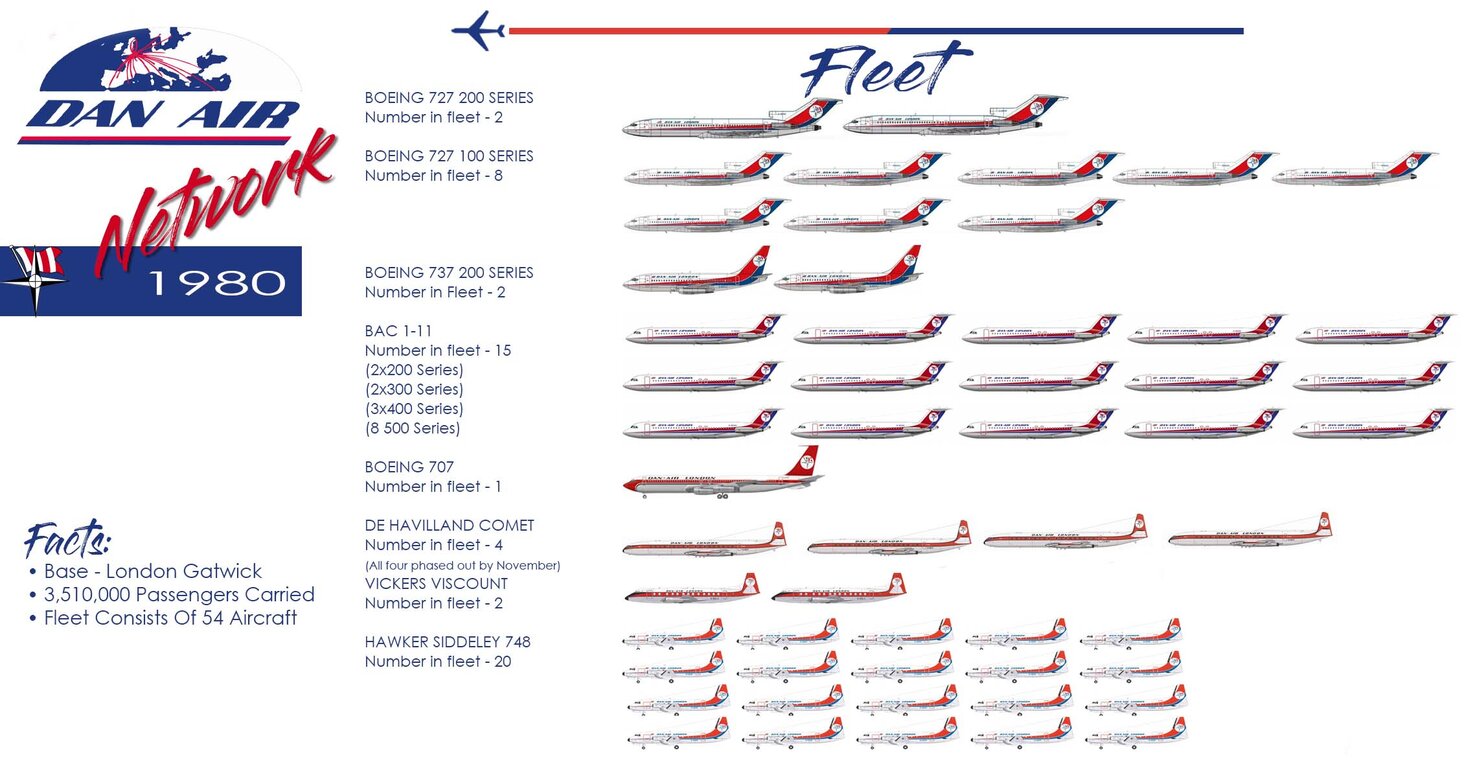
The number of passengers Dan-Air carried this year was down for the second consecutive year. The number was still substantial with 3,510,000 sector passengers flown. That was more than any other British airline with the exception of the state owned British Airways. The fifteen strong 1-11 fleet saw the implementation of the retro fitting of 'Hush Kits' to help reduce engine noise pollution. The cost was estimated to be in the region of £1,000,000. Twenty HS 748 turboprops aircraft and two Vickers Viscounts worked on scheduled services as well as the Oil Related Charter Flights.
The last two remaining Comet aircraft was retired by November. On October 17th G-BDIX flew from Gatwick to Hamburg and G-BDIW operated the last commercial Comet flight on October 31st, on a service from Gatwick to Frankfurt. November 9th saw the final ever Comet flight, especially chartered by aviation enthusiasts for a flight from Gatwick, returning an hour later. This was no ordinary flight, as the cameras, the notebooks, and the disappointed looks on the faces of those who had queued for seven hours in vain for standby tickets showed. Among the lucky was Paul Ward of Rusper, who paid £34 for his ticket:
'I thought it would be a nostalgic thing to do, flying on the last flight of the first jet airliner in the world, and it appealed to me to be part of history.' His wife understood he was 'crackers about planes' and didn't mind him going. 'It worked out about £8 a mile but to me it was worth every penny.'
Booking early with organiser Ian Allen Travel gave Paul a window seat, although few people stayed in their place as they were too excited. Dan-Air Captain John Kelly who said the Comet many pilots favourite aircraft gave the passengers a talk before the aircraft took off. Everyone was given the chance to join him in the flight deck at some stage. He had a few surprises up his sleeve for those inside the plane and indeed outside of it after its take-off which was steep, even for a Comet - as the plane came in low at Heathrow Captain Kelly put it in a climb again at 400 feet with full power. In the words of Ian Hunt, who works for Ian Allen - the Comet 'beat up' three airfields:
'There's never been a flight like it- we over-shot Lyneham, Brize Norton and Heathrow. We thought in the circumstance it was the best way to say goodbye to a very historic aircraft.'
'In fact, its super power was the reason it was phased out of service with Dan-Air, as it was no longer cost-effective with its greed for fuel.' Said Captain Kelly; 'There is no doubt it will be missed by man - passengers and crew alike, even fleet stewardess Val Barnett was seen to wipe away a tear.'
A Dan-Air spokesman said;
'We have obtained 49 Comets over the years and they have superbly served us over the last fourteen years, carrying millions of passengers on holiday. The aircraft was designed for long haul operations and we were not sure how she would adapt to flying many more cycles. The Comet handled the changes beautifully. The fact is, the Comet has not reached the limit of hours they were designed to fly, but the aircraft uses a lot of fuel compared to the other aircraft in our fleet. We are a business and as such, the bottom line is that each aircraft has to make money. Our latest Boeing aircraft carry far more people and use a fraction of the fuel a Comet does. We are keeping one of them to preserve it a Lasham and we have donated one to a museum in Berlin. We have been inundated with requests to purchase them, to turn them into restaurants or night-clubs.'
One of the Comets was donated to the British Civil Airliner Collection which is based at Duxford. The airline stipulated that the airliner remain in Dan-Air colours. In recent years the aircraft has been re-painted in BOAC colours, much to the annoyance of Dan-Air staff.
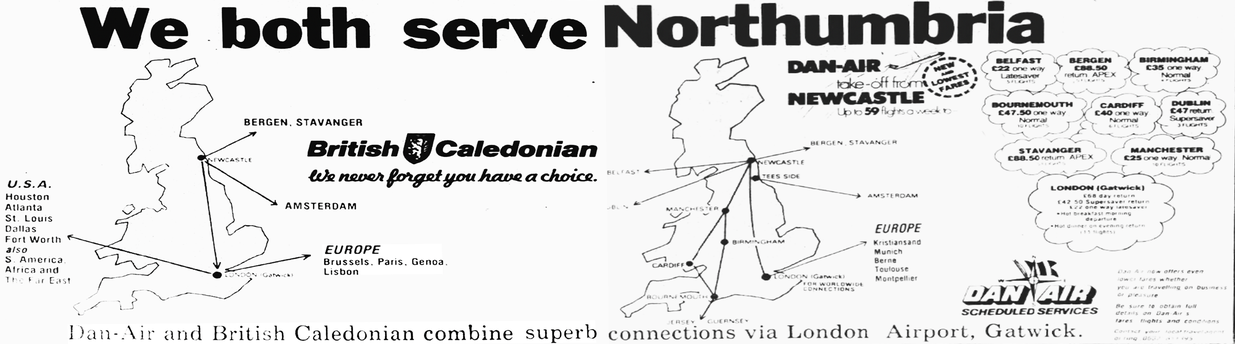
The link with British Caledonian was going from strength to strength. Both airlines had connecting flights timed to enable links for American and European cities. Their combined network is shown on this 1980 newspaper advert.
Noise levels at Aberdeen had seen a major campaign to stop the airport extending its opening hours. Dan-Air's HS 748 had been chartered to fly Royal Mail post to several cities. Royal Mail wanted to fly mail from Gatwick to Aberdeen landing at 2:15 am each day. Locals opposed to the flights demanded the flights be stopped. Dan-air were keen to show just how quietly the 748 could land. The demonstration was attended by councillors and protesters who gathered at the end of the runway. Captain John Smith's skill at bringing the aircraft in at barely a whisper impressed even the sternest of critics. Cllr. Ron Davidson, Chairman of Dyce Community Council said: 'I am very impressed, if this is the noise level, then I think we would be happy.' Aberdeen district Councillor Ken Watmough said: 'I will not be opposing this mail flight in the council.'
Bill Clark the Aberdeen Postmaster said that the North East of Scotland had a very poor postal service compared with other parts of the country and these flights would help improve the situation. Because of current transport difficulties, Inward First Class mail from England took two days to reach its destination. Outward mail was not a problem as flights left Aberdeen in the early evening. Dan-Air's Aberdeen manager said:'special noise abatement measures had been worked out so that local residents would not be disturbed. This has included the use of the HS 748 - one of the world's quietest aircraft, and making the pilot land with a threshold way down the end of the north runway. in future we may fit the aircraft with hush kits that will reduce the noise by half. we knew we could get an aircraft into Dyce without bothering anyone.'
Dan-Air were asked by the Post Office to submit a tender for the flights, but it would be Aberdeen City Council who would issue a permit. Grampian regional Councillor Eric Hendrie said; 'I am still against the flights, for I believe it will be the thin edge of the wedge.' The Post Office dismissed his comments saying that there was no need for another aircraft.
The Aberdeen - London price war got even hotter. British Airways had introduced 'Fire Cracker' fares on their flights, leading to Dan-Air immediately introducing 'Winter Saver' fares which they said was a result of BA's 'Predatory pricing' saying: 'We are not happy that a nationalised industry is being permitted to put on fares that we believe are unlikely to be cost-effective. We are determined to be competitive, however and we hope that the new fares will bring overall growth to the air travel market.' The Winter Saver' was not cheaper that the 'Late Saver' but was available to more passengers, and would be available until March 1981.
In December a Boeing 707 which crashed its way out of Bristol was safe to fly according to Dan-Air who repaired it. Before arriving at Bristol, the aircraft had been repaired at Lasham by Dan-Air engineers. It was reported that the owners failed to tell Dan-Air about 62 defects that the aircraft had. It was later to make a hellish departure from Bristol, smashing landing lights and skimming the A38 road. Dan-Air said the defects claim was nonsense and strenuously denied the aircraft had been unsafe to fly. A spokesman said 'Dan-Air had been asked to put 34 defects right. During the repair we found 19 other faults which were also put right. While at Lasham the aircraft was apparently sold, leaving under a Zaire registration. The Department of Trade then questioned the registration's authenticity. They said 'Dan-Air are not implicated technically or commercially with the Bristol incident - the aircraft's owners are Richard Rashid Khan Sr and his son.
New Routes
- Newcastle - Belfast - April 1st - (Taken over from British Airways)
- Newcastle - Bristol
- Newcastle - Cardiff
- Dublin - Newcastle - April 1st - (Taken over from British Airways)
- Dublin - Bristol - April 1st - (Taken over from British Airways)
- Dublin - Cardiff - April 1st - (Taken over from British Airways)
- Bristol - Jersey - April 1st - (Taken over from British Airways)
- Cardif - Jersey - April 1st - (Taken over from British Airways)
- Bristol - Guernsey - April 1st - (Taken over from British Airways)
- Cardiff - Guernsey - April 1st - (Taken over from British Airways)
- Leeds/Bradford - Guernsey - April 1st - (Taken over from British Airways)
- Bristol - Paris - April 1st - (Taken over from British Airways)
- Cardiff - Paris - April 1st - (Taken over from British Airways)
- Gatwick - Munich - May 1st
- Berlin (Tegal) - Amsterdam - Rights granted.
- Gatwick - Cork - Approved
NETWORK & PRESS 1980
1981
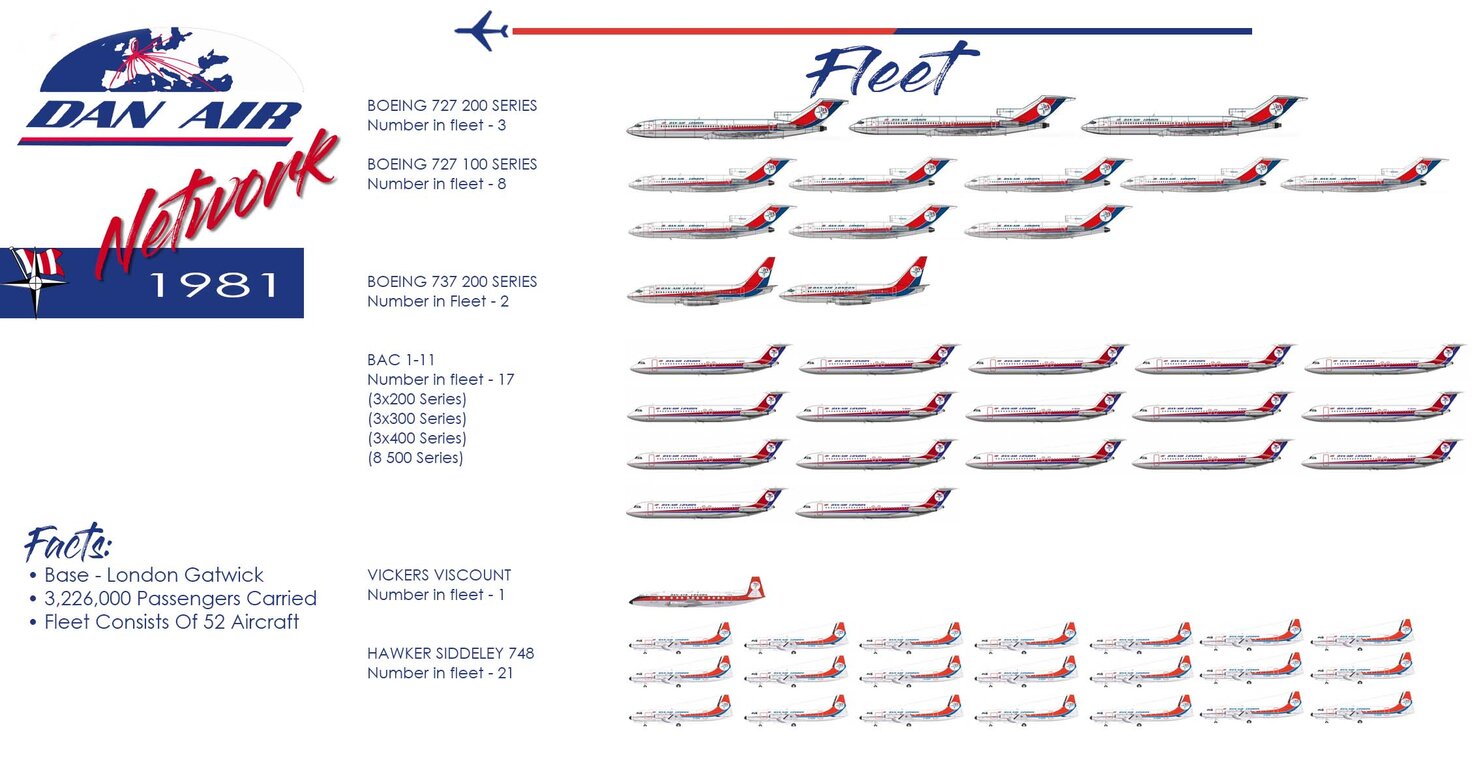
The UK recession had seen unemployment reach record levels and an unprecedented number of firms go bust or struggle. The travel and tourism industry was not the exception. Shares of the parent company Davies and Newman had risen to 126 pence, during January share prices sharply fell, at one point to as low as 81 pence. The price settled to 111 pence. The turbulent economic picture affected all airlines. On 7th January the Bristol-Paris (Charles De Gaulle) service was suspended indefinitely. The four times a week service had been abandoned by British Airways exactly one year prior. The Civil Aviation Authority said that the licence could be taken away from Dan-Air should airlines wish to re-open the route. The Bristol Airport Manager Leslie Wilson said he was already in talks with four airlines who had expressed an interest in taking the service over, one was later revealed to be Air UK. The service would provide just one flight on March 7th, which was fully booked with rugby fans for the France V Wales match. Dan-Air's George Yeomans said; 'It's simple economics. There are just not enough passengers. We will be keeping our other scheduled services to the Channel Islands, Amsterdam and Ireland open.'
In an attempt to boost passenger numbers at Bristol, the summer timetable was brought forward.
Heavy snow caused a company HS 748 to slide off the runway at Aberdeen as the aircraft prepared to take-off on 16th January this year. Luckily no-one was hurt and the aircraft was not damaged
The 'Link City' service, which had been operating for many years between Newcastle/Manchester/Cardiff/Birmingham/Bournemouth would close. Management said that it was no longer profitable. The company stated the bus stop service would cease on March 31. Dan-Air management were having to look critically at all of their routes, with a view to trimming services that didn't make a profit. Airport officials and Newcastle Council wanted to save the service in view of what was considered an inadequate train service from Newcastle to the cities served by the airport. Airport Manager Jim Denyer held talks with Dan-Air and Air UK, who had withdrawn their Paris service, he expressed the airport's concern and disappointment at the loss of the flights.
The Isle of Man was now served by just seven UK airports. Aberdeen - Birmingham - Bristol - Cardiff - East Midlands - London Gatwick - and Newcastle. Dan-Air's 'Fly-Drive' which as the name suggests offered passengers flights and hire car was further enhanced with several new destinations being added to the programme.
The new company livery that had begun to be applied to all the aircraft in the fleet also started to appear on advertisements, publicity items and corporate products. The 'vapour swish' was for the first time as Dan-Air declared 'Fly into the 80s'
British Airways dropped one of their seven daily services from Aberdeen to Heathrow, whilst Dan-Air increased theirs to four a day in each direction between Aberdeen and Gatwick with a second each way service added on weekend days.
Dan-Air made the record books, and secured a small piece of history when the airline flew the inaugural flight of the West Berlin and Amsterdam service. It was the first time an airline operated a service between two common market countries without touching the airline's country of origin. Dan-Air would operate the service twice daily.
The state-run British Airports Authority (BAA) announced that they were increasing landing fees by 17% this was less than the 20% they had previously proposed. This was in recognition that airlines were having a difficult time in the recession. The BAA had wanted a 15% increase at their London Airports, Heathrow, Gatwick and Stansted, and a 20% increase at Scottish airports Edinburgh,Glasgow and Prestwick. Fees as Scottish airports had risen by 70% at Aberdeen and 35% at the three BAA airport the previous year. This would force airlines to increase fares. With Air UK asking the CAA for a 10% increase and Dan-Air 7% on the Channel Island fares.
Tom Hill Holidays, a small, London based travel agent, took a gamble chartering a Dan-Air BAC 1-11 for weekly flights to Palma. The firm ran a newspaper campaign to sell its holidays and the gamble paid off. The 1-11 flew from Manchester with a full compliment of passengers every week.
Dan-Air had envisaged increasing the number of scheduled flights they provided, but warned the public of higher costs. A 10% increase was likely on the London-Newcastle route but a flexible super saver would be available on the route, costing £26 single with no restrictions on Saturday flights. From this year, all scheduled services from Newcastle would be operated by jet aircraft with extra flights added to the Belfast service. A new three times weekly Tees-Side-Dublin route was to start with immediate effect in February. Jersey and Guernsey would see a bigger programme this year, staring from March. A company spokesman said: 'We are seeking a 10 per cent increase from April 1st on the Birmingham, Bournemouth-Cardiff, Bristol, Manchester and Newcastle routes, but fares were reduced in winter 1980 and most services will be charged at lower rate than those for last Summer. This means that we have held fares for two years despite big increases in fuel, airport and landing charges. Many of our domestic air fares are now highly competitive with British Rail.'
Andy Handford who had been station manager at Berlin before taking up a similar position at Aberdeen left the company in March to become Station Manager at Manchester for Air Europe, the charter carrier formed by ex- Dan-Air directors in 1978. He was replaced by 36 years old Anthony Cook. Air Europe, the relatively new kid on the block carried their millionth passenger in February 1981. In less than two years they had grown to a fleet of six aircraft. Monarch Airlines, began the process of their own modernisation when they took delivery of brand new Boeing 737s. They also made headlines when they became the first UK airline to order the Boeing 757. Finally, Orion Airways carried thier millionth passenger with their six-strong fleet in August 1981. Dan-Air's charter fleet consisted of two 737 and eleven 727 (three of which were the 200 series) Seventeen BAC 1-11 flew charter and scheduled services. Twenty one HS 748 prop-liners provided scheduled services, but fourteen of them were based at Aberdeen carrying out charter flights of a different type - the oil supply division. A sole Viscount was used predominantly on Channel Islands flights.
A strike by 20,000 British Airways engineering staff was called off at the last minute, but no before several flights had been cancelled. Among the flights cancelled were the Inverness and Aberdeen services. Dan-Air had anticipated this and quickly seized an opportunity. One of the Aberdeen airport staff told us;
'We were called by managers at head office and told that on that day, aircraft on our Aberdeen-Gatwick flights had been changed. Goodness knows how they managed to get Boeing 727 and 737 aircraft and slip them in place of the 1-11 aircraft that we normally used. We were to issue a press release saying that we were operating to Gatwick with extra capacity. Of course, you hoped that if we flew them on time and made sure we looked after them, fed them and gave them a free bar - that they might come over to us as regulars. We had to put in the advert that the Gatwick rail link was so fast that it really wouldn't extend your travel time. Substituting those aircraft gave us an extra 156 seats each way, spread over three flights. But the 737 alone had 54 seats more than the 1-11, the 727 had 112 more seats. BA passengers were treated very well, and it must have been nice for the regulars to get on a much nicer aircraft than the Trident.'
Dan-Air subsidiary company London Air Taxi (LAT) took delivery of a Cesna Citation jet. A new division LAT Aberdeen was formed. The aircraft which would be based at Aberdeen and would be handled by Dan-Air. It was the first time such an aircraft was based at the airport. The eight seat executive jet could cruise at 420 mph and was capable of flying from Aberdeen to North Africa. The jet was aimed at serving oil executives and senior personnel. Ian Woodley was sales co-ordinator - oil services for both Dan-Air and LAT said: 'We believe the aircraft will be successful on flights from Aberdeen to London and Paris. It has also been chartered for longer distance flights to Finland and Spain. We have already used the aircraft for demonstration flights for oil company executives and they are delighted with it. '
In late March 250 Dan-Air Engineering staff voted unanimously to go on strike at the Manchester base in a row over pay. Their three week pay stoppage was solved on 6th April with a pay settlement of between 7-10%. The strike had threatened to 'black-list' Dan-Air aircraft.
The new landing fees at BAA airports were implemented with airlines publicly voicing their anger, Dan-Air said; 'We are very disappointed with the charges at Aberdeen and in fact, other BAA airports. We can no longer continue to absorb these increases. We are under a great deal of pressure to keep scheduled fares low and charter rates down for our customers. For the benefit of consumers and the aviation industry as a whole, we strongly urge that BAA pricing policy be re-examined, and we have written to the BAA to express our dissatisfaction.'
Labour Member of Parliament Charles Morris accused the Government of 'sluggishness and complacency' over the lateness in publishing the report into the Tenerife crash of April 1980. He said the Trade Minister, John Biffen was helping to put a 'gag' on the tragedy. He said: 'I've tried again and again to break down the official wall of silence but no-one takes any notice. Victims relatives are pleading to know what happened. The crash happened a year ago and I demand to know why the Government is taking such a supine attitude to the Spanish authorities.' A Department of Trade spokesman said: 'These investigations take time, and this one is no exception.'
This came at a time when the 1979 Sumburgh accident report had still not been published.
In April the airline offered free flights for anyone purchasing a full fare ticket on their Aberdeen-Gatwick service. The voucher was transferable to other people. This was a clever response when Dan-Air was deemed to have broken sex discrimination rules by offering half price tickets to the husbands and wives of business travellers. It came the same time that the company reduced fares on the Newcastle-Gatwick service. The new price was £88 return. This was £8 cheaper than BA's service to Heathrow.
As the UK economy continued to suffer amid a crippling recession, Dan-Air was not the only airline to feel its effect. Pre-tax profits had fell 30.4% to £2.350,000 in 1980 on turnover up from £129,409.000 to £153,800,000. Interest payable jumped almost one and a half times to £1,840.000. Chairman Mr. Fred Newman said the results ’Should be considered satisfactory in view of all the problems suffered in the aviation industry'. Newman went on to say, 'Activity the first quarter was lower, but the fleet is fully committed during the summer months'. Finally, he said 'I am confident that the effects of the recession , but I feel it only wise to make a cautionary note with regard to the current year.' Overall, it had been a good year for Dan-Air with the fleet fully committed for the year and substantial investment in new aircraft.
A mass memorial was held in Tenerife to remember those who had lost their lives in the accident. A memorial garden had been opened with 146 rose bushes, one for each of those who perished. Members of Captain Whelan's family had flown out to attend the ceremony, still angry with Spanish authorities who were said to be haggling with British investigators. An unpublished draft had been sent out in January with the British not happy at preliminary findings and recommendations.
The Royal Aircraft Establishment at Farnborough was the centre of much speculation in May this year. There had been plans to close the base and develop a housing estate on the site. Liberal councillors called for a major public meeting to discuss the matter. It was at this time that Dan-Air's name began to appear. The airline's engineering base at Lasham was leased from the Government and the lease was due to expire at the end of 1982. George Yeomans of Dan-Air said that the airline were aware of the Farnborough situation, but was unable to comment any further. Lasham employed 570 engineers and support workers. If the RAE was closed Dan-Air could be in a position to take over. (In the event none of this happened.)
In May, five passengers from the Sumburgh air crash of 1979 issued a writ to the high court in London for loss of earnings, injury, general loss and expenses. The amount was not disclosed. Their solicitor said; 'Their injury's were the result of negligence by Dan-Air, their servants or agents'. This was in addition to the four individuals who were suing Dan-Air under the Carriage of Persons by Air Act of 1967. It was expected to take a year before the court would convene. In October it was revealed that the group were looking at more than £1 million in compensation.
In May, Dan-Air applied to the CAA for permission to fly scheduled services from Aberdeen to Kirkwall, Sumburgh and Scatsa. Flights were planned to operate daily using HS 748 aircraft and significantly under-cut the fares offered by British Airways.
On 6th June Dan-Air began flights from Newcastle to Aberdeen using the HS 748 with fares from £22 standby. Dan-Air would be operating the flights under license from Air UK who had rights on the route. Air UK flew Monday to Friday but chose not to fly at weekends. Dan-Air would fill the gap. The same day saw Dan-Air commence services from Newcastle to Jersey.
Dan-Air suffered a further aircraft loss when a HS 748 on a mail flight crashed in Nailstone, Leicestershire on 26th June The crew of three were killed when the aircraft plummeted to the ground. One onlooker said 'The aircraft seemed to come out of its dive and was practically stood on its tail when a large piece of metal fell off. The wings then folded upwards, the plane then fell to the floor.'
The plane crashed just after 7 pm, landing in a wheat field less than 100 yards away from a row of houses. The aircraft was on a mail flight from Gatwick to East Midlands. Pensioner Reg Farnsworth said: 'I saw the plane come out of the clouds and then it banked to come round the church, as he banked, the wings dropped off. It seemed as if he was coming down pretty steeply, as though he was heading for the village. If the pilot had not turned he would have hit the village,gosh knows what would have happened then, because it is a densely populated area.'
Another witness Frank Botham said: 'There was a change with the engine noise, so I looked up to see the plane diving straight down. I thought it was coming right at me. Somehow it managed to pull out of the dive,and was almost stood on its tail when a large piece of metal dropped off. The wings folded upwards and sheered off and the plane dropped to the ground. The wings were on fire, and there were bits and pieces of the plane scattered over two fields.'
First on the scene was Patrick Finucane aged 15, who was fishing with his friend John Sperry also 15. Patrick said: 'The plane was very low and seemed to swerve around the village to miss the houses. It came down in the field, there was an explosion as it hit the ground. We ran over and saw that the pilot was still in the cockpit. Another man was lying nearby on the grass. The plane was scattered across two fields the engines in one and the main body of the plane in another. The rear door was in a cluster of trees at least half a mile from the fuselage.'
The pilot had managed to put out a 'May day' call before the crash asking to land immediately at East Midlands. The aircraft was scheduled to leave East Midlands for Liverpool and Belfast before returning to Liverpool and Gatwick. The aircraft was carrying three tons of mail. Initial reports suggested a mail bomb may have been the cause of the accident. A spokesman said: 'There was a loss of pressure and the rear door was blown off.' Asked about a letter bomb, the spokesman said: 'This cannot be discounted. These planes are maintained regularly and in our opinion the chances of a rear door accidentally coming off are practically nil.
The sixteen years old aircraft had recently undergone maintenance and had passed its CAA airworthiness certification just six weeks prior to the crash.
Police cordoned off the area and a team of six air investigation officials and senior Dan-Air staff attended the scene the next day. The aircraft was flying at just 100 feet altitude and just eight miles from the airport. It was scheduled to land in just four minutes, when at 7:15 air traffic controllers heard a 'may day' call seconds later the aircraft disappeared from radar screens and emergency services were called. The black box recorded was found the following day. The bodies of two of the crew were found immediately, and a search was underway for the third. The police fought a running battle to keep ghoulish sight-seers away.
The 'Black Box' revealed that the aircraft had been flying without any issues. The load master had asked the pilots if they wanted drinks and then went to prepare them. Load masters were usually aged between 18 and 22 years old. The mail flights were loaded with pallets which resulted in the aircraft not having an aisle. The HS 748 was fitted with seats that could be folded up against the walls. It was widely known that employing younger men was appropriate as they were the ones most able to climb over the pallets.
Whilst preparing the drinks, the load master (Who was studying aeronautics at college) had been aware of a red warning light that it was not locked properly. The cockpit also had lights that should have indicated a problem. The load master returned to the flight deck and alerted the Captain saying: 'The indicators on the port door are showing red!' The baggage door was on the starboard side and not the port side, but the load masters mistake didn't really matter, as ANY door showing signs of being unlocked was a problem. 'Showing red?' The Captain had asked. 'Yeah, it looks as though the handles (unintelligible) on it are showing red - not normal' the load master reiterated. The voice recorder was unable to pick up all of the conversation the load master was having as he would not have been wearing a headset. The Captain then asked for clarification 'The passenger door? Sorry?'
The load master then confirms by saying 'Yeah' - to which the Captain responds with 'Oh'
The Captain then instructed the load master to stay in the flight deck, as the seat the load master sat at was adjacent to the door. The flight had already begun its descent into East Midlands and the Captain decreased speed and levelled off the aircraft. Sensing the aircraft levelling off, the First Officer said 'Strong up draft' 'No! The passenger door.....the port passenger door is showing unlocked.' He then ordered the First Officer to increase the rate of depressurisation, hoping that the levels of pressure on the inside and outside would be the same, given the low altitude. The aircraft was cleared to descend from 6,000 feet to 3,000 feet over three minutes. At 5,450 feet a catastrophe began. The rear abruptly unlatched. The inside air pressure forced to door out, ripping it off its hinges. The Captain messaged air traffic control saying: 'We'd like to come straight in, we have had a violent de-pressurisation - er, it looks as though we have lost our back door and are having a severe control problem.' The door had been lost and had fell into the leading edge of aircraft's right horizontal stabiliser. Instead of falling to the ground, the door folded in half and wrapped itself around the stabiliser. The aircraft yawed to the right as a result of the huge increase in drag. The pilot reacted immediately pitching down and steering left in order to keep the plane under his control. The pilots had to use considerable force to try to control the aircraft. Which was now flying in a circular motion. Messages from the control tower were left unanswered as the pilots used every bit of their physical strength to keep control. The recorder heard several expletives as they fought. Despite their efforts the plane then pitched nose down. This had forced the pilots toward the cockpit ceiling. The aircraft then pitched upwards, nose down, nose up, all within a few seconds. The incredible G-force was beyond the aircraft's structural endurance and both wings were severed. The aircraft was at 900 feet when it broke apart. The three second descent killed all three on board instantly. Captain Roger Griffen aged 36 was named as the pilot, First Officer Darryl Hecht aged 29 and a 20 years old load master called Andy Bell.
It was fortunately the last fatal accident involving a Dan-Air airliner. It was dreadful time for the airline with three fatal accidents in as many years. The airline could take comfort, in July, when the official report cleared Dan-Air of any blame on the Sumburgh accident in 1979. Putney MP David Mellor who had raised the issue of Dan-Air in the Commons in 1980, once again brought up the matter int he house. He demanded an inquiry into Dan-Air's safety record. He said it was the fourth fatal accident in five years. This was not the case however.
By Monday 29th June the bomb theory was dismissed and air accident investigators began their task.
The Tenerife accident report was finally published in July and placed the blame on Captain Whelan and the crew.The report can be seen here.
The British Airline Pilots Association said the report was a 'whitewash'. The British Government said they wanted a major addendum added to the report as there had been a series of events that had led to the accident. The Spanish had pretty much exonerated themselves of any blame, saying Captain Whelan was 'flying too low on approach to Los Rodeos, but British Authorities said that the air traffic controllers had given the pilot the wrong instructions. The controller is alleged to have told the crew to turn left into a holding pattern over the airport while another aircraft landed. British pilots say that the controller should have said 'turns to the left' and not 'turn left'. Turns to the left would see the pilot take the aircraft over the sea to a safe area. By missing the 's' off turns the pilot made one left turning and went across the island and into the mountain. Dan-Air issued a statement saying that the report was 'unbalanced, incomplete and in certain respects incorrect.' The airline blamed air traffic controllers for issuing ambiguous communication, putting it in an unsafe holding pattern at a very late stage of the landing sequence. Dan-Air said that recorded conversations between the crew demonstrated that they were working together as a team, and that there was full co-operation between them. The crew were having difficulty understanding what the messages meant at a critical stage of the landing. What had also transpired was that the controller had been guiding a small inter island aircraft at the same time as the Dan-Air jet. The controller had not realised that the Dan-Air jet was travelling a lot faster than the prop-liner and would be on the tail of the Spanish aircraft. It was at that time that the Dan-Air airliner was diverted. A few days later, Dan-Air instigated court proceedings in Spain against the country's air traffic control authority. Dan-Air said it was not happy with the findings of the report and wanted its name clearing, the action was certain to be a long, drawn out process. Trade Secretary John Biffen said he would be taking the matter up with Spanish officials. He would also be taking the matter up with the Civil Aviation Authority and would approach the International Civil Aviation Organisation. Mr. Biffen told the House of Commons 'This report seriously understates those inadequacies of the Spanish air traffic control organisation which contributed towards the accident.
Captain Whelan's brother David was furious, claiming that the airport could have been running on a skeleton staff as it was in the process of closing down. He went on to say; 'air traffic controllers had brought him down from 6,000 feet to 5,000 feet and sent him into a mountain. If he had stayed at 6,000 feet he might have been all right.'
The Spanish said that the British Government had 'interfered' with the investigation and that British Authorities had agreed with the Spanish when they left Spain only to change their mind 48 hours later.
The report into the Sumburgh accident was also published on July 9th this year. The report stated that no blame could be placed on Dan-Air. The crash had occurred because of a technical fault that no-one in the flight deck could have automatically known about. The fault was not discovered until the aircraft was at such an advanced stage of take-off that an abandonment could not have been carried out without an instance of the aircraft over-running the runway, and in this case, crashing into the sea. Modifications, which involved replacing a part with a non-standard part had been carried out on the 17 year old aircraft at some point during its first 15 years of service whilst in Argentina. Dan-Air said that all of their fleet of 748 aircraft had all been examined and the 'gust-lock' devices had all been replaced with the most recent standard part supplied by BAe.
In July a writ was issued to Dan-Air from the families of victims of the Sumburgh accident in 1979. Dan-Air said they had received the paperwork and said 'There is a claim from with widow of Captain Watson and our solicitor has been notified of a claim relating to First Officer Roy Wells.' Dan-Air had already been cleared of any blame in the accident. Solicitor John Munro who was representing families said 'It is up to Dan-Air whether to defend the action or to make an out of court settlement.' He declined to release details of the financial claim lodged. Dan-Air said it was normal practice for next of kin to make a claim through an airline, as we are insured through an international agreement.' going to say that they expected further claims. The eventual figure was in excess of £1,000.000.
A company HS-748 was converted at Dan-Air Engineering's (DAE) Manchester base. The aircraft was fitted with a large cargo door. The first time such a task had been carried out. The 748 could land on short runways making it ideal for the Highlands services. The new door would enable a Land Rover to be carried. In total the aircraft could carry 5 1/2 tons of cargo. The 748 could be quickly converted into passenger use when not carrying cargo. Dan-Air had high hopes for cargo services should they be awarded any of the ex BA Highlands routes. The Aberdeen - Gatwick service would drop from 17 flights a week to 15 for the Winter months. Although there was an increase in frequency at weekends there would be one flight a day less on week days. On September 29th Dan-Air asked the CAA to revoke British Airways licence between Aberdeen and Orkney. Dan-Air had already asked the authority for permission to run scheduled service between Aberdeen and Kirkwall. The latest move by Dan-Air would mean they would have no competition from British Airways if their flights start on April 1 as planned.
Harry Goodman floated his International Leisure Group (ILG) on the stock exchange and made a sizeable return to invest in more aircraft for Air Europe. Alan Snudden who had left Dan-Air in 1979 to join Monarch Airlines. as Managing Director of Monarch had overseen the introduction of the Boeing 737 into their fleet. In September he announced that Monarch had ordered three Boeing 757. the aircraft would be in a single-class 238 seat configuration. The aircraft would be delivered in 1983 in time for the summer season. He said 'We are anxiously awaiting the deliver of this superb aircraft to work for us. This brings us a step nearer to fulfilling our ambition to operate a Boeing 737 and 757 fleet by 1984.'
Air Europe's parent company, Intasun, had seen bookings rise by 36% and had made pre-tax profits of £15 million, and had been profitable within the first year. Horizon had been successful with their start-up carrier Orion and Monarch were backed by Cosmos Holidays. Michael Croft takes up the story:
'At ground level I was with a national chain of Travel agents who made sure that they were giving us plenty of point of sale products. They gave us real inducements to plug their holidays. Educational trips were pretty easy to get on and they would send us bags and beach towels. It was a natural thing to do, years later when Thomsons took over Lunn Poly - whenever a customer walked in the shop and expressed an interest in a place, the agent would simply get the corresponding Thomson brochure that suited it. People had to be specific if they wanted any other company. I had always been a fan of Dan-Air because they were interesting! But the series of accidents they had gave them a real image problem. You would be almost at the point of completing a holiday, you would give out flight times, and sometimes people would say 'What's the airline?' and when you said 'Dan-Air' people would say 'Oh no, I don't want to fly on them, are there any other flights? I would tell them that they are a great company and sometimes it would work and sometimes people were adamant that they wouldn't use them. I think the new colour scheme and image might have helped a little, and most people don't know a 737 from a 727 so I don't think it was the aircraft. But the name could conjure up negatives. I wish they had a Tour Operator who was behind them 100% like Britannia had with Thomsons. I always thought that the scheduled services were fantastic, but they were really up against it, competing with BA. The other charter airlines had it so easy really, same aircraft, same destinations in generally favourable climates. Dan-Air were spinning God knows how many plates at the same time. If they had either bought up a Tour Operator, merged with one or started a new one, changed the name - I think the story would have quite a different ending.'
Holiday-makers besieged the Dan-Air desk at Newcastle Airport late at night on September 13th. They were reacting with disbelief that their sunshine holiday had been cancelled. Many had travelled a long way for their flight. Sunrise Holidays, a Dunstable firm had gone bust. In some cases flights were going ahead minus the Sunrise passengers. Dan-Air could only tell them that they should contact their Tour Operator. Most of them had done that, only to find their calls unanswered. The holidays to Malaga had cost approximately £200 per person. Meanwhile in Malaga, sunrise passengers were stranded with Dan-Air refusing to carry them home. Almost fifty were stranded at apartments in Torremolinos and the Tour Operator's boss, Terry Heyward was in jail in the resort, having been brought to court in relation to unpaid hotel bills. Dan-Air were unrepentant when questioned, saying: 'It is the Tour Operator's responsibility to inform passengers if their flight has been cancelled. We provide an aircraft that has been chartered. If the Tour Operator cancels this, or if our fees haven't been paid, or the company goes bankrupt, it is for Travel Agents, and Tour Operators to inform passengers. There is nothing we can do about this. It appears that these holiday-makers were advised of the cancellation when they arrived by a tour representative '
As well as being stranded, the holiday-makers had the worry of who was going to be paying for their stay at the apartments. The holiday complex said they had not been paid by Sunrise, and therefore the guests were liable for the bill. The British Embassy said that Mr. Heyward was in prison and we have not heard from anyone stranded. We can only help if they contact the Consulate.'
Later on, Dan-Air said they had been in touch with the Consulate and efforts were underway to repatriate those stranded. ABTA said that the situation was 'exceptional' ABTA did not allow Tour Operators to make last-minute changes to their schedule: Something very exceptional is going on, against our code of conduct. They should not worry however, the system of mutual aid between tour firms should ensure they are not out there for too much longer. A bond held by the Civil Aviation Authority as proof of a Tour Operator's financial security could be cashed to ensure they have accommodation. We will certainly be checking to see if this Tour Operator is a member. '
A special charter flight brought them home, to Gatwick the next day.
Shetland Islands council backed British Airways' bid to retain their monopoly on the Sumburgh-Aberdeen service. That was in contrast to the Orkney Islands Council and Shetland Tourist board who were fed up of BA not assisting them in promoting holidays to the Shetlands. The tourist board were backing Dan-Air. At the hearing in October British Airways stated that they did not wish to lose their Highlands services. Orkney Council said that although they were not actively backing Dan-Air they believed that the airline offered a better standard of service regarding frequency, timing and fares. The council wanted British Airways to stay, but would be happy if Air Ecosse or Dan-Air took over. Dan-Air asked for decisions to be deferred.
Despite saying that they did wish to loose any of the thier Highlands services, British Airways looked almost certain to drop eleven of its unprofitable Scottish services, when new timetables came into force in October. Dan-Air, had prepared arguments for the CAA hearing that would follow. Several other airlines expressed an interest in taking over the routes. On 29th September Dan-Air asked the CAA to revoke BA's licence on the Aberdeen-Orkney service. They also planned to operate from Aberdeen to Sumburgh, Scatsa and Kirkwall.
The tour Operator Travelscene were specialists in capital city short breaks. In previous editions of their brochure they had sold their breaks with scheduled flights. In September they announced they had signed a deal with Dan-Air who would provide chartered BAC 1-11 aircraft for their programme from Manchester. This would see a three night stay in Paris for £69 with air-fare included. The flights would operate to Beauvais where landing charges were a fraction of those at International airports. A three night stay in Amsterdam was advertised for £100.
Davies and Newman, the Dan-Air group, revealed first half year profits were down from £3,290,000 to £2,340,000. Increased interest and depreciation charges eventually put the figures into the red to the tune of £1,990,000 from last year's £716,000 loss. However, although Dan-Air had traditionally made half year losses. the company always went on to make a profit at the end of the financial year in April. Fred Newman said: 'The losses were caused by the seasonal trading cycle of Dan-Air, at its busiest during the summer months. The ship-broking subsidiary Davies and Newman continues to trade profitably he said, whilst the associated company Dan Smedvig, the oil drilling contractors is making good progress. Our airline charter business is lower than last year. Whilst the air traffic controllers go-slow in the second quarter reduced the revenue on the scheduled services. These had all been affected by the recession and severe currency fluctuations. 'The airline is experiencing all the adverse factors common in the industry at the present time. Although activity has been high over the peak summer months, rising costs and excess capacity throughout the industry continues to reduce margins.'
On September 30th the last airworthy Comet flew from Lasham to East Fortune, just outside Edinburgh, where the aircraft would be on permanent display in Dan-Air colours.
The Ryan Tourist Group of Ireland announced that they were slashing the price of their holidays to Ireland from £125 to £99. Flights would be with Dan-Air from Newcaslte an come with three nights hotel accommodation and a three night stay in Guernsey from Southampton or Bournemouth including air-fares in May 1982 was on offer at just £85.
There would be eleven redundancies at Glasgow over the winter months. It followed the traditional drop in winter charters. Dan-Air said that 1981 had been 'The worst year the world has ever known in the airline business.' The airline employed 50 people at Glasgow and 250 at Aberdeen where there would be no job losses as business continued to boom there. 'We are weathering the storm better than most European airlines, we are increasing our staff. The drop in charter business has, for some unknown reason, been more acute in Glasgow that at other UK airports. In Manchester there was a remarkable 25% increase in business this summer. However with 60% costs outside of our control, and rising continuously, we have to run harder to stay in the same place.'
The hearing for the Scottish licence applications convened at Edinburgh on 27th October. Dan-Air aid they would be announcing the next day if they were ready to go-ahead with their plans that week or wait until another hearing in London next month. The CAA said that any other applications would be dependant on what Dan-Air's proposals consisted of.
It was decided to abandon applications to serve Orkney and Shetland from Aberdeen, announcing that it was in the best interests of the islanders that British Airways should be given the maximum opportunity to make the services viable. In truth the airline had withdrew because the Civil Aviation Authority had stated that it was their policy to ensure the survival of British airlines and not to introduce competition. Another factor was the BA would introduce a Highland Division operating much smaller aircraft with higher frequencies in an attempt to make the services viable.
One of the Hawker Siddeley 748 aircraft was to be sold to Air BVI in the British Virgin Islands. This was a result of the BAC 1-11 replacing the HS-748 on the Bristol-Amsterdam service, which was now timed to link with CP Air flights from Amsterdam to Vancouver, Toronto, Montreal, Calgary and Halifax. The HS-748 took almost two hours to reach Amsterdam, introducing the BAC 1-11 would cut the flying time by 50 minutes. Travel Agent, Trobair's managing director said; 'It is vital that jets are introduced - at present people are stepping off Boeing 747s in Schipol and and onto a turbo-prop.So obviously we would prefer jets.'
British Airways' decided to attempt to make their Highlands Division a success. They had been using Vickers Viscount aircraft on the roues with little or no profit. Their new strategy was straight out of Dan-Air's text book. They had opted to operate HS-748s on the majority of the services. The main problem was that they only had two HS 748s in their fleet. British Airways announced they would be leasing three from Dan-Air and one from British Aerospace. The twelve months lease featured an option to increase the lease for an additional three months. No fees were disclosed about the leasing arrangement - but British Airways said the cost is within the monies available. The aircraft from British Aerospace was seven years old, and those from Dan-Air are between 12 and 14 years old, BA promised they would be 'stripping them down and they would be thoroughly overhauled before being put into passenger service.' Their own HS-748s were six years old. A spokesman for British Airways said that they did not think the age of the aircraft would cause undue maintenance costs, and said that the HS 748 fleet would be considerably cheaper to operate and maintain than the older and larger Viscounts that they would be be replacing. Pilot training would be undertaken before the aircraft joined the fleet. One of our pilot contributor said;
'Its laughable isn't it? They would strip our 748s down and thoroughly overhaul them. I don't think the terms of a lease gives you permission to start taking the aircraft you are leasing to bits. You know, you only had to look at their fleet at that time, it was the same as ours! At least the short hauls were. They had Christ knows how many Tridents on the go. They were a dead loss when compared to our 727s. Their 1-11s were exactly the same as ours. Their Viscounts and 748s were the same, and their 707s were getting on a bit as well. BA always looked down their nose at the rest of us. One of the things you don't do in the airline business is slag off another carrier's safety record, because the next day it might be one of yours that goes down. When you told me about the travel agent - I was shocked, and so I did a bit of research - in the period both airlines operated, from 1953-1992, we lost seven aircraft with three of them involving passengers. BOAC/BEA and BA had twenty four fatal and more than a dozen that were none fatal. Yes they were larger than us, by a great deal. But check the facts. They had faults with aircraft instruments, pilot error, pilot fatigue, structural faults. It's really not good to give off an air of superiority, at the expense of a competitor, in a not so roundabout way, and that's what they were doing - Saying we've got these 748s off Dan-Air, but don't worry, we will make sure they are fit to fly in. It didn't matter that up until our 748s entered service you would be flying on one of their twenty five years old plus Viscounts!'
In December Dan-Air's 'Operation Santa' ran again - to expatriate 3000 oil support workers, enabling them to get home for Christmas. The company used all its available HS-748 aircraft. The last flight would land on the mainland on the 22nd December. Scatsa would then close down, it would re-open on January 4th 1982, when Dan-Air would once again start the exodus northbound to Scatsa. In total 140 flights were carried out to eight Scottish airports.
Flights to Scatsa were in decline and the number of HS 748s based at Aberdeen were reduced from 14 to 12. Dan-Air said they were looking for work for the aircraft and actively seeking new charter contracts for them. In the meantime they would be looking for new scheduled services or increasing frequencies on existing ones to make good use of the aircraft.
The Viscount had never been fully integrated into the Dan-Air's fleet. Although ten of them joined for short periods throughout the 70s and 80s the prop-liner never won the hearts or minds of Dan-Air. None of the graceful looking aircraft were painted in the airline's new livery. A total of 3,226,000 passengers were carried this year, which include a flurry of passengers in December on the oil supply flights 150 flights were carried out, bringing oil workers home from Sullem Voe for Christmas. The same number of flights would head back over three days after the holidays.
This record number of passengers was more than any other UK carrier apart from British Airways. Dan-Air remained the second largest airline in the UK in terms of passenger numbers and aircraft fleet size.
New Routes:
- West Berlin-Amsterdam and Tees-side-Dublin services started - April 1st.
- Gatwick-Cork - Commenced April 13th
- Aberdeen - Newcastle - June 6th
- Newcastle - Jersey - June 6th
- CAA licence granted Gatwick - Dublin - August 27th
NETWORK & PRESS 1981
1982
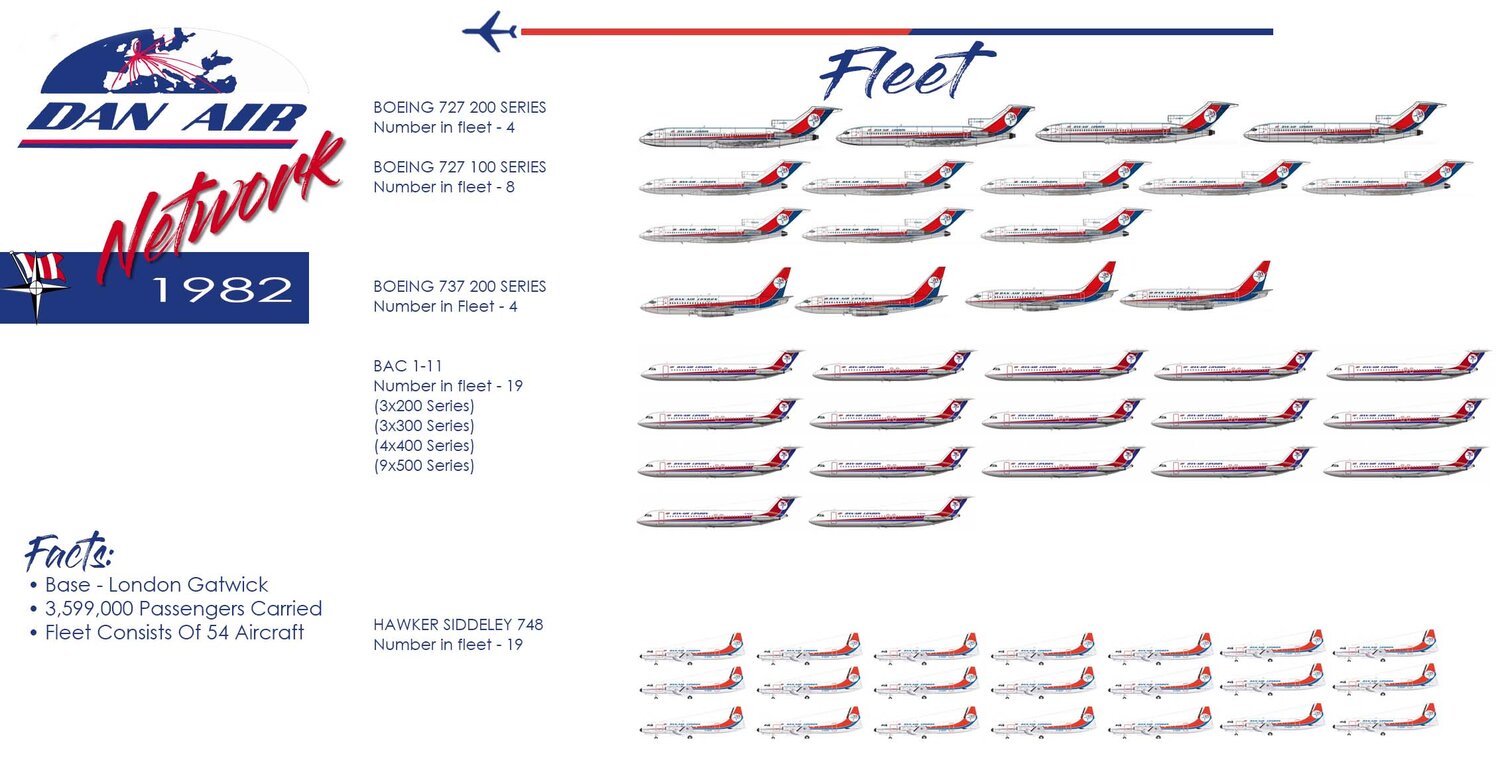
The year started with a new contract announcement. Red Sea Flotillas, an Israeli/British owned company chartered Dan-Air Boeing 727s for the winter season for holiday flights to Eilat in Israel. The late night flights would take five hours, departing from Gatwick. The upmarket holidays were aimed at affluent customers.
The relationship with the Civil Aviation Authority (CAA) hit a new low in January, when Dan-Air launched a new set of fares with reductions aimed at expanding their scheduled service network. Reductions of 10% were offered on Norwegian flights and discounts of up to 20% were offered on many routes including the Aberdeen-Gatwick and Isle Of Man services. The Highlands of Scotland became a major battle ground for UK airlines with Dan-Air, Alidair, Air UK, British Caledonian, Air Ecosse and Loganair all vying for routes. Dan-Air's own Scottish flights had been a runaway success. British Airways, meanwhile, had been under financial pressure for some time, posting significant losses of more than £200 million. Their Highlands routes alone had made a loss of £4 million this year. It was rumoured in the industry, that BA was set to walk away from all but the most profitable of the Scottish services. In an astonishing move, BA announced in late 1981 that they were, in fact, going to strengthen their Highlands network by ditching the costly to operate Viscounts and replacing them with a fleet of HS-748 aircraft. Three of them leased from Dan-Air!! British Airways said it hope to be profitable by the end of the year.
Boeing had invited UK carriers to look at their brand new 757 jet. Early orders came from Monarch Airlines had three on order, and British Airways wanted 19 of them in an order worth £400 million. The BA 757 would carry 180 passengers whilst Monarch had opted for a single class high density layout with 228 seats. Fred Newman, Dan-Air's chairman expressed an interest in the aircraft, stating that it would be ideal for their style of operation, but that it was at the maximum size for an aircraft they might use. Captain Alan Selby recalled at the time:
'Dan-Air had a formidable team who worked miracles every year to ensure that all of our aircraft were fully utilised. One can't imagine just how complex a job it was. I think that, that was one of the reasons that Tour Operators stayed loyal to us. We had the ability to offer so many aircraft types, as well as ensuring that Tour Operators didn't have to charter an entire aircraft. We had the numbers of aircraft, the staff and an undeniable reputation for service. I believe that counted for a lot. In terms of our aircraft, we were not in a position to re-equip with more modern aircraft as quickly as, certainly the pilots would have liked. The new 757 was a superb aircraft, costing £18 million apiece, that was, for obvious reasons, out of the question to the board of Davies and Newman. Leasing, in our world, meant getting an aircraft from another carrier for a short period. When one looks at an airline today, one can see that most airlines don't actually own a single aircraft. Dan-Air's apparent rag tag mix of aircraft were, largely, owned outright. Dan-Air saw that as an asset, which of course, they were when it came to the later struggles with Air Europe. I think the board just saw it in terms of heavy leasing payments and ignored the obvious fuel savings.'
More than £50,000 of an appeal fund launched after the Sumburgh air disaster had not been distributed more than two years after it was launched. The fund was launched in August 1979 and raised £75,000 for the relatives of the 17 men who died in the accident. The money, including £10,000 donations from Esso and Shell was to ease hardship for dependants. Families were raising concerns and administrators of the fund, Shetland Islands Council, could only say 'Legal difficulties'. However the local council refused to pay out until it knew the results of an inquiry into the crash, even though the appeal fund was donated without conditions attached. The Council said in January that were hoping to pay out soon, but couldn't say when. A spokesman for Esso said: 'We are distressed to hear about this. We would not wish to comment as a company on the administration of a disaster fund, although we would assume that the individual donors would wish to see that the funds are distributed as soon as possible.' Mr. Alex Tulloch of The Shetland Islands Council said: 'There were some certain legal difficulties as to who was entitled to the money in some cases. I understand that these have been cleared up and the money can be distributed in a matter of weeks.
Dan-Air subsidiary company Air Taxi London had opened a second base at Aberdeen and this year expanded their fleet further. As well as the 11 seat Cesna Citation Executive jet, the air taxi firm had a five seat Aztec, and an 18 seat Bandierante. The operator had another Bandierante on order and an 8 seat Cesna Titan.
Meanwhile, the Irish government refused Dan-Air's application to fly the Gatwick-Dublin service, despite British Airways having abandoned the route. Dan-air had been awarded the licence by the CAA in 1981, but Aer Lingus claimed that an existing 75 year old rule said that only BA could compete against them on Dublin flights. Dan-Air said it was inconsistent as they already flew into Ireland on the Cork service. The UK department of trade said they would have talks with their Irish counterparts.
On February 6th Davies and Newman shares soared 14 pence to 84 pence. Last year the price had dropped as low as 61 pence and risen to as high as 121 pence. The troubled financial state of many airlines had seen half year losses at Davies and Newman.
High level talks with the Irish and UK Departments of Trade and Dan-Air went according to plan. As an incentive to allow Dan-Air to fly into Dublin, the UK Government would allow Aer Lingus to fly out of Belfast to three European cities. Following that Dan-Air commenced services to Dublin from Gatwick in May. Dan-Air would operate morning services and Aer Lingus the evening flights.
Although technically rivals in many spheres, Dan-Air and Laker Airways enjoyed a good relationship. Laker's BAC 1-11 fleet was regularly serviced by Dan-Air Engineering, Both companies had a 50% share in Gatwick Handling. In January 1982. Laker had approached Harry Goodman at ILG and expressed a desire to sell off his Tour Operators, Laker Air Travel and Arrowsmith. The talks were held in secret and surprisingly had not been leaked to the press. No one in the industry was aware that Laker was in trouble, and certainly not as to how deep the trouble was. A deal between Laker and Goodman could not be agreed, and the sale was called off.
In February Laker spectacularly went bust. Laker Airways had suffered during the winter months of 1981. In an attempt to see Laker off the scene, Pan Am had reduced fares on Transatlantic flights. There was not enough traffic to support the four airlines who flew the routes. Laker's DC10s had been refitted with a premium cabin (Regency Class) to try and lure business passengers with lower fares and premium service. The DC10 had suffered with bad press following an accident a few years previously. Many people were actively avoiding the type. McDonnell Douglas, the DC10 manufacturer and engine maker General Electric had provided Laker with a £5 million rescue package. However, when British Caledonian found out about the deal, they wrote to GE and McDonnell Douglas saying that if the deal went ahead then they, along with a host of other carriers, would not do business with McDonnell Douglas again. Laker duly collapsed with debts of £270 million, which was, at the time, the biggest corporate failure in UK history. Laker's fleet was immediately grounded, including their eleven DC10s, three Airbus A300s, two Boeing 707s and six BAC 1-11 jets. British Caledonian, for their part, set about trying to take over Laker's Los Angeles service.
In the immediate aftermath of the collapse, thousands of Laker holidaymakers were stranded across Europe. Flights en route to Tenerife had been called back to Manchester with passengers forced to hand over their Duty Free goods. Dan-Air was one of the carriers to take part in a rescue operation. Laker sued British Airways, British Caledonian, Pan Am, TWA, Air France, Lufthansa, Swissair, KLM, SAS, Sabena, Alitalia and UTA for conspiracy to put his airline out of business by predatory pricing - they settled out of court for $50 million, while BA, in a separate case, settled out of court with Freddie Laker personally for $8 million. (In 1985 BA additionally agreed to contribute an additional $35 million on top of its out of court settlement with Freddie Laker - The total amount allowed Freddie Laker to settle his outstanding debt and begin launching a new airline.)
British Caledonian were quick to snap up two ex Laker DC10s to join BCal charter and their BAC 1-11s went to British Caledonian.
Harry Goodman's International Leisure Group (ILG) also would benefit from the Laker failure. Goodman had been engaged in talks with Laker and knew the perilous financial state Laker was in. In what could be seen as a harsh, calculated move, Goodman had charter aircraft, and put them on standby in preparation for a repatriation mission of Laker's passengers. Dan-Air picked up several of the charter programmes that had previously been allocated to Laker Airways.
Following the Laker collapse, Dan-Air took over sole trading of Gatwick Handling, expressing a desire to purchase Laker's share from the administrator. The British Airport Authority (BAA) refused this at a stroke. Gatwick Handling's original ten-year licence to Laker and Dan-Air had, coincidentally, expired in February 1982. However, the BAA insisted that other airlines should become additional shareholders to prevent Davies & Newman subsidiary Dan-Air from deriving an 'unfair advantage' as monopoly provider of third-party ground handling services at Gatwick Airport. This was nonsense. Caledonian had their own ground handling, as did British Airways and Servisair. US carriers Northwest and Delta used Gatwick as their London terminal as a result of them having restrictions placed on them with access to Heathrow. Both American carriers were existing Gatwick Handling customers. as a result, Delta and Northwest each acquired a 25% stake in the ground handling company in 1983 and 1984, respectively. The new shareholders replaced the former Laker representatives on the Gatwick Handling's board of directors with their own people.
Laker Air Holidays was swiftly purchased by Saga, a large Tour Operator who specialised in off-peak holidays for older people. Saga would use Dan-Air for its summer programme and announced that Laker Air Holidays would charter Dan-Air aircraft.
Laker's hanger at Gatwick was to be taken over by British Caledonian, who would extend usage to Dan-Air. British Caledonian then announced that their new Airbus A310 twin-jets, due to arrive in 1984, would be maintained there, along with their newly acquired, second hand, Boeing 747. Dan-Air would rent a part of the hanger and use it for its own on-site maintenance.
Braniff International signed an interline agreement for connecting flights from Aberdeen to San Francisco, San Diego and Los Angeles with Dan-Air providing feeder flights from Aberdeen to Gatwick.
Dan-Air decided to franchise out the entire operation of the loss-making 'Link City' network in March to Metropolitan Airways. Flights serving Newcastle, Manchester, Cardiff, Bournemouth and Birmingham would now operate by the Channel Islands operator. The good news for passengers was that Metropolitan, owned by Alderney Air Ferries, planned to boost schedules on the routes from four times weekly to twice daily, Monday to Friday, starting on March 29th. Metropolitan would replace Dan-Air's 44-seat HS-748 turbo prop planes with 20 seat 'Badierante' prop-liners, which would be based at Newcastle and Bournemouth. Dan-Air would handle all sales and reservations on the services in return for a profit related commission, and the aircraft would carry Dan-Air insignia. Dan-Air would continue to operate the longer routes from London to Aberdeen and Newcastle. These had now been grown to such a level that they could well be considered 'trunk routes'.
Liz Cowe, the air hostess who's bravery at the Sumburgh crash saw her be awarded with an MBE in the New Year's Honours List attended the ceremony at Buckingham Palace on February 19th, where she was presented with the award by the Queen. Captain Johnathan Dalrymple-Smith who was piloting another aircraft at the time of the accident was also honoured. He had left his aircraft and dived into the sea to help save lives.
In March a Dan-Air HS 748 departed in the early evening on a flight to Bristol. On board was former Conservative Prime Minister Edward Heath, who was one of 28 passengers on the flight. Shortly after take off two Dutch fighter jets streaked towards the civilian aircraft. The HS 748 could not take any action. Fortunately the two jets peeled off and flew either side of the Dan-Air prop. None of the passengers on board were aware of the incident. Captain Geoff Hopkirk immediately complained to the tower at Leeds/Bradford. When told of the incident that evening, Heath said 'I'm glad they missed.' His secretary said that Mr. Heath would have taken the whole thing in his stride as he was used to drama. The Dutch Defence Ministry recalled the pilots who were on a training exercise. They were supposed to be heading to an RAF airport to refuel.
Davies & Newman, after reporting a near trebled seasonal loss of £1.900,000 in the first six months of 1982, could only pull back to a £342,000 profit before tax for the full year. In 1980, the pre-tax surplus was £2,350,000. A deal was signed with Owners Abroad, who were very well known to those who owned or rented apartments or villas overseas. The £3 million deal would see Owners Abroad charter many Dan-Air aircraft for the upcoming summer. As an air broker, they would then sell the seats in blocks to package tour and villa operators. Last year they carried some 310,000 they hoped to carry 350,000 this year, 40% of which would be with Dan-Air, that amounted to 140,000 passengers.
Jet-setting Romeos were told to 'stop changing your partners'. from March crew were told that they had to register their 'fiances' with the company. The Dan-Air spokesman said 'It is so we can keep a check on people who have a different fiance every other week.' The 90% discount fare scheme was available to all Dan-Air staff and their dependants on all of the airline's scheduled flights. Prior to the ruling, staff had to fill out a form giving details of the dependent flying with them. Fiances were included under the list of dependants. From now, the fiance's names was to be kept on file, helping the company 'streamline' the administration of staff tickets,' 'Staff had to work for the company at least a year before qualifying for the discount.
Another Boeing 737 200 joined the fleet in March on lease from Maersk Air as a direct result of extra charter contracts being awarded, following the demise of Laker Airways. Owners Abroad, considered to be a small Tour Operator who specialised in Villa holiday flights. The company were popular as direct sellers of charter flights seats, enabling customers to get a flight without a visit to the Travel Agent. What the Tour Operators knew, but was unknown to most people, was that Owners Abroad were, in reality, one of the largest Air Brokers in the country. This meant that they chartered entire aircraft from airlines and then sold them on in smaller blocks to package tour and villa operators. In 1981 the sold 310,000 seats, of which about a quarter was direct sell flights to the public.
The regional airline Casair sought approval for a licence to operate between the Tees-Side and Gatwick with the unusual terminal stops of the Isle of Man and Guernsey. The licence was approved as was Casair's request for the revocation of Dan-Air's Tees-Side to the Isle of Man licence, which had not been operated for a year. Casair would use Shorts 330 aircraft on the route. There had been a considerable down-turn in visitors to the island. Just a few years ago, Dan-Air operated scheduled services from more than a dozen airports to the island and these were reduced to four this year.
Former Prime-Minister Edward Heath and almost thirty other passengers escaped death by a fraction of a second when two Dutch F16 jet fighters streaked towards their Hawker Siddeley 748 prop-liner, as it left Leeds/Bradford Airport on a flight to Bristol on March 19th. The aircraft had reached 2,000 feet at 10:10 am. The Captain , Anthony Leach did not have time to alter his course but the two military jets suddenly peeled off and passed the airliner on either side. The two fighters missed the 748 by just 500 feet and were said to be flying at 600 mph. That evening Government and military chiefs began an investigation to find out how two military aircraft strayed into civilian air space. The other pilot, Captain Geoff Hopkirk did not tell Mr. Heath or the 27 other passengers, but he protested loudly to the air traffic controllers: 'It was very close, I didn't have time to take any evasive action.' Leeds/Bradford Airport said: 'The jets should not have been there, they invaded our air space. The Dan-Air aircraft was given permission to take-off because there was nothing in our air space. The next thing is that the pilot reported that the jets had gone in seconds.' Mr. Heath was told about the incident when he attended a dinner that evening. He laughed and said: 'I'm glad they missed.'
His secretary Peter Luff said: 'He would have taken this in his stride, he is used to dramas.' The Dutch Air Force jets were on a training exercise, and were on their way to refuel at RAF Waddington in Lincolnshire. The Dutch Defence Ministry ordered an investigation and the pilots ordered back to the Netherlands. Captain Leach filed a near-miss report.
The Metropolitan Airways franchise began operation on March 29th. Almost as quick as the flights got off the ground they proved unpopular. The replacement aircraft was heavily criticised for being too small and cramped. Metropolitan Airways had not got off to a good start with pilots reported to be doubling up as air stewards as part of a cost cutting strategy to help them through the recession. Instead of having a Captain, First Officer and stewardess, their Twin Otter aircraft would consist of a Captain and a 'Flight Officer' who sat in flight deck and then carry out the role of a steward, he could also fly the plane in the event of an emergency: 'It cuts down on overheads.' said David Beety, Chairman of Metropolitan Airways. 'We have a team of nine pilots, two of whom were made redundant by the collapse of Laker.' The airline was to invest £1.1 million in taking over Dan-Air's 'Link- City' network and working in partnership with them. Dan-Air would provide reservations, ticketing ground support, while Metropolitan provided aircraft and crews. Despite the bad reviews, a new Bristol - Cardiff - Glasgow service would begin on August 25th. Captain Alan Selby recalls:
'The 'Link-City' had only come about because we couldn't get licences for anything decent. No-one could. Some of the point to point services were worth operating like Newcastle-Gatwick and Aberdeen-Gatwick, but let's face it, by the time the eighties had come about, it was a ridiculous to suggest that aircraft attempt to pick up people at Bristol and then Cardiff and then Manchester. By the time a fellow had left home, checked in - waited at the gate and boarded, he could have left home and got half way from Bristol to Manchester. It didn't matter how versatile the aircraft was, it still had to pay to land at these airports, and all for maybe half a dozen people. Airport had started to look at profits a lot more and their landing fees were ever increasing, as was fuel costs. Realistically, the domestic services should have only been flown point to point on routes where there was the need to move considerable people all year round. Even then, they had to be quicker than road or rail. You know if a person in Bournemouth needed to go to Aberdeen with us, they would have to endure five take-off and landings! Even more if you went back a couple of years. It was likened to a bus stop service. Well, enduring one of those cross country was a nightmare too. It was going to be same story with Metropolitan Airways, but at least it was out of our hands, and we got to keep the best routes for ourselves.'
This was certainly the case with the Aberdeen-Gatwick service, which continued to operate profitably with load factors of above 80%. British Airways who now were operating the three leased Dan-Air HS-748 were hoping that they could turn a £4.5 million loss into a profit within a year. They had been only too aware that the Vickers Viscount had been a drain on resources. As a whole, British Airways had reported staggering £250 million loss. In March BA announced fare increases on Scottish services despite promising to freeze them until at least Autumn.
British Airways was losing a reported £500,000 a day in 1982 and by April it was estimated that the airline had a £30 million loss,against a budgeted deficit of £8 million. The airline had dropped twenty of their most unprofitable routes and were reportedly looking at axing several more. The Highlands division in Scotland would reviewing their options after six months of the new operation. Dan-Air began a covert investigation to see if they could see any opportunities, whilst BA carried out a confidential assessment by accountants Price Waterhouse. It had been revealed that BA never made a profit on the London - Edinburgh and London - Belfast Shuttle.
In contrast Dan-Air's Bristol-Amsterdam service had paid dividends for the airline, especially now they connected with flights to and from Amsterdam with Canadian Pacific. This year the route would introduce BAC 1-11 jets with an increased capacity of 30 seats. It saw passenger numbers on the route increase by 107%.
Ninety ex-Laker Airways stewardesses were taken on by Dan-Air for the summer. With Dan-Air saying 'The girls were already trained on the BAC 1-11 which both carriers operated. Dan-Air have very high standards of customer care that we believe is unique to us. The girls knew the technical aspects of the aircraft, but we made sure they would do things the Dan-Air way, which they all have. They have made a fabulous addition to our cabin crew.'
It would be unfair to say that Dan-Air was 'struggling' but that is exactly what some newspapers declared after a year that saw only small profits of £342.000. This was in the middle of a particularly gloomy world-wide recession. Chairman Fred Newman said 'The situation of the airline world has been widely discussed in the media and Dan-Air have not been immune from this.' Cargo revenue was down and oil supply charters had been slightly down. The Falklands war had affected travel plans of many people. British Caledonian lost money when they were forced to cancel services to Argentina and had reported huge losses overall totalling £8.7 million. British airways launched a 'survival plan'. The International Air Transport Association said that their sixteen member airlines would make a combined loss of £1 BILLION.
Dan-Air had been keen to add Gatwick-Dublin to its network to go alongside the Newcastle-Dublin service. Dan-Air was given the go ahead by the UK authorities, only to be refused permission by the Irish. The CAA were keen to see Dan-Air on the Gatwick-Dublin service and agreed to allow Aer Lingus to fly into Europe from Belfast in exchange for giving Dan-Air permission to fly to the Irish capital, completing the deal in May this year. Fares would be £70 return and £80 for weekend flights in the peak Summer months.
Would-be hostess Debbie Readman of Tyne & Wear left her Dan-air training course after just two days. The story made the press who said that the story highlighted the North-South divide in Britain. Debbie ages 21 said that 'Some of the girls were nice, but most were a bit snooty.' She claimed the pay was not good enough, there was no job security and that the work was little more than a glorified waitress. A Dan-Air spokesman said: 'It's far from being a glorified waitress, you are responsible for several people's safety. You meet interesting people and get to visit lots of interesting countries. As far as being snooty is concerned, I don't think Dan-Air is like that at all - I am a Geordie myself and I think most Geordies are nice.'
By July of 1982 Dan-Air had reduced their fares on its Gatwick-Bergen service by 10% in an attempt to generate traffic, the new fare would be £121. The group of companies had been losing money for the whole of the year but they were still optimistic that they would be in profit by the last quarter. Dan-Air had to contend with five survivors from the Sumburgh crash in 1979 who had now brought law suits for compensation that the airline estimated would cost up to a million pounds. British Midland Airways opened the Edinburgh and Glasgow to Heathrow routes despite strong objections from Dan-Air, British Caledonian and British Airways.
In July, Dan-Air completed negotiations with British Aerospace to purchase two BAe 146 jets with a third on option. A company spokesman said one aircraft would be based at Newcastle where it would be used on the Gatwick service from Mondays to Fridays. The aircraft would then go on to supplement the charter programme during the weekends. Dan-Air thus became the world launch customer of this brand new aircraft. Captain Alan Selby recalls:
'As far as I can remember, British Aerospace wasn't bursting at the seams with orders for the 146. The word was that BAe were practically giving Dan-Air the aircraft for free. In some ways that is an honour. The fact that airlines around the world might be thinking; 'If Dan-Air have bought it new, it must be good.' is a something to be proud of. It wasn't an aircraft I wanted to fly. I was, by now, on the 737 as well as the 727, but I could see the 146 had many qualities that would benefit us. The fuel savings compared to a BAC 1-11 were huge. I know that the introduction of the type was a bit of a turning point for Dan-Air and how it wished to be presented to the world.'
Orion Airways announced they were purchasing Boeing 737 300 series aircraft. The new aircraft would seat twenty more passengers and had even greater efficiency than the 737 that other UK charter airlines, including Dan-Air, were operating. Captain Alan Selby said;
'The 737 joining our fleet was a remarkable achievement I thought. It is well documented that Fred Newman was reluctant to obtain them, but the facts were that all the new airlines that appeared, and kept on appearing throughout the eighties, were backed by major Tour Operators. They had a great deal of financial strength. Two of these airlines, Air Europe and Monarch also had board room strength direct from us. Heaven knows what information they were able to pass on in their new roles. They would have known all our strengths and all our weaknesses, and time has shown that we did have them. I am sentimental about Dan-Air, of course I am. But I know we made some bad decisions. Anyone could say that all our aircraft are all booked up for next year and that we have a fleet of fifty aircraft. But what use is that if only half of them are making money? We were offering the same charter rates as other airlines did. We were carrying them in aircraft that made far less money on the same trip. To make a profit we had to work like mad doing everything. Air Europe made more money than us in the first few years with a fraction of the fleet and a fraction of the leg work. O'Regan and Cossey walked away from Dan-Air and left behind the things they knew weren't worth the time and effort doing. They went for quality charter work to destinations they could make money on. Leaving us to do the less appealing work for the same rates. When they were in a stronger position in 1982 to attempt to get licences for scheduled services. Did they mess about with Newcastle to Bristol? Of course not - they went straight for Alicante, Palma and Faro. It made perfect sense - and I know that skill came from their time with us. From 1982 onwards, I would say in many ways we were playing catch up all the time. It wasn't until our scheduled services really moved up a gear in the late eighties that we had a product that was unbeatable in Europe on schedules.'
Bristol Airport asked Dan-Air to re-open their service to Paris a year after they had cancelled the flights. Dan-Air said that landing costs at Orly were prohibitive. In response Bristol invited other airlines to look into flying between the two cities.
On July 28th, a service vehicle was involved in a collision with a Dan-Air Boeing 727 at Gatwick. The incident happened in the middle of the night when a Boeing 727 was being towed from stand 17 to a maintenance area. The driver of a truck owned by Marritt In-Flight Catering had not noticed the aircraft until it was too late. He sped up in an attempt to avoid the moving aircraft, but it was too late. The truck collided with an engine and it fell to the floor. The engine was valued at hundreds of thousands of pounds. Dan-Air said they couldn't put a price on the accident until they had been through their insurance company.
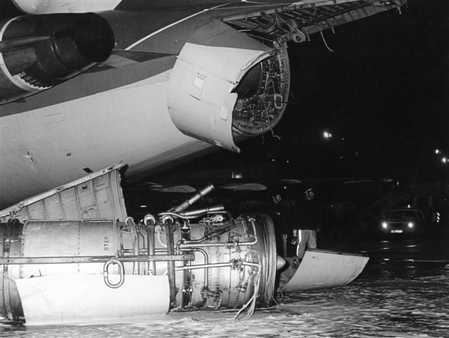
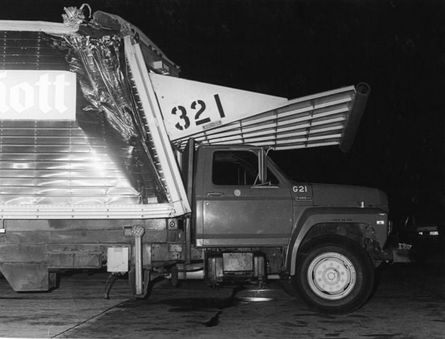
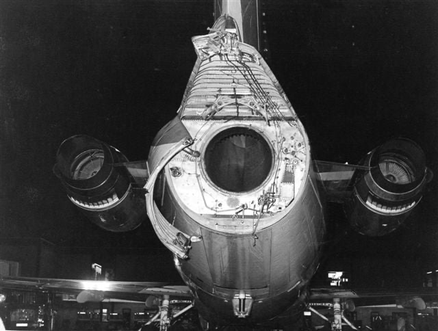
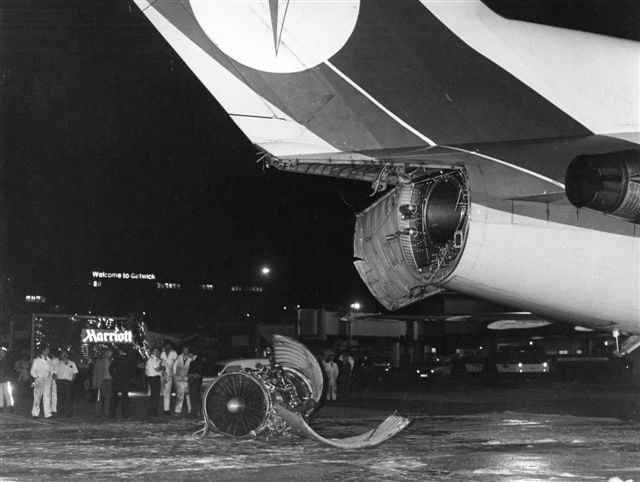
It would turn out, the following August that driver Francis Kitson who was from Ilford has caused £1 1/2 million worth of damage to the aircraft. The 53 year old man was convicted at Crawley Magistrates court for failing to drive without due care and attention and not giving way to the plane. He was fined £55. The truck owned by Marriott had caused the engine to fall to the ground which then leaked fuel over the truck. Mr. David Lewis, prosecuting said: 'It was extremely fortunate that the aircraft was not full of passengers, and that the engines were not running. The aircraft was being towed from the main pier to the Dan-Air Engineering maintenance area when the incident happened. Mr. Kitson said he had been a driver at the airport for sixteen years without accident. He said he had seen the plane only minutes earlier when he was driving to load catering equipment. He said: 'As far as I was concerned it was a dead aircraft because there were no lights on it.' He was driving past the aircraft when his work-mate shouted 'Watch out!'
'I swerved inadvertently to the left and skidded to a halt. There was a terrific bang.'
Stanley Constable was the driver of the tug who was towing the Boeing said he had checked the aircraft to see if the aircraft lights were on: 'I checked over my shoulder - I saw the Marriott's truck - and then thud. I went round the back of the plane and saw a great big chunk of metal on the ground, I couldn't believe my eyes.'
Accident Investigator PC Frederick Stone said: 'I am satisfied that this was not an impact of any great magnitude, but the results were spectacular.'
The engine casing - one of three on the aircraft was being held together by three sheer bolts. PC Stone said that when hit sideways by the truck, the mountings sheared and the engine fell. Mr. Lewis said that the rules at the airport stated that all vehicles must give way to aircraft at all times. Kitson was fined £50 for failing to give way, £5 for driving without due care and attention and ordered to pay £100 towards the prosecution's costs.
The following day Kitson was dismissed from his position. He had originally denied blame he carried on working at the airport. A few days after the trial he was suspended on full pay. The day after he was asked to go to the airport where he was dismissed. He recalled: 'They said, as far as we're concerned we can give you an excellent reference work-wise, but as it was a fact that an aircraft was involved it was immediate dismissal.' Marriott's said 'We can confirm Mr. Kitson has been dismissed. We held the initial inquiry and told him that if anything came up later it would be taken into consideration.'
Kitson went on: 'It's a chance in a million, I have been working there for sixteen years without accident. I was careful at the airport, always have been, so i can't see it's my fault. The wing-man who is supposed to be present whenever an aircraft is being moved wasn't present at the time. As there was no wing-man and no lights on the aircraft, it is what's known as a dead aircraft - and it should not have moved.'
When told about a change in rules concerning wing-men Kitson said: 'Well, it's a bit too late for me, if it had been in force at the time of the accident, the accident wouldn't have happened. I think it's a very good idea, it might prevent some further accident in the future.'
The accident had high-lighted the need for a review of aircraft safety procedures. Dan-Air said: 'Before the accident vehicular traffic had to give way to moving aircraft. It was the responsibility of the tug driver to make sure that they had room to move equipment about. Since the accident we have added the extra precaution of requiring the tug driver to call up the supervisor to ensure that the roadway is clear.'
On the same week, Dan-Air flew the Royal Philharmonic Orchestra, complete with instruments on a specially chartered aircraft from Gatwick to Aberdeen.
Another special charter was carried out under a cloak of secrecy, when a Boeing 727 departed Gatwick with a very mysterious cargo. The airline had been asked to fly the body of an unidentified Middle East Sheikh to Sharjah. The aircraft departed Gatwick in the middle of the night with the sole cargo of the dead Sheikh. Dan-Air refused to name him, or discuss the matter as a result of 'Customer confidentiality'
British Airway's order for nineteen Boeing 757 needed to be reduced as the airline had to make further economies. The aircraft would instead be bought by Air Europe who became the third UK airline to purchase the aircraft. The savings to BA would amount to £40 million. It would mean the Air Europe had effectively jumped the queue in delivery times for their aircraft. Air Europe's parent company ILG who owned Club 18-30, Intasun and Lancaster Holidays made a profit of £10 million, they also announced that the company would go public in 1983.
A company Hawker Siddeley 748 took off from Leeds/Bradford on a regular flight to Jersey and was struck by a 'missile'. It was believed a bolt from a crossbow may have been responsible. Shortly after take-off the bolt hit the propellor badly damaging it, it pierced the wing and tore into the fuselage. the aircraft continued to Jersey where it landed safely and underwent repairs. A company spokesman said; 'It is a bit of a mystery. It wasn't a bird-strike or anything like that. We think it might have been a crossbow that fired a bolt. We don't know if it was intentional. We hope not and that it was accidental, it could have led to a tragedy. The passengers heard the strike but no-one was hurt and it was considered safe to carry on to the destination.'
Dan-Air were awarded a licence for the Gatwick-Zurich service. Laker had planned to take over the route that had been previously operated by British Airways. The Civil Aviation Authority allowed Dan-Air to operate the service for three years.
In August Dan-Air were in a position to announce that they were in the final stages of negotiation with British Aerospace for the purchase of two new BAe146 jets with more on option. On paper, at least, the aircraft cost £6,500,000 each. Dan-Air would be the world's launch customer, a spokesman said they had been interested in the four engined airliner because of its remarkable fuel efficiency and the fact that it was so quiet: 'The current thinking is to base one of these two new aircraft at Newcastle and the other at Gatwick. If everything goes to plan, the aircraft will be flying the Newcastle-Gatwick service next year. It will operate from Newcastle during the week and at weekends it will be used on charter flights out of Tees-Side.'
Almost immediately the Tour Operator Airway Holidays chartered the aircraft. Flights would be carried out to Palma, Barcelona, Alicante, Malaga and Venice. Mike Hatfield of Airway said: 'Using these brand new aircraft will, we believe, increase the holiday traffic at Tees-Side by 60%. what we are really pleased about is that we can offer real style and the latest in jet travel, direct from the North East.'
On September 28th British Airways announced that it was axing 17 routes from its Highlands and Islands services, despite promising earlier in the year to increase them, and invest in the division. Their proposed Highlands service had made a substantial loss of £4.5 million, which they had anticipated would be profitable within 12 months. BA blamed a 37% drop in traffic resulting in a loss of £1,400,000 on the services. This cost cutting measure would help towards reducing the £10,000,000 that the state owned carrier needed to save. The fact that British Airways had made a similar statement the previous year, regarding reducing Scottish routes, only to rescind them later on, was an inconvenience for the CAA and other carriers.
British Caledonian, which was in a desperate financial state decided to enter the Scottish air routes battle, wishing to operate from Edinburgh and Glasgow to Gatwick with a return fare of £110, which was £8 cheaper than British Airways. BCal proposed a standby fare of £33 one way for weekends and off peak travel. British Midland hoped to fly from Glasgow to Heathrow. Press reports at the time had suggested that Dan-Air was a 'Struggling airline' despite posting a pre-tax profit of £2m in 1981. The airline posted a profit in 1982 which admittedly was smaller at just £342,000. What this website finds remarkable, when looking at press coverage from the period, is that Dan-Air was one of only two scheduled carriers to post any profit at all that year.
Dan-Air had been contacted by the CAA and asked which routes they would like to be considered for. Dan-Air had never been an airline that took unnecessary risks, nor did the airline seek rapid over expansion. It was well-known that independent airlines could operate services with much lower operating costs than British Airways. To ensure that any new route applications had at least a fighting chance of survival, and profitability, a detailed study would have to be carried out. This would mean looking at optimal slot times, fares, aircraft types, and the possibility of interline connecting flights for onward travellers with other airlines.
The network Dan-Air had built up was by no means large, and yet every route had undergone feasibility studies. It became obvious to Dan-Air that there were few, if any, reasons to take over every one of British Airways' loss making routes in the belief that they would instantly be profitable for another carrier. New routes traditionally begin operating at a loss. Given time there was a possibility that the route would become a success. The concerns independents faced, was the length of time it took for a service to become profitable.
Dan-Air had seen potential with the Inverness-Heathrow service, which would finally give them access to Heathrow Airport for the first time. British Airways had given the CAA six months notice, giving Dan-Air time to evaluate the route over the next few months. Local MP Russell Johnson said: 'British Airways have acted quite shamelessly in withdrawing from theses routes.'
A Hawker Siddeley 748 carrying 44 passengers was struck by 'a missile' at Leeds/Bradford Airport on September 12th. The missile was later believed to be a steel bolt to be from a crossbow. One theory was that protesters who were angry that work had started on a runway extension, may have tried to shoot the plane down shortly after take-off. After being fired the missile hit a propeller which was badly damaged, penetrated the wing and entered the fuselage. The aircraft was able to continue the flight to Jersey where it was taken out of service. A Dan-Air spokesman said 'The crew and passengers heard a noise, but no-one was hurt and the aircraft was safe to carry on.'
The inquest into the Nailstone accident of 1981 took place from October 4th. The inquest at Loughborough was told by Peter Coombs, the senior inspector of accidents, that not all the doors had been fully secured. Warning indicators at the bottom of the doors were not in synchronisation. Mr. Coombs had spent twelve months investigating the accident. He told the deputy North Leicestershire chief Coroner, Mr. Kenneth Brydson that two of the four locks were not secure and after breaking free the door became impaled in the tail of the aircraft. Mr. Coombs said that this caused an imbalance in the aircraft which caused the aircraft to be virtually impossible to control.
He said 'If the door had missed the tail plane it would have been an embarrassment, rather than an accident.' A verdict of accidental death was record for Captain Roger Griffin, First Officer Darryl Hecht and postal assistant Mr. Andrew Bell who all died of multiple injuries. The jury made the recommendation that the manufacturer, Hawker Siddeley, should look closer at the indicators and consider installing a second set of indicators. Witnesses described the crash, including Mr. Andrew Harvey who saw the aircraft go down, when one wing folding back, then there was a bang, and smoke. Mr. Robert Porter said the aircraft had nose-dived to the ground, and that it was over in about five or six seconds. Mr. Leslie Shaddick, the principle inspector of accidents at the Department Accident Investigation Branch said that the aircraft had a defective locking mechanism and a faulty warning light. The indicator should have shown red in the cockpit when there was a problem with the baggage door, but there was a degree of ambiguity in the warning provided. He said no-one would have been able to detect if the door was locked or not. The cockpit voice recorder revealed that Mr. Bell had informed the Captain that the mechanical indicators on the rear port door of the aircraft were showing red. Mr. Shaddick said the Captain's comments showed his concerns about the possibility of the door striking the tail plane and he slowed the aircraft and took all possible steps to safeguard the machine. A verdict of accidental death was recorded on all the men.
First Officer Darryl Hecht's mother, Celia who attended the inquiry said: 'I can't say who is to blame, that is for the full accident report to say. I don't care, it won't bring my son back. It certainly wasn't the crew's fault. They were praised for the way they handled the emergency. They did everything so perfectly, it wasn't true. Darryl was damned good. He had flown since he was 17, He was a very experienced pilot, so was the Captain Roger Griffin. I went to the scene of the accident, I knew it would all have been ploughed away, and there was nothing to see, but they brought the 'plane down in a field, they missed farmhouses and everything. I have been told by my lawyer that the full report will be published in about six weeks time. It's been a darn long wait, but I think it will be worth it, they seem to have done a very thorough investigation.
A New partnership was formed in October of this year. Scandinavian Airline System (SAS) along with Dan-Air and the cruise line company Fred Olsen would offer skiing package holidays to Bergen. The lucrative programme would run from December to April 1983.
The contract for oil related charter flights was up for renewal in October. Following negotiations with the oil giant Shell Expro , Dan-Air had stated that they would operate 44 seat HS 748 aircraft on the flights. The Scottish airline, Alidair had submitted their plans, detailing that they would operate three services each way between Aberdeen and Sumburgh using 75 seat Vickers Viscounts. Whilst it is unknown what quotes were submitted, Alidair were victorious with their tender. Announcing the news on the 23rd of the month a Dan-Air spokesman said: "Of course we are very sad to lose the contract, after so many years of flying for Shell Expro, but we have been in business for thirty years and the loss of one contract is not going to be the end of the world."
Afrer months of route evaluation Dan-Air decided to formally submit an application to take over the Inverness - Heathrow service from British Airways. But they were not alone with their plans, British Midland, and Jersey based GB Airways, who were ironically part-owned by British Airways, also submitted applications. Dan-Air submitted their application to the CAA on October 27th. The Highlands Development Board said they were looking for an airline that would provide at least a twice daily schedule of flights. There would be a public meeting that would convene in January 1983. In the meantime Dan-Air had the backing of 60 Members of Parliament, The Highlands Development Board and several businesses. GB Airways quickly withdrew their own application, having said they would acquire Viscount aircraft for the flights only if they were successful. British Midland stated they would operate three flights a day with 80 seat DC9 jets. Dan-Air would operate two flights each way with a third via Aberdeen using BAC 1-11 with 89 seats. British Midland claimed that they would be best suited at Heathrow, because they already operated several flights there, making them better equipped, where Dan-Air were strongest at Gatwick. Both airlines said they would open a base employing about eight people.
Dan-Air announced that they were applying to the CAA for licences to operate scheduled flights to Palma, Faro and Alicante, all were routes that British Airways had relinquished. Air Europe, who claimed that they were a charter airline and had no interest in getting involved with scheduled services applied for three scheduled services out of Gatwick - Alicante, Faro and Palma. Britannia Airways submitted the same application. Air Europe also wished to fly from Manchester to Gibraltar.
The half year financial results in November revealed that the expected loss was £1,740,000 compared with the 1981 figure of £1,900,000. There had been hefty charges from leasing aircraft. In spite of this the airline was able to increase trading profit by 49% to £3,480,000. The turnover had also increased by 20% to £78,200,000. Shares went up to 72 pence. Fred Newman was able to report that the Summer charter programme was fully committed for the Summer. The recession had affected most airlines, most of whom lost money this year. Dan-Air, with a fleet of 54 aircraft, was certainly 'holding its own' said Newman. Both the airline and the shipping division had coped well in the economic slump.
British Airways anticipated recovery on the Highlands network had not been a success. The airline returned one of its leased HS 748 to British Aerospace, but decided to retain the two leased from Dan-Air for another year at least.
Dan-Air asked the CAA to be able to offer cut price day-return tickets from Bournemouth to the Channel Islands, the proposed fare would be £44. One of the airline's HS-748 prop-liners was involved in an emergency landing on November 23rd. The aircraft, on an oil supply charter, took off from Aberdeen heading to Munster in Germany when one of the engines developed engine trouble. A full-scale emergency was declared and the Captain decided to re-route to Newcastle. Captain Gordon Pederson landed the aircraft safely on one engine. The 32 passengers were taken to a hotel and left for Munster the following day. Dan-Air said that an oil pressure warning light had come on in the flight deck and that the Captain handled the situation with calmness and skill.
Black ice caused a BAC 1-11 to slew off the runway on December 12th. the airliner on a flight from Gatwick to Aberdeen via Newcastle skidded for more than 100 yards, ending up nose down on a grass strip next to the runway. The 86 passengers and six crew exited the aircraft via the rear door. Passenger Richard Brown said: 'We were just taxiing, preparing to take-off when I realised the pilot had lost it. The plane was not travelling very fast, but it is now well dug in by its nose. There was no panic.'
The results were not in with the licence application for the Inverness-Heathrow service, but Dan-Air became aware that if they were successful, there would be a spanner in the works. They would have to deal with British Airways' new plans. British Airways had decided they would now operate a new service from Inverness to Glasgow where a flight timed to arrive in time for passengers to connect to their Glasgow-Heathrow shuttle, which would arrive at Heathrow at 9-30 am.
Of Dan-Air were successful they would have to have flight times that would actually work in their favour. Any slot times that would be given would come from the authority in charge of landing slots at Heathrow. Which was run by - wait for it - British Airways! The decision about the licence would come in 1983.
The Metropolitan Airways' services that had been franchised in late March this became profitable within six months. Despite bad reviews and complaints about the aircraft used on the services. The 'planes were tiny in comparison to the HS 748 and BAC 1-11s used previously, but those types could not make the routes pay. The new Metropolitan Airways arrangement was working well for Dan-Air in particular.
Dan-Air's perceived reputation had taken a knock over recent years, the airline had suffered five fatal crashes within eleven four years, three of them within the last three years. Those failures were not a result of any of the airline's operational, technical or personnel errors. How the company was to be perceived as it moved forward was a challenge. It had been decided that newer aircraft and better publicity would bring a more positive view of the airline from the public.
1982 had been an exceptionally difficult year for the aviation industry. The UK was in the middle of a significant recession, despite this, Dan-Air carried over 3,599,000 passengers in 1982. They must have been doing something right. This number was the largest since 1979. The size of the Dan-Air fleet stood at 54 aircraft. It was by far the biggest independent airline fleet in the UK, excluding, of course, British Airways. British Caledonian who always claimed to be the second largest airline in the UK had just 29 aircraft in their own fleet.
New Routes:
- Gatwick - Dublin - Daily service started. - June 28th
- Gatwick - Zurich - CAA Licence granted - August 11th
- London Heathrow - Inverness - Route Application for October 28th
NETWORK & PRESS 1982
1983
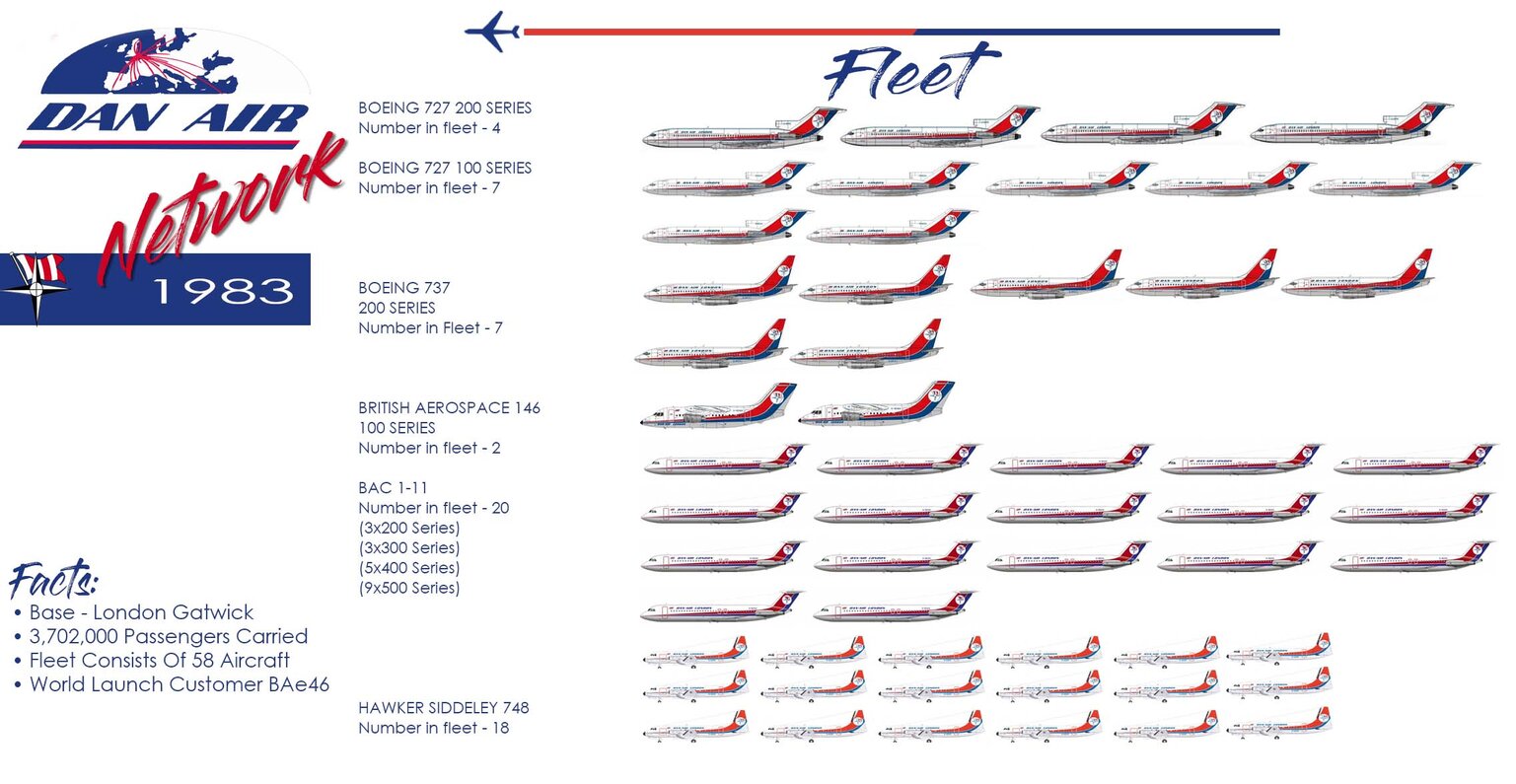
Dan-Air's 30th anniversary year would see the fleet consisting of up to 59 aircraft. The airline was positioning itself a serious player among scheduled service carriers in Europe. As well as this, a massive charter programme was carried out, far bigger than any of its rivals. This new direction would see further enhancements to the fleet. The Boeing 737 had proved to be reliable and popular with passengers, crew and most important of all, Tour Operators. Most charter airlines in the UK were operating the type, but rival airlines were looking to expand, perhaps at Dan-Air's expense. Britannia had ordered the superb Boeing 767 and both Monarch Airlines and Air Europe had ordered the Boeing 757. Air Europe had ordered a stretched version of the 737. The 300 series had a larger capacity and superior fuel efficiencies.
Charter airlines did not operate in the same way as scheduled services, which had to be fought for. Scheduled fares and frequencies were regulated and the Civil Aviation Authority (CAA) were not nearly as agreeable to awarding licences for scheduled flights as they were with allowing charter airlines to go about their business.
Nowhere was this more evident than with the Scotland - London sector which had, in recent times, become something of a battlefield. Dan-Air had applied to take over the Inverness-Heathrow service which was one of the 20 routes that British Airways had relinquished in 1982. British Airways had been losing money for years and despite promises to make their Highlands and Islands division profitable, they had failed. One service had finally begun to make a profit - Glasgow-Heathrow. The service had increased passengers to more than 600,000 over the twelve months. The national carrier had plans to add a tenth daily return to their roster. British Midland Airways had also submitted an application to connect Inverness and Heathrow, claiming they would be better suited as they already had a presence at Heathrow. Their own Glasgow-London service was reported to have taken 2,000 passengers a week from British Airways, mainly because British Midland offered cheaper fares. British Midland announced a new timetable offering seven return flights a day in place of the six it operated currently. British Caledonian, who were losing £3 million a year on the Scottish routes were operating three daily return flights between Glasgow and Gatwick.
On 11th January Dan-Air opened a new round of applications with their plan to take over the Inverness-Heathrow service. British Airways would leave the unprofitable service in March this year. Dan-Air's plan was to operate two flights a day into Heathrow and one into Gatwick, as opposed to British Midland who wished to carry out three each way into Heathrow alone.
Dan-Air said that they believed they could make the route profitable from the start, even though British Airways had lost £1 million a year on it. Dan-Air's project planning manager Martin Clough told the hearing that the airline's North Sea oil charter operation was slowly running down. This could mean redundancies or redeployment at Aberdeen. He said that if Dan-Air were given a licence for Inverness-Heathrow, redundancies would not be necessary.
After the three day hearing Dan-Air were awarded the licence. The airline announced that flights would commence in March, with a special advance purchase one-way ticket price of £40. The standard one-way fare would be £75 (£10 cheaper than BA). Unlike rival airlines, Dan-Air would have Inverness based aircraft for the service. A company spokesman said: 'This is a wholly different approach to Scottish services. We will be operating flights from Inverness to London first. That means we want to provide the best possible service for people in Scotland who wish to travel to London. The aircraft will be based there as will the crew. We want to emphasise the Scottishness of this service. For too long business travellers have had to put up with flights that are late, or cancelled because aircraft are not available for one reason or another. These aircraft will be dedicated to this service. We have greatly reduced the flying time by providing a jet and there will be plenty of things to celebrate when we announce our full timetable.'
Over the next few days details began to emerge about what Dan-Air had in mind. The BAC 1-11 which would fly the services had seating removed, and would carry 88 passengers. This would provide ample leg-room. Cold, unappetising meals were discarded and in its place would be hot meals, including a Scottish breakfast and the bar service on board would be complimentary. In addition to the weekday flights, a Saturday and Sunday flight would operate to Gatwick. Which allowed the BAC 1-11 earn extra revenue carrying out a quick return charter from Gatwick before heading back to Inverness to resume the weekday timetable.
The new service would mean up to a dozen new jobs created at Inverness. Dan-Air said they were looking forward to starting the service and would give details of timings as soon as suitable slot times could be arranged at Heathrow. A spokesman said 'We hope to keep the 60,000 passengers BA have carried each year on the service, and hopefully some of those who make the journey by rail.'
It all looked positive, and it was - from Dan-Air's point of view. But there would be obstacles along the way before the flights could take-off. When Dan-Air said: 'There will be a smooth transition on the service when we take over in late March.' As one of our contributors said: 'The best laid plans......'
The BAe 146 was ready at Hatfield for delivery in April. Dan-Air arranged for almost 200 councillors from Inverness, Aberdeen and Newcastle to visit the aircraft. Once in service the aircraft would serve on the Newcastle-Gatwick route. It was a busy month for Dan-Air as Scotland would be in the final at the European Cup Winners Final in Gothenburg. Altogether 11 Dan-Air aircraft would be among 22 other carrier's aircraft on specially chartered flights from Aberdeen to Gothenburg.
Just two weeks had passed since Dan-Air had been awarded a licence for the Inverness-Heathrow service when a major problem came their way. Applications had been submitted to Heathrow Airport for landing slots, roughly in line with those operated by British Airways. The Heathrow Airport Scheduling Committee did not approve the slot times. A Dan-Air spokesman said: 'Given that British Airways will not be operating the flights after March 27th, it would seem feasible that those landing and take-off slots would be free, the committee have offered us totally unacceptable slot times.'
If one can believe it......Heathrow's Scheduling Committee was managed by - British Airways!
Inverness M.P Russell Johnstone of 'extraordinary behaviour and lack of responsibility towards Highlands air passengers'. He accused British Airways of deliberately frustrating the smooth take-off of the new direct Inverness-Heathrow service. British Airways new Inverness-Glasgow flight would land at Glasgow, giving passengers enough time to transfer to their Glasgow-Heathrow service. This would and at Heathrow at 9:25 am. The Scheduling Committee had offered Dan-Air a landing slot at Heathrow for 11:10 am. A full hour and a half later than BA's two flight option. British Airways would be using HS 748 prop-liners on the service. Incidentally - they had been leased from Dan-Air!
Dan-Air's BAC 1-11 would be parked at Inverness overnight in preparation for their first flight. Something BA had done themselves with their ageing Viscounts. A furious Dan-Air spokesman said: 'We are prepared to take this to the highest level. They are simply trying to stop us having the same facility they had themselves. To add insult to the injury BA have offered to handle our flights at Inverness.'
British Airways insisted that they were not to blame for Dan-Air failure to get a suitable landing time, and as far as their Inverness-Glasgow-London service is concerned 'Competition is the name of the game.' The Inverness MP Russell Johnson said: 'I think they are pulling a fast one. They are certainly not displaying social responsibility. British Airways lowered the standards on their direct Inverness-Heathrow flight. They made the times inconvenient and they removed aircraft and staff. Now they set themselves up in competition with someone who is willing to operate a better service. I think it is extraordinary behaviour.'
On February 28th the Highland Road & Transport Committee, who had backed Dan-Air, met. Councillor John Young said they were 'outraged' and said they would be writing to Junior Transport Minister Iain Sproat 'in the strongest possible terms'. Councillors claimed that the service would be put in jeopardy if flights were not given an early morning landing slot at Heathrow. They urged members and the public to write letters of protest to the Minister.
in a letter to the CAA, Russell Johnson said: 'I find it difficult to understand how an operator can be given a route based on certain landing times without arrangements being made to ensure that these timings could be introduced. Clearly some way must be found to sort out this problem.'
A British Airways spokesman said they had 'no extra muscle' in the allocation of landing times at Heathrow. He said that these were made by the scheduling committee which was made up of several representatives of many operators. He said he understood that Dan-Air were sixth in line, in competition with international airlines for the 9:40 am landing slot they had requested. He went on to say that 'Our Inverness-Glasgow-Heathrow service is viable, it leaves Inverness at 7am and connects with the 8:15 departure to Heathrow. Competition is the name of the game, as the two flights are already part of our Highland and Islands service there in no need for a new licence.'
Dan-air said: 'We are optimistic and determined to get an early landing slot. There is no question of us thinking in terms of defeat or pulling out.'
Dan-Air scooped a major award from top Spanish Tourist Officials in February. The award was for service to the industry in Spain. Since the mid-sixties Dan-Air had flown more than ten million holiday-makers to Spain. Commercial Manager Danny Bernstein accepted the award at a ceremony in Madrid.
The Inverness base was formally announced on February 4th. The base would start recruiting immediately. Nine jobs would be available for check-in, ticketing and cargo handling staff. The next day, the battle to ensure landing slots hit another problem when it came to light that the landing slots were the property of the airline and not the route. British Airways now said they were not prepared to hand over such times to a rival carrier. The Department of Trade had not anticipated this problem, since their liberalisation policy. But the fact that Inverness-Heathrow was the first to emerge had startled Ministers and officials. Although nothing was said officially, it was understood that civil servants were working flat-out to find a solution for Dan-Air. A source was quoted as saying: 'There is a determination that technical problems will not be allowed to defeat the policy of liberalisation of air travel.'
On February 7th Dan-Air took their grievances to the Aviation Minister, Ian Sproat who said that the CAA were doing all they could to help Dan-Air out. The Department of Trade, meanwhile, said they couldn't do anything to help Dan-Air, expressing the view that they couldn't understand why Dan-Air didn't just make use of Gatwick as it was their main base anyhow. Dan-Air responded that their own market research had pointed out that 82% of passengers and businessmen wished to use Heathrow, throwing the gauntlet down, Dan-Air gave the ultimatum that unless a fair slot time was given within ten days, they would withdraw from the service. Dan-Air even threatened British Airways with the High Court. This seemed to do the trick, Dan-Air were granted a slot at 7:55 a.m, although it was not the time the airline preferred, it was better than the 11:10 a.m slot originally offered. They said negotiations would carry on to find an even better arrival time.
In preparation for the take-off an office was opened at Inverness with the nine staff, who received intensive training. For the first time cargo would be available on all flights and Dan-Air had made space for up to a ton of cargo on each flight. Reservations for flights were now being taken and timetables were printed. Dan-Air's new Inverness - Heathrow flights would take off at 6:40 a.m and 5:30 p.m landing at Heathrow at 7:55 a.m and 6:55 p.m. The Heathrow-Inverness flights would depart at 8:55 a.m and 7:55 p.m arriving at Inverness at 10:25 p.m. APEX fares would be from £40 one way on standby. One way fares included: Super Saver - £55 and regular economy fares £75.
The Inaugural flight on Monday 28th March took off on time at 6:40 a.m with 69 passengers on board, 17 short of full capacity. Passengers were treated to a cooked breakfast, complementary champagne, shortcake and fruit cake. The plan was to introduce the BAe 146 by May. Dan-Air's Inverness manager Gary Dominey said that advance bookings for the service were 'excellent'
Dan-Air's Highland services would be further enhanced with the introduction of an Inverness-Aberdeen service to be introduced in May. Flights would then continue to Gatwick. The Inverness-Aberdeen service had been dropped by British Airways who said it was losing money. Inverness and Aberdeen passengers would now have access to Dan-Air's extensive network from Gatwick and be able to join charter flights from Gatwick. It would make economic sense to passengers, as tour Tour Operators usually added heavy supplements in their brochures for airports outside London. These supplements rose even higher for passengers wanting the most attractive flight times, often the supplements were higher than the cost of the scheduled flight fare into London. The fare from Aberdeen to Glasgow would be £12 and the cheapest one way from Glasgow to Gatwick would be £40. The network was expanded further in April. Zurich would be served from the 30th of the month with daily scheduled flights from Gatwick.
Dan-Air were flying high with the end-of-year financial figures released. Pre-tax profits for 1982 were £3,316,000 compared with £342,000 in 1981.Turnover was up by £30 million to £183,840,000 following the development of new routes. Davies and Newman, Dan-air's parent company announced that 95% of the turnover had come from Dan-Air. A dividend of 7 pence was recommended to shareholders compared with 3 pence the previous year. Bringing the total dividend for 1982 to 10 pence. Dan-air's Wilf Jones said: 'Dan-Air's profit was the result of increased volume and cost control.'
Shareholders were delighted to see that their shares had shot up from £1:20 each to £1:60 the following day they settled at £1:93 each. The result has smashed through the £1 million that city analysts had predicted, and was a ten-fold increase on 1981's result. Company Chairman, Fred Newman was 'delighted'. In light of the failure of British Airways to turn a profit, Newman said 'It is because we have a frugal style.' The press went on to say that Dan-Air had only bought one new aircraft since they had been formed, and preferred to seek second-hand aircraft until the recent purchase of the BAe 146. Newman said: 'If you have the business, you can have the aircraft.'
The first BAe 146 arrived in Late May, it would be used on the Gatwick-Berne, Dublin, Toulouse and Perpignan routes. The second due withing weeks would operate on the Newcastle-Gatwick, Bergen, Stavanger flights. the aircraft would reposition at Leeds/Bradford to carry out the twice weekly Jersey service.
The BAe 146 was the only jetliner able to land at Berne airport due to its short runway. As the launch customer for the 146 Dan-Air were able to take advantage by advertising jet flights to the ski resort area early in the year. To increase reservations performance the company introduced the Travicom Reservations System.
At the end of May, Dan-Air announced that they were adding a third daily flight from Inverness-Gatwick via Aberdeen. This brought the number of Dan-Air flights between Scotland and England to 80 per week. British Airways introduced the 189 seat Boeing 757 on its Aberdeen-Heathrow flights.
In May, a new Dan-Air stewardess, Sarah Lipyeat made headlines when she saved the life of a passenger on her first flight! Sarah was on her return flight from Malaga when a passenger, Alan Dow, had a heart attack mid flight. Former nurse Sarah gave Mr. Dow the kiss of life and administered cardiac massage. Mr. Dow briefly recovered before his heart stopped a second time. Once more, Sarah carried out CPR while the Captain radioed for an emergency landing in France. Medics were on hand to meet the patient at Nates where he later recovered in hospital. Sarah said 'I remembered my nurse training and just calmly got on with the job. I hoped that my second flight would be less eventful.'
Oil supply flights continued to be a revenue success for the company. As did scheduled services from Scotland to London. A application was submitted to operate flights from Prestwick to London which had the backing of a newly elected MP. The CAA rejected the application, despite there being no direct flights between the two cities. No other airlines place any objection to the proposal.
Laker Holidays had tried to regain an ATOL licence. Their application was refused. Laker had new brochures, TV advertisements and had began recruiting resort staff. Laker had panned to charter Dan-Air aircraft on their European charter operations. Naturally Dan-Air were disappointed.
As soon as the BAe 146 entered service on the scheduled service network it proved to be popular. Local officials at Newcastle and Tyneside were taken on a short demonstration flight around the north east to show off the quiet performance of the jet. Public relations officer at Dan-Air George Yeomans said: 'This is an aircraft that is as quiet as normal road traffic. Years of design and research has gone into the BAe146 and people living near to airports might find that ear shattering noise may soon be a thing of the past.'
The BAe 146 was capable of carrying up to 100 passengers in comfort. The aircraft was able to adapt to schedule services and charter flights too, which were to be flown at weekends. The first charter flights the BAe 146 operated were on behalf of the Airways Holidays group.
The Inverness-Heathrow service proved to be a smash hit from day one, and by July of 1983 almost 20,000 passengers had flown on the route, 25% more than were carried by British Airways for the same period the previous year. The airline said the success was a combination of attractive air-fares, convenient flight times with day-return facilities in both directions, and a higher standard of cabin in-flight service. At a press conference Dan-Air announced that they would be offering cheaper 'through fares' for passengers on flights for Orkney (Wick) and Caithness (Kirkwall) passengers flying via Inverness to London. The link up with Loganair would see return fares from Wick-Inverness-London for £120 and Caithness-Inverness-London at £135.
Dan-Air launched a bid to increase their presence at Heathrow wanting the chance to compete head to head with British Airways on the busy Heathrow to Aberdeen and Heathrow to Manchester routes. Until earlier in 1983 British Airways had the sole licence for these services. British Midland had been successful with their application to serve Belfast, Glasgow and Edinburgh from Heathrow, despite objections from British Airways. Dan-Air's proposal to operate from Belfast to Heathrow would have a cheaper fare than British Midland, who had given the route up. The Government had wanted to introduce freer competition on air licences. British Airways said they were studying Dan-Air's bid and that they would almost certainly object. British Airways carried more than 500,000 passengers on the Heathrow-Manchester route and 370,000 on the Aberdeen-Heathrow one. Dan-Air would be happy to take some of those passengers in a free and fair competition. In September, Aberdeen based Air Ecosse became the fourth airline to apply to fly between Aberdeen-Heathrow.
In June Dan-Air won a contract previously held by Air Ecosse to ferry oil support workers on charter flights from Aberdeen to Scatsa in the Shetland Islands. The flights would be carried out using HS-748 prop-liners. One of our pilot contributors said;
'I was a First Officer on the 748. It was a rugged little machine but the conditions on the Shetland Islands flights really did test your nerves. The cross-winds came from nowhere and it wasn't unusual to be rocked about for almost the whole flight. Not many aircraft could carry out what our 748's did. The wings were longer than a lot of much larger jets and that really helped. It was, from my own point of view, challenging going back and forth on the same sector. The passengers were all men, they all behaved well, but it was a bit soul-less. I was always looking to get onto the jets. When I look back at that time, there wasn't a single airline who were doing all the things that we did. I don't know if it was our airline's attitude that we would take anything that was offered to us, which may have suited us at some point or another. But I couldn't see Britannia even considering the kind of charters we did. It often seemed like someone would ask 'can you do this' and the response at Dans was to say 'yes we can' - That is a fabulous attitude to have, but I still don't know if it was always a profitable strategy. It seemed a real hard slog to try and get any decent scheduled services. We had been at it for thirty years. Air Europe only four years, yet they were being considered suitable for scheduled services to Alicante and Palma. I just didn't get it. Times were certainly changing. I did eventually get a First Officer position on the 727 and eventually my command. I adored the 727 and I stayed loyal to Dan-Air until the end. I had total faith that the board room knew what they were doing. They were the ones who did the maths. From my point of view, I just turned up and did a job that was the best job int the world. I wasn't concerned about profit and loss. The fact that I was being paid to do it was a bonus. It is only now, many years later, that I look back and see how things might have been different if we did things differently.'
On August 4th the Civil Aviation Authority had to agree to investigate an incident at Aberdeen Airport when a company BAC 1-11 was forced to overshoot the runway. The CAA's Mike Randall said that tapes of conversations between the aircraft and air traffic control would be sent to London. 'The incident will be investigated by a central unit in London who will determine if any action will follow. An overshoot is a standard manoeuvre and whilst we are concerned by any incident, we do not regard this as serious.' However Dan-Air did not see the incident in the same way, with a spokesman saying: 'One of our BAC 1-11 aircraft with 57 passengers on board was about to land when it was discovered that there was a light aircraft belonging to Pegasus Flying Club on the actual runway. We had assurances that the aircraft did not come any closer than a mile from each, which we think everyone can agree is not a great distance when an jet aircraft is landing at more than a hundred miles an hour. Our aircraft was given permission to land and the landing wheels were locked. We were told to abandon the landing after someone realised the mistake. It is unthinkable to imagine what could have been.'
Intasun was, by now, the second biggest Tour Operator in the UK. They had increased their business buy more than 27% since 1982, Winter holidays increased by 107%. Intasun had 590,000 advance booking for 1984. The Tour Operator was part of the International Leisure Group (ILG) who also owned Air Europe, who had flown 1.2 million passengers in 1982. Their success meant that they would increase the number of flights they would charter from Dan-Air. The aircraft of Air Europe were not used exclusively for Intasun holiday-makers. In 1978 they had flown on behalf of eight Tour Operators, by 1984 twenty seven firms had chartered Air Europe aircraft. Air Europe had greatly improved standards for charter passengers and many upmarket brands wished to use them.
Intasun's style of operation was very different to many other Tour Operators. Their in-house airline, Air Europe, would operate roughly 30% of their flights for Intasun to places where they knew there would be no empty seats. The rest of Air Europe's charter flights would be offered to Tour Operators who were keen to use Air Europe. Intasun was seen as a 'cheap and cheerful' brand. Provided other airlines could match or beat charter rates then Intasun were happy to use them. Many Intasun flights to Spain were with Aviaco, the Spanish carrier, consistently voted the worst Spanish airline. Up to six Dan-Air aircraft a season were chartered for ILG tour brands. ILG would wait until other Tour Operators had chartered their aircraft before coming in, at the last moment, and taking up any spare capacity on flights that were departing at ideal times for them. Where they did charter aircraft outright, they tended to do so with late night and mid week flights that had much lower landing rates. This suited Dan-Air as their aircraft were fully utilised for longer periods.
ILG were to make a great deal from recent rule changes. For many years a Tour Operator had to charter an entire aircraft, which worked for popular destinations. It was not so easy to fill entire aircraft to less busy resorts. Dan-Air's solution was to have a varied fleet with aircraft that had seating capacity from 44 to 189 passengers. In the 1970s the rules were amended to allow two Tour Operators to charter an aircraft. From now on, airlines were permitted to sell small blocks of seats on flights to several Tour Operators. This form of consolidation worked very well for Dan-Air., who had become adept at juggling aircraft to suit Tour Operator's needs. This year had also seen difficulties with less popular destinations not getting enough bookings, despite Tour Operators offering the holidays. A new method of combining flights came into play. Travel agent Michael Croft told us:
'I was working in Leeds at the time. When the new brochures came out, there would be queues out of the doors. Within hours, loads of the Benidorm and Majorca holidays had been booked up. All the Canary Islands sold like hot cakes too. Then you would also have the people who wanted to go to a small Greek Island or Morocco, or somewhere new and there would be no problem booking them a holiday. Fast forward a few weeks and our branch might have sold three holidays to Agadir. I'd speak to other branches and they had similar bookings. Then we would get a call from the tour operator saying all those booked on the Leeds-Agadir flights will be consolidating with those booked to Agadir from Glasgow and Newcastle. Now - it might be that they just told the Glasgow clients - you can go up to Newcastle because Glasgow is cancelled, or worse still - that the Glasgow flight would now be calling at Newcastle and then Leeds. This might add more than an hour of flying time. Now, if someone had booked thinking they were flying on Air Europe at 8am on Saturday morning and they were now being told they were flying on Dan-Air at 11 pm on Wednesday, well it could well pee them off. They could book another holiday, but only with the same tour operator - but by this time, all the popular destinations would have sold out. So they often had to lump it. Intasun were notorious for doing it. Often they would blame us, blame Dan-Air and not blame Intasun! Others did it as well mind you. I can see why - they had a contract with the client, and if they broke it they would have to give them their money back - so they bent the contract, they got away with it.'
After only four years of operation as a charter only carrier, Air Europe surprised many in the industry by applying for a licence to fly scheduled services from Gatwick to Gibraltar late in 1982. The service was already operated by GB Airways, so it came as no surprise that the application was rejected. It left no doubt, however, that the fledgling airline had high ambitions for the future.
A third airline commenced operations between Aberdeen-London when Air UK began flights in August. Dan-Air did not need to worry too much as the Air UK flight would depart from Stansted and land at Norwich before continuing to Aberdeen. Norwich was an under utilised airport, but Air UK had skilfully worked with KLM to feed UK passengers into Amsterdam for worldwide onward connections. This was a brave move, Amsterdam is a world class hub, and Air Anglia,the predecessor to Air UK, could not gain access to Heathrow. Air UK said to the press;
'The CAA, British Airways, and Heathrow have always had an active policy of denying independent airlines any access to Heathrow. It is grossly unfair. We have the aircraft, and the infrastructure to carry out these flights just as well as any airline, including British Airways. Airlines will not be able to thrive when if are restricted in this way. Air Anglia, one of the airlines who came together to form Air UK, had been successful for many years in feeding passengers from several UK airports directly into Amsterdam, where they can make onward connections to all corners of the globe. Flying times are roughly the same as a domestic flight into Heathrow. We have worked extensively with KLM, the Dutch national carrier, to time our flights so that they connect with some of the most popular world-wide destinations. Our passengers don't see any more or less inconvenience when flying into Schiphol. We long ago came to the conclusion that Heathrow's loss is Amsterdam's gain. We have similar plans to do the same job at Brussels. It is a dreadful shame that British regulatory bodies do not wish to see this happen at Heathrow.'
August saw an application to join the busy Manchester-London service. British Airways flew half a million passengers between the two cities and Dan-Air believed they could take a share of them. The confidence might have stemmed from their own success on the Inverness-Heathrow service. This was explained as 'We are offering a higher standard of service, attractive fares, jet aircraft and ideal timings.' The CAA gave Dan-Air the right to operate head to head with BA on the Aberdeen-Heathrow service. Their latest proposals were to fly Aberdeen-Manchester-Heathrow.
The oil charters had began to see a down-turn in flights as larger helicopters with a longer range were now available to take workers from Aberdeen directly onto oil rigs. Nevertheless, six HS-748 aircraft were based at Aberdeen for these charters. Half the number from just two years ago. Three other 748's remained on lease to British Airways for their Highlands services. The nine remaining prop-liners worked on regional flights in the UK and Germany.
In an effort to show how committed the airline was to the Inverness-Heathrow service, August 12th saw an opportunity to publicise Scotland and Dan-Air. The 12th is known throughout the world as 'Glorious 12th' for Scotland's grouse shoot. Birds were shot at 3 a.m by the Earl of Cawdor, six and a half brace were then taken straight to Inverness airport, packed into the BAC 1-11 hold, where they were ferried to London to be roasted and served just after 10 a.m at the London Inn at the Park Hotel. Not all the birds were carried as cargo though. Some were cooked and prepared at Inverness to be served to passengers with champagne at 33,000 feet on the early morning flight to London Heathrow.
In September when Dan-Air submitted an application to serve Belfast-London Gatwick, British Midland said they had no objections to other airlines flying from Belfast to Gatwick. Dan-Air Announced that they would slash not only fares, but flight times as well. Proposed fares would start from just £35 one way on twice daily flights. Timings would be reduced with the introduction of a BAC 1-11 jet, competing against BMA's ageing Viscounts. On this particular service, Dan-Air would be offering flights £9 cheaper than those of BA.
Food writer Egon Roney, who for many years had reviewed some of the best restaurants in the world, decided carry out reviews of airline food, service and cabins. All European airlines came in for hostile reviews. Caledonian was slammed for thier 'narrow seats', British Midland was berated for operating 'noisy old, aircraft and serving food that made the reviewer ashamed to be British'. British Airways came under fire for having 'unsmiling stewardesses' and Air UK for 'A miserable affair of a lunch box'. How did Dan-Air compare? Well, good and bad - Charming, friendly stewardesses, narrow seats and meals that were ok - if you were not hungry'.
Dan-Air was the only airline to comment to the press, saying; ' It's a pity that the reviews were carried out on flights that were not at meal times. On the Newcastle - Bergen and Gatwick - Zurich flights, all passengers received canapes and free drinks. If they had flown on the Aberdeen service they would have had the benefit of a full catering with a delicious hot meal and free bar.' The airline went on to say that they thought the report was unfair. Egon Roney replied 'We had complemented Dan-Air on their cabin crew!"
Dan-Air staff were not at all happy with the report. Check-in girls Trudy Hunter, Diane Paton and Sheila Baynes hit back after being labelled 'robots' in Egon Ronay's guide for 1984. The guide, published in November, put Dan-Air at 11th place out of 18 European airlines, for comfort, efficiency and catering. As well as criticising the check-in clerks, it said Dan-Air planes were uncomfortable and the stewardesses had no finesse, and expected their passengers to find their lack of polish at 'part of the fun'.
Dan-Air management laughed off the comments saying the thousands of satisfied passengers meant more to them that the grumblings of a 'tetchy' Egon Ronay, keen to be controversial. Sheila who had worked for Dan-Air for three years said the guide concentrated on the wrong aspect of the job, saying; 'The elderly, infirm and nervous passengers are treated with special,personal care and attention. We give them more time because they need that time. We are trying to see 130 people in about 60 minutes and we have important things to do. I think businessmen would be impatient if we kept them waiting.' Trudy called the criticisms 'completely out of line'. Diane said: 'If Egon Ronay's comments meant that Dan-Air's check-in clerks were as efficient as robots then she would agree.' Dan-Air's public relations chief George Yeomans said;
'We are glad that the airline staff's cheerfulness came through in the Ronay critique. One inspector was won over by the naturalness of our 'rosy-cheeked northern lasses' as he called them. The general tone of the report was that our service was friendly - we aim to give a friendly service. He was out of order giving a critique on meals when he flew on a none meal-time flight like the one from Newcastle to Stavanger. In less than an hour our stewardesses are expected to serve food, give free drinks and sell duty-free goods. We take all reports seriously and we don't accept the general criticism of this one. We stand by the results we get at the end of the year and we are one of the few airlines that make a profit.'
schedule Service planning manager Frank Burke said: 'They are entitled to their opinion,we just happen to think that on this occasion they are wrong.'
The first half financial results announced in October, showed the usual losses, which had climbed by a £1 million to £2,870,000. Turnover remained steady at £78,700,000. The half year figures always made unpleasant reading. Most of the loss was accounted for with aircraft leasing. Twelve of the fleet were leased aircraft. These had to be leased for longer this year. Fred Newman refused to say if he thought the airline would go into profit for the end of year results in April next year. He did say that the charter fleet had been fully utilised for 1984 and that the scheduled services continued to perform satisfactorily.
Even the cargo business was improving with high yields on the Inverness-Heathrow service. After only six months operation, the service had become profitable, compared with British Airways who lost £500,000 on the route the previous year.
Spanish Authorities announced that from 1983 at lease 40% of all UK holidays to the Spain would have flights carried out by Spanish charter airlines. UK airlines called for immediate talks with the officials. At present 80% of charter flights to Spain were flown by UK airlines. The weakness of the Peseta made Spain an attractive destination for 1984.
With the Heathrow - Inverness service proving to be an undoubted success, Dan-Air were keen to expand their Scottish network. British Airways had undergone a restructuring process on their Highland and Islands network division, which led to a profit for the first time in forty years. The Aberdeen-Heathrow service was rumoured to make a profit of up to £20 million. BA's restructuring process was carried out for the carrier's impending privatisation. British Airways did not want any competition on the Aberdeen route and objected when Air UK, British Midland and Dan-Air all applied for a licence. The Civil Aviation Authority conceded that it was fair that BA face competition from at least one other carrier. Going on to say that the service could be profitable for at least two airlines. The British Airports Authority were not of the same opinion, stating that Heathrow was perilously close to its capacity. Dan-Air would operate BAC 1-11 jets on the flights should they be successful. They felt, this would be more of an incentive to would be travellers, who had to fly on HS 748 prop-liner with BA. British Airways said they were looking at replacing the 'old 748's' with Dash 8 prop-liners or re-equipping the 748's with improved engines. This was taken as a swipe at Dan-Air, as three of the 748's that BA used were leased from Dan-Air.
New Routes:
- London Heathrow - Inverness - 27th March - (Taken over from British Airways)
- London Heathrow - Belfast (Taken over from BMA)
- Gatwick - Zurich - Daily from April 30th
- Aberdeen - Gatwick - 21st May
- Inverness - Gatwick - 21st May
NETWORK & PRESS 1983
1984
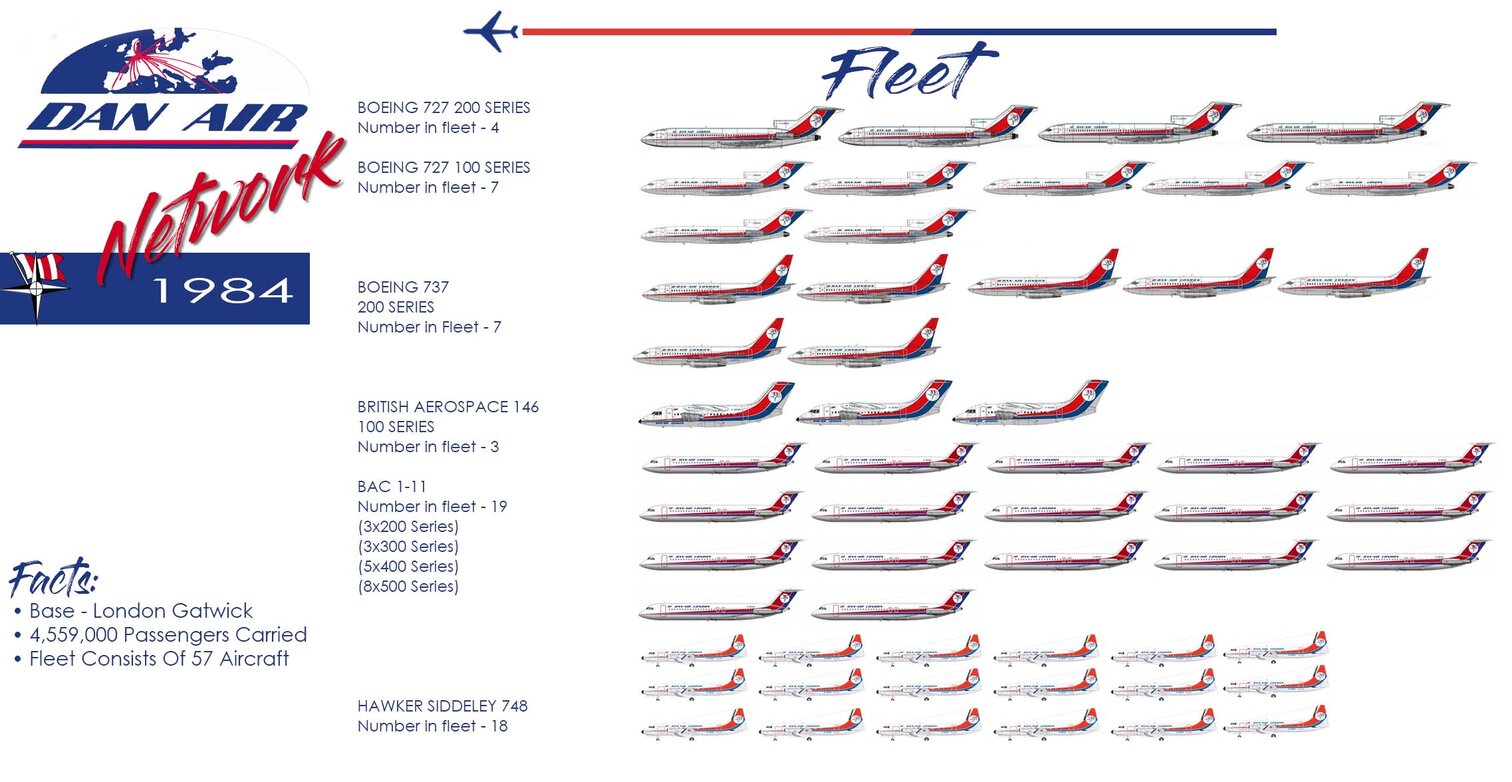
The Civil Aviation Authority (CAA) finally convened a hearing to consider the proposed Aberdeen-Heathrow service, along with several other applications. British Airways (BA) were the sole operator on the Aberdeen-Heathrow route, and did not wish to face any competition on it. The service was very profitable for the state owned carrier. British Airways never disclosed profits on individual routes, but it was claimed that BA made as much as £20 million on this service alone. Dan-Air and three other airlines submitted applications for a licence to operate between the two cities. Dan-Air's proposal would place BAC 1-11 jets on the service, provide hot meals and a free bar service. British Airways' used HS 748 prop-liners on the route, and offered tea or coffee with a biscuit.
British Midland (BMA) had recently purchased Loganair, the small Scottish, regional carrier, with the aim of helping BMA gain a larger market share in Scotland. Their Aberdeen-Heathrow bid claimed that BMA would improve cabin service 'beyond anything their competitors were presently offering.'
Air Ecosse, the tiny Scotland based airline had leased a BAC 1-11 in advance, anticipating a victory with their application. They claimed they were in the best position to meet Aberdeen passengers' needs as they were Aberdeen based. Air UK meanwhile, had kept what they would offer under wraps until the hearing. Their only revelation was that the flights would use jet equipment. Each of the airlines objected to all the other airline's applications.
The Heathrow-Aberdeen route was so desirable to all these carriers because out of the ten busiest routes that British Airways presently flew, Aberdeen-Heathrow was placed tenth. This 'blue riband' route carried more than 360,000 passengers annually.
British Midland had given their licence on the Gatwick-Belfast service, when they were given rights to operate from Heathrow to Belfast. Dan-Air were keen to step into British Midland's shoes from Gatwick.
At the hearing in London Dan-Air detailed their plans to offer an APEX one-way fare of £35 between the two cities. They believed they could capture 116,000 passengers on the service with a standard one-way fare of £65 and an un-bookable one-way fare of £45. Dan-Air said they expected the route would turn a profit after two years, but admitted that 'the going will be tough'. The Northern Ireland Tourist Board backed the plans. It was understood that about half the passengers on their three times daily timetable would use the £45 fare, and a third the APEX fare. The proposals were objected to by Guernsey Airways, who wished to operate from Gatwick to Belfast's new city harbour airport using non-jet Viscount aircraft. Dan-Air were granted the licence, which was deemed to be less popular than the Heathrow option which would now see British Airways and British Midland go head to head, but Dan-Air said they would 'compete vigorously' for a share of the market. Their first move was to offer a return fare of £70 which undercut significantly the price of their rivals.
A second scheduled service out of West Berlin would open in January. Flights would take- off to Saarbrucken, in addition to the one already operating to Amsterdam. Both used HS-748 airliners.
The new Gatwick-Belfast service scheduled to start on February 20th, the day after British Midland's last flight. Dan-Air had plans in place for a smooth transition for the change. The whole operation was thrown into chaos on January 19th when British Midland called Dan-Air to say they would be withdrawing from Gatwick on January 29th. Dan-Air asked British Midland to re-consider as their own route planning department had made an aircraft available for the later date. British Midland politely declined, saying that they did not have a spare aircraft themselves. A former route planning staff member takes up the story:
'Everything had been going well. We had BAC 1-11s ready to start on the expected date. Crewing had done rosters, and catering, re-fuelling, and ground handling were all in place. Then in an instant everything was in disarray. We now had ten days to arrange about 130 flights. The only saving grace was that the take-off and landing slots were already in place. It was the finding of the aircraft that was a headache. We had the aircraft of course, but they were already in use and would be right up to the expected date. We didn't have the luxury of aircraft sat doing nothing. We were desperately trying everything to prevent a gap. The flights were pretty much every two hours. Business flights tended not to do weekends, but there were four return flights on Saturdays and Sundays. We had no wish to let rivals see how bad it was going behind the scenes. We worked around the clock and we managed to get a solution from February 7th. This would still leave a week where we would not have aircraft available. We had hoped that British Midland would have stuck to their side of the bargain, as well as being furious we were disappointed, because it would be us the public would blame and not them.'
British Midland were questioned by the press in Belfast and stated 'Dan-Air's success and viability on their service is a question only Dan-Air can answer.' Dan-Air would provide flights which would take just one hour and ten minutes, almost an hour quicker than the Viscount prop-liners British Midland had been using. Flights would depart Belfast at 7 am, 11 am, and 5:15 pm. There would be a day return flight on weekends leaving Belfast at 7 am and Gatwick at 7:15 pm. Dan-Air said: 'Our service will appeal to people living south of the River Thames. We need to let the people of Northern Ireland know that there are trains direct from Gatwick into the capital which departed every 15 minutes with a journey time of just 24 minutes. In May, the trains will be direct - shortening the journey time even more, and don't forget there's an enormous number of connecting flights from Gatwick through the world. Our flights from Belfast to Gatwick have been timed to link with the bulk of foreign departures, including Dan-Air services, we have links with British Caledonian and dozens of American Airlines travelling all over the world.'
Manx Airlines applied to take-over the Isle of Man-Birmingham service from Dan-Air. Services to the island had been reduced over the last few years as overseas holidays became more affordable. Manx were local to the island and claimed that Dan-Air were only operating the flights occasionally at weekends. If successful, Manx would operate year round services with a Shorts 360 regional prop-liner.
Intasun launched a full programme of holidays to Majorca from East Midlands. It was a first for Intasun, who chartered BAC 1-11 aircraft for the flights. Tour Operator Classic Holidays chartered a Dan-Air Boeing 737 for flights out of Stansted to Majorca, Menorca, Ibiza, Malaga and Tenerife. When the Boeing 737 landed at its new base at Stansted, it became the first jet aircraft to be based at Stansted in fourteen years. The Bristol-Amsterdam service was reduced from eight return flights a week to seven.
When I researched the dateline for Dan-Air, which is an on-going project, I didn't know whether to include the next article, but I decided, on balance to do so. It is a little bit random, but it is a fascinating story. It involves a Captain who, whilst flying with with Court Line, was celebrated by the press in 1974. Captain Peter Hogg was in command of a Tristar which was on a re-fuelling stop in Canada on a return flight. The aircraft was about to be impounded in Canada when he, and his crew, discreetly managed to get all of his passengers aboard the aircraft and depart for Luton. He announced to his passengers 'First the good news, we are going home, now the bad news is that Court Line has collapsed.'
After landing Captain Hogg was interviewed by journalists who praised his efforts. The story was even featured on TV. Shortly after the collapse of Court Line, Captain Hogg joined Dan-Air and trained for the Boeing 727 fleet. At the time, Hogg's marriage was falling apart. His wife, was well known in their village for her promiscuity. In an attempt to occupy his wife, Hogg set her up in business as a restaurateur. This didn't help, and she continued her affairs. The couple had two children. Hogg was well-liked as a person and respected as a pilot. However, in 1976 Hogg reported his wife to be missing. He told the police that his wife had been having an affair and it was believed that she had eloped with the much older man. Hogg continued his work as a pilot and was granted a divorce on the grounds of desertion.
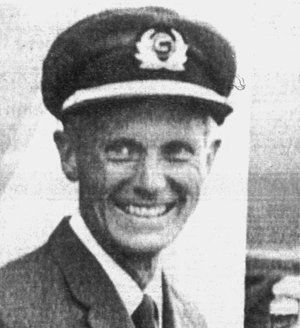
Captain Peter Hogg
Fast forward a few years and we see that Captain Hogg was now working as a Captain with Air Europe. He had found love with a woman named Rosemary Steele. Hogg, Steele along with his sons Geoffrey and David continued to lived in the house in Cranleigh, Surrey that he had shared with his former wife, Margaret. His eldest son, an eighteen year old, was working at Gatwick as a baggage handler and their fourteen year old son was at a boarding school. On March 1st 1984 police divers were searching Wastwater Lake in Cumbria looking for a French student, Veronique Marre who had been reported as missing after a stay at a Youth Hostel in the Lake District the previous year. The lake is the deepest in the UK. Divers found a body in the lake, trussed in carpet and wrapping and weighed down with a concrete block. The body was of a woman in her thirties with dark hair. The icy temperature and plastic had prevented the corpse from decomposing and being eaten by fish. Hogg was arrested in March and charged with Margaret's murder. He was remanded in custody. At a separate hearing he was granted bail on condition he surrender his pilot's license and passport. Captain Hogg admitted killing Margaret by strangling her following an explosive row with her over her lover. The court was told she had come at him like a tiger, scratching him and kicking him in the crutch. Hogg said it was 'extraordinarily painful' He lost control, and retaliated by punching her in the face. He then 'got her by the throat, squeezing hard until she stopped squirming.' Before her body was cold he wrapped her in plastic and carpet and dragged her to the boot of his car. Astonishingly, he then made the 1000 mile round trip to Cumbria. Before setting off, he made an appointment with his son's school in Taunton which he attended, with his wife in the boot of the car. He was aware that people would assume he was spending the night in Taunton. Instead he drove to Cumbria, where, in the dark of night he inflated a dinghy and rowed to what he thought was the deepest part of the lake. He then threw her body overboard. He then drove back to Taunton to pick his son up from school. He then took him home for the school holidays. The body lay undisturbed in the lake for seven and a half years. Hogg said she had been taunting him for years about her affairs. After the murder he said 'Sanity returned and I felt shock, horror and the realisation that I had to get rid of the body.' Back in Cranleigh, he told friends and family that she had walked out on him. He said 'It was quite easy to settle down again.' He said that he had been waiting for years for the midnight knock at the door from police. He wasn't sure if the body would float to the surface. He said he had thought of the incident 'a couple of times a day at least.'
Hogg must have thought he had got away with the crime, which he would have, but for two mistakes. He had not removed her wedding ring which bore the inscription 'Margaret 15-11-63 - Peter. The second mistake was to wrap her body in plastic sheeting that had a shop's name and address in Guildford printed on it. Four extraordinary chances also led to his arrest. The body had only sunk 108 feet, it had been caught on a ledge. If he had rowed just twenty more yards, the body would have sunk 258 feet to the bottom of the lake, and would almost certainly never have been discovered. The third chance, was that the body was, at first, first spotted by civilian divers in December 1983 but had been too heavy for them to lift. The divers had assumed it must have been a dog. Mrs. Hogg was identified using dental records from dentists in the Guildford area. What was even more remarkable was that the dentist had revealed that dental records were destroyed after seven years, and it was completely by chance that her record was held. Captain Hogg was found not guilty of murder, but guilty of manslaughter. He was also found guilty of obstructing the Surrey Coroner and committing perjury in later divorce proceedings, when he swore he had no idea about Margaret's whereabouts. He was sentenced for three years for manslaughter and twelve months consecutively for the other offences.
But back to Dan-Air....
A lightning strike by British Airways in Belfast put Dan-Air's Belfast Manager, Harry Spring to the test on February 24th. All of Dan-Air's flights to Gatwick were fully booked, but Harry asked head office about putting on extra flights. An additional BAC 1-11 and two Boeings were pressed into service. Off duty staff were summonsed and a total of five extra flights were laid on. Harry said: 'We knew we were going to have our busiest day, but we hadn't expected to be at full capacity for a couple more weeks. It just hit us and we tried our best to respond. We carried 805 passengers in total on the day.'
As March approached, rumours circulated that Dan-Air would be withdrawing their application for the Heathrow-Aberdeen service. Dan-Air fiercely denied the rumours and stated that nothing had changed as far as they were concerned. Just two weeks later Dan-Air withdrew their application. A company spokesman said 'We were being realistic and that not only did not not want to fly the route, we don't think anyone else should either' claiming 'We just don't think that there is enough room for two operators on the route let alone three or four. We think the status quo should be retained.'
In May the CAA refused applications from Air Ecosse and Air UK for Aberdeen-London flights. This upset Air Ecosse in particular as they had leased a BAC 1-11 especially for the service, and went to the lengths of training pilots and cabin crew for the new service. Air Ecosse had ambitions to turn Aberdeen into a hub airport.
British Midland would be challenging British airways on the Belfast-Heathrow service from March 25th Dan-Air were successful with the CAA request to offer a low off-peak fare of £27 on their Belfast flights.
A Dan-Air BAC 1-11 was chartered by Pickford's Travel in April for trials of a new pleasure flight. As part of its schedule the aircraft sat idle at Aberdeen for six hours every Monday. Pickfords offered would be jet travellers, a one hour pleasure flight for an affordable £27. The flight would travel around the Scottish Highlands, giving passengers stunning views of the incomparable Scottish landscape. The first two flights were massively over subscribed with Pickfords saying that they could easily have filled another aircraft. The flights offered a paid bar service. The flights were successful and several more were carried out. The Captain of the first flight, Ridley Hall provided commentary as he flew over oil rigs and the Sullem Voe oil terminal.
the Gatwick-Jersey service would restart in May this year, with one way fares from just £35.May would see the inauguration of a new daily scheduled service to Zurich from Manchester using BAC 1-11 aircraft. Switzerland's financial capital, Zurich had already been proven as a successful destination for Dan-Air from Gatwick, in June a second daily service to the city was introduced with BAC 1-11 jets. Berne would now be served from Gatwick with the BAe 146. There would now be 22 flights a day from Gatwick to Switzerland.
For a short time in early 1984, the company used a Handley Page Herald on its scheduled network. This aircraft had to be leased in from British Air Ferries. On February 27th the aircraft took off from Newcastle on a scheduled flight to Stavanger. Shortly after take off, lights in the flight deck indicated that the brakes had jammed. A major incident followed which saw the aircraft flying to burn off fuel and then land declaring a full scale emergency. A minor electrical fault had caused the drama. The next day the aircraft was returned to British Air Ferries, never to return. The negative publicity was something no airline could wish for.
Eight UK airlines, Dan Air, Monarch, Air UK, Britannia, Orion, British Midland, British Caledonian and British Island Airways urged the Government not to sell British Airways off as a monopoly. Whilst they all welcomed the privatisation of the state carrier, they collectively felt that it would be detrimental to thier own survival if BA were allowed to retain 'the dominant position enjoyed by British Airways for historical reasons, should not be perpetuated in private ownership.' The airlines wanted to see an end to the 'immense difficulties' they had faced trying to survive in the shadow of BA. Together, the carriers wrote to the CAA, pressing for an early assurance that in the process of privatisation, the unfair and regulatory bias will not be allowed to weigh against the existing private sector.' They concluded by saying 'It would be a travesty, of commercial justice, if, in the enthusiasm to bring a state corporation to join the private sector, the existing private airlines were to be commercially damaged, and a valuable British industrial asset was depleted in scope and diminished in value.'
Dan-Air issued a statement saying: 'We want less regulation in air travel. Competition between airlines would help bring down air-fares in Europe. Operating costs in Europe are twice the world average, with charges for navigation and landing fees being four times of what the world average is. We want competition, we want more opportunity, we want less regulation, and we want a more simplified fare structure.'
A major review of airline regulation was being carried out by aviation Minister Nick Ridley who was seen to be in favour of less regulation in the air. The review had already indicated that there was a case for reducing the monopoly enjoyed by British Airways. He said: 'More airlines should be allowed on main air routes and regional air transport should be encouraged. The restrictive cartel system of pool arrangements between national airlines should be broken up.'
Ex Dan-Air stewardess Sylvia Lepretre spoke about the relationship between British Airways airline crews had with those from different carriers:
'It wasn't good at all, I was taken on in the 1980s and it was pretty normal to have a chat with the girls from other airlines. Some even shared houses with other airline crew. But British Airways were not at all friendly. I don't know if they were told to be like that or not. We were told not to discuss airline business in front of other airlines, but that was the same with our passengers. Shortly after I joined I heard someone talking about Nigel and Rodney and I asked about them - I was told that was the nick-name for BA pilots! Their stewardesses were called 'horseys' and Lady Penelope' - All because of the way they looked down on us. I laughed out loud when I was told was that British Airways' lousy in-flight breakfast of cereals and a banana was called a 'Rodney Burger'. They didn't like competition, thought they were superior in everything - and they weren't.'
The Belfast-Gatwick service had been a success from the start. The cabin service was even mentioned in the press. Dan-Air said they were 'overwhelmed' at the the number of phone calls, letter and cards praising them. As well as success at Belfast, an extra flight was added to the Zurich route.
There had been a large increase in passenger numbers the previous year, resulting in Davies & Newman share price reached a record high of 181p in January. Davies and Newman claimed that this was due to an unprecedented surge in summer sun bookings. The charter programme for 1984 was looking to be a packed season with the entire fleet fully utilised. End of year profits for the Davies and Newman group rose from £3.32 million to £4.31 million shares rose again to 198p.
On May 24th Dan-Air announced an order for a 149 seat Boeing 737 300 series. The latest, most technologically advanced version of the jet. Disclosing to the press that 'More and more of our scheduled services were now being operated by jet aircraft, the BAe 146 in particular.' Dan-Air said it was ideal for services that had previously been flown with prop-liners. The BAe 146 had double the capacity of the HS-748 and used about the same fuel. The 146 was quieter and had a galley that could prepare hot food. This was an important factor, BAC 1-11 and HS 748 aircraft had galley limitations, neither had ovens, which was a problem if your company was offering hot food. A solution had been found - meals were pre-cooked and packed in vacuum storage boxes before being loaded onto aircraft. These boxes could keep food hot for up to three hours. The BAe 146 outperformed the 1-11 in almost every way. The 748 had been the backbone of oil supply charter flights. These contracts were less popular for oil companies as helicopters with much longer range capabilities were now available. The new helicopters could fly directly from Aberdeen onto the oil rigs. Eliminating the need to fly fixed wing aircraft to a half way point on the Shetland Islands. British Airways and Bristow Helicopters had built up significant fleets, but Dan-Air refused to enter the market with a press report saying:
'We still are by far the largest operator of oil supply charters, but we recognise that newer aircraft in the form of Chinook Helicopters can directly reach oil platforms and rigs. The cost obtaining of these machines is very high and there are disadvantages to that kind of operation. We would have to recruit and train staff, and completely change our style of operation. There have been issues with safety, not with the operators, but with the weather conditions that prevail in that region. It is as far removed as a holiday airline or a scheduled services airline can be. We cannot envisage a time when we would wish to be involved in that kind of operation.'
For the first time, since joining the fleet, the HS 748 was under employed. In no small part because Dan-Air had lost a large oil charter contract in 1982. At one stage fourteen HS 748 had been based at Aberdeen. Leaving just seven of the type working on short haul scheduled flights. The airline wished to concentrate on profitable jet scheduled services and charter flights to holiday destinations.
Dan-Air were successful in their application for a service from Belfast to Amsterdam which would start in July. The success of the Belfast - Gatwick service had surprised many people, since flights had began in February, 30,000 people had chosen Dan-Air. The cheapest 'super saver' fare of £35 was reduced by £2. No other carrier had cheaper fares between the two cities. The small regional airline Genair went bankrupt in July and Dan-Air quickly took over the now vacant Belfast-Tees Side via Newcastle service and Manchester traffic was given a boost when a new service from Manchester to Zurich commenced this year and the Gatwick - Jersey service became an all year round service this year.
Tees-Side was added as an additional stop on the Newcastle-Amsterdam service. Flights would undergo a one month trial period using the BAe 146 aircraft. The new service would see jets replacing the HS-748 turboprop. Fares would be from £79. Dan-Air's Martin Clough said;
'The public are becoming more fastidious, wanting jet aircraft that are also comfortable as well as being faster and quieter. We will be taking on British Caledonian head to head on the service. The service has been a loss-maker for the last two years, but we are confident that the introduction of this aircraft will see a boost in business. Flights between Newcastle and Tees-Side are just twenty minutes and the flight to Amsterdam is a mere sixty minutes, forty minutes faster than before.'
The new Newcastle - Tees Side - Amsterdam service was an overnight success. British Caledonian withdrew from the route shortly after Dan-Air commenced flights, leaving Dan-Air with a monopoly on the route. It was hardly a surprise as British Caledonian's fares were priced at £102 and Dan-Air's were £79. Keen to capitalise on this, it was announced that Dan-Air wanted to link Glasgow to the new service. Fares were also reduced on the Bristol-Amsterdam service, which would now be just £69 return. Cardiff-Amsterdam would be £79 return. If the new routes were successful they would offer them as point to point destinations. The BAe 146 would also be introduced on two days on the daily flights from Cardiff-Bristol-Amsterdam service.
Dan-Air, British Midland and Air UK agreed to apply for different flights out of Manchester if the CAA stripped British Airways of some of their Manchester flights after an anticipated report was published. The three airlines would co-operate on similar flights that BA may also lose from Glasgow and Birmingham. Michael Bishop of British Midland said 'It won't stop other airlines applying for them, but we do not want to enter a dog flight with each other.' Air UK said; 'Because British Airways has domestic services and this huge hub at Heathrow, Its interest is to send passengers via Heathrow. That has slowed the advancement of direct services from Manchester to the continent.'
A new direct service from Tees-Side to Belfast would commence on August 6th. The flights would be operated by 48 seat HS-748 prop-liner. The route had been abandoned by Humberside regional carrier Gen-Air, who, prior going bust had been using Shorts 330s.
A contract with the British Airports Authority to build an eight acre maintenance facility at Gatwick was signed in July. The sixty year lease would see the facility open at the north side of the runway and was believed to cost several million pound. Planning permission was given for the development, which was expected to be phased in over a period of years. Dan-Air could not give details of price, they said, as it would depend on trading patterns. The first phase would involve the developing of a three and a half acres into apron and aircraft parking. Other plans involved a stores warehouse, hanger and office space.
Air Europe had been given a licence to fly scheduled flights between Gatwick and Gibraltar, but decided against operating them. In July they were granted a licence to operate scheduled flights between Gatwick and Palma - a licence Dan-Air had also applied for. A Dan-Air spokesman said that the 'CAA had once again not examined the proposals. For many years independent airlines who operated charter flights were told that they did not have the necessary experience of scheduled service operations. We have been flying them for thirty years. An airline who have never flown scheduled flights were granted a licence after less than five years of operations.' Britannia Airways were granted the licence for Manchester-Palma.
The Parent company of Air Europe, International Leisure Group Chairman, Harry Goodman said that there was an over capacity on the charter market and that despite accounting for 40% of the group's profit, part of Air Europe may be sold. In August Air Europe sold four aircraft and leased out a Boeing 757 it had on order. They also made 40 pilots redundant. The fleet would consist of just three Boeing 737 and two Boeing 757. They also applied for eight scheduled licenses in Spain, Portugal and Gibraltar, one of which was only awarded to BA the month before. British Midland made 39 pilots redundant after failing to wrestle the Manchester-New York service away from British Airways.
British Airways now saw Dan-Air as a potential threat to them on scheduled services, in an effort to get them out of the way at Aberdeen BA increased frequencies on their flights to London. Dan-Air formed an interline agreement with American Airlines to provide feeder flights for their transatlantic services. Business Class passengers would benefit from the use of executive lounges at Aberdeen and Gatwick. British Airways then offered free helicopter flights from Gatwick to Heathrow to connect to their own long haul services. Single trips would be £60 with a super saver fares available at £48. Better value could be found on the 'Extra Saver Ticket' - priced at £30. British Airways' regular single fare was £87. British Airways had lost the battle to stop Dan-Air. Flights The new service would commence in April 1985.
Talks with the Secretary of State for Transport, Nick Ridley, went ahead in August this year. The Government had announced that British Airways would be privatised the following year. A group of 18 independent airlines lobbied ministers to try to get them to ensure BA's Gatwick operations would transfer entirely to the independent airlines ahead of the anticipated £1000 million sale. British Airways however, did not want to lose the routes. The independent carriers saw it as the only way they could survive against a newly privatised airline with increased financial muscle. British Airways had an impressive network that was second to none anywhere in the world. Their fleet of aircraft was 200 strong, with many of the aircraft purchased within with the last year or two. The Government had invested heavily in BA over the last four years to make it more attractive for public sale.
Dan-Air and other airlines claimed that the report concentrated so heavily on British Airways and British Caledonian that it all but disregarded every other UK carrier. The independents accused the Government of investing too much in the state airline in preparation for its privatisation. A White Paper was issued in October which was heavily criticised by Dan-Air, who accused the Government of setting back aviation in the UK by ten years. British Caledonian Chairman, Adam Thomson had a meeting with Prime Minister Margaret Thatcher to discuss the paper. Other airline chiefs then met Transport Secretary Nick Ridley. They pointed out to him that between them they carried more that twenty million passengers and more that 17,000 people were employed by the lobbying airlines alone. They were looking for re-assurance. Lord King, British Airways' Chairman said the Government would be 'breaking a pledge' if it agreed to a transfer of routes to the independents. He said BA supported competition between airlines on individual routes, but rejected a straight transfer. 'It would lead to considerable redundancies and loss of revenue, and therefore profit.' He said.
One of the company managers told us;
'It's something that I have never commented on, and the fact that I am doing so now surprises me. I don't want my name out there, for obvious reasons. The fact of the matter is that British Airways had been primed for sale. BA's privatisation was going to raise a fortune. But it wasn't always like that, just a few years prior, BA stank. They were losing millions on lots of their routes. Their fleet was terrible, and the Government put an absolute fortune into them to make them suitable for privatisation. Behind the scenes they behaved in an appalling way for decades. When they were two carriers (BEA & BOAC) They ordered aircraft that the Government were paying for, well, the public were paying for. Then when they got them, they didn't want them. Despite the fact that the aircraft had been produced specifically for their requirements. BOAC were called 'The Boeing Only Aircraft Corporation' They had the luxury of a huge workforce, who were only too aware that it was very unlikely that they would ever be made redundant. Both companies were terribly over-manned, and the overheads were so much higher than an airline like ours. The merger of the two companies was hellish. Not only for other carriers, but for themselves. They were both giants but they had such different operations. All of this transferred to the public, who had become to loathe them as an airline. Their service was dreadful, they didn't care a toss about their passengers. They didn't have to, because if you wanted to get to a capital city from Heathrow - who else could you fly with? - no-one, unless you went with an overseas carrier. Almost every UK city with an airport had a connection to Heathrow - provided by them of course. What was a fact, was that UK airlines, other than them, were treated as pretend airlines. The CAA would throw us a nugget here and there in an attempt to keep us happy. Everyone knew it was largely a waste of time applying for a licence, because if BA didn't oppose it, then the CAA would, if not them, the BAA. Most independents were indeed playing second fiddle, by operating charter services that might not be there the next year, and were not there all year round in any case. In the early days of package holidays, BEA and BOAC stuck their oars into every aspect of charter flights from the price to where we were allowed to fly. They even set up a charter airline to eat into the very business we clung onto.
It doesn't matter how well we ran the airline, we would never be given a fair chance. The so-called 'third force' in aviation - British Caledonian; it was never a third force. It was a smokescreen, like British United before it was. BCal never got into Heathrow, had they done so - they would have beaten BA on any service. As would we, and we did so on the Inverness-Heathrow sector. When we were given the chance to go head to head on Heathrow-Manchester, BA put on larger aircraft, increased frequency, timed flights to depart ten minutes before each of ours - lowered fares and threw the kitchen sink at it. Of course they were losing money on it. But they could keep that up for as long as it took. Because they had the money - they, until privatisation - had the Government as a bank. Over the years they saw off Laker, ate up BCal, Dan-Air and British Midland - Every route they lost at the time of privatisation - they got back, every landing slot - the lot. It was terrible. What is even worse, is that the most harmful aspects of all this were carried out when the Conservatives were in office. The party of business and competition. They created a near monopoly out of BA in 1973, they invested in a loss making, sloppy carrier, making it ripe for privatisation, and then let them behave like a shark - eating up all opposition. I have nothing but contempt for them. When deregulation started in Europe in 1992, airlines like Easy Jet and Ryanair thrived, thankfully; just look at the size of both of them now, they have been able to achieve what they have achieved since deregulation. Without Heathrow, I might add. We had a good product and the experience - we should have been able to fly from where we wanted to where we wanted with fares we dictated. I am convinced - that we would have become a much bigger airline and still be around today if we could have made our own decisions. I didn't want total deregulation, that could have killed off smaller carriers - I wanted fair regulation. Who were the CAA to tell us 'no'? Airlines know if they can survive on a route after a short time and they withdraw from it. We were being told that we couldn't fly to places because the railways might suffer! We couldn't fly from Liverpool because BEA were flying to the same city from Manchester - Outrageous interventions. My attitude then and now was provided an airline is safe, they should have let them get on with it. The pubic should have decided whether they wanted to fly on Dan-Air, British Airways or any other carrier. What the CAA should have opposed and stopped happening, was airlines, like Laker from being driven out of business. It is a disgrace.'
Associate Director and head of scheduled services, John Varrier was appointed to the Board in late July. He was joined by Associate Personnel Director Malcolm Davies and Danny Bernstein who was Commercial Director of Dan-Air was appointed a director of the airline's parent company Davies and Newman. Captain Bryn Wayt became the airline's Deputy Flight Safety Officer. Wayt, who had served the RAF for twelve years before joining Dan-Air in 1975 flew Comets before joining the BAC 1-11 fleet.
The Labour Party's John Prescott called for the Government to scrap the CAA's report that proposed greater competition among airlines. He said that the CAA's report was 'impracticable, damaging to British aviation, and unhelpful.' The CAA had called for some of British Airways' European routes to be given to independent airlines. British Airways was fearful of a 'triple alliance' from Dan-Air, British Midland and Air UK. Prescott claimed that the CAA was 'a highly partial body.' It was clear that Prescott wasn't partial himself as his brother was employed in the flight deck of Dan-Air as a flight engineer.
August 16th saw Dan-Air in the news for the wrong reasons when it was brought to everyone's attention when it was discovered that only a handful of cabin crew were male. These few males were only employed on mail flights, and oil supply charters. Not on regular services. The airline employed 600 female cabin crew and four female pilots. A statement was issued saying "We honestly believe that the majority of our passengers prefer young ladies as cabin crew." The Equal Opportunities Commission said there would not be a formal investigation. Saying that they preferred 'Persuasion'.
September 28th saw the CAA licence Dan-Air and Air UK to fly direct from Newcastle to Amsterdam. For the third year running Dan-Air would be offering long weekend flights from Newcastle to Stavanger or Bergen for £130. The offer would apply for flights departing Thursday, Friday and Saturday for the winter months. Dan-Air also hoped to fly into Oslo as well as Bergen and Stavanger from Gatwick in 1985.
Dan-Air announced that they wished to extend their links with Heathrow and Inverness. In addition to the flights they already operated between the two cities, They now wished to add a daily service from Inverness to Heathrow via Manchester. Dan-Air claimed that passengers often flew to Heathrow to catch long haul flights that were not available to them from Inverness. As Manchester had a large network, it would make sense to offer a closer airport with many available connections. It would also open up the many package holidays departing from Manchester. The Inverness-Manchester-Heathrow service would replace the existing Inverness-Gatwick service. The year's figure on the existing Inverness-Heathrow route was up 20% to 88,000. The route was an unqualified success.
As the year drew to a close Dan-Air announced that they had applied to serve Lourdes in the south of France with return fares from £102. Despite the economic situation in the UK, with a miner's strike that had, at the end of the year, lasted six months, Dan-Air seemed to be bucking the trend and looked to 1985 with confidence.
For the first time, the company carried over four million passengers. In fact, half a million more than that. In total, 4,559,000 were carried, making 1984 by far the busiest for the airline. The tie in between Metropolitan Airways and Dan-Air had not been entirely successful. After initial successes some of the flights began to lose money. Metropolitan was not in the best of financial health.
Half-year profits for the company had slipped into the red again in October. This was pretty normal, although the figure of £2.97 million was heavy. Increased aircraft hire charges more than wiped out an improved operating surplus. The measure of the airline's expansion was shown with an increase in turnover, which was up from £78.7 million to £99.9 million. In common with much of the airline industry, margins were under pressure.
Bergen and Stavanger in Norway had been a Dan-Air scheduled services destinations for much of its history, operating from Newcastle. The airline applied for scheduled licenses to operate to both cities from Gatwick this year as well as to Lourdes in the south of France. There would also be weekend flights to the Norwegian cites from Newcastle.
1985 was to be a year of expansion Dan-Air said in October. Scheduled flights from Manchester to Oslo were planned and there would be low cost flights from Manchester - Heathrow after British Airways lost their battle to stop Dan-Air entering the route.
The recent problems experienced by Air Europe earlier this year continued to have an impact on the carrier. More staff were made redundant at Manchester. Air Europe were owned by Intasun and the industry was shocked to see Intasun award rival carrier British Airtours a five year contract to carry Intasun holiday-makers, citing 'commercial reasons'. Andy Handford of Air Europe said:
'I believe that whatever the British Airtours deal was, it went beyond what could have been a commercially viable level. It was predatory pricing to take away our business. Yet, Air Europe's profits were £7.6 million, 43% of Intasun's total profit, and with the award of 'charter airline of the year' (awarded by the Travel Trade Gazette) They could reasonably claim to be the best in the business. I am absolutely demoralised.'
British Airtours said that they were not subsidised by British Airways and had to bid for charter business like 'Any other airline. The company's pricing policy is based upon profit, without which we would go out of business. Therefore our prices are commercially viable and not in any way predatory.'
One of our contributors from the charter division told us;
'I had no idea that they were in any way struggling. They always presented themselves as a success story. I worked in the charter division for two decades, and what British Airtours said was true to a point. The thing is, if you own a tour operator and an airline then the interline arrangements are far more simple. You don't have to take bids from other carriers, you know what the margin is for profit. What is more, Air Europe had a better fleet than British Airtours in terms of modernity and cost effectiveness until about 1983. So Air Europe would have been fully aware of Airtours' costs. AE had sold on four aircraft and were about to embark on scheduled services. In my opinion they would have wanted less density in the cabin with better service. They didn't have spare aircraft to dedicate to a scheduled operation. I reckon they just farmed out the charters to anyone. They certainly didn't offer the job to us. We were in an ideal position at Manchester, and we worked for years with Intasun. I dunno, I think this was perhaps the start of their campaign to get us out of the way. I remember even at the beginning they said how efficient their aircraft were and how passengers expected the best in air travel these days. I thought at the time, is that a dig at us? It's a toss-up who was the biggest charter airline, us or Britannia. Thomson's owned Britannia, they were the biggest Tour Operator, so there's no way they could get rid of them. They knew which airlines had the backing of their own Tour Operator and they needed their own aircraft to be chartered by other Tour Operators. The senior management were mainly ex Dans and they knew what we operated and how we did so. We were large and I got the feeling they wanted us to not be so large.'
Air Europe's Gatwick charter passengers had been introduced to a new 'Premier Class' on flights. The service had been popular and was introduced to Manchester charter flights to Tenerife and Madeira. A maximum of eleven passengers would enjoy the service which would be equal to first class travel on European scheduled services they claimed. For between £19 and £38 they would get dedicated check-in, the use of an executive lounge. On board they would get a free bar, hot towels and hot meal. Free wine was served with the meal which would include a meat course, fresh fruit, a cheese board and liqueurs to follow. Plastic glasses and cups were out. Only the best glassware and crockery would be used. The aircraft would also have a dedicated cabin. One of our contributors said:
'It was excellent. My flat-mate worked for them. We were both Manchester based. I must confess I was jealous and did consider applying for a job. I spoke to Diane Humpage who was our base stewardess at Manchester and she said 'yes I've heard about it, sounds fabulous.' When I asked if were doing the same, she shrugged her shoulders and said, 'we'll have to see.' That, was to me, a big mistake for us. We should have been all over that over the winter months. Even for the next year - but we never did anything with the charter flights. I know our service was excellent. As good as anyone's, but we never got in-flight entertainment. I learned that was because it cost too much to install on older aircraft. But the new ones we were getting didn't have it either! We did have an all bells and whistles business class - but not for a few years. It didn't make any difference to my job, but it would have made the passenger's experience better.'
Most of the restrictions concerning charter flights were finally removed this year. From now on there would be total freedom of pricing, choice of destinations, of who they sold seats to, flight times, discounting and seat only selling. Only Cyprus within Europe refused to allow seat only clients, feeling that such a practice may lower the tone of holiday-makers visiting the island.
Seven Boeing 737 were now in the fleet, a larger fleet of the type than Air Europe! Seven Boeing 727 100 and four 200 series were also wearing the company colours. Nineteen BAC 1-11 were used on scheduled services and played a reduced role on charter flights. Four BAe 146 were working on the scheduled services network. Despite oil supply charters decreasing, several HS-748 aircraft were still operating the Aberdeen flights for oil companies. Three of the HS-748 fleet was leased out to British Airways and three more were leased to Philippine Airways, and others flew on low density scheduled services. One of the HS 748s was based at Berlin. The Berlin base also had two 727, one 737 and one BAC 1-11 based permanently in the German city.
Further expansion at Dan-Air Engineering saw the opening a third base - this time at Gatwick. The project would cost an estimated £10 million Lengthy talks resulted in the airline receiving planning permission for the largest hanger at Gatwick to date. The success of the Inverness-Heathrow service warranted Dan-Air looking at Engineering facilities at the Inverness airport in addition to a dedicated cargo facility. Cargo handling had been a major boost to profits on the service. As the company looked back on the year they could boast that many of the routes that had been established now saw extra flights being added, and newer, larger aircraft began to appear throughout the network. The base at Berlin also prospered, following the approval of the Berlin - Saarbruken service using HS 748 aircraft. This was the second route to be operated from within Germany that did not land in the UK. Dan-Air had approval from the Allied Air Attache for the licences to operate the services. This year was important to the charter industry as a whole.
New Routes & Improvements To Existing Routes:
- The airline started a Saarbrucken-West Berlin service, taking over the contract TAT. - January 9th
- Heathrow - Belfast (Aldergrove) - Taken over from British Midland. Dan-Air operated twice daily until March 26th then 3 x daily jet service - introduced the lowest fares on the route. - 5th February
- Gatwick - Zurich route now twice daily - 30th April
- Berne services increased to nine weekly - 30th April
- Manchester - Zurich - Daily service commenced - May 14th
- Gatwick - Jersey all year round service commenced - May 30th
- Newcastle / Tees-side - Amsterdam Commenced - July 16th
- Tees Side / Newcastle - Belfast - Replacing Genair on this service.
- Jet service to Guernsey from Bristol and Cardiff (Replacing HS-748)
- London Heathrow - Manchester - Approval granted. This service would be in direct competition to British Airways' Super Shuttle - Plans to commence services April 1st 1985
- Inverness - Manchester - Route applied for - Hopes to commence April 1st 1985
- Birmingham - Geneva - 16 Weeks ski flights
NETWORK & PRESS 1984
1985
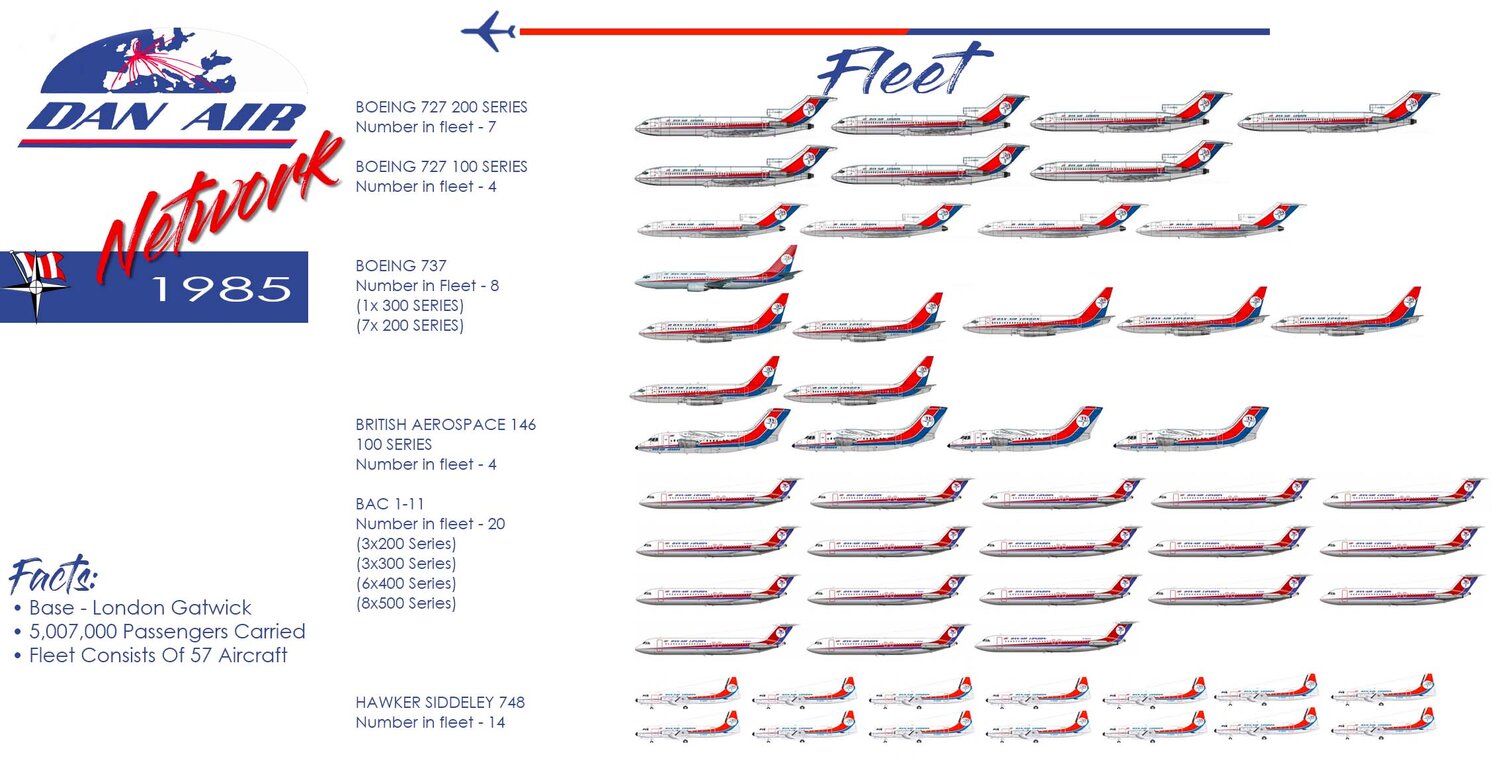
1985 got off to a flying start when in January the millionth BAe 146 passenger was carried. Two of these superb jets were based at Newcastle. As well as their work on the scheduled network they would be used on Dan-Air's charter programme for 1985. They were fully booked at maximum utilisation for the entire year. Over Christmas 1984 and well into the new year, the 146 was able to fly a series of charters to Innsbruck from Gatwick. The first time a British airline had operated there in 20 years. The aircraft also flew to the Swiss capital Berne and Guernsey, the only jet airliner that could operate into the cities.
Newcastle was home to five 146 dedicated flight crews. A further eighteen pilots were based at the airport working on other types of aircraft. Newcastle was now a major base for the airline who could provide engineering support for their aircraft. The airport had cabin crew and ground crew based there and a team of sales staff. Newcastle had also become the home for the airline's pilot training.
A new scheduled service from Newcastle to Oslo would open in March this year, extending Dan-Air's link to Norway. Dan-Air's chief BAe146 pilot, Captain Les Bates confirmed new BAe146 aircraft were on order or option.
On January 9th, a BAC 1-11 carrying 60 passengers was 30 seconds from touch-down at Aberdeen when Air Traffic Controllers refused to give the Captain permission to land. The aircraft had been delayed at Gatwick because of bad weather and was 90 minutes behind schedule as it made its final approach. With just seconds remaining the Captain was told that the airport was closed. The 10:30 p.m closing time was enforced because of local noise restrictions. A Dan-Air spokesman said; 'It was outrageous. The aircraft had to overshoot the runway and divert to Glasgow, 150 miles away. We had a considerable number of complaints from out passengers. We are making a formal complaint to the British Airports Authority.' the airport said that they deeply regretted the inconvenience caused, 'but the law was the law, and we have to live with it'. The diversion to Glasgow had cost Dan-Air £4,000 with extra landing fees and the cost of ferrying passengers by coach to Aberdeen. The aircraft itself had incurred landing and take-off fees at Glasgow plus the extra fuel to fly to Glasgow, and return to Aberdeen in time for its operating schedule the next morning. The passengers did not arrive in Aberdeen until 4 a.m. Recordings of the conversation between air traffic control and the Captain confirmed that the wheels were down, landing lights were on and the time was 10:31 p.m.
The Inverness-Heathrow service had seen a further increase of passenger numbers to 88,000. In January Dan-Air said that they would be dropping the Inverness-Gatwick service and adding extra flights to Heathrow instead. This was purely a response to passenger demand with a spokesman saying: 'Passenger number on the Gatwick service were healthy, but we have learned that many people had chosen Gatwick simply because they could not get onto the Heathrow flights as they were fully booked. We are looking at putting larger aircraft on the flights in March when we stop the Gatwick flights. We knew we had the right product when we took the service over from British Airways, I guess you could say we have been a victim of our own success.'
Twenty eight years old Lynn Barton became the first woman pilot of the new BAe 146 jet in January. Lynn had learned to fly at the same time she learned to drive, aged 17. Now she was a First Officer on the BAe146 flying between Newcastle and London. Londoner Lynn was trained by British Airways but was made redundant in a cost cutting exercise by BA in 1983. She was quickly snapped up by Dan-Air, she said: 'Up to now, no passengers have been worried about being flown by a woman. Some of the stewardesses tell me that some passengers look startled when they hear my voice on the tannoy giving flight details, but I haven't heard anyone demand that the plane land immediately when they hear my voice.'
Mr. Frank Burke, Dan-Air's route standards manager said: 'This company has always pioneered the way for female pilots. In fact I was on the flight when the first all female crew flew a plane from Bristol to Amsterdam in 1977. Lynn is an extremely capable pilot. She regularly pilots our planes into Berne in Switzerland, and that's a difficult landing, with a short runway and mountains all round. The 146 is the only jet which is capable of landing there.' Although Lynn is part of the jet-set, she relaxes quietly between flights: 'I usually sit and read in the hotel or go for a swim. I like the exercise, otherwise I feel like I have been sitting down all day.'
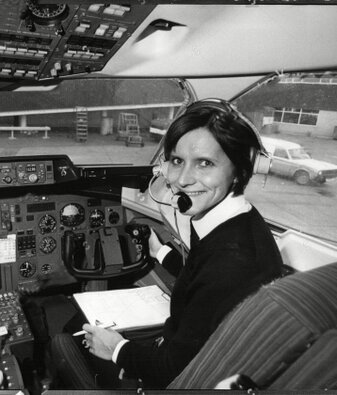
Lynn Barton
On February 6th Dan-Air celebrated a year of flying on the Gatwick-Belfast service. British Midland had given the route up as profitable. Dan-Air had carried 107,000 passengers in the twelve months 56% more than British Midland. Dan-Air's sales manager David Mortimer put the growth down to the introduction of a jet service rather than the Viscount prop that BM used. Northern Ireland General sales agent Gerry Spring said: 'We are absolutely thrilled at the response we have had from passengers.' But he cautioned that the route had not gone into profit yet, which he said was because there were too many carriers flying it. He said the price war on the route in 1983 had been the main culprit for the lack of profit: 'Prices between Belfast and London were being sold at a ridiculously low level, and all the airlines will have lost on it, those losses will have to be recovered. Although he said it would be done gently. He said that there was no chance the airline would change its in-flight facilities, which he said 'were the best any passenger is ever likely to receive when flying in or out of Belfast airport on a domestic flight.' This, he said has become a major attraction, which has made Dan-Air the largest passenger carrying service to and from the province: 'We have the highest load factors compared to any of our competitors. All our flights from Belfast to Bristol, Cardiff and Newcastle have been successful. we believe another contributing factor is that our cabin staff have been recruited locally and this policy is of great benefit as people returning home like to hear a local accent. We have faith in our local staff and we believe that we can do the job better than anyone else.'
Newcastle Airport held a three day holiday exhibition from February 9th this year. Dan-Air had made three aircraft available for the event. A Boeing 737, BAC 1-11 and a BAe 146 would offer 30 minute flights for £15 a head. The aircraft would travel up to 300 mph and would fly as low as 2,000 feet over the North East coastline. It was the first time that pleasure flights sold to the general public had been made available at the airport. People who booked the flights would have to have limited hand luggage and still pass through security. One of the passengers was a 90 year old Lily Anderson who was flying for the first time. Boeing 737 captain Nigel Burnside took the jet to a snowy runway at Newcastle where it took-off into 40 miles per hour winds. Several passengers had to use the sick-bags provided as the winds had caused turbulence.
On 11th February one of the new BAe 146 airliners. After taking off from Newcastle bound for Stavanger, the pilot noticed that there was a problem with a fuel gauge indicator when transferring fuel from one tank to another. The aircraft was 150 miles out into the North Sea when the Captain requested permission to return to Newcastle. An RAF Nimrod and four helicopters were scrambled. Life-boats were launched in case the aircraft needed to ditch into the sea. The aircraft landed safely with all four engines running. It was the second technical hitch the aircraft had suffered that day. Earlier it had left Gatwick for Newcastle and had been taken back to the stand after a starter motor failed, resulting in a delay. Neither incident was related, but the jet was removed from service and a BAC 1-11 was substituted for the flight which was no running two hours behind schedule. The aircraft was repaired and re-entered service the following day.
Dan-Air heard that they had been successful with an application to serve Amsterdam from Manchester on February 11th. The flights would be timed to link with Dan-Air's Aberdeen flights into Manchester.
The self titled 'world's favourite airline' British Airways were up in arms over Dan-Air's plans to fly scheduled services into Madrid and Lisbon from Gatwick. Dan-Air were seeking to limit the amount of flights that British Airways flew on the route. BA claimed that it was not competition, but replacement. Air Europe had plans of their own to operate scheduled flights to Madrid, Barcelona and Malaga. BA said this was substituting one carrier with another, which they said was contrary to Government policy. At the end of March it was announced that there would be three return flights daily between Manchester and Heathrow and a daily return between Inverness and Manchester. There would be three new international services from Manchester from April 1st, to Bergen, Stavanger and Oslo in April. Fares would start from £109 return.
In March, British Airways leased a fourth Dan-Air HS 748 for their Highlands and Islands division. British Airways had recently intensified their presence in Scotland and Dan-Air had a surplus of the aircraft as oil charters had by now declined dramatically. Newer, long range helicopters could fly directly onto oil rigs from the Mainland. The lease of the 748 was also a contradiction of British Airways' stated aims of 1984 that they wanted to get rid of 'old 748s' and replace them with Dash 8s.
Financial results for the full year were announced in May showed that Dan-Air's profits had fallen from £4.3 million last year to just £3.1 million. The airline said intense competition on both the charter and scheduled services were to blame. The fall of sterling did nothing to help. There had been many efficiencies made over the year with better performing aircraft. Turnover was up 20% at £242.8 million. Interest payments were down 48.6% at £1.69 million. There had been a £1.4 million benefit from the share of profits from associated companies. In spite of tough competition 80 charter destinations were served with 450 charter flights a week being carried out. For the first time more than a million passengers were carried on scheduled services.
The new Heathrow-Manchester service, in direct competition with British Airways, commenced in April. The going was tough from the onset, despite APEX fares being as low as £32 one-way. British Airways immediately introduced their new Boeing 757 aircraft onto their service, one that was already firmly established. Dan-Air's load factors were a disaster from day one. In an attempt to make headway on any available passengers, Dan-Air increased the number of flights each day. The number was quickly matched by British Airways, who timed their own departures to take-off ten minutes before the Dan-Air flights were due to depart. A Manchester stewardess said:
'It was awful. British Airways' staff were never friendly to us anyway, but our aircraft were parked next to each other on the domestic pier at Manchester and we had to walk across the apron to board them, so we were looking at them face to face. We had our little 1-11 and they had the 757. Our figures were dreadful, I did a flight with four people on it. I might be naive, but I kind of wanted us both to be successful. I know BA's reputation wasn't great, and I think ours was good for service, but we were mocked because of our aircraft in the past. British Airways just didn't want to share what they saw as their passengers. It's a shame we couldn't make a go of it, because our service was better.'
Dan-Air marketing told passengers that their flights gave people more choice. They didn't offer hot food as it would not be practical on a one hour flight that only spent 30 minutes in the air. In late May, Dan-Air offered two for one flights on the route for the entire month, provided the two passengers travelled together. This, Dan-Air claimed was an attempt to raise awareness of the route. they believed that when passengers had experienced the Dan-Air difference they would be hooked. In reality, all it did was increase load factors for the month of June. No amount of free drinks, free refreshments and great service would be enough. Especially, if every time you had an aircraft scheduled to depart, the competition put one on ten minutes before.
What mattered was flight timings, frequency of flights and possibly aircraft type. This brutal form of competition could not continue, but Dan-Air extended the two for one offer through July. The Boeing 757 that British Airways used was a magnificent aircraft, and had been an instant hit for British Airways as well as several charter operators. Dan Air themselves stated in public that they were considering it.
As well as trying to establish the Heathrow flights, preparations were underway for the launch of scheduled flights to Oslo and Montpellier which were to start on April 29th and May 25th respectively. Prices to Oslo would start at £129 return and Montpellier £153 return.
Newcastle plane-spotters got a treat on Saturday 4th May this year when a brand new Boeing 737 300 series was flown in from Seattle. The aircraft was the first of its type to land at Newcastle. Cleaners looked bemused as they boarded the gleaming jet only to find that the aircraft had just a few seats on board. The 149 seats that would be used in service would be fitted that weekend before the aircraft conducted a series of test flights. It would then enter service. Its first flight would be Gatwick-Zurich. The 300 series was one of only forty that had been delivered world-wide so far. Before the aircraft left the Boeing plant Dan-Air's director of engineering, Lee Crockford was presented with a solid silver key to the plane. the Boeing 737 300 series uses 20% less fuel than the 200 series and carried almost 20 more passengers. The aircraft stayed in Newcastle for one hour before flying to Gatwick to be cleared by customs.
In late 1984 Air Europe had reduced their fleet of Boeing 737 aircraft to just four models, whilst at the same time, their parent company Intasun chartered British Airtours Boeing 737s to carry their holiday-makers. The move was called out as a predatory threat by Air Europe, who's employees who could not understand why they had chosen to sell their own aircraft and charter the same type from another airline. This year, British Airtours hit back at the accusations. Britannia Airways alleged that British Airways' predatory practices forced them to axe 350 jobs. In an attempt to put things right and set the record straight, British Airtours boss, Rod Lynch faced the press. He said he thought it was necessary to clarify the situation concerning the current market position and method of operation;
'As a separate company British Airtours produces its own profit and loss account and balance sheet, and these are audited prior to being submitted, prior to approval by the board of directors. We lease aircraft from our parent company, British Airways, on normal commercial terms, and any suggestion that we lease them for less than the going rate is untrue. If it were true it would not be necessary to lease on the open market, nor would British Airtours be able to lease in aircraft profitably. The charter market is going through one of the most significant changes in recent years, but Airtours do not object to that.
In response to the claim that British Airtours has an unfair advantage over other charter carriers, Mr. Lynch said 'If that were true we would not be the third largest charter airline, behind Dan-Air and Britannia,'
In May, Dan-Air Montpellier flights from Manchester started using BAC 1-11 aircraft. May also saw Air Europe enter the scheduled services market with flights from Gatwick to Palma starting. Air Europe would be in competition with four other airlines on the route.
Orion Airways had been formed as part of the Horizon Holidays Group. By 1984 their fleet had grown to eleven aircraft. For the first five years of its existence Orion flew exclusively for their parent Tour Operator Horizon, who also used Dan-Air aircraft on their programme. In 1985 it was announced that Orion would now carry out charter flights for other Tour Operators besides Horizon. With so many competitors Dan-Air were at risk of being squeezed. Air Europe, Britannia, Monarch and Orion were all after the same business. In most cases the major Tour Operators had their own in house airline. Dan-Air were by far, the largest exception. Britannia commenced operations with wide-body aircraft in 1984, when the Boeing 767 joined their fleet. Britannia Airways carried 4.5 million passengers, in 1985, half a million less than Dan-Air, but the Thomson group profit was £26 million.
A group of boozy rugby players boarded a company HS 748 on a flight from Cardiff bound for Jersey in May. Many of them were already drunk, and shortly after take off began singing bawdy rugby songs and dancing in the aisle. Six of them dropped their trousers in front of cabin crew. The Captain had twice ordered them to behave before landing at Jersey. Upon landing one of the men opened an emergency door and stepped out onto the wing. He then jumped off the wing onto the runway. The danger cannot be overstated as the propellor driven engines were still turning and the man could have been torn to shreds by the blades. The men were arrested and later fined £60 by Jersey magistrates for reckless, drunken behaviour. Dan-Air then refused to carry all fifty of them back to Cardiff, saying: 'We simply cannot risk that kind of behaviour on board our aircraft.' The men had to make their way home by sea and road as other airlines also refused to carry them.
A BAC 1-11 carried out an emergency landing at Gatwick after one of its two engines failed shortly after take-off in May and a Boeing 727 with 170 passengers on board made an emergency landing at the same airport in July after reporting an undercarriage problem. In both cases the aircraft landed safely with no-one hurt.
In June, the Gatwick-Munich service was restarted after a four year absence. This came as a result of a renegotiation of the air services agreement. The Civil Aviation Authority refused Dan-Air's application to revoke British Airways license on the Gatwick-Madrid and Gatwick-Lisbon services. The eleven day hearing also concluded that the state owned airline could not fly from Gatwick to Palma. Rod Lynch, Managing Director of British Airtours, who operated British Airways' flights out of Gatwick said he was pleased with the decision. Dan-Air's Gatwick-Innsbruck service was given the green-light and flights would start in December.
Applications from Orion Airways and British Island Airways to operate their charter flights with 50% of the seats sold as seat only was also refused. The CAA also turned down applications from Air Europe (Gatwick - Madrid, Alicante,Malaga) Britannia (Gatwick - Malaga, Palma) and Orion Airways (Gatwick/Manchester/East Midlands -Alicante, Malaga, Las Palmas, Tenerife, Palma) Michael Croft a travel Manager at Hogg Robinson told us;
'The sheer cockiness of the CAA left us all breathless. We had all sorts of advance material from all of these airlines who were keen to get on the scheduled services market. There was absolutely no reason at all why any of these airlines should have been denied a licence to operate any of these services. What sort of operation did they think these airlines were carrying out? Air Europe, as far as I could see were miles ahead of BA in terms of modernity - and the aircraft that Dan-Air wanted to operate on them were brand new Boeing 737 300s. So it was not the aircraft. The charter airlines had well trained staff, knew how to run an airline, without Government backing I hasten to add. They had everything in place. What were they protecting? British Airways? The public? The airlines themselves? The public were safe anyway, because the same rules applied to charter airlines as they did to charter carriers when it came to safety and airworthiness. The airlines knew all the risks they would be taking, and let's face it, it would be their money they were losing, if the services failed - which was unlikely because they were to high density destinations that were always the most popular - by a long long way. Can you imagine in 2024 saying to an airline - ' you can't sell half the seats on your aircraft as seat only - You can sell 20% of them and the rest of the passengers have to be part of a package tour deal.' - It was a ludicrous situation.'
The Civil Aviation Authority gave Dan-Air permission to extend the two-for-one deal on flights between Manchester and Heathrow. Sales had picked up on the back of the offer, but behind the scenes, Dan-Air knew that once the offer ended, sales would plummet. The airline was not in a position to cut the prices indefinitely and a decision was made to withdraw from the service. The only problem was announcing to the press and public that they had failed to make in-roads on British Airways' route. Captain Alan Selby said:
'I don't think there was anything we could have done to make this one a success. British Airways had been doing it for years. You can only try and tap into the consciousness of new passengers and offer them a choice. Our fares were better, but BA were never going to let us have a share. They just matched us. We could have used a more appealing aircraft perhaps, but BA themselves had replaced Tridents on the run with 757s. So they had the upper hand all along. Whatever we did - they would have matched, so it was better to cut our losses and leave them to it. No point using up a valuable aircraft with no-one on it - we could find better use for it. Gatwick to Manchester was doing ok though.'
The glorious 12th was celebrated in fine style on August 12th - The Grouse were shot in the early morning and were flown to Switzerland by Dan-Air to be prepared in Berne's Belle View Palace Hotel. A brace also went to the Walton Restaurant in London. Almost all the remainder would be on the menu in Nairn, Scotland. The Swiss bound birds would be on the table in under twelve hours since they were shot. A few of the birds, prepared in Aberdeen would be offered to Dan-Air passengers on the 06:50 am flight from Inverness to Heathrow, along with a 'nip of local whisky'.
The CAA gave permission for scheduled flights from Gatwick to Innsbruck, flights would commence on December 19th. BAe146 would carry out the Thursdays, Saturdays and Sundays flights. The airport had not been used to seeing jets as it had a short runway. The BAe146 was the only commercial jet that could carry out flights there. It was another major coup for Dan-Air, who said that if the flights were a success, were looking at daily flights
Both Skybridge Tours and Century tours went into receivership in August. This badly affected Dan-Air's Gatwick-Nice service as the two companies booked 90 holiday-makers onto Dan-Air scheduled service flights every Saturday. The Dublin service was given a boost when the CAA gave permission for both Dan-Air and Aer Lingus to reduce their fares to £89. In 2024 - It must surely come across as strange that government departments were responsible for determining the price of an air ticket. The CAA had recently refused the independents requests for a few pounds increase on the grounds that "They were already making enough money on the routes." It seems almost alien to anyone who wasn't around at the time, to believe that the Civil Aviation Authority deemed it necessary to decide whether a company was making enough money or not.
The British Airtours disaster at Manchester Airport in August involving a Boeing 737 saw the Civil Aviation Authority order immediate checks on 737 engines. The move affected many UK airlines.some of the type were flown home from resorts empty to undergo the major inspection and a number of flights were disrupted. The port engine had exploded on take-off rupturing a fuel tank. The inferno tore through the cabin killing 54 people. As checks began, Monarch Airlines said one of their 737s was affected. The CAA said that aircraft with more than 14,000 hours which had undergone the same modifications that the British Airtours jet had, would need to be checked. The engine was also to be found on Boeing 727 and Douglas DC9 'planes. The engines would have to be either stripped down or x-ray'd to check for defaults. Most airlines operated at least some of the types affected. Dan-Air were able to clear all of their fleet within a day. Panic stricken holiday-makers were phoning Tour Operators demanding that the aircraft type be changed. The Association of British Tour Operators said that passengers had absolutely nothing to worry about. They said that not every engine is affected, and those that were, had been grounded so that modifications can be carried out. Three of Monarch's aircraft were grounded and three of Air Europe's. Dan-Air instructed passengers to turn up at the airport normally. Some of Dan-Air's aircraft were sub-chartered to fly other airline passengers. The flights were extra to their timetable.The accident had led to criticism about emergency chutes and exits on aircraft. The press wrongly claimed that BAC 1-11s were still fitted with ropes to slide down in an emergency evacuation. Diane Humpage of Dan-Air was angered enough to write in to the Manchester Evening News to say that Dan-Air's BAC 1-11s had been fitted with more modern inflatable chutes. Stephen James Chandrell acknowledged Diane's rebuff but stated that British Airways were still using what it called 'old fashioned ropes on 1-11s and asked why the CAA passed such a dreadful means of evacuation.'
The Swiss Travel Service announced that their 1986 programme of holidays would be carried out using Dan-Air scheduled services.
On September 1st, things came to a disastrous conclusion with Metropolitan Airways. The commuter airline had taken over Dan-Air's Link City Network. The small airline's aircraft were painted in Dan-Air colours and had the additional benefit of Dan-Air's ticketing, sales and promotional assistance. Metropolitan would provide the flights and Dan-Air would take a commission. Metropolitan Airways used tiny aircraft with very limited passenger appeal. None of them could provide a full meal service. Co-pilots were even given the task of serving drinks. Metropolitan Airways had asked Dan-Air for financial assistance, which was refused, leading to the collapse of the airline. Metropolitan had upgraded their fleet to include three Shorts 360s which they used on the three time weekly Bristol-cork service. This would be taken oven by Dan-Air, who would use HS 748 on the flights.
The Inverness-Manchester-Heathrow service withdrew two of the three daily return services citing a lack of passengers as the reason. The early morning services had hoped to attract businessmen, who could arrive in central London before 9 am. The later afternoon flights would also be cancelled. Dan-air said that their lunch-time flights were doing well.
Emergency services went into action on October 1st when a BAC 1-11 with 122 people on board reported fuel problems whilst on approach to Gatwick. The aircraft landed safely. Bristol Airport was to see a former cinema that was used to entertain RAF crews during World War Two into a cargo store.
The Heathrow- Manchester route was finally closed in late September when Dan-Air withdrew the route from the network. It had been unprofitable from the start, and subsidising it for longer would have been pointless.
The launch of the Newcastle-Amsterdam service in November came as a result of British Caledonian withdrawing from the route. The fact that Caledonian had now withdrawn from another domestic route that they had operated for a long time was duly noted. It was felt that Caledonian were not performing anywhere near as well as they had in recent years. The CAA awarded both Air UK and Dan-Air a licence for the service.
KLM, The Dutch Airline was also well established on the service, having operated Glasgow-Newcastle-Amsterdam for some time. KLM claimed they were not in competition with the other airlines as they only operated it to get people to Amsterdam to connect to long haul onward flights. Where the two British carriers were aiming at point to point passengers.
The challenge of taking on Air UK was something Dan-Air were more than prepared for. One ex-manager told us: 'We were getting bloody used to it' Dan-Air had secured the first departure slot from Newcastle at 6:45 a.m fifteen minutes earlier than Air UK's departure time. The Air UK flight had earlier departed from Glasgow before landing at Newcastle to pick further passengers up before flying to Amsterdam. Air UK's service commenced operations using a Fokker F28 jet until Dan-Air commenced the service. When Air UK replaced the jet with a 45 seat Fokker F27 turboprop aircraft. Dan-Air introduced the Brand new BAe 146 jet on the service. Even better news for Dan-Air was that they had secured the latest arrival time back at Newcastle, giving businessmen a full day in the Dutch city.
Hot meals would be provided on all Dan-Air services, unlike the catering on KLM and Air UK. Local press decided to review each operator in turn. Air UK's launch service carried just 30 passengers, and although the carrier scored highly with service, the return flight was delayed for an hour and then cancelled because of a leak in one of the engines. Return passengers were thus booked onto the Dan-Air and KLM flights (KLM had refused to take part in the review) Meanwhile the Dan-Air flight had only 10 of its 88 seats empty. The tasty breakfast comprised of grapefruit, served with a hot omelette, sausage,mushroom, tomatoes, a bread roll and jam, orange juice and tea or coffee. The return flight had a complementary bar. The reviewer was impressed with service and praised Dan-Air for using metal cutlery and even serving milk from a jug! The meal, he said, was the best packaged breakfast he had ever had on board an aircraft. Air UK announced they intended to use a BAC 1-11 jet on the service as soon as possible. Dan-Air offered the lowest APEX fare at just £83 return, £10 cheaper than Air UK.
In the early 1970s, the UK Government had decided that there would be a 'second force' in UK aviation. The Government had chosen British Caledonian to be that carrier. British Caledonian would be the UK's flag carrier to South America. British Caledonian operated many impressive scheduled service routes, their most profitable being that of London Gatwick to Buenos Aires, In 1984 the UK Government had almost completed their privatisation plans for British Airways. The newly invigorated British Airways, with a new board of directors, an enhanced fleet and a staggering 83% of all UK scheduled airline passengers, would pose a significant threat both to Dan-Air and British Caledonian both were well aware that British Airways had a disproportionate share of routes flown. BCal wanted the Government to allocate several of BA's long-haul routes directly to them,
In what was seen by many as an arrogant demand, BCal also proposed the transfer of BA's short-/medium-haul routes from Heathrow to Vienna, Helsinki, Athens, Istanbul, Malta and Larnaca, which BCal wanted to serve from Gatwick, The airline furthermore proposed to take over the national carrier's services from Gatwick to the Iberian peninsula and to the Caribbean. British Airways dismissed the demands in a stroke. Meanwhile, BCal lobbied the Government to find a solution to the impasse. All of the independent airlines would struggle to compete with a privatised British Airways. It was suggested that British Caledonian and Dan-Air might take some of the routes and operate them from Heathrow. Caledonian however, wished to remain at Gatwick. The least preferred option was for merger of BCal and British Airways. British Airways' new chairman, Lord King offered £200 million to buy BCal's assets, which British Caledonian said was a 'smash and grab raid'
The residents of the Orkney Islands had grown furious with British Airways lack of progress with bringing connecting services up to a standard compatible with the rest of the network. Air Ecosse and Dan-Air had withdrawn their own applications to serve the islands as they hadn't felt supported by the local council. The same council were now up in arms demanding reduced fares from an airline that had a monopoly. The told the press that for once and for all, British Airways had to lower fares to an attractive rate - otherwise they claimed, that they would have had nothing but broken promises from the airline. British Airways admitted that competition did reduce fares, but said that there was not sufficient traffic to and from the islands to justify another airline.
The huge mess created by the Government and British Airways came to a head in 1985, when eight UK independent airlines made a joint proposal to reduce BA's share of the scheduled services market to 60% (from 83%). This would increase the independent carriers share to 40%. The Government produced a white paper on the matter and the CAA agreed with the some of the consortium of independent airlines airlines requests. The CAA produced a report called the CAP50 that suggested all long haul trunk route flights out of Gatwick be operated by British Caledonian with British Airways being the dominant airline out of Heathrow. They also suggested that BCal take over the Saudi and Caribbean services. In the event, the Government decided not to implement all the recommendations of the CAP50, instead, they proposed giving BCal the Saudi Arabian routes to Dhahran and Jeddah and a new route to the Saudi capital Riyadh.
The route transfer on which BCal had agreed with BA and the Government took effect at the start of the 1985 summer timetable period. BCal commenced scheduled operations from Gatwick to Dhahran and Jeddah, replacing the BA service from Heathrow. At the same time, BCal relinquished its traffic rights to Recife, Salvador, Rio, São Paulo, San Juan, Caracas and Bogotá. British Airways acquired these traffic rights and began serving most of these destinations from Heathrow. BCal made record profits in 1985.
Gatwick Airport had by now become very busy. The Government rejected plans for a second runway and with breath-taking arrogance, British Caledonian called for all charter flights that operated out of Gatwick to be relocated to Stansted. The Government, for their part, agreed to meet BCal half way and said that all scheduled flights from Gatwick would have preference to charter services in all future slot allocations at the airport.
Dan-Air's route planning team had to work hard to find ways to increase their own scheduled network without taking any huge risks. Simply because profit margins in the airline world are notoriously small. The prospect of deregulation was on the horizon, and airlines like Dan-Air were not looking forward to a 'free for all'. But the idea of challenging other carriers on a route by route basis would, Dan-Air hoped, mean a more level playing field.
One source told this website creator:
"Oh of course the CAA were heavily in favour of British Airways. I think that they just did not understand what we did. They saw us as a little charter airline. I think it perplexed them when we applied for scheduled services. I don't know how they thought charter flights operated. There's very little difference to scheduled services when you are on board. If we were carrying more than five million people a year we must have known what we were doing. By the 1980s we had the 146 and the latest 737s. We had earned the right to fly these routes. I won't say the names of some of our rivals, the independents - but some of them were flying aircraft that were ancient - and we were the ones that that got the bad publicity - One such company that had nothing but praise heaped upon it was in such a mess financially that it paid for maintenance we did on their aircraft by giving us a BAC 1-11 because they had no money! I guess that might have narrowed it down a bit as to who I am referring to!! But in all honesty, we had some decent aircraft and our staff were exceptional. By the mid eighties we were as good as anything European, far better than a lot. You know, the CAA awarded licences by way of bi-lateral arrangements with some Eastern Bloc airlines and let them fly into the UK. Some of those aircraft were death traps with metal visible through the tyres! We were gold standard compared to them....! We were in a decent position financially, and we were very well run, with an excellent management structure, but such is life I'm afraid."
The financial half year in October showed that Dan-Air were in the red, this was the usual trend, by April every year the picture was much healthier. This year the results showed that the figures til the end of June had worsened by 20% - or £605,000 with losses at £3,570,000. At the operating level Davies and Newman showed a profit of £5.550,000, but out of this came aircraft hire charges at £5,600,000, depreciation of £2,900,000 and interest at £1,200,000. Chairman Fred Newman said that aircraft utilisation this year was almost exactly the same as the same period last year, but the fall in demand of inclusive tour holidays had 'an adverse effect on the level of activity in the early part of the season. In spite of a difficult year, all our aircraft have worked at their full capacity during the peak summer months. Although margins have been under sever pressure. Ship-building and associated companies made a profit. Share-holders would get an interim dividend of 3p per share.
Two Boeing 727 100 series left the fleet in 1985 to be replaced by one Boeing 737 and a BAe 146 bringing their totals to eight and four respectively. More Boeing 737 were added to the fleet, including the new 300 series - the fleet of that type now numbered eight. Eleven Boeing 727 including four of the 200 series worked on the charter fleet. Twenty BAC 1-11 in four variations were employed on charter and scheduled operations. The HS 748 fleet was reduced to fourteen examples. The oil support flights had seen a further downturn in numbers, resulting in a reduction of the HS-748 fleet further still.
1985 was also a milestone in terms of passenger numbers with more than a million passengers carried, for the first time, on Dan-Air Scheduled Services. Altogether, 5,007,000 people flew with the company in 1985. For a British independent airline to carry more than five million passengers was unprecedented. Making the company second only to British Airways in terms of passengers carried. It was half a million more passengers than Britannia Airways, who claimed to be the largest charter airline in the World. In fact, Dan-Air carried more charter passengers than any other UK airline in 1985, and for many years afterwards. British Caledonian lagged way behind Dan-Air in terms of passengers carried on either scheduled or charter services.
Capt Lynn Barton gained command on the BAe 146 being the first female Captain of the type in the world. Although the company had still failed to recruit male cabin crew, Dan-Air had an impressive record with female flight deck crews. Lynn was one of four female pilots who were employed at the time. The airline had employed several more women in the flight deck.
Following changes in Government rules and the EEC concerning regulation of air routes, making it easier to obtain licences. This resulted in Dan-Air submitting further applications for licences to fly from Alicante, Santiago, Seville and Berlin. With further applications for Manchester to Lisbon and Oporto to commence in 1987. The Gatwick-Lourdes licence applied for in 1985 was successful, as was the Innsbruck application
The Newcastle-Oslo service that Dan Air applied for in 1985 took to the air for the first time this year. It was the fastest route to the Norwegian capital. Fares were from £122 and consolidated Dan Air's position as number one carrier from Newcastle. Dan-Air had been operating for thirty two years it was only right that the CAA were finally giving more routes to them.
New Routes & Improvements To Existing Routes
- January - Applied for weekly Gatwick-Lourdes service - January.
- London Heathrow - Manchester service commenced in direct competition with BA - April 1st
- Manchester - Inverness
- Manchester - Newcastle - Oslo service that connected at Newcastle with Bergen & Stavanger flights began
- Gatwick-Lourdes commenced - April 6th
- Gatwick - Munich services resumes 3 times weekly after break of 4 years - May 1st
- Manchester - Montpellier service begins - May 24th
- London Heathrow - Manchester service discontinued. August
- Gatwick - Innsbruck service begins - December 15th
- Dan Air applied to Civil Aviation Authority to serve Lisbon & Oporto from Manchester commencing 1987
- The company appealed against a rejection for the flights to operate from Gatwick - Lisbon
- Gained Civil Aviation Authority approval to operate London Gatwick - Santiago (Portugal) & Seville (Spain) subject to Portugese & Spanish government approval.
NETWORK & PRESS 1985
1986
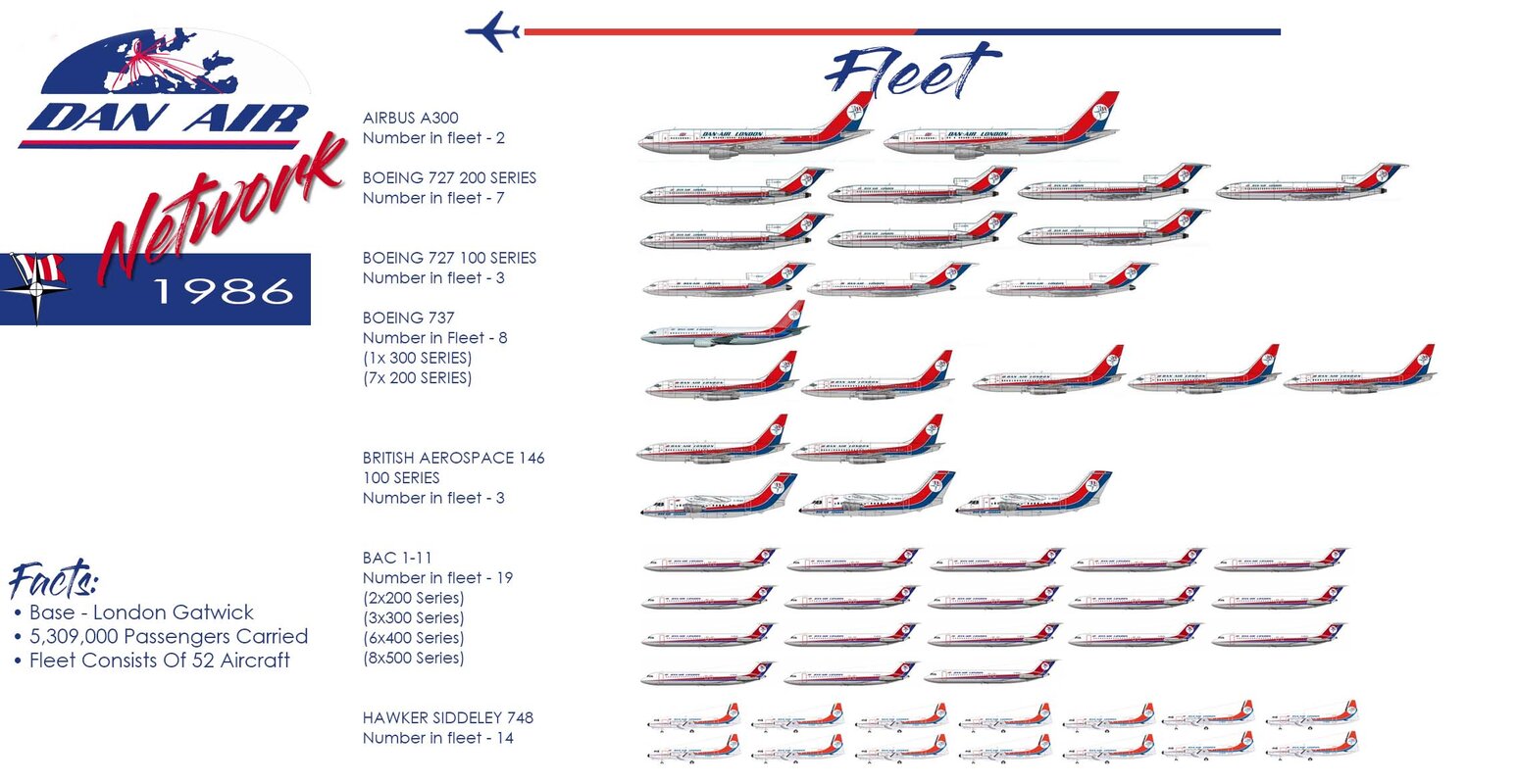
Dan Air carried 5,309,000 passengers in 1986 - increase of several thousand from the previous year. The network of scheduled services was steadily growing, this was in no small part to the UK government relaxing laws on how independent airlines could apply for routes. Dan-Air crossed swords with the CAA in January, after the UK licensing authority had been investigating how to handle proposed increases in traffic up to the year 2000. The CAA had suggested that charter traffic be shifted to Stansted, and that certain airlines should relocate their schedules from Heathrow to Gatwick. Dan-Air were not happy - In a swinging broadside they quipped 'It is up to airlines to decide how they are going to cope with eighty million passengers by 1995 and 100 million by 2000.'
January saw the introduction of a new £75 return fare on the Belfast-Gatwick service, a £5 reduction. The fare would apply to APEX fares, and the 'Late Saver' fare was launched to try to attract business men on the service. The two tier fare structure was also introduced on Channel Islands services where pensioners would be entitled to a 30% discount. The return APEX fare from Gatwick to Jersey was £79.
In Inverness both the Highlands Council and the Inverness Airport Consultative Council contacted the Secretary of State for Transport, Nick Ridley, to urge him not to divert the Inverness-Heathrow service. Dan-Air had worked hard to make the route a success since 1983. British Airways had carried 55,000 passengers in their final year of operation on the route. Dan-Air had increased the number to 102,000. This was a combination of excellent service, flight timings and the use of Heathrow as the preferred terminal. The Inverness-Heathrow service had indeed gone from strength to strength, and by January 24th the route carried its 200,000th passenger.
My own source said:
'Who did they think they were? If traffic was going to grow, why the hell should it be at the expense of airlines like Dan-Air? And why should charter passengers have to be the ones to suffer? That was exactly what I said to you before. they didn't understand Dan-Air and I think they thought of them as second class. British Caledonian, who let's face it, were a relatively small airline, when compared to BA, were demanding all sorts of things and the Government were listening. We had a bigger fleet, and carried far more passengers, but that didn't seem to interest the Government. BCal's chairman, Adam Thompson was very proud of his airline, rightly so. It was a great carrier. He should have perhaps reflected on his own airline's history. When we were taking charter passengers on jet airliners to Spain, he was taking his across the Atlantic on post war piston engined DC6 relics.'
Aberdeen residents, specifically Dyce, close to the airport, had been complaining about noise from aircraft for many years. This had led to restrictions on night flying. New noise restrictions that came into force on January 1st. The noisiest culprit was the Trident, operated by British Airways which had now been replaced with quieter Boeing 737s. Dan-Air had agreed to retro-fit the BAC 1-11 fleet with 'hush kits'. Which would enable them to continue to operate from Aberdeen.
Manchester airport was given a boost in late January when six new services were licensed to operate from the city. Dan-Air had been successful with applications for Amsterdam, Stockholm and Oslo. Although a tiny operator called Sucking Airways would also be permitted to fly to Amsterdam via Ipswich. Connectair would be permitted to fly to Rotterdam and Air Europe to Gibraltar. The routes each came with a start up grant of £450,000 which was provided by British Airways. This start up pool came after the Government published a white paper about airline competition. The total amount was £7,000,000, and Manchester was to receive the largest share.
Angry air stewardess demanded the removal of a raunchy calendar that had just been launched featuring a model wearing a Dan-Air uniform. Te girls claimed the picture depicted them as 'flying call girls'. The model, Gail Thackeray was topless and partially stripped but still wearing the recognisable Dan-Air uniform. The caption under her Miss May page on the Vladivar Vodka calendar reads: 'The excitement of a uniform and the prospect of sex on a plane are classic fantasies, wouldn't everyone like to join the 'Mile-High Club.'
Former chief stewardess, Janet Ford, now in recruitment said: 'It's disgusting, when you consider how hard our girls work and the image they are trying to project.' Vladivar spokesman Phil Staniforth said: 'We did take the insignia off the stewardesses hat and we never did intend to offend anyone. The calendar is all about fantasy not reality.' Model Gail, 20, said 'I think the Dan-Air girls are being a bit stupid, the whole point of the calendar was to be a bit outrageous.' Behind the scenes things were not so light hearted. One stewardess, who wished to remain anonymous told us:
'So, all of the number ones were brought in in groups, of which I was one of. The uniform on the picture was without our logo, but there was a clue that gave the rank of the stewardess. It was a number one's uniform. When we changed uniforms, the company never asked for the old ones back, we always kept them as souvenirs. Those who were temporary staff had to give them back I think at the end of the season. That was because of security I would image, if you were to walk into the airport wearing it, I think you would have got a fair amount of access to places. The ID badges were not as sophisticated as nowadays, you could hold it up and you'd be waved through. The uniform on the picture was the current uniform, and Dan-Air were not only p***ed off that our present uniform was on show, and that it looked like one of our girls was half naked modelling. They were also of the opinion that it must have been a present number one who had given a loan of her uniform, perhaps done so for a bit of extra cash. In my case - it wasn't me by the way - I was asked if I had a boyfriend, which I did - they wanted to know what he did for a living! I think they thought he might have been a photographer! But they might have been right about how the uniform was got hold of, but it could have been anyone. Someone who knew someone from Vladivar or the photographer's sister's aunt's daughter-in-law! No-one came forward that much is true! The entire staff were sent a memo saying that on no account was any part of our uniform be used for anything other than work related purposes, and no part of it may be loaned, sold, or given away. Lots of us laughed. I think our uniform and logo was pretty well known, so I can see the airline's point. I don't want to be rude about the model, but I couldn't see any of our girls doing it. Then again, if the money was right - I might have done it!
The Newcastle-Amsterdam service, which the CAA had awarded to both Air UK and Dan Air in 1985, had been a hard fought battle, with both airlines losing money. The two airlines threw everything they had at it to out do the other. As there was only 15 minutes difference in the departure times, it was a brutal, pointless exercise, that saw neither airline achieving dominance. As a result the two companies decided to share the route with each offering one flight in each direction each day instead of them both operating two returns each. Dan-Air's presence at Newcastle was not entirely diminished, as the summer service to Jersey was very popular, as was the one from Leeds/Bradford. Dan-Air was keen to be part of the growth in Newcastle Airport. In March they could boast that Dan-Air flew to nine airports from the city, as well as a considerable charter programme.
Dan-Air was never an airline to boast loudly about their success. Instead, preferring to let the figures speak for themselves. Their reputation as a first rate regional carrier was fast gaining support from regular repeat passengers. Little touches were implemented, that were sure to keep the company fresh in passengers' minds. One extra touch, on Valentines day this year, was to present every female passenger on a scheduled service with a rose. It was noted and word soon reached the press who reported the lovely gesture.
In January it was reported that Dan-Air were to be the subject of a full investigation by the Equal Opportunities Commission (EOC) regarding their failure to employ male cabin crew. A few men had worked as cabin crew. They carried out a similar role as stewardesses, but they were not called stewards instead they had the title 'loadmaster'; In January 1986 just one man was employed as loadmaster, Russell Smith carried out his duties on the oil related charter flights.
Another man had complained to the Equal Opportunities Commission (EOC) after applying for a job as a male cabin crew member. He was told that Dan-Air only employed female cabin crew.
The EOC's Helen Holden reported;
'We received a complaint asking us if we knew that the airline was operating a sexist recruitment policy. We investigated it and the company confirmed it was their policy and that they were not prepared to change it. They say 'people prefer to be served by a woman.' The complaint came from a man, and the EOC then launched a formal investigation into the airline. This is only the ninth time in the EOC's history that this had happened. For their part, Dan-Air said they would fully co operate with the EOC but were refusing to make a further comment until the investigation was completed.'
Dan-Air found itself in hot water in February when a cargo flight carrying four tonnes of radioactive nuclear fuel from Liverpool to Dounreay flew over Aberdeen city. The aircraft was supposed to only fly in controlled airspace over the country side. Air Traffic Controllers had not been guiding the aircraft, as it was claimed to be flying at over 40,000 feet. Air Traffic Controllers had been in contact at take off without knowing what the aircraft's cargo was. The United Kingdom Atomic Energy Agency said they moved the fuel ten to twelve times a year and that Dan-Air had been carrying out the flights for four years. Local MP Bob Hughes said he was trying to find out the exact route of the flight, reported to be a HS-748. The Secretary of State for Transport, Nick Ridley told him that the aircraft had never flown in Dyce airspace, despite reports claiming that the aircraft had flown directly over Aberdeen.
The success of the Belfast-Gatwick service was quite unexpected. after two years of operation 200,000 passengers were carried which was the total anticipated for a three year period. Dan-Air managed a 12% share of all Belfast - London passengers. The Dublin-Gatwick service had operated six return flights a week, from March this year a further three return flights a week would be added. Return fares would be from £99.
A company Boeing 737 slipped off a taxiway and onto a grass verge in February. The aircraft was being towed and had no-one on board. The tow-bar became dislodged and the aircraft slipped into the tow vehicle before rolling into the grass verge. Fortunately there was no damage to the aircraft.
March saw a new service from Manchester to Amsterdam introduced with daily flights to the Dutch city. As an introductory offer, passengers who booked an APEX ticket could enjoy the return fare for just £77. The Aberdeen-Gatwick service was reduced. The morning and early evening flights would be unaffected but the lunchtime service was scrapped as it was losing money. This was not the case with the Cork-Jersey service which was profitable. Irish links were further strengthened when the Gatwick-Dublin service had three more weekly flights added.
A blueprint for the restriction of domestic flights into heavily congested Heathrow emerged in late March. It detailed a possible end for two services into the capital, those of Dundee and Inverness. Looking further ahead it could also spell restrictions on the number of flights from regional airports with the exception of Glasgow, Edinburgh and Belfast. The Civil Aviation Authority (CAA) had been reviewing the future of UK aviation at the Government's request. It was reported that Heathrow was already congested and that something would have to be done. The CAA recommended that in future, small aircraft and cargo flights should not have access to the airport. There would also be a ban on any new domestic flights. The CAA did not envisage much opposition with the move. However, the third stage was to phase out services with limited inter lining. In other words, flights that did have many passengers joining international flights at Heathrow. This move certainly caused a stir at Dan-Air. Top of the CAA hit list was Euroair's Dundee-Carlisle-Heathrow service and Dan-Air's Inverness-Heathrow flights. Other flights earmarked were those from Plymouth, Newquay, The Isle Of Man, Guernsey and Jersey. The CAA said that they had been analysing the flights for two years and these flights were mainly those simply wanting to fly into London. The CAA claimed that if those flights were diverted into Gatwick or Stanstead, then there would be 10,000 slots opened up for lucrative international flights. The CAA defended their recommendations saying that international air service agreements demand opportunities for international airlines to fly into Heathrow, and there was increasing demand for more international flights into the airport. The CAA said they might also have to 'frequency cap' some of the international services as well. The blueprint would next go to airlines and the Government for consideration. Dan-Air's scheduled services manager, John Jones said;
'We are greatly concerned at the prospect of being forced to switch our flights to say, Stansted, as this would deny our passengers from the Inverness area the right to connect to international and intercontinental flights.'
One of our regular contributors said;
'It was the same old story - if it wasn't the CAA kicking us in the guts then it was the Government with regulations. When I saw this so called 'blueprint' I contacted the CAA and said to them: 'So you have discovered that a flight between two cities is full of people wanting to go from place A to place B - And that took you two years! What in God's name is wrong with that? We had obtained a loss making service from British Airways and developed it into a blue riband trunk route that was carrying a great number of people. It helped Dan-Air make a profit and created jobs. What's more, Dan-Air paid for the landing slots at the going rate and the fuel. We had earned the right to use that airport and to fly to wherever we were licensed. This blueprint ignored the fact that our flights carried mainly businessmen who had work to carry out in the capital city. They needed to go there, do their work and go home in the evening. How dare the CAA tell the Government, or our passengers that they would have to fly into another airport, a great deal further away from the city. How dare they.'
Since 1984 the oil support charters had seen a huge drop in numbers, with all airlines carrying out the flights seeing similar reductions. British Air Ferries had secured a £3 million deal with Shell to take over from Alidair. Shortly after this Alidair went bankrupt.
The UK Government announced plans to privatise the British Airports Authority. The BAA controlled seven UK airports, including Heathrow, Gatwick and Stansted. It was claimed by Trades Unions that airlines Air Europe, Dan-Air and Britannia would be most at risk as the landing fees would increase saying; 'Those domestic flights that are in place after the privatisation will be forced into off peak times. Money spinning international flights that pay higher rates for take-offs will always take precedence.' The claims were dismissed by the BAA who said:
'The times for take-off and landings are decided by a scheduling committee, this has worked for many years, but should this break down the Government will have the power - under the new bill - to impose their own scheme for the allocation of slots.'
In March it was announced that Dan-Air were going wide bodied. The airline had acquired an ex Hapag Lloyd A300 B4 100 series twin-jet, capable of carrying 336 passengers. The aircraft would serve the busy Spanish and Portuguese resorts, as well as the Canary Islands. With twin aisles, and lower operating costs, the aircraft enabled Dan-Air to compete with Britannia's 767. The aircraft began operating in a hybrid colour scheme before being repainted in the current Dan-Air livery. The aircraft was delivered on 29th March. A former cabin crew member told us;
'I was selected for training on the new type which was very exciting. I had been on the 727 and 1-11 until then. This aircraft was enormous compared to them. It was very modern too, although Hapag Lloyd's seats were vile. They were orange and blue with these big flowers on. The tray tables were a yucky brown. When they eventually were re-fitted to our own style they looked fantastic. There were lots of things that I had never done before, like having two aisles and two door boarding, it made me feel like we were really competing with the other charter airlines. We joked that it wasn't new - of course it wasn't - this is Dan-Air! But it was new to us and I loved it.'
March 19th saw the Air Marshal Sir Ian Peddar appointment to the role of Deputy Chairman. Sir Ian had a long and distinguished career with the RAF before going on to be controller of the UK National Air Traffic System and a member of the Civil Aviation Authority.
It was also the date when Dan-Air announced three additional daily return flights from Gatwick to Dublin with a promotional APEX fare of £89 return.
On April 3rd Dan-Air flight DA 081 was just about to set off from Aberdeen to Gatwick on the 7:05 am flight, the safety announcement had been made and the aircraft was taxiing to the runway when passengers heard the Captain shouting emergency instructions to the stewardesses. Passengers recalled seeing the stewardess run the length of the cabin at full speed to open the back door. They were then told to evacuate through the back door or via the slides on either side. In the terminal, passengers were given refreshments and put on the British Airways Heathrow flight two hours later. There were 49 passengers on the flight, captained by Brian Maher. Dan-Air said that the evacuation was a result of a simple malfunction. 'the aircraft had been pushed back and there was a wrong indication that there was a fault on number two engine. the Captain followed all normal procedures including evacuation. There was no panic, no-one was hurt and all the emergency drills were followed exactly. In fact, there was a Civil Aviation Authority man on board, and when he got to London he commended the crew. This type of incident is very rare, but bearing in mind we operate more than 400 flights a week, they are bound to happen occasionally. The incident was formally reported to the CAA and they will carry out an investigation.'
In April this year the Cardiff - Dublin service was dropped as a result of poor sales. A company spokesman said 'Unfortunately the financial performance from Cardiff was not acceptable. We are very disappointed but feel that we couldn't carry on this summer.' The Manchester-Amsterdam service was met with success from the beginning.
The Airbus A300 was delivered on the 30th April. It would enter service for the summer season this year. With 336 seats the aircraft gave Dan-Air the ability to match any of their rivals on European high density destinations.
From its very beginning, Air Europe had been critical of what it perceived as Dan-Air's undercutting, opportunistic risks taken style. They correctly saw that Dan-Air had become highly diversified carrier, but Cossey and O'Regan knew that many of Dan-Air's charter sectors never turned a profit. This weakness, they felt, overwhelmed the Dan-Air management with activities that were seeing a negative return on investment. Dan-Air justified their diversification strategy by its low marginal cost as aircraft and crews were already available. For many years at Dan-Air, each aircraft type represented a 'cost centre line' that was financially accountable for itself.
A typical example of Dan-Air's opportunistic diversification into activities was its long-term commitment to start a comprehensive network of regional scheduled services linking secondary airports across Europe, many of which operated on a seasonal basis only. This took up massive resources – financial and managerial. Cossey and O'Regan therefore honed in on low-risk activities, specifically, a few core activities. These being Short-/medium-haul charter flights, long-haul charter flights and finally, scheduled services serving markets where half of the available capacity could be profitably filled with Intasun customers. Intasun, the second largest Tour Operator in the country at the time, were beginning to show a reluctance to charter Dan-Air aircraft. The company had now started their own scheduled services in Europe. As a display of their intention to show how professional they were, Air Europe soon offered a business section in their aircraft on scheduled routes named 'Premier Class' which presented passengers with improved catering, greater leg-room, a free bar, china crockery, glassware and stainless steel cutlery. The aircraft also had audio and video in-flight entertainment. Something Dan-Air had failed to offer, even on their most lucrative charters.
British Caledonian had been riding on a wave of good fortune after a very difficult first half of the decade. They had been seen by the Government as the preferred independent airline in British aviation for many years, and to some extent BCal was treated exceptionally well by authorities. That is not to say that the company wasn't deserving of this. The airline was a credit to the industry. However, four events in 1986 changed the company forever. The airline had formed a charter division - British Caledonian Charter - which later was re-branded as Cal Air. The three DC10s of Cal Air did not have the impact on the charter market that BCal had envisaged, despite these large aircraft flying to high density Spanish destinations and to far away places such as the USA. Two further incidents had a huge impact on them; in April the US bombed Libya with reprisal attacks, and in Chernobyl, Ukraine, a nuclear reactor suffered the world's worst nuclear accident. These events almost emptied the cabins of BCal's wide-bodied planes plying the transatlantic routes of Houston, Dallas/Fort Worth, Atlanta, New York JFK and Los Angeles, because of a sudden surge in cancellations. Especially from passengers based in the US. Many of BCal's American passengers cancelled or postponed their trips at that time because they feared retaliatory attacks by Libyan secret service agents. Secondly, they did not want to risk exposing themselves to the radioactive fallout from the Ukrainian nuclear catastrophe while conducting their business or spending their holidays in Europe. At the time, BCal's transatlantic scheduled services accounted for a quarter of the airline's worldwide revenues, and 37% of its total passenger traffic. The Libyan bombings also dashed any hopes BCal had to resume operations on its profitable Gatwick - Tripoli route later that year, resulting in a further loss of expected revenues and profits. The fourth event that followed was a text book statement as to how close any airline is away from failure, with profit margins so notoriously low.
Suddenly, the Nigerian currency was devalued. The adverse impact of this on BCal's earnings from passenger and freight bookings originating in Nigeria was devastating. Revenue paid for in the local currency, which the Nigerian government of the day then prevented from being repatriated to the UK. These combined forces turned BCal's record breaking profits the previous year, into a loss of £14 million. Next came the shattering news that BCal had lost the licence for their helicopter shuttle between Gatwick and Heathrow following the opening of the M25 orbital ring road. Altogether, British Caledonian suffered losses of £80 million. A thousand people would be made redundant and significant asset selling became a priority. Two relatively young DC10s were sold and the entire BAC 1-11 fleet was sold to British Aerospace only to be immediately leased back. One BAC 1-11 had been given to Dan-Air as payment for engineering work carried out.
One of our contributors says;
'The thing is, and I would get a roasting for saying this, I believe that Caledonian thought they were something special. They always behaved like every other carrier was inferior. What people didn't see was what went on behind the scenes. So, they had made a holy stink saying that charter flights should get out of Gatwick because it was busy and should only operate scheduled flights - they almost got their own way with that - then they go on to rubbish charter flights - then they start a charter airline - then - when they are down on their uppers, because they lose a ton of scheduled passengers - B Cal itself comes back to the charter scene and start throwing their weight around there, wanting to operate charters out of Gatwick! It was as if they were saying - you guys might have been in the charter business forever, but you are amateurs and should be doing it this way. To be honest I was not a fan of the management of their airline. On top of all this, they were force feeding the world about how fantastic they were, and how crap everyone else was, and yet, we kept on posting profits year in year out. In our darkest times in the nineties - we never came close to losing the amount they lost!'
In May new uniforms were debuted. Several cabin crew have told me how much they hated the hat! The general feeling was that the 1978-86 uniform was a favourite with the 75-78 a close second. Although Aberdeen and Inverness girls didn't like the 1978 hat - as the prevailing winds in the Shetlands often saw Dan-Air girls scurrying across the tarmac to retrieve it. The bowler style has was admired though. The dress and blouse from that period was derided because of its tendency to run when washed. But this was modified over the next few years and many did not want to lose the uniform. One girl said:
'I loved the mix and match as it was called. Each year there might have been a slight alteration, you know collars became smaller than the big old flappy ones of '78. But all things considered, I think it was ideal. This new thing was awful. I hated the kick pleat at the front and I certainly hated that hat. It was something very similar to one my mum bought from British Home Stores. I hated the bow thing as well, with the scarf wed before, we were allowed about four styles to pick from, you know, how we tied it. We could take it off as soon as the doors closed. This thing hung there the whole time. If you put the two side by side now, nearly forty years on, I think the older one is more stylish and timeless.'
The cornflower blue remained, and this was the look that Dan-Air carried, more or less, until its closure. The new uniform could be worn with a skirt or trousers. The coat that accompanied it was also widely criticised for its outsize design. The designers, House of Mansfield, noticed that in the six intervening years, since the last uniform was styled, that the ladies of Dan-Air had also changed shape. Previously the most common figure was 36-24-36 and now they measured 36-24-38. Dan-Air told journalists 'We can't understand it - It's not because our girls haven't developed in this area because they have been sitting on the job.' The new look included a relaxation of rules which allowed the girls to wear selected jewellery and longer. The spokesman continued; 'We're expanding'. No doubt the ladies were pleased at the changes. Dan-Air also debuted a new slogan to go with its new look on their advertisements - 'Dan-Air - We're Going Places'.

There was drama five miles high over Rome in June when a Dan-Air Captain flying a Boeing 737 with 130 passengers aboard from Manchester to the Greek island of Zakinthos radioed to say that he had seen a British Airtours Boeing 737 half a mile in front of him and only 500 feet difference in altitude. Italian Air Traffic controllers immediately told him to turn away. A British Airtours spokeswoman said that their Boeing 737 also carrying 130 passengers from Naples to Gatwick had been travelling in the opposite direction. The Dan-Air Captain had been climbing to 31,000 feet when he was suddenly told to level out at 28,000 feet, but by that time he was already 1,000 feet higher. It was then that he saw the other aircraft. Dan-Air said that they had reported the incident to Italian authorities.
Dan-Air were furious in December when British Caledonian were granted rights, in direct competition on their Aberdeen-Gatwick service. BCal had got around the existing rules by having a 15 minute stop in Manchester. It was now known within aviation circles that British Caledonian was in serious financial difficulty. It was rumoured that a merger with SAS was on the cards. Harry Goodman, the owner of ILG had offered to buy the entire company for £36 million. Goodman wanted BCal's European routes and the slots at Gatwick. By now, his company (Air Europe) had started to operate scheduled flights. The CAA baulked at the idea of ILG buying BCal.
At the same time, Britannia, Monarch and Orion had all launched scheduled services to sunshine destinations such as Alicante and Palma. The semi deregulation of flights in the EU zone had brought large increases in the number of flights taking off and landing throughout Europe. As far as international flights were concerned, the rule was, that if one country agreed to an airline flying the route, then it could go ahead.
The Irish, who wished to protect their state owned, heavily subsidised airline, Aer Lingus. Now objected to Dan-Air flying into Ireland at all. Mrs. Thatcher's UK Government, however, gave approval, so the routes went ahead. As a concession, Aer Lingus were allowed to operate three services from Belfast, something Aer Lingus had previously never been given permission to do. The one and only time an Aer Lingus aircraft had landed in the province was when it carried Eurovision winner Dana on her return flight home after winning the contest in 1970.
Ryanair - the relative newcomer was given approval to fly between Dublin and Luton offering significant price cuts compared to Dan-Air and Aer Lingus/BA. Ryanair had used a 15 seat Embraer aircraft from Waterford to Gatwick and had thus far failed to make a profit. Ryanair's move to Dublin, where the catchment area was far greater, would give them a chance to make in-roads, although Luton Airport itself was not connected to London by rail. Flying into Luton was seen as a disadvantage for most business travellers. Only the most budget conscious travellers would be willing to endure long transfers. The Ryanair fare was £56 one-way, compared to Dan-Air's £97 standard fare. Dan-Air offered several inducements which dramatically reduced their own return fares to £80.
Meanwhile the CAA recommendations from earlier this year reached their conclusion. Because Heathrow was so busy, the CAA decided to move some routes from the main London Heathrow Airport to Gatwick or Stansted, as they had threatened to do. For domestic flights, the criteria laid down was to be the number of interline passengers the route had. So, for instance, 80% of Birmingham-Heathrow passengers went on to catch another flight immediately, so this met the rules. In the case of Dan-Air's Inverness route, only 17% did so, and would therefore have to move. Dan-Air protested, explaining that this was simply because the vast majority of passengers needed to go to central London alone, for business or leisure. The route had been so popular for Dan Air, that they desperately wanted to retain it. The CAA saw otherwise. This led to Dan-Air taking the matter all the way to the then Secretary Of State for Transport - Malcolm Rifkind, who would have the final say. Fortunately he chose to back Dan Air. The Civil Aviation Authority had such power that often an independent airline would have no redress other than to appeal directly to the Secretary of State.
The UK - Ireland routes were the most expensive per mile trips in the world. Dan Air, Aer Lingus and British Airways had reduced fares to a little over £100, which saw Dan Air then reduced theirs to £91. Days later Aer Lingus were offering seats for £74 return. This was all announced before the Irish Authorities had actually given approval. Ultimately, the Irish Aviation Authority agreed that the airlines would be able to carry out their price reductions. Both countries kept Ryanair at bay by being refused to increase the number of flights they could carry out until they could prove they could successfully operate what they were already operating! Although only months before, airlines had dismissed the viability of Ryanair's offering. It was reported that Ryanair had 94% load factors on their HS-748 aircraft and were looking at leasing BAC 1-11s.
As fares to and from Ireland had been so traditionally high - 60% of present day crossings between were by sea. Ferry companies had started to feel the pinch and as a result, they too entered the price war; offering crossings for £79 including rail connections.
The madness of the situation with the Irish Aviation Authority even extended to what aircraft a carrier operated. Ryanair had been using HS-748 and wished to operate BAC 1-11 jets on their services, giving them an equal footing with Dan-Air, British Airways and Aer Lingus. In preparation Ryanair leased three 1-11s from Romanian State airline Tarom for an undisclosed sum. They had been built in Romania under licence from British Aerospace. Ryanair were denied the right to use them on services until the IAA granted approved. In the meantime they would have to continue using HS-748.
The air-fare war would see carriers offering more by way of in-flight catering than their rivals. Dan-Air's own advertisements would boast that they were the only carrier offering free hot meals, free tea and coffee and a free bar for all passengers - even those who had only paid £74 for their flight. In comparison, Ryanair offered a free newspaper and a cup of tea or coffee and a paid for bar.. British Airways and Aer Lingus gave only a free cup of tea or coffee.
One of Dan-Air's HS 748 aircraft was chartered this year to carry a series of flights carrying plutonium on behalf of British Nuclear Fuels. When it was discovered that the highly radioactive waste was The plutonium Liverpool Airport refused permission for the flights to land at Speke. Blackpool was now considered as a departure point by BNFL who needed to take the plutonium to Duunreay power station in Scotland. BNFL had been unable to convince Liverpool that if there was an accident, there would not be a catastrophe. In the end the aircraft took off from Blackpool carrying the plutonium amidst tight security. Each aircraft would weight four tonnes and contain four 14 foot long radioactive fuel assemblies, sealed inside a steel container. The fuel would be brought by road to Blackpool from Sellafield and flown north over the sea to either Thurso or Wick in Scotland.
A cargo of a much lesser risk involved carrying the cast of the hit musical 'cabaret' from Gatwick to Aberdeen after a week of performances at Eastbourne. Leading the cast was celebrated dancer Wayne Sleep who delighted crew with an impromptu dance on the tarmac. Sleep praised the Dan-Air stewardesses as 'delightful'.
A Dan-Air BAC 1-11 was taxiing to the runway at Manchester when leaking fuel from a fire engine set ablaze and was heading towards the airliner. The aircraft with 109 passengers aboard was evacuated. Passengers were taken to safety while the fire was put out and the area cleared. The jet took off an hour later. A Boeing 727 with 170 had to return to Manchester after leaving for Rhodes. A full scale emergency was called after the Captain reported that the undercarriage doors had jammed open. The aircraft landed safely, but passengers had to wait four hours before re-boarding the aircraft. The problem was found to be a flight-deck light that had malfunctioned.
Captain Elizabeth Overbury, one of five female pilots employed by Dan-Air was made the first female Liveryman of the Worshipful Guild of Air Pilots and Air Navigators. Captain Overbury flew out of Newcaslte as Captain on the HS 748. Having started her flying career aged 17 she had by 1986 amassed thousands of flying hours. She was now Dan-Air's longest serving female pilot.
Eating at 35,000 feet was rarely an uplifting experience, but for most Brits it would be the last taste of dear old Blighty before they took their return flight home. The Manchester Evening news went undercover for a review of charter airline food from Manchester:
The Monarch Airlines flight to Faro produced a rather incongruous looking but quite nice tasting chicken and cashew nut sweet and sour sauce with boiled rice - followed by a sticky lemon cheesecake. Dan-Air, on a flight heading to Rhodes, were by far the best, serving a homely chicken and ham pie with mixed vegetables and mini fried potatoes - followed by mandarin cheesecake.
Britannia Airways on a Rimini flight offered a lamb hot pot followed by apple charlotte. Air Europe served roast lamb with vegetables
Airtours holidays signed a multi million pound deal with Dan-Air to charter two BAC 1-11 and a Boeing 727 200 for the winter of 1986 and summer of 1987. Two of the aircraft were to be based at Manchester and one in Birmingham operating for subsidiary company, for Carousel Holidays.
There was no doubt that the BAC 1-11 suited Dan-Air's operation. The problem was that many of them were quite old, newer aircraft were much more cost effective with fuel saving efficiencies. The BAe 146 used a third less fuel than the 1-11. This was a problem that kept coming up for Dan-Air. In the 1970s. There had been a desperate need to replace the fuel-thirsty Comet, which had become a financial burden. The issue Dan-Air faced at the time was how to dispose of almost 20 Comet aircraft, and replace them with 20 less fuel consuming BAC 1-11 or Boeing 727s. Dan-Air had managed to achieve this spectacular feat by taking advantage of other airline misfortune and using their extensive contacts to find out when replacement 1-11s became available. The Comet jets had not reached the end of their air-frame hours, in fact many had thousands of hours remaining. The two fundamental flaws of the Comet was it's fuel consumption and the fact that the aircraft looked old fashioned compared to second generation jets that were now commonplace.
The same problem with fuel inefficiency was now affecting the BAC 1-11 and the 727, in particular the 727 100 series, which had begun to lose its economic edge. The low acquisition costs of the 727 aircraft had offset their high fuel costs. The BAC 1-11 used the same amount of fuel as the more recent Boeing 737, but cost significantly less to purchase. They also carried 11 fewer passengers. Those small details could be the difference from a charter flight being profitable or loss making.
The new aircraft in Dan-Air's fleet such as the Boeing 737 300 and the BAe 146 used significantly less fuel than other types in the fleet. The gap now was far greater than that of the Comet & 727. The problem that Dan-Air had was how to finance new aircraft. Aircraft leasing of the type all airlines today employ, was in its infancy in the 1980s. Some of the Boeing 727 in the fleet had now seen 13 years service with Dan-Air, and three years with their previous owner. The sale value of them was minimal. The 727s main attraction was their extra capacity over the 737, particularly the 200 series.
The long-term solution to this ever present problem, was the 1-11 fleet to be phased out and replaced with the BAe146. The 727 used exclusively on charter flights would be replaced with newer models of the 737. Several national European carriers were still using the 727 and British Airways the BAC 1-11. Captain Alan Selby takes up the story:
'The 727 could be profitable, particularly on scheduled services, where they had a much reduced capacity. Lufthansa, Iberia and Air France all used them between major destinations. Most American carriers used the 727. Scheduled fares were much higher and therefore generated more income. On top of that, they were able to carry cargo. Which would have been very lucrative for those airlines. Their was a business class cabin, with even higher fares. The 727 we had were used entirely on charters where they were not permitted to carry cargo. It might have been a wiser decision to have used 727s with a refitted cabin on scheduled services and not the 737.'
The Ireland-UK price war showed no sign of ending in July when Aer Lingus, closely followed by Dan-Air and British Airways reduced fares again. Return APEX flights from Dublin to London were now £74. Ryanair had blindsided the established carriers and had enjoyed success. Dan-air was accused of 'jumping the gun' with their fares, although commercials did state that their advertised fares were subject to Government approval. The Irish aviation minister faced a dilemma, if he approved the fares, he would be seen as backing airlines at the expense of start up airlines like Ryanair, in an attempt to squeeze them out of business. This had happened a few years earlier when Avair was forced out of business. The Irish state owned ferry company B & I were also worried. The Irish Government had recently given B & I a £38 million rescue package. The Irish were said to be backing the European Commission's emerging 'open skies' policy, which would support lower air-fares to encourage the aviation sector's growth.
In July a flight from Palma to Newcastle saw the pilot radioing ahead to ask police to meet rowdy passengers who had disrupted the flight. The Captain said that passengers had refused to comply with stewardesses demands to quieten down. An airline spokesman said: 'They had been rowdy, shouting and swearing and trying to inflate life-jackets. It was upsetting for other passengers, some of whom had children. they were jeopardising safety and so we had police meet them at the gate. The problem is alcohol, especially duty-free. Most of the difficult passengers start drinking it, which is against the law. What they don't realise is the effect of alcohol in the air. It is almost double the effect than when taken on the ground. They have three drinks and then they don't know what has hit them. They just can't take it. They get drunk very quickly and then the trouble starts. Airlines can refuse to carry any passenger who it thinks is a risk of danger to other passengers. If any passenger behaves in this way we will notify the Tour Operator that we will not carry them home, and we have the right to inform the police. That might mean their first taste of their holiday country is inside a jail.'
More than 100 passengers had to evacuate a BAC 1-11 bound for Spain at Manchester on August 19th after fuel dripping from an engine caught fire. The jet was preparing to taxi when the blaze started. The captain switched off both engines and the fire was put out by a ground engineer using a hand held extinguisher. The 109 passengers disembarked normally and returned to the aircraft two hours later after a repair had been carried out.
Dan-Air were the last major airline to operate services out of Cardiff. In September it was announced that the three weekly return flights from Cardiff to Amsterdam would stop. Falling passenger numbers had brought about the withdrawal which would also take effect at Cardiff. A spokesman said: 'We have tried to make the route the success, we have increased the number of passengers we take on the flights, but it is just not paying its way.' The reservations and tickets office would close and fifteen redundancies were inevitable. Although Dan-air said they would try to find alternative employment for the staff. The cargo facilities at the airport would remain.
British Caledonian banned pipe and cigar smoking on their flights in September. Dan-Air said they already only permitted cigarettes on their flights and had increased the number of non-smoking seats from a third of the cabin to a half, in response to trends.
The feminist magazine 'Everywoman' accused airlines of employing women who were recruited for their looks rather than their skills or common sense. The magazine said that airline cabins were full of inexperienced people who were retired at 28. Dan-Air hit back saying it was their policy to employ cabin crew until they were sixty and that 10% of their girls were over 35. British Midland had a limit of 30 and Air UK 45.
The new look uniform was rolled out to ground crew on September 24th. The uniforms had used enough material to pave the runway at Gatwick four and a half times the airline said.
In September Dan-Air finally agreed that they would drop their 'man ban' and recruit both male and female cabin crew following the months long dispute with the Equal Opportunities Commission. Dan-Air claimed that the decision had nothing to do with the EOC's ruling stating 'Dan-Air has traditionally always employed female cabin crew, but we have taken a firm decision to employ people of either sex, provided the applicant meets the qualifications for the job.'
November 1st saw a new ruling that only permitted airline passengers one piece of cabin baggage limited to 5 kilogram in weight. This was a result of the British Airtours disaster at Manchester in 1985. It was claimed that excessive hand luggage may have prevented passengers exiting the aircraft in time.
There would also be a new system in place where a person who had been denied boarding would have their tickets marked, so that other airlines would be aware of the ban. Nineteen other UK airlines agreed to the scheme. The twenty airlines all agreed that they would refuse to return home any passengers who had caused disruption on outbound flights. A spokesman said:
'This year we have refused boarding to 40 passengers, set against the five million we carry, that isn't a bad figure. The majority of our passengers present us with no problems and just four people behaving badly can spoil the flight for everyone else. It is not an endearing start to your holiday, if what is a major part of it, is disrupted by three or four individuals.'
Although Dan-Air had dropped its policy on only employing female cabin crew in September. The airline was served with a non discrimination notice in late October.. The Equal Opportunities Commission revealed that they had started an investigation on Dan-Air in July of 1985, because it believed the practice of only employing women cabin crew was unlawful, saying: 'The Commission welcomes the company's assurance that they are changing their policies to accord with the Commission's code of practice.' Dan-Air said: We have already made a firm policy decision to employ cabin staff from this point forward irrespective of sex, provided the applicant meets the standards and has the qualifications to do the job.' Dan-Air had between 700 and 1000 stewardesses during a given year and only one of them was employed as a cabin crew member, and he doubled up as a load master. The airline had a pioneering policy with females in the flight deck, with seven women pilots. The airline said it had previously only employed women because of tradition.
Dan-Air, British Airways and Aer Lingus applied to increase fares on the Dublin-London service by 4% but the Irish Government refused the request. They did however allow reduction on fares to Dublin from several UK airports including Manchester, Birmingham, Bristol, East midlands and Glasgow.
At a ceremony on October 17th Dan-Air were presented with a silver Dan-Air aircraft in recognition of twenty five years of service at Newcastle Airport. Deputy chairman Sir Ian Peddar and Captain Elizabeth Overbury accepted the award.
Air Kilroe was a Manchester based a taxi and charter airline with a tiny fleet of Beechcraft and Jetstream regional prop-liners. it was reported in November that Liam Lonergain who owned an Irish Tour Operator called Club Travel had struck a deal with Dan-air to purchase three of its Boeing 727 aircraft configured in a 131 seat layout. Rumours began to circulate in the Irish travel trade that he had already paid a £400,000 deposit for one machine. Lonergain said the rumour was 'not an entire fabrication' He denied that he had put a deposit on the aircraft or made a purchase contract. It was later confirmed that Lonergain had been in serious negotiations with Dan-Air. The other participant in the venture was Tim Kilroe of Air Kilroe, who said: 'As far as I know we are going ahead with it.' Aer Lingus had a complete domination of the charter market in Ireland and it was hoped that this deal would open up the charter market there.
Aberdeen Airport was placed on emergency alert after a company HS 748 took off on an BP oil supply charter flight to Scatsa and had to return. The starboard engine had failed 50 miles out of Aberdeen. Captain john Smith shut down the faulty engine as a precaution and landed safely on one engine. The 33 passengers including a child boarded a British Air Ferries flight to Sumburgh. Along with other airlines, Dan-Air's oil charters continued to decline - The drop in this work saw a reduction in the number of HS-748 aircraft in the fleet.
Santa soared into the jet age on December 7th when he joined more than 100 children on a Boeing 737 that Dan-air had provided for a fun flight around the Newcastle region, followed by a party at Newcastle Airport. BP provided the fuel for the flight Trust House Forte laid on the food for local children. The event was supported by the variety club of great Britain and Dan-air staff who had raised £1,600 for the special day. As a bonus each child would be given a special certificate signed by Newcastle based pilot Captain Geoff Hopkirk.
On December 18th a court heard a list of the problems caused by holidaying pals Mark Brennan and Andrew Smith after downing duty-free drinks on the way home from Majorca. But the troublesome pair came down to earth with a sobering bump when the Boeing 737 from Palma arrived at Newcastle and police were waiting on the tarmac. Brennan aged 25, an unemployed stonemason, and Smith aged 26. a heating engineer admitted being drunk on the Dan-Air flight on August 11th. Each was fined £2OO and ordered to pay Dan Air £64:50 compensation by magistrates at Bedlington. Mr. Donald McFaul, prosecuting, said the homeward flight was turbulent and passengers were asked to stay in their seat with belts on. But Smith got out of his seat and then rubbed food in his friend’s face. A stewardess got him back into his seat but then Brennan started demanding a meal. Mr. McFaul said Brennan was drinking from a bottle of whisky which had to be taken from him but more trouble was to follow. Shortly afterwards the two men pulled life-jackets from under their seats with Smith inflating his. The Captain then radioed ahead requesting the police attend the aircraft on arrival. Strict rules meant that the life-jackets had to be re-tested and this had cost Dan-Air £64:50. Brennan told the court he was just being silly and laughing, but now wanted to apologise, he realised how serious the antics were.
The BAe 146 fleet now totalled three, and they had proved to be effective in the 100 seat market. This had presented opportunities for Dan-Air to replace the HS-748 with the 146 on more routes. Over the last few years the airline had been considering new aircraft. Fred Newman, the airline's Chairman, had stated that he was interested in the Boeing 757, stating that a 200 seat aircraft would suit their style of operation on high density charter routes. The McDonnell Douglas DC 9 Series 80 was also considered. Both aircraft had massive fuel efficiency savings compared to the 727 carrying roughly the same number of passengers. It was the preferred option of British Island Airways who, having recently broken away from Air UK were set on taking on more charter contracts, including some of Dan-Air's, by offering Tour Operators the same sized aircraft as Dan-Air's 727s at greatly reduced rates. One Boeing 727 was sold to an Irish consortium who had plans to form a charter carrier in the republic. This left ten in the charter fleet with seven of those being the latest 200 series. A second Airbus A300 was acquired for the following year's charter programme. Almost five and a half million passengers flew on Dan-Air - the airline had come a long way in thirty three years, and were now, undisputed as the second largest UK airline.
NEW ROUTES & ROUTE CHANGES
- Manchester-Amsterdam service started - March 31st
- A300 G-BMNA start to enters service - May
- Bristol-Amsterdam - Route cancelled after 8 years.
- Luxor charter flights begin - May
NETWORK & PRESS 1986
1987
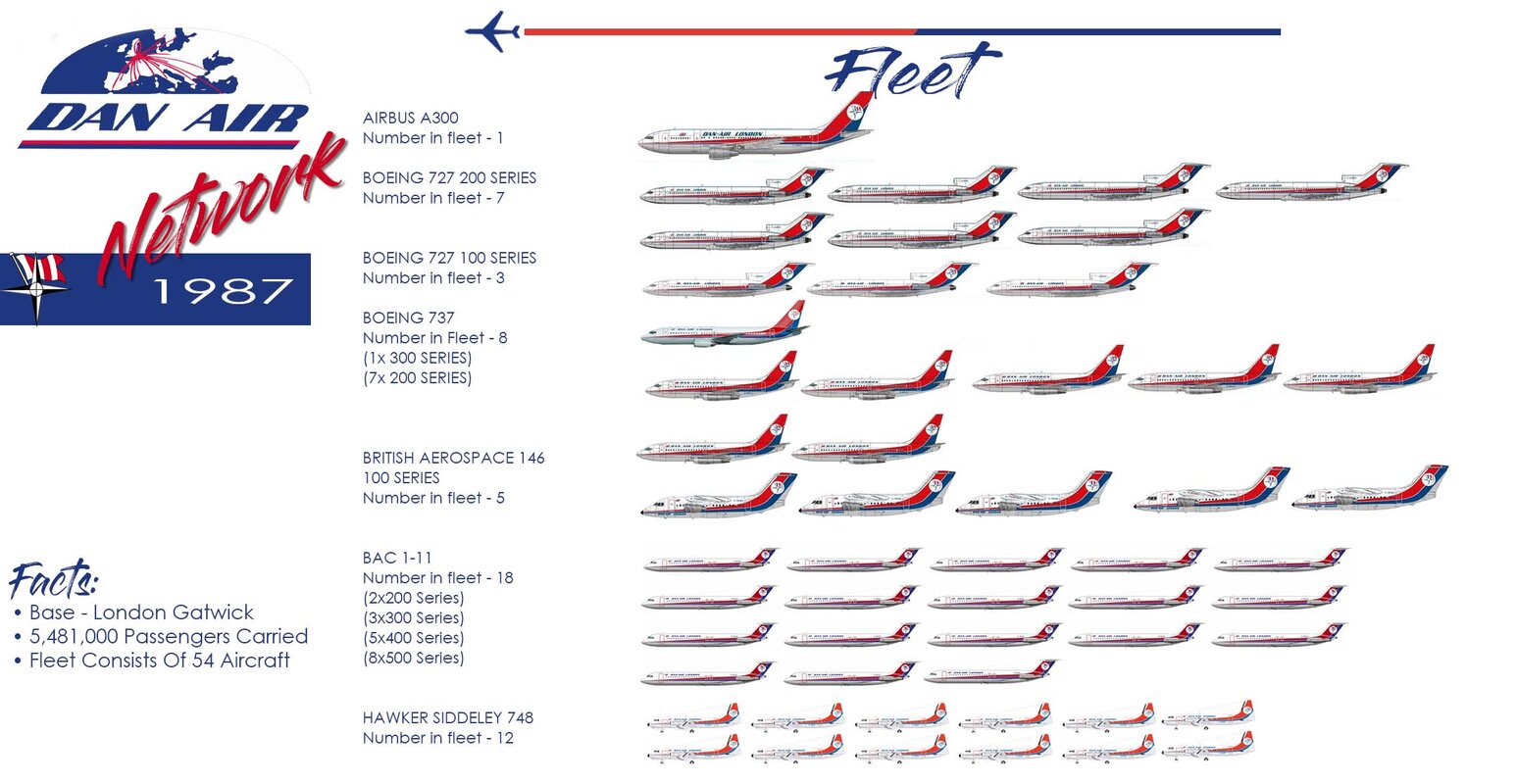
The year got off to an impressive start but the price war between airlines on the Dublin-London route had been damaging to all parties. None of the carriers could make a profit selling tickets at such low fares. The obvious winner throughout the battle was Ryanair, who operated into Luton with much lower landing fees than those at Gatwick and Heathrow. Ryanair had finally been given permission to operate the BAC 1-11 jet on the route in favour of the much smaller HS 748. Their standard return fare was just £94. Dan-Air and Aer Lingus reduced their fares to £95 return to Gatwick and Heathrow, Dan-Air's 'Latesaver' fares were being sold for just £69 return. Whilst Ryanair gave passengers a cup of tea, and Aer Lingus the same with a snack! Dan-Air offered a free bar, hot drinks, hot meals, and a newspaper! The only two conditions that applied being that tickets could only be purchased after 1pm the day before travel. Tickets had to be purchased from a travel agent or a none airport based airline office, finally there was a minimum stay of one night. The rest of the domestic network saw a price hike of 5% but promotional fares were lowered.
Dan-Air were always pioneers when it came to female pilots. Air UK boasted in 1987 that they employed twelve women pilots making them the leader in women flight deck personnel. This was not true! Dan-Air had eight women pilots. Yvonne Sintes was now retired after twelve years flying with Dan-Air. She had been the first pilot to command a commercial aircraft. Air UK's boast was spoiled when a training pilot with the airline said that 'Because we fly turboprop aircraft, which are slower and lighter than jet, we can accept pilots with less flying experience!'
The Airbus A300 was chartered for the winter season for a series of flights to the Canary Islands. The type was perfect for such high density flights. The A300 would be based at Gatwick but would fly ad-hoc charters from other UK airports. A Boeing 727 would be based at Stansted for this year's summer season, replacing the Boeing 737 that had worked there in 1986. The 1986 operation had been a huge success and Tour Operators were confident that a larger aircraft would be profitable. The new aircraft led to an increase in bookings almost immediately. The 727 provided 69 more seats than its predecessor and would be carrying out the same programme as the previous year with flights to Alicante, Palma, Girona, Faro and the Canary Islands. In addition there would be flights to Almeria, Malta and Rhodes.
Airtours, the Manchester based travel agent had, over the last few years, grown from a small, regional retail agent that organised a few package holidays under their own brand, to a fully fledged Tour Operator, employing more than 200 people. Airtours was now the sixth largest Tour Operator in the UK, and had secured a multi million pound charter contract with Dan-Air. The consumer magazine 'Which' had carried out a survey on Tour Operators and Airtours had scored bottom out of forty companies surveyed. In total, 93 Airtours clients were questioned and none would recommend the firm's travel or accommodation standards. Airtours said the survey was unrepresentative. One of our contributors who worked in the charter team says;
'I remember this happening and it was really unfair. If you looked at a Thomson holiday, the price reflected what you got for your money. Thomson usually had Good flight times, and if there was a delay out bound you would get meals and drink vouchers or put up in a hotel at the UK airport. Down route, you would be looked after at the resort hotel, and fed and watered if delays occurred. There would be good food on the aircraft, which was generally a Britannia Airways 737. There would be a nice air-conditioned coach to your hotel when you landed. Their representatives were well trained, efficient and courteous, they would have all the tools needed to ensure they could do their job well. The hotel itself would be of a good standard with a high standard of catering. That standard didn't come cheap you know. On the other hand, if you were to book an Airtours holiday, which I reckon would be roughly about 30-40% cheaper. Therefore they did not have the resources to give you meal vouchers if there was a delay. You couldn't cut corners with safety, but you can knock off all the little extras. Like three course dinners on shorter flights. You would get a sandwich on a three hour flight and just coffee and biscuits on a shorter flight, say to Alicante! So, straight away passengers felt they had lost out. Especially if they had travelled with a company like Thomson on previous holidays. The hotels Airtours used were not dumps by all accounts, but Thomsons had several 'Thomson Exclusive' hotels - where they would be only Tour Operator with guests in the hotel. They could call all the shots at those hotels and insist they maintain a very high standard. Airtours just didn't have the same buying power or volume of guests to do that. I can't speak for them as far as hotels and reps go. But on the flights, I can. Ok - if you say a holiday with Thomsons and Airtours to Benidorm costs £200 with both firms and you had Airtours standards - then you could say Airtours was rubbish - because you got so much more with Thomsons for the same price. But you got a lot less with Airtours - and that was reflected in the price. It was unfair. Like comparing a fish and chip shop to Michelin star restaurant. They both feed you - but it's not the same. The cabin crew were really pee'd off about it. Because they were the ones handing out biscuits on flights. Which I promise was not Dan-Air's fault. We were not making enough profit from these flights to provide hot meals at our expense - that is a fact. If we were to do that it would only be for our own public relations and that doesn't make any sense. Monarch tried that years later - to their cost. As I recall, the meal situation, or lack of it, got to be such a problem, that we had it printed in the in-flight magazine, saying something like; 'Passengers are advised that the catering for scheduled services is provided by Dan-Air - The catering for charter flights is as requested by your Tour Company - Which the crew could use to deflect any barbs.'
Airtours were perfectly well aware that bad publicity would be harmful to their business and promised improvements. They would offer a half price money back guarantee if booking arrangements made by the company to improve its service this year were not fulfilled.
'Which' magazine carried substantial weight with their surveys, but as our previous contributor said - it was not fair to compare two different things. The publication released its own list of favourite airlines. Wardair in Canada, Singapore Airlines and Cathay Pacific of Hong Kong were winners of the Golden Wings Meanwhile, Lead Balloons were awarded Aeroflot, Yugoslavia's Aviogenex, The UK's British Island Airways and Spain's Aviaco and Spantax. Here lies the first inconsistency - 'The Golden Wings' winners were all long-haul operators who had much larger aircraft with far more time to spare to give better service and catering. The Lead Balloon 'winners' included two airlines that were operated in Communist Yugoslavia, carrying out short-haul flights, as were the two Spanish airlines. British Island Airways had a small aircraft fleet, so were as far away from Singapore Airlines as an airline can be. British Caledonian scored the best across the Atlantic, followed by Virgin and British Airways. Those travelling on charter flights were happy with Britannia, Air Europe and Orion and not happy with Dan-Air, Balkan Bulgarian, JAT and Inex Adria of Yugoslavia, Olympic Airways of Greece and Spain's Iberia. As was mentioned previously. The aircraft in the majority of those carriers were exactly the same, with the same seating configuration. A Dan-Air flight chartered by Airtours who served only biscuits to passengers was always going to score badly against a Britannia 737 chartered by industry leader Thomsons who offered cooked meals. They did not compare like with like. Had they done so, they would need to have compared Dan-Air scheduled services with other UK carriers on a similar service, and a Dan-Air charter flight with a charter flight with a UK airline. Something they failed to do.
The Aberdeen Air Fair took place in January and for the second year in succession, thirty under-privileged children were flown on a thirty minute pleasure flight courtesy of Dan-Air. Altogether 4,500 attended the event. It came the same day that Dan-Air announced they had flown 5.3 million passengers in 1986.
Dan Air selected Smith Etcetera as their new advertising agency in January. The Widnes company said they had some fantastic ideas they wanted to show. The Inverness-Heathrow service continued to exceed all expectations. On Burns night all passengers on the service were fed Haggis with a free miniature of whiskey.
The Aberdeen-Amsterdam service had been shared between Dan-Air and Air UK and had worked reasonably well. Dan-Air's George Yeomans said in January: 'The route share will be handed over to Air UK at the end of March. We wanted to be able to concentrate our services where we are the principle UK operator. It gives us more flexibility with fares and timings and enables us to be able to expand services unhindered.'
Bi-lateral talks between the Irish and British Transport ministers and airlines were arranged, with a view to ending the Anglo-Irish price war. representatives from Aer Lingus, Air UK, British Midland, British Airways and Dan-Air would take place in Dublin. Ryanair however, were denied a place around the table. Furious executive Eugene O'Neill said: 'It is absurd that we have been denied the right to attend, how on earth can Aer Lingus,a rival of ours, be expected to validly represent us in an impartial manner? The decision was taken despite us requesting for representation, and the fact that Dan-Air, Air UK, BA and BMA are going to be there.' - Which was a fair description. Aer Lingus denied the claims saying 'It is normal procedure with meeting of this kind. We are there to discuss. Ryanair would be represented by us on an impartial basis. This is the procedure that is normal in European countries, where the Government relies on the expertise of the national airline.'
* Editor's note - I wonder what Pepsi Cola would have to say if they were denied a meeting of drinks manufacturers if Coca Cola, R.Whites and Fanta were going to meeting with a Trade Minister, and Coca Cola said they would impartially represent Pepsi........
Dan-Air was rocked to its very core in February, when the Equal Opportunities Commission (EOC) made its final decision and ruled that Dan-Air had been in breach of of the law. If one reads the 1985/6 timeline, you might recall that Dan-Air had been investigated by the Equal Opportunities Commission following a lengthy investigation into the company about its policy of employing only female cabin crew. The EOC ruled that the airline must change its policy. Dan-Air then went on to say that it had made a 'firm decision to employ people of either sex, provided the applicants meet the standard and requirements of the job and have the right qualifications.'
It later transpired that a male applicant had been planted by the EOC, and when his rejection letter told him the company policy was to employ only females. The EOC were then able to investigate further. Following a fifteen month inquiry the report was published on 2nd February this year. It revealed that on 15th October 1986, the EOC had ordered Dan-Air to change its policy on recruitment. The commission said that during the inquiry - 'Davies and Newman PLC said 'they would not be able to change their policy of excluding male cabin staff because of the risk of AIDS, until the diagnosis and treatment of the disease (be)came clearer.' The report revealed that the airline went to extraordinary lengths to avoid employing male cabin staff. Vacant posts were not advertised and males who phoned enquiring about jobs were discouraged from applying. Schools career sessions were only given to girls and completed applications forms were not processed. No male applicant was ever interviewed. When the commission ordered Dan-Air to employ male cabin crew immediately a spokesman said; 'From this point forward we employ cabin staff irrespective of sex, provided the applicant meets standards and qualifications for the job.' But it was only 2nd February 1987 that the management claim of the AIDS risk was made public. The spokesman went on; 'Dan-Air is an equal opportunities employer - In a statement on October 23rd last year - it introduced an equal opportunities policy throughout the company. This was before the non discriminatory notice was served by the Equal Opportunities Commission, and a firm policy decision was taken to employ cabin crew irrespective of sex. It is well known throughout the industry that Dan-Air has always previous policy was to only employ female cabin crew. However, it was stated at the time that Dan-Air changed its policies and practices in the light of medical evidence that there is nothing in particular in the line of work as cabin crew which should give rise to the spread of AIDS. We are recruiting male cabin crew now and expect to take on about 20. we will end our old policy immediately We presently receive about 400 applications from females a month and approximately 40 from males.'
Counsel for the company said that AIDS mainly affects homosexuals and that up to 30% of males attracted to cabin crew work were homosexuals. Counsel also alleged that cabin crew were generally sexually promiscuous and made the point that AIDS was generally transmitted through sexual intercourse. It was claimed that the disease could also be spread by blood and saliva and therefore there were risks if cabin crew cut themselves at work or if they were administering artificial resuscitation. The airline believed that in the circumstances its policy of discriminating against men was justified under the Health and Safety at Work Act 1974, which obliged employers to ensure the health, safety and welfare of employees and others. The commission consulted two AIDS experts, both provided written evidence to say that there was 'no medical evidence' to support the belief that AIDS could be transmitted by mouth to mouth resuscitation. Basic hygiene and commonsense were sufficient to prevent any contamination of food.' The commission said that Dan-Air had agreed to comply with its order. The airline said their comments about cabin crew being 'promiscuous' had been over simplification resulting from summarising complicating evidence. 'Dan-Air has the highest regard for the personal and professional integrity of our cabin crew which we regard as second to none among British airlines.'
I have to give full disclosure here. I was interviewed for a cabin crew post roughly at this time. I had been an admirer of the company for many years and I did wish to fly. The fact that I have created this website twenty years after the airline ceased trading is testimony to my admiration of the company, and that I continue doing so in 2025 - thirty three years after the company's closure shows pure devotion.
My disclosure comes because of the way I was interviewed, and some of the questions that were asked of me. It was a regrettable experience that tarnished entirely my view of the airline. Whilst the crews, I suspect with very few exceptions, would have a positive attitude to male crew, some of the 'higher ups' including Arthur Larkman, who wrote about the matter in his memoirs, actually still believed this so called 'defence'.
I believe it was bad judgement to continue with such a stance. Dan-Air's position was inexcusable. It was inaccurate and insulting - even to the female cabin crew they already employed. Perhaps worst of all - it was largely uninformed. The airline deserved to be called out on the matter, and made to change their policy. Experts at the hearing said Dan-Air were wrong to assume that anyone was at risk - as the disease was not spread by saliva, food or food handling. There had been early reports that it could have been. Very quickly it was established that it would take pints and pints of saliva to infect a person, and even then - the chances were next to impossible.
What was inexcusable was the apparent disregard of the difference between HIV and AIDS which are two linked, but entirely different illnesses. To suggest that a person who had AIDS would be working is incredible. A person with HIV might well have been working, perhaps unaware that they even had the disease. Should that person's HIV positive status develop into AIDS they would almost certainly not be working, they would be very poorly. It would be a matter of weeks or months before they would be hospitalised - because they would be dying. The lifespan at that time of a person infected was roughly two years. A person with AIDS would simply not be well enough to work.
The Government had spent millions on educating the nation about HIV and AIDS with a country wide leafleting campaign along with TV advertisements. The LGBT plus community had been pushing a major safer sex initiative running in tandem with the Government's own. This had been embraced by the gay community. Charities produced leaflets and even provided extra strong condoms free of charge to high risk groups. Going as far as to provide them in large bowls on bar tops throughout the country. There had been initiatives to increase sexual health screening and provide free and confidential testing across the country. Gay community groups had worked with Government agencies to get the message through to gay and bisexual men. The campaign had proved to be so successful that the rates of infection, whilst still on the rise had slowed down among those groups. Meanwhile, by 1987 the most 'at risk' groups of the country were now heterosexual sex workers, intravenous drug users and heterosexual and bi-sexual men and women who were still refusing to practice safe sex.
In the 1980s, HIV awareness was much less than it is now, but even then - simple research, and discussions with relevant organisations would have provided Dan-Air management with all the answers that they would have needed.
Given all of that - It still seems to me, that a lot of middle aged men, in middle and senior management, simply preferred to employ female cabin crew. It may not be very politically correct to hold that view in 2025, and certainly not to say it aloud, let alone have it as an official policy - Back then, it might have at least been an honest point of view. It is a view, that even me, as a gay male, could have been sympathetic to. But the fact of the matter is, that point of view was not even politically correct in 1987!
By the late 1980s men were employed as nurses, midwives, and other female dominated environments. Women too had become pilots, plumbers and construction workers. Nobody with an enlightened attitude would have opinions about women being chained to a kitchen sink and men being the bread winner. It is the sole source of shame and embarrassment that I could find in the Dan-Air story. This is also not the blame of the general workforce, who, like the overwhelming majority of the country, couldn't care less, the sexuality of their colleague.
Dan-Air had employed regular male cabin crew on certain flights since the early 1970s. Long before HIV and AIDS had appeared . These gentlemen were known as 'Loadmasters' who's responsibility was to work as the title would imply, on cargo flights to ensure paper-work was carried out and that freight was secure. They would then provide cabin services to the flight deck. These men would also work on oil supply charter flights. Where an entirely male group of passengers were carried to the Shetland Isles to and from Scottish airports en route to the oil rigs. These flights also used female cabin crew. Loadmasters were employed to use as 'brute force' where it is presumed female cabin crew would not be capable to doing the job in case they broke a nail or got oil on their skirt. - It really is as ridiculous as that!
What was Dan-Air's excuse for not fully fledged male cabin crew until they were forced to have them? BOAC and BEA already employed them as did British Caledonian. In fact, the history of cabin crew details that at one time only men were employed in the role. Certainly when we reach the golden age of air travel in the 1960s, women would work as air hostesses, but always with a man in charge of the cabin. British Midland had employed men for many years - their Chairman was openly homosexual. Virgin employed men and Air Europe, Monarch Orion and Britannia had employed them for several years.
After the publication of the report, The Transport Trades Unions pulled no punches - carpeting Dan-Air, saying that it was 'an insult to suggest that Cabin Crew were any more promiscuous than people employed in any other industry'. At the same time, Dan-Air said they had relied on the words of their 'in-house' Doctor. Which was an absurdly weak response. Was this Doctor a HIV and AIDS specialist? Did Dan-Air or the Doctor engage with AIDS charities or organisations to find out the full facts? It would appear not. One journalist wrote that if staff had very ill with what transpired to be cancer, would they just rely on the diagnosis an 'in-house' GP? We live in different times, thankfully, and people like politicians are acutely aware of the 'optics' of what is being presented to the public. Spin Doctors and SPADS are there to advise which line to take. Looking back, it seems the airline was floundering in unenlightened waters. My advise would have been to say 'We are wrong - we are being old fashioned - we have listened to the facts - we are sorry, we will correct this immediately.' - BUT
Dan-Air initially refused to comply with the EOC's recommendations. they said; 'Having to employ men they would be actively discriminating against women!' When confronted with evidence about the spread of the disease. Arthur Larkman said many years later, in his book An Airline and its People 'The EOC had 'no experience in aircraft and galley conditions'.
REALLY? All those years afterwards? - was hes still of the same opinion that AIDS could be spread in an aircraft galley during a working period? Did he believe that people at work were injecting drugs with dirty, shared, infected needles? That cabin crew were having unprotected sex in the galleys? If they were, with whom? Each other? Passengers? With airline and airport staff?
When Dan-Air were eventually forced into employing male cabin crew; these men had to endure the indignity of an AIDS test - something that no potential employee should ever have to undergo. Even higher-risk occupations in medicine didn't make staff do this. According to Larkman, the first applicant tested positive for HIV - Not AIDS, as has been claimed in his book. The EOC rightly said that this was depriving people of their right to privacy. To which the airline pointed out that therefore every test was an deprivation of privacy!
Because the ONLY way to pass on the disease then - and now, is through unprotected sex - passing on infected blood, semon, or bodily fluids. NONE of which would be present in a galley. At least one hopes not! The virus is actually a weak virus, and outside the body, those fluids quickly lose viral strength. In fact, simple hand washing would kill it from unbroken skin. Even if a crew member cut themselves - another crew member would have to cut themselves - and the two sets of blood then combine to have ANY chance of infection.
Nowadays there is a simply daily tablet that a person who is HIV positive takes. This makes the virus UNDETECTABLE and also means that the HIV positive person CANNOT pass the virus on. Even if they have repeated unprotected sex.
Incidentally Arthur Larkman, whilst acknowledging that male cabin crew served the airline well, went on to write that his opinion 'is unchanged' He even bemoaned that their proud record of employing female pilots had been somewhat hampered as British Airways knew that they had not employed female pilots. Following the EOC investigation, BA went on to poach some of Dan-Air's female pilots. One of those had left the company to fly long haul Boeing 747 with British Airways.
To have had that opinion back then, could perhaps be understood, even tolerated HIV and AIDS was a new and frightening disease. Larkman's book was published in 2008, I sincerely hope his attitude has changed.
Following the hearing, several Dan-Air Stewardess were incensed. They had witnessed, in an open forum, from Dan-Air management, that cabin crew were promiscuous. This was met by Dan-Air stewardesses and Unions with fury. The Dan-Air Chairman, Fred Newman sent all stewardesses a bouquet of flowers and an apology letter. In an additional move the airline donated £5,000 to the Children's Trust charity which organised flights for disadvantaged children. (Author's note - perhaps the money might have been better served if given to a women's charity and an AIDS charity)
The unique relationship that Dan-Air management had with all their staff had been put in serious jeopardy through ignorance. From a public relations point of view - this was a disaster - Some good news was needed.
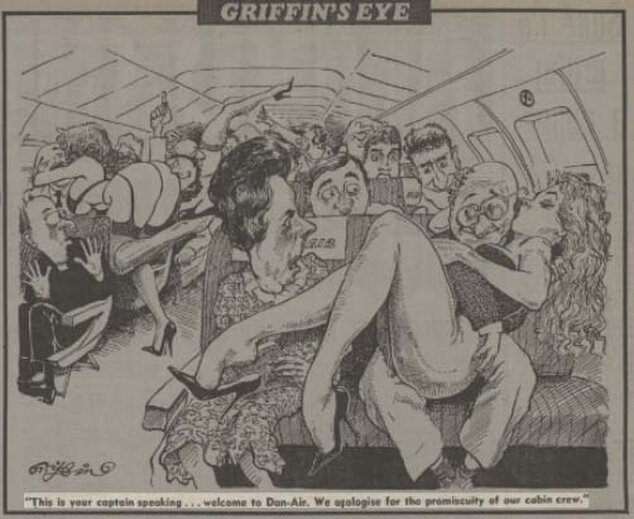
The good news came when Andrew (Mitch) Young became Dan-Air's first male flight attendant in March. His first flight was from Inverness to Heathrow. A new uniform for male cabin crew was introduced and with each intake of new recruits, male cabin crew became more visible.
One former male cabin staff told us;
"I had applied the year before and was rejected without an interview, I re-applied and was invited to attend an interview, and travelled all the way from Scotland to London for it, I wanted to relocate anyway because I felt trapped in a fairly small town, I am a gay man and I needed to experience city life. At the interview I was asked some very peculiar questions. I won't say who interviewed me, because she is still around, and I do really adore her. She knew the questions were bizarre. Without saying it, she was trying to find out if I was gay or not, not that it bothered her, as it happens. She later told me that she loves gay men!! She asked if I would be prepared to take an AIDS test which I baulked at. I agreed because I was desperate to fly. As it happened it was just days after the company lost at the hearing. So I never had to have the test. As a matter of fact, I had the test regularly anyway, but that's another story. When it came to the training I knew I was with a great airline. They helped me find some temporary accommodation and I ended up sharing a house with two Dan-Air girls, I had five fantastic years with Dan-Air and I was never made to feel uncomfortable by any of the cabin crew. There were a few pilots who I knew weren't impressed with the boys. But we weren't impressed with them either, and the girls felt the same way as us. We called them fossils and dinosaurs. One nameless pilot, once said to me that he was ok with gay men as long as they didn't 'try it on' with him. My female colleague replied 'He's not that desperate!!' That borders on arrogance don't you think? There I was, a fairly good looking young man, well turned out, and the Captain was this flabby, middle aged bloke who obviously thought gay men will go with any old man. I told the First Officer my thoughts and he confided in me that he was bisexual! Actually, the First Officer was a bit of a hunk. We both laughed about the Captain's remarks. After Dans was taken over I went to BA and did a year - but I resented what they had done to us. Our terms were not as good as those already at BA so I went to Virgin, where I am still flying today.'
Another said;
"Well, I had been applying for cabin crew jobs with loads of airlines. I knew that the competition was tough. Thousands applied for perhaps a few hundred vacancies. When I saw Dan-Air's advertisements, I thought I was in with a good chance because they had just had their knuckles rapped for not employing men. The first interview was a bit intrusive, I had never had my sexuality questioned before at an airline interview. Anyhow, I took to the training like a duck to water. I was determined to be as good as I could be. My trainer said I was 'outstanding'. We became close, socially much later on. I told her that if men want to be served by dolly birds - a term I don't like - then what about all the women passengers we had? Didn't they deserve to be served by an attractive man? I know most male cabin staff are gay - so what! I was good at what I did. I even did the 18-30 flights and enjoyed a bit of banter with the passengers. Stuffy men in the boardroom were not in the same bubble that we were in. But, at my time at Dan-Air I was hit on by two flight deck crew. One I rejected, saying 'Your wife will kill you, or I will' and the other, I am proud to say, I accepted, and I am still with him today. I later went on, thanks in part to him, to pursue a career as a pilot myself. I am almost at the end of my flying career now, and I have Dan-Air to thank for giving me the opportunity to get the flying bug, and to my husband, who pushed me to believe in my ability. We both flew long haul for a long time. He retired a few years ago. The sad thing was that he never felt he could come out to his colleagues at Dan-Air. We had to keep our romance a secret. He believes to this day, that they would have got rid of him. It was the climate of the time to be hostile in general to gay people. I'm sure that some, if not most, of his colleagues had an idea he was gay, because he was the age he was, and still single. I told a few of my hostie mates, and, no doubt they all blabbed anyway!! But, thankfully, I don't think it reached the personnel department or the boardroom.'
One former steward had a sad tale;
'I joined in 1990 and I am pleased to say after reading what people had said on this site, that things had changed at the interview stage. I was treated the same as everyone else as far as I can recall. The training course was tough, or shall I say thorough! It wasn't easy for me to store all that information - but I managed it. I was a party animal until that course started. But I wanted it so bad, that I stayed in at nights and studied. I got my wings and started flying. I wouldn't say I am massively effeminate, but it's fair to say that it's pretty obvious I am gay. Some of the flight deck crews were downright rude. There was a Scottish one - I absolutely detested him. He would say things like; 'If you were on the oil charters in Scotland, those lads would eat you alive. They'd tear you limb from limb.' He would make a point of saying to a complete stranger that 'This is one of the boys that we now employ' and while he said it he would make his wrist go limp and say it with a camp voice. A number one once said to him; 'that's enough! And your rank doesn't frighten me nor stop me from reporting this'. It's a shame that some of the Dan-Air pilots were so old. Many were ex-military and it showed. The younger ones were much nicer. I did meet some of the very senior management over the years, including Mr. Newman. He was very courteous and pleasant and said we had brought something new to the airline, and well done. Whether he meant it - I don't know. In the end, I left for Airtours when they started long-haul. It was difficult because I had made friends at Dan-Air. But Airtours was a much younger airline and their flight deck crews were younger too. It was, I have to say, a lot more relaxed and trendy. Dan-Air had dome great people - but in many ways they were very old school.'
An interesting call came from a Lancashire man:
'I didn't have the cash to train to be a pilot, and I never fancied the RAF, but I wanted the chance to travel. So, when I saw the advert in the paper saying Dan-Air were recruiting, I applied for a job. I worked in carpeting. I told a couple of my workmates I had applied and I was ribbed straight away. They said 'Keep your back to the wall' and 'Don't bend down to pick stuff up' - I had no idea what they meant. So one told me that all air stewards were p**fs - Well I wasn't. Anyway, I ignored their mocking and then a letter came inviting me to an open interview. I have to mention that it was assumed by almost everyone that I was gay. One of the training staff said 'Have you heard him? He's obviously a straight man' - So, I get into the training and it was nothing like laying carpets. There was none of that laddish banter and swearing. It was bloody hard work. I had to learn all kinds of polite ways and manners. I wasn't pig ignorant then, but I was a bit rough around the edges. Dan-Air smoothed all of that out in five weeks. I was a totally different man. I was smarter, took a lot more care of my appearance, I was groomed, smelled good and had a different attitude about everything. I wasn't homophobic, I don't think, but I was, like I say, a bit rough around the edges. There were a couple of lads on my course who were gay and they were absolutely fantastic with me. We had such a laugh, usually at my clumsy expense, but they helped me as well. When it came to flying - I loved every second. I had a few flirty moments with some lady passengers, and a few dates. My previous demeanour came to the fore when a Captain dismissed me as being gay. I told him that if he ever so much as hinted that to me again, that he would have Personnel, the union and my right fist to put up with. I must admit though, I did get a bit more camp as time went by - you can't help it. It's funny - it makes you more funny. I never looked back on my old job, I still saw my old workmates around occasionally, but I had moved on. I didn't want to be stood up in the same Wigan pubs every night. I wanted more - and Dan-Air gave it to me. I stayed for four years before I was taken on by Continental Airlines, where I met my wife and I now live in New Jersey where I actually train flight attendants. So to all those who didn't want men on Dan-Air aircraft - Up yours mate!'
Finally, a female cabin crew member said:
"I had been with British Caledonian for a year and I didn't enjoy the long haul flights, so I applied for a job with Dan-Air. During the training, I made friends with a couple of the guys on my course. They were great lads, both gay. They have been my friends since, and all three of us are still flying. No airline could have been better served by anyone better than those two. Professional, hard working, kind and friendly. During training we discussed how different our interviews were. They never felt welcomed at that initial stage, but everyone at our level couldn't see any reason not to have men cabin staff. But it was the eighties and the same hostile attitude prevailed in the armed forces and with tradesmen. My brother was an electrician, and he was always so scathing about gay people. He met my friends and was so shocked at how good their company was. Thankfully, the country has changed its attitude to gay men.'
Dan-Air's recruitment drive for cabin crew in 1987 proudly boasted that 'Dan-Air is an equal opportunities employer'. The Trades Union representing cabin crew were incensed at cabin crew being labelled as promiscuous, saying 'They are ordinary, nice, hard working people, many of them are married. There is no evidence to suggest that they are any more promiscuous than people in any other industry.' Stewardesses had threatened to work to rule and the Transport and General Workers Union said they were considering legal action.
Two Gatwick workers got so drunk in the pub after a work-shift that they walked along the runway at Gatwick thinking it was the A23. One of them thought it was strange that there was no traffic on the road. It was only when they saw an aircraft taxiing towards them that they realised where they were. Barry Smith, 27 and Paul George Perry, 34 were fined £300 with £18 costs. Captain Anthony Perris had just landed a Dan-Air Boeing 727 and was taxiing towards the terminal when he saw the two men walking across the taxi way. He was forced to stop the aircraft to avoid the pair, but there were no injuries to anyone one the plane. The two men were removed from the airport and it was discovered that they had entered the airport through a hole in the fence. Smith was dismissed from his job at the bonded stores. Both apologised for the trouble they had caused.
Dan-Air signed a three year deal with Aer Rianta at Shannon Airport for use as a training airport. Swissair and Air France were also committed to the deal said to be worth £5,000,000. After three years on the Belfast-Gatwick service Dan-Air were thrilled to have a 20% share on all Belfast-London flights. British Airways and British Midland also flew from the city to Heathrow.
In February Dan-Air along with British Island Airways and Airways International Cymru objected to the Civil Aviation Authority (CAA) over a new airline being established at Cardiff. Inter European Airways was set up with the help of a grant from the Welsh Office. Owners of the airline, Aspro Holidays had a long established relationship with Dan-Air. Director of Airline Operations Captain Robert Seed said that two Boeing 737 aircraft were to be delivered in time for the busy summer which would start in May.
Fashion designer Lilian Marshall chartered a Dan-Air Boeing 737 and had 30 seats removed for a flight over the North Sea where a special fashion show would take place at 30,000 feet. The one hundred passengers paid £40 each to see her new collection in what would be the most unique fashion show ever.
Mitchell Young was flying high in early April this year after becoming the first male cabin crew member. Mitchell from Inverness joined the BAC 1-11 fleet and flew his first flight to Heathrow with Jill Clunas, Heather - and Mo Green.. He had worked for Dan-Air for four years as ground crew on check-in desks. He was the first of ten men employed. A further 20 had been recruited nationally and would start their training in late April.
Late in 1986 Tour Operator Owners Abroad announced they would be launching their own in-house airline this year. The new Airline - Air 2000 began a recruitment campaign in January - the lure of a brand new company saw several flight deck and cabin crew leave Dan-Air who's spokesman said: 'It is bad enough that we have to have so much competition from airlines without them actively poaching our staff. The only consolation is that our standards of training are so highly regarded throughout the world.' The new carrier would operate two new Boeing 757 and be based at Manchester. Air 2000 would fly 35 flights a week and had plans to have additional aircraft based at Gatwick.
Former Dan-Air Managing Director Errol Cossey who had left the company to start Air Europe had now resigned and would be the Chief Executive Officer of Air 2000.
The new airline boasted that their in flight service would be significantly better than rival airlines, at a level never seen before on European charter airlines. Each passenger would enjoy a drink of complimentary Bucks Fizz, a hot three course meal and hot towels on the flight. Owners Abroad had begun life as a Tour Operator in 1972 having been founded by a taxi driver, ice cream van owner and movie extra Neil Scott. The company was created after Neil had been working in travel agents for six years. His idea was to buy blocks of seats direct from airlines - most notably, Dan-Air. He would then sell the seats to owners of overseas accommodation and time share clients. In his first year he sold 400 tickets. By the mid 1970s Owners Abroad could boast serving twelve destinations with flights from Manchester, Gatwick, Tees Side, Luton, Newcastle and Birmingham and East Midlands. Owners Abroad then commenced selling the blocks of tickets he had purchased direct to Tour Operators who needed extra seats, without the expense of chartering a full aircraft. By 1980 Owners Abroad flew to 18 destinations.
In 1977 Owners Abroad had sales of £3 million and just five years later this had increased to £24 million. Profits had zoomed from £37,000 in 1977 to £1,250,000 in 1982. The company sold 310,000 tickets in 1981 just 75,000 of them to those who owned overseas accommodation. Neil was a millionaire by the time he was forty. At the time of the Stock Exchange flotation in 1982, shares were offered at just 10 pence each. The tag on his own investment was £1,800,000. Within three days the shares stood at 15 pence, by March the value of each share had risen to 24 pence. After just one year the company made a profit of £2.5 million. By 1983 Owners Abroad extended their reach by offering time share properties of their own. In 1985 Owners Abroad bought out ailing Tour Operator Arrowsmith Holidays for £1, thus giving them access to thousands of Hotel holidays. At this time, Owners Abroad had bought Bena Holidays - a golf holidays specialist. For the first time, Owners Abroad would sell their own package holidays. This was a winning situation for Dan-Air. Owners Abroad did not have their own airline and chose Dan-Air as their main partner. By 1986 Owners Abroad had become Britain's sixth biggest Tour Operator. When the news broke in May 1986 that the company was starting an airline, Dan-Air had every reason to feel anxious. Inter European Airways was finally launched in May with the backing of Aspro Holidays. Tickets had gone on sale and then other airlines objected. This would mean that the Civil Aviation Authority would have to have a hearing. This could mean that their first flight, due on May 1st would have to wait until after the hearing at least. The CAA said there was a waiting list until the middle of May for any hearing. Even if a license was granted the company would then have to apply to the Department of Transport for permission to fly into foreign countries. Inter European complained bitterly about the delay, but said if they hadn't received their license, they would charter aircraft from other airlines - but they would not be using British Island Airways, Dan-Air or Airways Cymru International. These two, small start up carriers with a combined fleet of just four aircraft could account for a potential 20% of Dan-Air's charter fleet.
The first Inter European Airways flight took off on May 17th. Having been given a temporary license. Airways Cymru International had submitted a writ to the High Court saying that there was insufficient business at Cardiff for another carrier. The full CAA hearing would take place on June 4th. The airline spokesman said 'We are absolutely delighted to be up and running. We have a Boeing 737 200 which will be joined by two of the 300 series later this month.'
One contributor said;
'The airline industry is definitely exciting, but it is can sometimes mean you are on a fairground ride. When Caledonian went off the scene, there was the good news that we had been successful in gaining some of their scheduled routes. So there is a high period. Knowing your new scheduled services are going to bring in new revenue. Scheduled services can make good profits and had, at that time, better margins. Then there is the swing backwards - a new airline comes along and it's backed by a Tour Operator - so that is going to eat into your charter business. 1987 was particularly tough. Inter European Airways and Air 2000. Air UK Leisure started up the following year. Every new airline seemed to start off with two aircraft. That would mean two Dan-Air aircraft that Tour Operators wouldn't need. Because they always had a Tour Operator that backed them. It made everything a challenge. We always managed to get the business, but from now on it seemed to be with smaller firms. Thankfully more and more people were travelling abroad than ever before. So that was a help!'
The spring campaign on the Dublin-Gatwick route saw the airline offering passengers free train travel to central London and two nights accommodation at any one of 180 hotels throughout the UK for every ticket purchased. For this Dan-Air joined forces with Aer Lingus. The intention could not have been more obvious. They had to remove the threat that new upstart Ryanair posed. Ryanair offered the flight, a cup of coffee and a newspaper. For just one penny more you could have a meal, free drinks and free bar with Dan-Air. The cost of this campaign was in excess of £50,000. The Dublin-London route was traditionally a lucrative one, with high fares and thus high profit.
The end of year financial results in April showed that Dan-Air had carried a record 5,300,000 passengers in 1986, up 300,000 on the previous year. Profits had soared six-fold to the tune of £6,600,000 against the previous year of £1,000,000. The final dividend was 13p. Fred Newman, the airline's Chairman said that all of the fleet were committed for the Summer season.
British Airways had decided to recruit women for flight deck positions, and Lynn Barton, the former Dan-Air BAe146 pilot was one of a trio of females joining BA. She would be a First Officer on their Boeing 747 fleet.
The Equal Opportunities Commission said that they had been working closely with Dan-Air for a few weeks, overseeing the recruitment of male stewards. Their spokesman said: 'It's early days yet, but we are working with them to see how best they will comply with our anti-discrimination notice.' Dan-Air were still upset about the notice, saying 'We had already decided before the Commission intervened, to change our recruitment policy to comply with the law against sex discrimination. In addition, we feel aggrieved because we were the first major British airline to employ women pilots - we have done so for years, so the fuss over our cabin steward policy was ironic to say the least. We now have about 20 male stewards in service on our fleet and we are in the process of recruiting more.'
A company HS 748 left Newcastle on time at 8:05 am on a scheduled flight to Belfast on May 12th. Flight DA 141 developed engine trouble shortly after take-off and the Captain reported that he was in difficulty. A full emergency was called and fire crews were on standby as the stricken prop-liner returned to Newcastle. The aircraft landed safely and none of the 38 passengers were hurt.
Thousands of passengers faced delays of up to twelve hours at UK airports when French air traffic controllers went on strike in May. Dan-Air offered their passengers £4 restaurant vouchers, flights returning tot he UK were also affected.
A company BAC 1-11 on a return flight from Ibiza reported that an engine was on fire. Fire crews anxiously waited as the aircraft landed at Gatwick, shortly after touch-down the fire crew flooded the engine with extinguishers. The pilot later reported that the fire had been a false alarm.
A new contract was signed with Kuoni Holidays for flights to be flown to Luxor in Summer on the airline's newly ordered Boeing 737 400. The company would then use the Boeing 727 for Winter flights to Egyptian hot-spot. Another upmarket Tour Operator to join the list of Dan-Air Tour Operators was Hayes and Jarvis.
In May this year, Dan-Air gave another blow to competitors on the Dublin and Cork routes when they announced new fares of just £57 and £67 respectively. The only fare rule being that the flights be booked two weeks in advance.
In May Virgin Atlantic applied for a licence to operate flights between Luton-Dublin using Viscount aircraft. The proposed fare would be a flat £50 one way. The airline hoped to feed passengers on its American flights from Gatwick. The CAA would hear the proposal. It was not clear at that stage why Luton was the preferred airport as Virgin flew out of Gatwick.
An unusual charter took place from Derby in June. Day trippers would be taken to the capital by coach where they would have three hours to do as they please, before taking a coach trip around some of the famous London landmarks. Passengers would then board the aircraft at Gatwick for the flight home at 6pm. The fare for the trip was £38 which included sparkling wine and a commemorative certificate. One of the charter team told us:
'You wouldn't believe what we managed to pull off you know. I don't think any other airline would even have thought of bothering. I had a contact in the East Midlands and we had a charter going from East Midlands using the A300 which has 336 seats on it, to, I think, Alicante. Well, the aircraft wasn't based there, it was based in Gatwick, so it would be flying from Gatwick to East Midlands with no one on board for positioning. So I approached my contact to see what we could come up with and we arranged a day trip from Derby to London!'
British Caledonian had not been having an easy time in recent years - the privatisation of British Airways had seen a handful of their services to rival airlines. British Caledonian had asked the UK Government to transfer several routes directly to them from British Airways in the hope that they could start to make a profit. The only other proposals were a merger with BA or for BCal to transfer into Heathrow. In 1986 the BCal had made a loss of £80 million. As a result the airline embarked up a huge asset disposal programme resulting in the sale of two relatively young DC 10 aircraft and the sale of the entire BAC 1-11 fleet to British Aerospace. These were then immediately leased back. Then came the selling off of British Caledonian Helicopters, Caledonian Hotels and Caledonian Airmotive.
By July 1987, British Caledonian had exhausted most of the proceeds from the asset disposal programme. The proceeds from the sale of two DC-10s to Continental Airlines was all that was left to keep the airline in business. Senior management realised that the company was unlikely to survive on its own and that it needed to act fast if it wanted to avoid a collapse. British Caledonian was unable to match the significantly lower costs of emerging, aggressively expanding airlines and their precarious financial position made it obvious to most of its rivals, that the airline lacked the financial strength to survive on its own for much longer. British Caledonian had valuable traffic rights to operate scheduled services on a number of lucrative, long-haul routes to parts of the world that were not served by any other British airline at that time. It therefore became a desirable takeover target and a bidding war ensued between several potential suitors. The chief protagonists in this takeover battle were British Airways, ILG/Air Europe and SAS. In 1986 ILG chairman, Harry Goodman's offered to purchase BCal's short-haul operation, which Sir Adam Thompson rejected outright. Thompson had baulked at the idea of a take-over by Air Europe partly because ILG only wished to operate British Caledonian's short haul haul services, which would see, at the very least, the company split in two. To enhance ILG's credibility as a serious contender, Air Europe's bid contained a detailed proposal to return BCal to profitability by way of a re-organisation. This proposal had been prepared by a retired BA head of route planning whom ILG had specifically hired for this purpose. British Caledonian would be split into four businesses, each of which with its own management accountable for the performance of that unit.
Upon hearing suspicion that British Airways were involved, in July of this year, Goodman launched a counter bid for the entire British Caledonian Group. Air Europe, like Dan-Air were concerned that a new entity combining British Airways and British Caledonian had the power to destroy the UK's remaining independent airlines. ILG/Air Europe's new bid would see British Caledonian's long-haul operation using the BCal brand, the short-haul operation would be merged with Air Europe's existing operation, with the aircraft using British Caledonian's brand on business routes and the Air Europe brand in leisure markets. An engineering and a ground handling unit would also be established.
Meanwhile, Scandinavian Airline, SAS, was also prepared to offer £110 million for 26% of British Caledonian Group's stock, valuing the entire group at £400 million. The SAS group were well aware that so-called 'nationality clauses' in most bilateral air services agreements would restrict SAS's direct involvement in British Caledonian's finances to acquiring only a minority stake in its holding company. SAS faced a barrage of hostile propaganda and delaying tactics from British Airways that were designed to stall any third party's competing bid to acquire British Caledonian for as long as possible. SAS received a mixed response to its planned counter bid for BCal from various departments of the UK Government. To counter these negative sentiments, SAS's proposals also included a plan to offer Dan-Air the right to participate in its merger with BCal by merging their scheduled services division with the new airline's combined scheduled operation, thereby strengthening Dan-Air's position at Gatwick and the airport as a hub.
The ILG deal would see British Caledonian's short-haul operation have a fleet upgrade with brand-new aircraft, which would have seen BCal's ageing BAC 1-11 fleet replaced with Boeing 737 300s that Air Europe already had on order. ILG also planned to replace BCal's short-haul product with the standard Air Europe model. ILG had claimed that whilst British Caledonian had superb long-haul service, their short-haul product fell well below that of Air Europe.
British Caledonian's senior management rejected outright the ILG bid saying they felt that both airlines' nature of operations and their business strategies were incompatible and that therefore there was nothing to be gained from combining British Caledonian with what was in their opinion 'essentially a charter company'. Therefore, the search for a financially strong partner acquired a renewed sense of urgency.
At the time, Air Europe had ambitions of its own to become a major short-haul scheduled operator, and subsequently applied for 11 new routes from Gatwick to Europe, many of them competing head to head with Dan-Air or British Caledonian's services. Given a combined British Airways - British Caledonian's superior financial strength, considerably lower borrowing costs and far greater economies of scale, Air Europe's management felt that it would be imprudent to launch these new routes if it had to compete with British Airways out of Heathrow and Gatwick as well. Therefore, its parent - International Leisure Group (ILG) had decided to make a counter bid, which it hoped would either kill off British Airways' proposal to take over British Caledonian lock, stock and barrel, or result in it being referred to the Monopolies and Mergers Commission. A former ILG manager told us:
'It had little or nothing to do with wanting British Caledonian's operation, their charter division was weak compared to ours. They hadn't taken delivery of the Airbus aircraft they had ordered and were using their 1-11s on charter flights. We had seen with Dan-Air that these were not really suited to the job they were doing. They were a lot older than our aircraft and cost a lot more to operate. We didn't want their DC 10s either. They were fine aircraft with some good revenue routes. But the top and bottom of it was, the airline was going under. They blamed Chernobyl and Libya, but there was a lot more to it than that. They had a chequered financial history and their reputation was up there with the best. But they were obviously doing something wrong. If we had their European routes, it would be worth buying their company. Albeit a very expensive way of obtaining a few European routes. The main objective was to stop British Airways from becoming what they sadly ultimately became. I still believe that they should never have been allowed to become as big as they became. We were operating from 1979 and it was tough going when we started applying for scheduled licenses, and in 1987 we were doing it in what was supposed to be a more liberal attitude to independent airlines.'
For its part, Dan-Air had no interest in breaking into the long haul market, or making a bid for British Caledonian. However, several of their Gatwick slots to European capitals would be taken away from the newly merged carriers and those routes were being eyed up. More to the point, Dan-Air knew that British Airways would no longer be given the most favoured position previously enjoyed with the Civil Aviation Authority. Many people, within British Caledonian and the Government believed it might be better if the whole company went under. Dan-Air's very deep concern was that a much larger carrier comprising of British Airways and British Caledonian was the worst possible outcome. With one senior management telling us;
'We had lived through the BEA and BOAC monopoly and seen first hand how independents had been stymied by regulatory bodies over some of the most basic applications we made. We were not even given the chance to feed passengers into airports for their services. Air Anglia had resorted to feeding KLM flights into Amsterdam after trying forever to do the same at Heathrow. A Tory Government had made British Airways a reality which was a terrible blow to us all. Throughout the 1970s British Airways had a rotten reputation for service and in so many instances they were operating at a loss. BCal had a slightly more favourable treatment from the CAA to the other airlines, but when it came down to it, they were never going to ever be a real competitor to British Airways. We had seen good carriers fold one by one. The likes of British Eagle had been allowed to go to the wall - not because of how they operated, but because of how they were not allowed to operate. It didn't matter that British Airways was lousy, someone else was going to pick the tab up - the tax payer. The Government had ploughed money into British Airways to make it ripe for privatisation. It was now very profitable and very large. I know that had either British Caledonian, Laker or ourselves ever been given half of the licences that British Airways had operated - with zero competition from a UK carrier that we would have all been a great deal larger and vastly more profitable than we were. But we had to sit there for years and years and count every penny and try to find a niche or a gap in market. The very idea of being allowed to operate from Heathrow to Dublin and Paris was a dream. Who was going to challenge BA on long-haul if Caledonian went? Virgin didn't have the fleet and none of the other carriers could just start up on the Caledonian routes overnight. SAS was my preferred option. If we got the European services we were in with a chance of growing. But BA didn't want us to have them. It felt sometimes, like we were living in the Soviet Union.'
With press speculation at its peak, the last thing Dan-Air wanted to hear about was a new charter carrier, complete with a Tour Operator's backing, launching in early June. Air UK Leisure, backed by B & C Holdings and another travel group, Viking International was announced. The airline would be strongly linked to Unijet, who had for many years been one of Dan-Air's largest clients. Air UK Leisure predicted they would carry 120,000 in their first year. Their fleet would be based at Stansted, where Dan-Air had one aircraft based.
On 16 July 1987, British Caledonian's Sir Adam Thomson and Lord King, chairmen of British Airways announced it was the intention of British Airways to acquire British Caledonian for £237 million. Officially this was presented as a 'merger between equals' it was however widely acknowledged as being a rescue deal to avoid the collapse of British Caledonian. In addition, British Airways, was keen to get hold of BCal's assets. These included British Caledonian's lucrative traffic rights to cities British Airways did not serve itself as a result of the now defunct 'Second Force' policy. British Caledonian's financial difficulties had presented an opportunity for British Airways to forestall any competitive threat a revitalised British Caledonian could pose to it in future. It therefore wanted to get hold of these assets before any competitor could lay its hands on them.
The Civil Aviation Authority granted Dan-Air two licences in July. Flights would soon commence from Gatwick to Menorca and Ibiza. Orion Airways had applied to operate similar flights and those were rejected. Orion Airways said: 'This is simply not on at all. Passengers must be given a choice. To have only one airline allowed to serve Menorca is anti competitive.' Orion later said they had written to Transport Secretary Paul Channon asking him to have a second look at Gatwick flights. Monarch had applied for the same flights and had also been rejected. The CAA said that they had awarded Dan-Air the routes as they offered a higher frequency of flights than the other airlines, and Dan-Air already had a significant scheduled service presence at Gatwick. The CAA said the new flights would be a springboard for Dan-Air's expansion. Their development would be less dependent on either Orion and Monarch on drawing its traffic from other airlines.
A minor dispute arose in August, when, in a cost cutting move, Dan-Air planned to issue ground staff with second hand uniforms! Ground staff and the trade unions were not happy with the proposal and threatened industrial action. Dan-Air, backed down and agreed ground staff could be issued with new uniforms.
On August 7th a company HS 748 with 25 passengers and four crew made a dramatic emergency landing at Sumburgh after a serious fire on-board. Only it didn't - The mock emergency landing, complete with smoke flares was carried out in test conditions, with firefighters and medical crews as passengers. Only the crew were carrying out their jobs as normal. The airport's entire emergency team took part in the simulation which was designed to simulate a disaster at the Sullem Voe terminal. Roger Rimmer the airport's manager said the exercise seemed to have been a complete success.
The Summer season brought a large increase in the number of passengers carried on charter services. The news carried stories of three separate incidents involving aircraft that had to divert due to unruly passenger behaviour. One four hour delay gave a passenger ample time to drink his duty free and cause havoc on a BAC 1-11. A Boeing 727 had to divert to Toulouse after a 23 year old Welshman became so anxious he began pacing the aisle whilst smoking. When the crew instructed him to stay seated, he attempted to open an emergency door. This led to the Captain deciding to land the aircraft mid-flight and the passenger being kicked off. One similar problem arose when a passenger claimed to have a bomb, before attempting to open the main passenger door. September started with a 6 foot 5 inch Irishman who went berserk on a scheduled service. He tried to throttle a fellow passenger before thumping the First Officer and attempting to open an over wing exit. These incidents are still happening on aircraft.
The UK to Ireland price war continued unabated, with all parties trimming fares and offering better timings. Dan-Air was the only carrier offering a free bar and hot meals on flights. To try to tempt more passengers Dan-Air offered free train tickets from Gatwick to London central and two nights free accommodation in England or Ireland. Aer Lingus offered business class lounges and upgrades to business class, a days car hire or two nights free hotel accommodation. Dan-Air's advertising claimed that every seat on its flights was the equivalent of a business class seat. Indeed, the cabin on their BAC 1-11 had reduced the number of seats to improve leg room. In May, British Air Ferries announced they wished to compete head to head with Ryanair on the Luton-Dublin service.
In this latest round of the price war Dan-Air reduced prices to £57 return on the Dublin - Gatwick route. The only restriction being that it was booked 14 days in advance. In June, Dan-Air had replaced the BAC 1-11 with a British Aerospace 146 whisper jet on the service. The replacement would see huge savings on fuel. This applied to that the aircraft that other carriers were using on their own services to and from Dublin. A catering manager told us:
'We had instructions from those above that we had to make our meals the best. We used a company called Laird's in Aberdeen and they had got it absolutely spot on. So they sent people to Belfast to help out. Our 1-11s didn't have ovens and we needed to provide a full cabin service on all flights, and we wanted to give a higher standard of catering to all our passengers. A system had been devised whereby meals were cooked in a convector oven before being sealed in containers. The containers could stay at their exact temperature for three hours. Breakfasts were the only meal that was prepared the night before, everything else was freshly cooked. We had photographs of how we wanted the food presented, and that was right down to the garnish and the cherry on the cake. We knew normal bread rolls would be too large, so we had those specially made. They cooked these giant meats and they were then separated. Vegetables were ordered and came in frozen. We knew we couldn't serve normal eggs, so we offered scrambled eggs, the method had come from the Canadian Air Force. They came liquidised in this enormous bag, which was boiled. Once it was cooked it was brought out and kneaded and rolled before being put onto the breakfast tray. It never went sticky or lumpy, they were lovely. Some of our rivals we found out, did what was called 'belly up' flights. This meant they had the meals for both directions on board. All the airport did was replace the cutlery and crockery. Our bosses rejected that. We wanted people to think they were getting something special - and they were. When I first started, years before, short-haul scheduled flights offered terrible food. Hard boiled eggs always played a large part back then, as did ham. It was egg and ham salad on most flights. We were now offering Vegetarian, gluten free, salt free, kosher and halal food. Baby food and children's meals in cartoon boxes on some flights. Scheduled flights had gone from 25% cold food to 75% hot food almost overnight, and remember this was only from Dublin to Gatwick, we did the same on the Inverness to London flights. I would say that by 1987 we were offering the best scheduled services catering throughout Europe.' I don't know how the cabin crew did it. There was a bar service and tea and coffee. The hostie's even had milk in jugs and not those little cartons. Other airlines out of Dublin were giving a coffee and a biscuit.'
Gatwick Handling, 50% owned by Davies and Newman opened an operation at Stansted, where they would carry our ground handling for Dan-Air and other airlines, and a new computer reservations system was launched at Newcastle in August. The system, a forerunner to today's internet, was served by a satellite that sent the details to a host in the United States and back to Dan-Air within three seconds.
The British Airways and British Caledonian deal went ahead without being referred to the Monopolies and Mergers Commission. The British Caledonian brand would be scrapped. The wholly owned British Airways charter carrier British Airtours had been operating for several years. In this new deal, British Airtours would also be scrapped and in its place Caledonian (Not British Caledonian anymore) would emerge as the new charter division of BA. The fleet of the new charter airline would compose of new Boeing 737, 757 and former British Airtours Tristar aircraft.
Spanish Air Traffic Controllers caused mayhem in late august when industrial action, which seemed to occur annually left passengers delayed for several hours. A Dan-Air flight from Manchester to Venice in August saw one passenger strip naked and run up and down the aisle. Crew reported that the man 'went berserk - he was very violent and was doing very strange things' The UK Foreign Office denied that the passenger had shouted 'I have a bomb' and had tried to open an emergency door over the Alps. Police escorted the man from the aircraft at Frankfurt where the jet had made an emergency landing. The man was arrested and named as Paul Sturhaug of Manchester. This incident was followed a few days later when a man flying from Palma to Stansted was booted off an aircraft by passengers! The man kept walking up and down the aisle smoking, something forbidden on aircraft. The crew had repeatedly asked him to sit down. The aircraft was forced to divert to Toulouse where police were expected to arrest the man, Gendarmes would not board the aircraft. So, instead, passengers kicked him off the aircraft. The man, John Lindley, from Cardiff was sedated and taken to hospital. French medics conducted a brain scan to see if Lindley was fit to fly home. Concluding that he was the French Police said that they could not allow an ill man to be left to find his own way home. It transpired that Lindley, who was described by his Father as 'self confident' had cut short his holiday in Majorca by a week. On board the aircraft he suddenly developed a 'manic fear of flying' this led to him smoking in the aisle. Once seated, Lindley's anxiety increased and the man tried to open an emergency door on the Boeing 727 whilst it was cruising at 35,000 feet. This forced the pilot to land at Toulouse. Dan-Air said it had to ensure the safety of the other 145 passengers and crew of eight.
A Dan-Air BAe146 and a Britannia Airways Boeing 737 reported a near miss over Manchester on August 5th. The Dan-Air aircraft with 58 passengers was en route to Newcastle and the Britannia aircraft with 123 passengers on board had left the city bound for Tenerife. Both pilots reported the incident, but a spokesman refused to comment saying air miss reports were confidential. But it was leaked that a senior air traffic controller was suspended and disciplinary action was to be taken out.
On September 4th Dan-Air announced that it was cancelling its early morning Belfast-Gatwick service citing 'gross over capacity' on the route. The airline said that they were not abandoning Belfast, in fact, their other two daily flights had proved so successful that they would be using larger aircraft on them. In November the Boeing 737 300 series started the flights, which would provide 420 extra seats a week.
The same day, Breakaway Tours, a Cardiff based travel agent was reported to the CID after passengers went to the agency to pick up tickets found the doors locked. The police and irate travellers tried all day to contact the firm, who claimed they were Dan-Air agents. Breakaway Tours was not ABTA registered. People then discovered that their hotel accommodation had not been paid for by Breakaway. Dan-Air's spokesman said: 'There has been a lot of speculation about this Breakaway and the people who run it seem to be rather difficult to track down. However, if people can show us that they have paid Breakaway for a Dan-Air flight, I think we would probably still issue them with tickets. We will certainly consider each case on its merits.'
An 'eagle eyed' air traffic controller noticed smoke coming from the wheels of a company Airbus when it landed at Gatwick. He radioed the pilot and notified him. The Captain explained that he had no indication from his on board warnings, but nevertheless sprung into action and alerted crew to carry out an emergency evacuation. As the aircraft went to a remote stand and began the evacuation it was discovered that the aircraft had not suffered any smoke damage and there had not been a fire. As fire engines surrounded the aircraft, the red faced traffic controller stood them down. Dan-Air said 'These things happen. better to be safe than sorry. Although the bill for refitting the evacuation slides will be heavy, and we don't intend to be paying it.'
In October Thomas Cook chartered a Boeing 727 for a series of 'fear of flying' flights from Stansted. The flights would have a full complement of crew to help people get over their fears. The hour long flights would follow a morning in a classroom and were priced at £39
The Health Education Council launched a campaign against obesity and Dan-Air's company Bob Liddell supported the move, saying:
'Here at Dan Air, all our flight staff are take regular medicals, and if they're overweight, there can be a problem. - If a member of the cabin staff goes above ten per cent of the recommended weight then we recommend thy lose weight, if they don't they may not have their contract renewed. as for flight deck crew - we are concerned about their weight - fat - blood levels so we have an entire picture about their health before we make any decisions. You seldom see a fat airline pilot, and yet you see fat taxi drivers and lorry drivers all the time, and they don't have the rigorous checks that we carry out.'
Dan-Air sponsorship deals continued to give good publicity to the airline with a football team and the Ulster ladies squash team being sponsored by the airline.
Dan-Air applied for the ex BCal Manchester-Gatwick and Manchester-Aberdeen services. It also had to evaluate how many of the Gatwick services to apply for. They had their eyes set on Gatwick-Glasgow - Gatwick-Edinburgh and Gatwick to several European cities.
In December the airline was presented with a brass plaque for their 'Profound Improvement' in promoting Inverness and the Highlands of Scotland with outstanding airline service.
More than 180 passengers were delayed in Seville by eighteen hours after a coach that was driving to ferry incoming passengers on a Dan-Air Boeing 727 crashed into the aircraft as it taxied to the stand. The aircraft was damaged and a replacement Boeing 727 wasn't immediately available. A spokesman said:
'The Boeing 727 200 is a large aircraft and we simply didn't have another replacement aircraft to carry that many passengers. All of our other aircraft were flying, so we couldn't even arrange for two replacement aircraft. It was a case of waiting until there was an exact replacement. Of course we are very sorry about the delay. It was out of our control and we were not to blame for the accident. we have been told there will be a thorough investigation, and we hope, compensation for our repairs and for the passengers inconvenience.'
Plans were drawn up to refurbish the fleets interiors. A company called Fliteform was recruited to overhaul current fleet's look. This involved new cabin walls and ceilings. The overhead luggage space was to be replaced with large modular luggage bins and the cabin seating would be refitted with wide body look seats. Altogether, the fleet comprised of 50 plus aircraft. This year Dan Air joined IATA this year, giving them an enhanced status.
NEW ROUTES & ROUTE CHANGES:
- 4 April - Manchester-Lourdes service started - April 4th.
- Gatwick-Lisbon service started - May 4th.
- Gatwick - Toulon (South of France) Route approval
- Gatwick - Perpignan becomes all year route
- Gatwick - Mahon
- Gatwick - Ibiza
NETWORK & PRESS 1987
1988
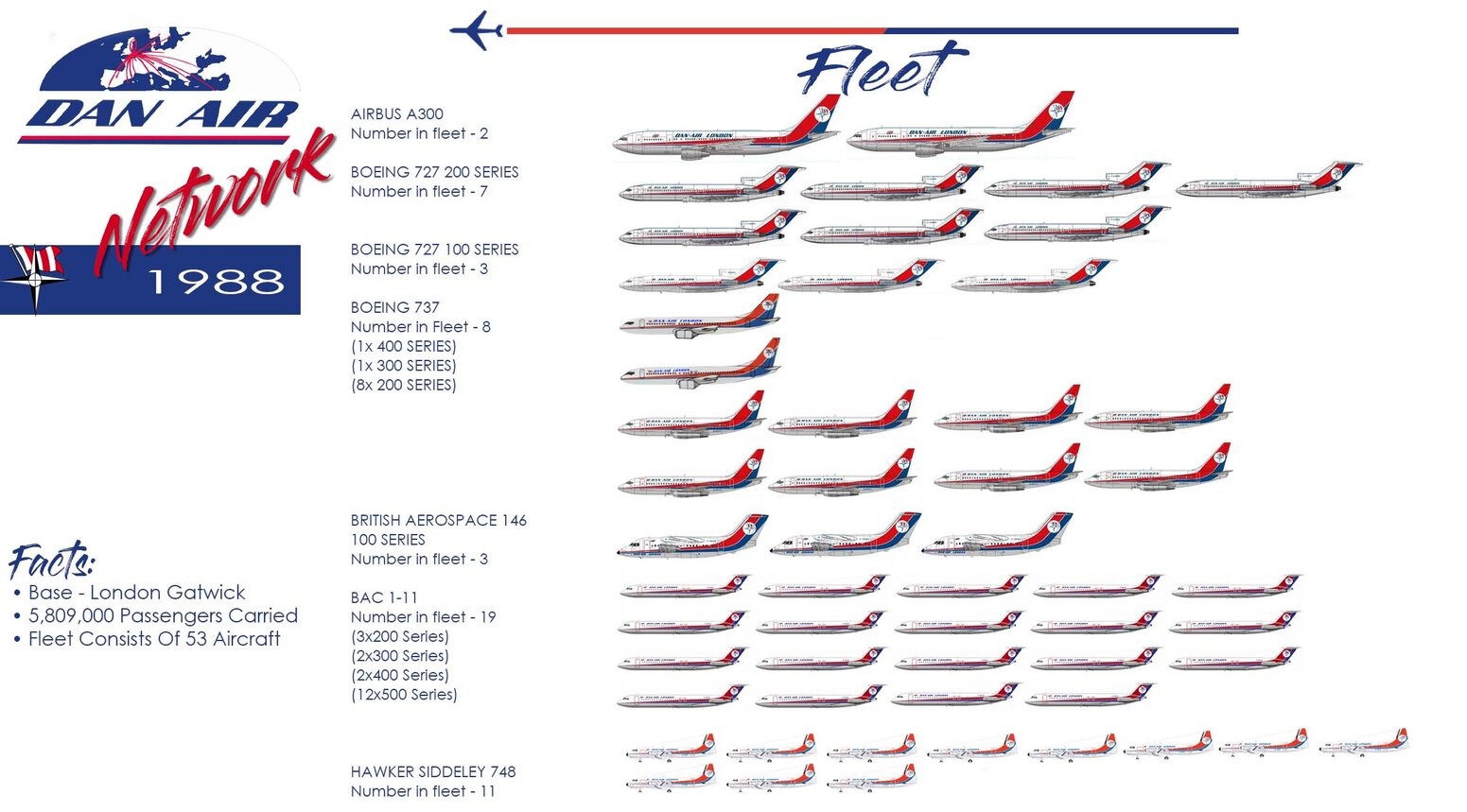
At the start of the year Dan-Air could announce that they had set a new record for the number of passengers carried on a UK independent airline. A total of 5,481,000 passengers were carried in 1987. Meanwhile the price war on the Gatwick-Dublin route had reached levels that were unsustainable for any of the operators who were battling for a share of the available market. Offers that included two for one tickets and two night hotel stays with tickets were being sold. Tickets that were being sold at prices that could barely give the airline any profit. Dan-Air had reduced their fare to £66 and with within day this was dropped to £63. An application to serve Lisbon from Gatwick was submitted to the Civil Aviation Authority.
Boozed-up holiday-makers, mainly from Manchester Airport, with its open-all-hours departure lounge faced being grounded this year when. European governments were now threatening to send drunks home on the next plane. The European Parliament held a conference on the behaviour of passengers. The European Parliament Tourism Spokesman ed McMillan-Scott said that he was shocked to see passengers drinking alcohol at 8am at Manchester Airport. He said: 'Drunken louts are endangering the whole of the flight-only holiday programme.' He told Travel Agents to do something to stop the 'Pie eyed in the sky yobs, who were ruining it for everyone.'
He said that he did not want to see airlines forced to ban the sale of alcohol on aircraft as that wouldn't be fair to the overwhelming majority of passengers who behaved well on flights. But that he did not want to see airlines 'overdose' passengers with alcohol either.' He urged the Association of British Travel Agents to take action on the matter. He wanted the Government to take steps to warn passengers about the danger of drinking and the loss of their reputation when overseas. This was a particular problem for the 2.5 million people who took flight-only trips overseas. Foreign Governments including those of Spain and Greece were particularly worried about the few people who drank to excess. Some travel firms encouraged visitors to attend drinking parties. If the problem were to get any worse these tour firms could be facing a crackdown with the overseas Governments saying 'no' to them being allowed to bring holidaymakers to their resorts. Dan-Air's head of public relations, George Yeomans said 'Airports should be more restrictive over the sale of alcohol. With airports and air traffic getting busier as the industry continues to expand, and holidays packages continue to be relatively inexpensive, sadly, we can expect this relatively new phenomenon of drunks on board aircraft will continue to increase unless tougher action is taken all around.'
A new local rate number was launched in January that would see the same charges apply for calling from anywhere in the UK. The scheme was praised as being cost effective to budget conscious travellers. The 0345 10020 number was easy to remember too.
Arrowsmith, the Tour Operator owned by Freddie Laker in the 1970s was now fully owned by Owners Abroad, who in 1987 launched a new company - Skysavers - as a stand alone Tour Operator. The difference from other Owners Abroad product was that their brochure did not advertise holidays, just flights. With prices such as Manchester - Girona for £49. Cathel Maclean the Managing Director said that the company would primarily be selling seats on their sister company, Air 2000. There would be no reduction in the quality of service on board their aircraft for passengers who were travelling as seat only guests. He said:
'I find it amazing that some of our competitor tour operators only offer coffee and biscuits on, say a four hour flight to the Canaries, and that maybe after they have had a substantial journey to get to the airport. Coming back, they may have had a nice holiday,but they will remember how hungry they felt on the long flight. And it's all for the sake of £2:50 a head, which is what the airline to provide a meal.'
The statement was seen as a dig at Airtours, who had become the butt of many jokes. Owners Abroad chartered Dan-Air aircraft and insisted that on all flights passengers on their flights would get a meal. The Skysavers programme would have access to all charter flights in the Owners Abroad programme and would be offering similar discounts on Dan-Air and other carrier's flights. Maclean went on to say: 'As usual with seat only charters, the price does include very basic accommodation. Whether you use it or not (nudge nudge) is up to you. In other words (wink wink) arrange your own.'
Following the British Airways takeover of British Caledonian several of their services were removed and put up for tender by other carriers. The Civil Aviation Authority (CAA) had also taken some of British Airways' Gatwick services and they too became available. Following the takeover, Virgin Atlantic became the only UK independent airline providing long haul scheduled flights. Even if any other carrier had ambitions to enter the arena, the Monopolies And Mergers Commission had not instructed the CAA to take any of British Airways' long haul services or invited other airlines to apply to operate them. Two ex-British Caledonian services were of interest to Air Europe and Dan-Air Aberdeen-Gatwick and Aberdeen-Manchester. Dan-Air placed applications for the two services in late 1987. In January 1988 Air Europe placed a similar application for the Gatwick-Aberdeen service. In fact Dan-Air were awarded both services and to celebrate, launched the new early morning service from Aberdeen with their 'champagne breakfast service' where passengers would enjoy a cooked breakfast with a Bucks Fizz cocktail.
Marinair - the Channel Islands specialists introduced Lydd Airport as a departure point for their holidays and chartered Dan-Air HS 748 aircraft to carry out the flights. It would have been several years since Lydd had seen a Dan-Air airliner after scheduled flights had been dropped from the airport. Lydd had ambitions for major investment from the Department of Trade, a new runway and terminal were being planned. The aircraft was configured to seat 48 passengers and flights would take 55 minutes. Similar flights would operate from Cambridge and Newcaslte on behalf of Premier Holidays.
The Gatwick-Lisbon scheduled service commenced in February with 9 am flights on Monday, Wednesday and Fridays with a Sunday service from March. The two hours thirty minute flight promised a Bucks Fizz breakfast and a chance to read the Sunday papers. The 8am departure would be the first flight of the day from Britain to Portugal. Press reports said of the first flight: 'It is a very organised service which is well run. The cabin staff are friendly and the food delicious.'
The Inverness - London service had carried 110,000 passengers in 1987, an increase of 7.5%. An additional early morning daily flight was to be added and an extra Sunday flight. What had surprised Dan-Air was the success of the cargo that was carried on the route. Loads included fresh salmon, lobster, and shellfish which was up 25% with 381 tons of those items alone carried. The demand for the seafood produce was exceptional with much of it heading to London's restaurants and hotels. The new flight had inter line connections for other Dan-Air scheduled services including Mahon, Alicante, Madrid and Ibiza. The Gatwick-Innsbruck service started offering three weekly return flights using a BAe146 jet-liner. The Gatwick-Zurich service was upgraded to three daily return flights, one more than previously offered.
Dan-Air pilots Charles Steel and Ken Jones had formed a company called Air Data which won a Design Council award for a sophisticated flight planning system. The computerised system plots information that is required for flights such as fuel requirements, windspeed and flying time, taking into account the individual performance characteristics of different aircraft. It provided quick and accurate information that saved airlines money, by calculating whether it was cheaper to refuel at foreign airports or take enough fuel on board from take-off. The system was used by Dan-Air and after successful trials was snapped up by Monarch, British Midland, British Island Airways and Monarch.
The domestic services that British Airways /British Caledonian had been forced to abandon as part of their 'merger' were the first flights to become available for new applications - the highlands routes - were highly sought after, and in addition to Dan-Air, airlines including Loganair, Air UK, British Island Airways and Virgin Airways all placed applications. It is not an understatement to say that the independents were horrified to find that the CAA made it clear that they would welcome applications from British Airways who had only just had the services taken from them! Dan-Air had their sights set on Gatwick to Paris, Nice, Edinburgh and Manchester as well as the Manchester - Aberdeen service.
The 11th February was the last day that applications to the CAA could be submitted and by waiting until the last day Dan-Air were hopeful that fewer airlines would apply. It would prove to be a worthwhile tactic. Dan-Air were confident that these applications would be successful, and that the services would go on to be profitable in a very short time. Provided fares could be priced at the right level and have good departure times, Dan-Air felt the services would be highly marketable. There had been an increase in the number of people with second homes at the destinations. Time shares were still enjoying good business and the number of independent travellers who rented villas and sought accommodation on arrival was also on the increase. Dan-Air had been squeezed out of some Tour Operator programmes as most of the major companies now had in-house airlines of their own.
The new scheduled services would perfectly suit the growing number of people who had second homes in Spain or had time shares. The way people took holidays was beginning to change. Holiday makers were now renting apartments from publications such as Dalton's
Dan-Air were also working with Continental Airlines, the major US carrier, feeding flights from regional UK airports into Gatwick for onward flights into the UK. Continental were also selling Dan-Air onward connections for American flights heading into Europe. An inter line agreement was established with Dan-air and Emirates for flights from Dublin to Dubai.
Dan-Air Scheduled Services provided a new level of service on domestic flights this year when passengers would be offered free Bucks Fizz or Champagne on domestic flights. Air 2000 had offered Bucks Fizz in a plastic, yogurt style pot. Dan-Air would serve Moet & Chandon in glassware to all passengers.
Dan-Air's press campaign for its scheduled services told potential customers that whilst some airlines offered great service at high prices in Business Class, others offered one class at a cheap rate with very little service. Dan-Air, they insisted were the only airline offering the entire cabin a Business Class service. This would include dedicated seating with improved seat pitch, a complimentary bar, hot meals on even short flights, hot towels and even free newspapers.
Profits announced in April showed that the airline had made £9.1 million plus £1.4 million as a result of cash injections from the sale of surplus aircraft. The share price rose sharply to 490p, including a jump of 70p in a single day. Dan-Air stated that if the route applications were granted, four new aircraft had been lined up to operate the them. Air Europe would attempt to go head to head with Dan-Air's applications on many routes. Dan-Air were successful with their applications for international flights from Gatwick to Nice and Madrid. Domestic licences were awarded to Gatwick-Manchester and Manchester-Aberdeen. Loganair who thought they were well placed to win with their bid to fly Glasgow-Gatwick in fact lost out to Air UK. It wasn't only Loganair that were peeved at the decision. British Island Airways lost out with an application for the Gatwick-Nice route. Dan-Air went on record saying they would be expanding non-stop from now until 1992.
A unique cloak and dagger charter occurred in April when P&O ferries chartered a company Airbus A300 to fly 237 Ferry staff to Rotterdam to bring back two ferries that were stuck in the port after unions called a strike. The passengers had agreed to P&O's new rules. The secrecy of the operation was a result of Sealink also joining the action.
April this year saw Dan-Air in the headlines when Captain Wilson refused to allow a drunk passenger on his return flight from Tenerife to Manchester. The Spanish Authorities insisted the passenger be carried. Captain Wilson refused and a stand off ensued when the airport refused to allow Captain Wilson to take off. After two hours the aircraft took off without the drunk passenger. Captain Wilson said;
'In aviation law, like maritime law, the Captain is in charge of the vessel and it is him alone who decides who may fly on an aircraft.'
This incident followed a similar event earlier in the month when a fight broke out on board a flight to Tenerife, also from Manchester. The guilty man was met by police at Tenerife. Soon afterwards the police kicked the man from the island. Dan-Air would not carry him home, and the British Consulate had to negotiate a return flight home with Britannia Airways.
In May, the CAA awarded Dan-Air licences to fly the Gatwick-Paris service and Air Europe won the Gatwick-Brussels licence. British Airways said "We are disappointed at a decision which appears not to be no consistent with a desire for increased competition." They then went on to say "Our argument at the hearing was that the main arbiter should be the consumer, and it is not necessarily the CAA that should make the choice for the consumer. If those carriers which wish to fly the route where licensed competition and the consumer would dictate preferences. This is particularly true on the Brussels route, where the Government specifically negotiated an agreement with Belgium which allows any carrier to operate at any frequency and any fare. Against that background the CAA has chosen to reduce competition by cutting the number of British carriers from two-British Caledonian and Air Europe - to one. It cannot be good for either consumer choice or the national interest."
The CAA said "Our decision to grant Dan Air's application for the Gatwick-Paris route was to encourage competition between services from Heathrow and from Gatwick." Both Dan-Air and Air Europe welcomed the CAA decision.
The Summer programme of charter flights was affected, as usual, by industrial action at various places. The worst of which was in Spain and Greece where Air Traffic Controllers went on strike. The ATC staff as always, chose the month that would have the maximum impact. Several Dan-Air aircraft had passengers sat for up to five hours on aircraft returning back to the UK. Greek controllers would only give flight crews ten minutes notice when a slot became free.
One member of the operations team told Dan-Air Remembered:
'We had problems every year with one country or another. I remember the Spanish and Greek problems in 1988 vividly. Air traffic controllers were on strike and Manchester had been badly affected with nearly all flights delayed. As well as our passengers, nearly 30,000 others had been delayed at that one airport, Birmingham and Luton had their fair share too. With all that chaos, a Boeing 737 then went tech at Newcastle. We had 126 passengers headed for Corfu when the engine developed a major fault. Engineers thought they could fix it on the ground but they couldn't manage it. The flight was due out at 2235 and by the time we had a replacement engine fitted it was Nearly 7pm the next evening. People had been getting angry because we hadn't put them up in hotels - but that was because we thought we could fix it. It's was not just that flight that was hit though. Our aircraft worked 12-13 hours a day and that one had been out of action for 20 hours. It took days before things got back in order. The Greek dispute was sorted out pretty quickly. But no sooner had we got things right by the Thursday then we had to go through it all again for the second week of the Spanish strike action. No sooner had that eased when the baggage handlers in Spain went on strike."
Air UK Leisure took delivery their first Boeing 737 which was to be based at Stansted. The aircraft would make 41 flights a week. Twelve Tour Operators named Air UK Leisure in their programme. A second aircraft was to be based at Manchester. Within a few weeks of the airline starting operations, the airline placed an order for the Boeing 737 400. All of Air UK Leisure's aircraft would be on lease. Several of the Tour Operators who had been named by Air UK Leisure were Dan-Air clients.
In April this year, the erstwhile wholly owned subsidiary of British Airtours adopted the name Caledonian. British Airways' take-over of British Caledonian. The BCal brand was popular with the public and now free to do with it what they wanted, BA applied a modified British Caledonian livery to the entire British Airtours fleet. The modified livery used BA's 'Landor Titles' whilst applying the former rival's colours and rampart lion insignia. Caledonian Airways began replacing its Boeing 737 fleet with ex-British Airways L-1011 Tristars and a number of brand-new Boeing 757s were sourced from the orders placed by its parent company. The former British Airtours 737s were re-configured in British Airways's contemporary short-haul two-class cabin arrangement and began replacing the BAC One-Eleven 500s British Airways had inherited from British Caledonian.
A former BCal girl told us;
'I was upset by the take-over anyway. British Caledonian had been a wonderful employer, they had made sure I had seen most of the world by the time I was in my mid-twenties. I was made redundant at the time and I applied for loads of cabin crew jobs. I was offered a position with British Island Airways, but the wages were no-where near as good as BCal's, nor would I get to fly long haul any more. I am sure that they were a great company, but I will say this, British Caledonian had sort of ingrained into us that we were the best, and that all other airlines were very very much beneath us. They didn't say that other company's were rubbish, but they made us feel like the others were a long way behind us. So, I ended up applying for a job with Caledonian. I got the job, and the pay wasn't as good, but I went for it. When I started I was impressed as far as charter airlines went. We used steel cutlery and the headrests on the seats were of a very high standard. The uniform was more or less the same. The flying conditions were nowhere near like BCal's. I did a lot of European flights and it was really tough going. I had been used to doing a flight and having lots of rest days overseas! I really didn't like the upper management at all. I took a chance and applied to Dan-Air, who took me on for the following summer. I would still have to retrain. Even though I had started off on BAC 1-11s years ago! So, after my temporary contract at Caledonian finished in the winter, they offered me reduced hours over the winter and a permanent contract starting in April the following year. I had to tell them, thanks, but no thanks, I was off to Dan-Air! They were not happy at all. Words to the effect that I was a silly girl who must have been out of her mind for wanting to work for Dan-Air when there was a position here. I had a long rest and did my training with Dans - They were great from the start, I joined the 737 fleet and went straight onto scheduled services because of my background. I stayed to the end, and when BA took Dan-Air over, I wasn't considered for a job. I bet they saw my name and said 'well she can sod off for a start' I went onto Cathay Pacific and then left to marry and start a family.'
As a footnote - In 1995, British Airways decided to exit the package holiday market and sold Caledonian Airways to Tour Operator; Inspirations, along with its fleet of five Tristars. Following Caledonian's sale to Inspirations, the 757s were returned to British Airways. Inspirations became part of the Thomas Cook Group in 1999, when Caledonian Airways was merged with the Flying Colours airline to form JMC Air Services, which in turn became the UK arm of the now-defunct Thomas Cook Airlines. Following Inspirations' takeover by Thomas Cook, the former Caledonian Airways Tristars were withdrawn from service as these had suffered increasing, widely publicised reliability problems resulting in the travelling public's generally poor perception of Caledonian Airways 'Mark Two'.
But back to 1988 - The CAA's decision to award Dan-Air the Gatwick-Nice service was greeted with joy, it is fair to say, that Champagne corks were popping in Dan-Air's offices. British Island Airways did not join in the celebrations and launched an appeal against the Nice decision. Late June saw the Gatwick-Manchester and Aberdeen-Manchester licences gain approval, giving more reasons for Dan-Air to celebrate. The Inverness-Heathrow service continued to break records. The route was flown by 20,000 extra people this year, bringing the total to 130,000 in a single year. Fares on the Gatwick-Nice service were announced with one way offers from £125.
December saw three Boeing 737 400 join the fleet. They would immediately commence services on the scheduled network as well as supplementing the winter charter programme.
The troubles in Northern Ireland were a constant headache for all airports and airlines flying in and out of the province. A Dan Air Boeing 727 had flown 170 children and their minders into Geneva for a school holiday. As the aircraft boarded to return home the airline had a call from a man claiming to be from the IRA. He said the airport had 15 minutes to clear the aircraft before it would be blown up. The call, was in fact, a hoax and although the aircraft was evacuated no device was discovered.
In April, a passenger on board a Dan-Air Boeing 727 decided to film the view from his window. Within seconds he saw a Caledonian Tristar which he could clearly identify. The Captain came on the PA system and advised passengers that the aircraft was 1,000 feet higher and more than a mile away. The passenger disagreed, saying 'Why did it peel away so quickly after the pilot told us it was normal? I fly a lot and it seemed like we were in touching distance, I have never seen two aircraft that close.' The Boeing was on a sub-charter on behalf of Caledonian Airways, returning from Geneva and was at 8,000 feet. Caledonian said that they had no idea anything was amiss, and British Airways said they would look into the incident. Dan-Air said the passenger had simply got it wrong. The Tristar was landing at Gatwick and both aircraft were at standard separation.
In May scheduled flights commenced to Ibiza and the CAA gave permission for scheduled flights to depart from Gatwick to Madrid, bringing the number of Capital cities served by the Airline to five in ten European countries.
A tactic employed by Tour Operators to consolidate half empty flights had first appeared in the early eighties and had angered many holiday-makers who found that their flight had suddenly changed with additional stops or the times altered, in some cases by several days. Airlines and Tour Operators had worked hard to eliminate the problem by only offering flights where they knew there would be sufficient demand. This year saw several instances where the issue had returned. One pensioner said at the time:
'My wife and I had just retired and so any day of the week was convenient for us, as long as the price was right. However, we just couldn't win as I found out on three successive holidays. In June 87 we paid a supplement and a fuel surcharge and the flight was altered from breakfast time to lunch time. In January 88 we had a flight to Majorca, Wednesday January 20th at 0915. After payment - it was changed to 1530. On both occasions this was with Dan-Air. So, when I went to Pickfords on January 5th to book an Intasun holiday, I was told that the airline was definitely going to be Air Europe. After final payment, I was written to saying the flight was now with Dan-Air and instead of 0930 the flight was now 1630. I wrote to ABTA and a more biased answer could not have been written. They just backed Intasun and Dan-Air to the hilt. I told them that as regards supplements, if we were flying with Air Europe, I would be happy paying the £14. When I looked at the Airtours Winter brochure, it said that there would be no supplements on mid-week flights until May 24th, and their carrier was Dan-Air. Yet I went on March 11th with them and was told I had to pay £28 supplement on Manchester-Gerona flight. Pickfords were very sweet, but no-one could explain the anomaly. The Dan-Air flight gave us a cup of tea and biscuits. Intasun and Airtours were just so mean. We were starving by the time we got to the hotel.'
Dan-Air's George Yeomans said: 'We do not generally deal with the public on charter services. Any criticism of timings and supplements should be taken up with the Tour Operator. We understand it is frustrating, but consolidation is unavoidable, otherwise Tour Operators would go out of business. We at times impose surcharges, or issue rebates to tour operators according to the cost of fuel. It is up to the Tour Operator if they pass on that rebate to their passengers.'
Intasun said:
'Even with the cost of the supplement the cost of our holiday is cheaper than Airtours. Although the majority of our flights are carried by our own airline, Air Europe, or our sister company Air Europa, we do state in our brochure that we use other airlines like Dan-Air.'
A licence was awarded to Dan-Air on May 8th to operate six round trips a week from Gatwick to Paris. The ex British Caledonian route would also be times to allow connections with Dan-Air flights from Belfast. A spokesman said: 'This represents a major growth for Dan-Air Scheduled Services with new routes opened up to Lisbon, Madrid, Mahon and now Paris. Already we offer a Belfast service to Lisbon via Gatwick, and we are very confident that the Belfast/Paris through Gatwick will be very attractive to business and leisure passengers.'
Julie Ann Thornton had an academic background when she decided she had had enough of studying and wanted to earn a living. She successfully applied to be an air stewardess with Dan-Air: 'It is perceived as a desirable occupation, but it's not as glamorous as you'd think. The safety angle is very important. I'd heard that Dan-Air was a very good company to work for and that they were well regarded among other airlines for their thorough safety training. I worked mainly on the Belfast-Gatwick service which allowed me to live at home and enjoy horse riding in my spare time. I wanted to get into advertising, and marketing and PR, so I applied for a course at Queens which would allow me to continue to fly. I was due to start in September when Dan-Air made the decision to base the Belfast crew at Gatwick and we were called to a meeting to see what we felt about the move. I thought it was about time to sort out what I felt on a long term basis. You can't really be an air hostess at 40 - it's that kind of job. During a discussion that followed I was offered a job as assistant to the marketing manager at head office in London. I took up the position in November 1987. I felt like it was a chance I could not ignore. So I never took the course at Queens. Dan-Air did not have a marketing department until 1986 and this was a major reason why I liked my job. If I was working in a huge marketing company my jobs would be pre-set. But I got tremendous scope, in whatever I thought I was capable of doing. We had an in-house team who were responsible for national marketing campaigns, and I liaised directly with a PR company in Northern Ireland, as well as seeing to exhibition work around the country which gave me an opportunity to travel. We were the largest independent British airline with the largest fleet after British Airways. We flew scheduled flights to 30 destinations around Europe and we came up with 'The Secret Is Service' Which emphasised that nobody really knew how big we were, and yet we were able to compete successfully with the other airlines. I was tasked to target AB males, as we were carrying more and more business men. It was so important 80% of the seats we sold was bought by 20% of the passengers. We were trying to stress the differential between Dan-Air as a scheduled services airline to that of Dan-Air the charter airline. Whilst 75% of our flights were charter, 25% were scheduled services. The Belfast-Gatwick service had lots of interlining flights, which meant they were travelling onto other destinations once they got to Gatwick. That route was working at over capacity, because the competition was very keen. We simplified fare and targeted leisure passengers on certain flights - this led to a shortage of seats on our flights. I travelled every Friday back to Belfast and sometimes couldn't get a seat. This marketing meant we had to put on 2000 extra seats by increasing the aircraft type. I had a background in English, but the work I did at Dan-Air was very creative and exciting, I had the chance to work on all sorts of projects. In 1987 I was involved in a campaign that was worth £1 million. I did like London, but the quality of life was not the same as back in Northern Ireland. Some of my friends struggled finding a job, but I was an air stewardess first and that helped me know the company a lot more. i really knew the airline and I gained product knowledge.'
A Boeing 727 took off from Manchester on May 19th bound for Dalaman in Turkey when shortly after becoming airborne, a warning light alerted the flight crew that there was a fault on the wing flap. The Captain flew out over the Irish Sea where he dumped thousands of gallons of fuel, almost all of the fuel that would be needed on the four and a half hour flight. This was to reduce the airliner's landing weight. The aircraft landed safely an hour later with fire crews on standby. The 187 passengers de-planed and were taken to a lounge, until a replacement aircraft was found. The aircraft departed two hours behind schedule. A spokesman said that the routine was standard procedure when such a warning flags up.
The first day of June saw red faced air stewardesses lose a wallet containing the bar takings for a flight to Venice. Each of the girls thought that the wallet was in the other's possession. After the flight landed the girls searched in vain for the money, but it was believed that a passenger had stolen it. The crew called the police, but passengers had already entered the terminal at Venice. Dan-Air's Peter Hogg said: 'You don't imagine that someone might steal the takings in such a confined space, I have never known it happen on any of our flights before.'
In June a company Airbus burst a tyre upon landing. This led to a hydraulic cable being severed. Thanks to the skills of the pilots, the aircraft landed safely and passengers were ferried to the terminal by coach. Meanwhile a group of Baptist pilgrims had booked 20 seats on the scheduled service from Aberdeen to Gatwick where they would join a Dan-Air charter Boeing 727 on a flight to the holy land in Israel. The passengers arrived on time in Aberdeen with tickets in hand only to be told that the seats had been resold. Dan-Air's state of the art computer reservations system which was based in Los Angeles had wiped their booking clear. Dan-Air then resold the tickets. Being the professional airline that it was, Dan-Air were able to charter a British Airways HS 748 especially for them to get them to Gatwick on time. The HS 748 was due to stay in Aberdeen anyway for a later flight. Dan-Air said the reservation system had done this on more than one occasion and a full investigation was launched.
On June 20th it was announced that Inverness was to get an air link with Aberdeen after a gap of three years. Dan-Air would provide services at the same time as boosting the very successful Inverness-London Heathrow service because of rapidly growing demand. Passenger traffic was up 17% on the previous year and was still growing. As a result, an extra return flight would be operated on Fridays. There were plans to extend this to Mondays. The service to Aberdeen would be part of the 0830 departure from London Gatwick to Aberdeen. the aircraft will then go on to arrive at Inverness at 1045 returning from Inverness to Aberdeen at 1600 with fares set at £20 one-way. Dan-Air had given up the service when they commenced Aberdeen-Gatwick and Inverness-Heathrow as independent services.
On July 21st of this year, a Dan-Air Boeing carrying 132 people was involved in a near air miss with an RAF Tornado jet. Air Traffic Control at RAF Leeming in North Yorkshire instructed the RAF jet to take avoiding action as it passed about two miles behind the Boeing as it flew over Darlington. The airliner was on a return flight from Malaga to Tees-Side. Both aircraft were flying at 2,000 feet. The Civil Aviation Authority launched an investigation. Captain Deli Fisk-Gray on of the airline's female Boeing 727 Captains was flying home over the Mediterranean Sea when she was alerted by French Air Traffic Control that a much slower aircraft was on the same flight path as her. The traffic controllers instructed the slower aircraft to descend to another level. The Captain protested saying that the jet should take a lower flight level, 'Ah yes!' said the controller with Gallic gallantry, 'but the pilot is a lady.'
There had been press reports of air-misses involving RAF jets, two occurred on the same day involving the same BAC 1-11. In one case it was landing and the other shortly after take-off. The RAF aircraft involved was a Jet Provost which had come as close and 2000 feet away from the 1-11.
If you take one normal sized jet airliner and refurbish it to convey just a handful of people anywhere in the world, and so, a cabin becomes a 'through lounge' fitted to a standard becoming to an Arab Sheikh, African Chief or western commercial mogul. Many of these aircraft came out of the Manchester base of Dan-Air Engineering. Of course this only represented a small part of what happened at the Manchester base which looked after the airline's HS 748 and BAC 1-11 fleets, as well as the types operated by other airlines. Upholstery supervisor Ray Cheetham recalled: 'We had a grey blue carpet which was ankle deep and cost £50 a yard then. It was so heavy that a piece that was 10 feet by 14 feet took four men to carry on the aircraft. Whilst we did that a French polisher came to do his magic on a mahogany and walnut veneer. Affixed to one table top was a magnificent statue of a stallion that was about 5 inches high at its head. The other tables had cut glass rose bowls and other precious nick-knacks.'
Crew chief Keith Braid recalls one Middle Eastern gentleman who bought a BAC 1-11: 'He had asked an architect to reproduce the aircraft as a suitable scaled down adaptation of the classic design of the foyer of his favourite hotel in Brussels, the Hilton. Then the aircraft was prepared for flight and brought here to Manchester, with - at that stage - a fairly vague specification for refurbishment. So, our engineers who usually deal with aircraft systems and equipment set about the design and installation of the interior cabin. Every section of the base was involved. There was the deepest blue wood finish for the bulkheads and cabinets with 14 coats of lacquer to produce a marble like smoothness, a bar with a highly polished brass top, settees with gold threaded reversible fabric, armchair style leather seats that could move forwards and back, side to side and could fully reverse, complete with built in footrest. There was a beautifully framed gold extract from the Quran, when we took it down we were told that it was worth £15,000, we quickly had it taken to the bank for safe-keeping. The main problem was fitting all of that around the existing systems on what was built as as a conventional passenger aircraft. During production the aircraft had been bought by an African tribal chief and we had too work around the clock to get it finished in time for it to be presented to him for his birthday.'
Another 1-11 jet owned by an Arab Sheikh was equipped with an English bone china tea-set, displayed in a walnut wall cabinet. Each piece had to be secured in its own vibration proofed padded recess, said Gordon Rogers the base manager. he went on 'These aircraft come equipped with their own business equipment, always telephones, televisions and video, often showers and beds.'
Greek air traffic controllers had worked to rule throughout August, causing delays for thousands of people in the UK and overseas. One flight to Venice had been delayed for several hours before being diverted to Rimini because of a thunderstorm. The aircraft then flew to Venice after the storm cleared. By this time the flight was more than six hours behind schedule. The passengers, who included a contingent from Wales were unhappy as they boarded their late aircraft. Unbeknown to the crew, a swarm of mosquitoes had invaded the galley. The Captain asked for fifteen volunteers to go without meals as they had been 'infested' the offer of a free drink was given. This was on top of the one already offered as a result of the delay. The Captain, Tony Anderson, then announced that the scheduled stop at Bristol would not go ahead as the airport was closed. It would head straight for Manchester, where the Welsh party were ferried to Bristol.
Disgruntled British Airways walked away from what it called the 'air routes dog fight' after losing the routes from Gatwick to Paris and Brussels. The CAA had said that British Airways would be permitted to re-apply for the routes and rejected their applications in favour of Dan-Air, who were awarded the Paris service and Air Europe who obtained the Brussels route. British Airways had been obliged to hand over Gatwick flights as part of the agreement to allow them to takeover British Caledonian. The state carrier had been given permission to re-apply for the routes they had lost, but instead decided to withdraw from the battle for Nice, Oslo, Edinburgh, Glasgow and Manchester. Chief Executive Sir Colin Marshall said: 'Following the decision on the Paris and Brussels route were were left in no doubt that no matter how sincere our motives and intentions and no matter how vigorously we pursued our case, we had no prospect of securing any of the routes for which we were contending. Our objective must now be to manage our time and resources to better effect in developing further those routes which we currently operate and seeking further opportunities. There will inevitably be some concern about the level of staff numbers.'
British Airways had forecast that up to 2,000 jobs were likely to be lost. Ultimately 1,400 people were made redundant.
In August another inquiry was launched by the Civil Aviation Authority after another air miss involving an Air UK Boeing 737 flying to Jersey and a Dan-Air Boeing 727 en route to Malaga both flying at 18,000 feet. The incident occurred at 8:15pm over Farnborough in Hampshire. Both aircraft were under the control of London Control Centre. A Spokeswoman for the CAA said 'Preliminary investigations indicated that the Dan-Air pilot was advised that the Air UK aircraft was at a range of four miles. With the other aircraft in sight, he passed by at 18,000 feet three quarters of a mile away.' She added that there would be a full investigation by the independent Joint Air Miss Group. Any aircraft that comes within a five mile range or within 1000 feet vertically is deemed an near-miss. The inquiry revealed that the air traffic controller responsible had just re-trained another traffic controller suspended over a previous near-miss above South Wales. The re-trainer found himself being re-trained by his former pupil of a few months previous!
Yet another near miss was reported by Dan-air involving yet another RAF aircraft. This time a Provost military jet based at Inverness. The incident occurred as the BAC 1-11 was coming in to land at Inverness on a flight from Heathrow at 3:00pm. The 1-11 had been cleared to land and was less than half a mile from touch-down. The Provost had been cleared to join the circuit. The RAF was fully aware of the 1-11 and it was claimed that the pilot had it in sight at all times. The Provost then crossed above the runway of the incoming airliner. The RAF said that there was no avoiding action necessary.
The Gatwick-Paris flights were scheduled to commence in October, British Island Airways who had seen their own application for the service rejected, were furious at the decision. In August they made a formal objection to the license. But another dogfight broke after Dan-Air were awarded the rights for Gatwick-Nice flights which British Island Airways, Britannia Airways and British Airways had also applied for. As we stated earlier, BA withdrew from the process, but British Island Airways now took the matter to the Secretary of State for Transport Paul Channon. British Island's chairman Paul Villa said: 'We feel there were a number of inconsistencies which led to an inappropriate decision being made. The CAA summed up its verdict by stating that Dan-Air's application was 'on the face of it' more appropriate. We are about to add a fourth MD83 to our fleet, two are already in service with another due next spring. The lease has cost us £1.95 million, but the addition to the fleet was as a result of Gatwick's increased passenger numbers.'
Fred Newman, Dan-Air's chairman stated in September that package holiday prices would increase by roughly £20 per person after 1992, when duty free sales on board aircraft would be abolished. He added that flights could see a further £15 per person on a return flight following a European Commission directive that would make Tour Operators fully liable for clients. Newman foresaw that higher fares would come down, but that lower fares would increase. European Commission Air Transport Ministers had issued several new rules. Newman said he welcomed many of them as they were taking steps at liberalisation of European air routes saying;
'Some of these new rules will be of benefit to consumers, but there are other EC proposals that will have the opposite effect if implemented, by increasing airline and travel trade costs.' He also warned that the addition of Value Added Tax (VAT) on aviation fuel, catering and airline tickets would lead to increases passed on directly to consumers, while 1992 harmonisation policies could lead to increased labour costs. He concluded by saying; 'We believe market forces should be left to determine fares and capacity, smaller airlines could be 'swept' away by larger airlines like British Airways and their continental counterparts.'
The new scheduled services from Aberdeen to Manchester and Gatwick to Paris, Nice and Manchester would commence on October 23rd. The domestic flights and Paris would be with a BAC 1-11 and the Paris service operated using a Boeing 737.
Inverness passengers got a 'Glorious Twelfth' treat on 12th August on the 6:50am flight to London. The treat was courtesy of Dan-Air and the Golf View Hotel at Nairn, who aimed to be the earliest birds of the year at the start of the grouse shooting season. The operation involved a grouse shoot on a Moray estate being shot and then rushed to the hotel to be cooked in the early morning. There was then a dash to the airport to get them ready to be served to passengers, who were also treated to a miniature bottle of whisky.
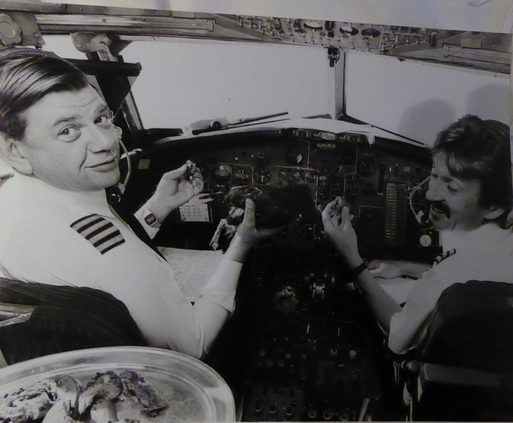
A report was published on August 26th by the National Consumer Council saw many Tour Operators criticised. Particularly those who operated from northern airports. The report, called 'Dreams, Nightmares & Consumer Redress' had surveyed 10,000 holiday-makers. Airtours and Intasun along with their subsidiary companies, Global and Lancaster were singled out as the 'the worst offenders'. Asked to rate various services, 20% of their customers said they were dissatisfied with their reps from the four tour firms. Among Airtours customers, 20% said that the brochure description was inadequate. Accommodation provided by Global and Airtours were badly rated. the most startling find, according to the report, was that 22% of tourists had their holiday changed after booking - the figure for Airtours was 40%. The report called for an end to surcharges and for better compensation when things go wrong. Eileen Hills of Intasun said: 'Complaints like this have to viewed in perspective, as the second biggest Tour Operator we will take more than two million people on holiday this year.' She believed people would rather be taken to a different hotel than to one that had fallen below standard. The company had a large quality control department which monitored holidays very closely.
Miss Jane Shaw, Marketing Manager of Airtours said thing have changed dramatically since the survey was carried out in 1986: 'That was a difficult year for us since then contracts with a foreign airline and various hotels were reneged on because they were offered more money by one of our competitor operators in the UK. We now have a three year contract with Dan-Air to protect ourselves and our customers, and various long-term agreements with hotels in resort.
The Consumer Council said that the 10,000 complaints made to them and Trading Standards are 'the tip of an iceberg'. The report was in response to the European Commission's draft directive on package holidays, calls for an end for surcharges, tour operators to be liable for any failings with the holiday and compensation for aggrieved tourists, saying: 'surcharges are unfair and unjustified and not counter-balanced by refunds.'
It suggested that in times of fierce competition that some Tour Operators were tempted to lower prices to attract bookings and then apply a surcharge. One Tour Operator said that the amount paid by consumers in unjustified surcharges exceeded the haul of the Brinks Mat robbery.
Ms. Hills said that Intasun had abolished surcharges for 1989 but could not see beyond that. A spokesman for the Association of British Travel Agents said: 'If the NCC got all the things they wanted then the cost of holidays would increase substantially.' Mr. Doug Goodman of Thomson said they were surprised by the report because they had already abolished surcharges and agreed with most of the things that the NCC had recommended, but making Tour Operators liable for faults of hoteliers, airlines and others would not work.
Dan-Air aircraft were chartered for a series of day-trip flights to Amsterdam. Prices were £89 which included the return flight and a train to and from the city. There was an additional river cruise for just £2:40.
East Midlands based Orion Airways had grown substantially in the eight years that it had been flying. The fleet had grown to 21 aircraft including 12 Boeing 737 200, 7 Boeing 737 300 and 2 Airbus A300. The carrier flew in excess of two million passengers a year and had recently started scheduled services. The carrier had quickly earned a reputation for its punctuality and its class of serve. Parent Company, the Tour Operator Horizon was purchased outright by the brewery Bass in 1987. The purchase of a brand new flight simulator in 1988 made the airline appear to be secure in Bass' hands. The fact that the airline was running as a neatly organised company complete with a fully integrated Tour Operator made it ripe for a take-over. The industry was surprised, when ever expanding Thomson made an offer of £75 million to Bass that was accepted. Orion would be fully integrated into the Thomson group. The last Orion flight would take place in January 1989. All of the scheduled services would pass onto Britannia Airways without interruption. The Horizon brand would continue to trade. The East Midlands base would cease to be the operating base for the airline. Management were released from their roles and decided to open a new airline in association with Belgium's Trans European Airways - TEA UK. Under the take-over agreement the new carrier was forbidden from having a base at East Midlands Airport, so they chose Birmingham Airport which was fairly nearby. Subsequently TEA UK did go on to have a sizeable presence at East Midlands. the same management would later form Excalibur Airlines. Horizon had used Dan-Air on several charters and this was likely to stop - It did! Horizon was the third largest UK Tour Operator and Thomsons' expansion would now put them way ahead of their nearest rival, Harry Goodman's ILG. Thomson would now operate almost 50% of package holidays.
1988 saw the bitter rivalry between Dan-Air and Air Europe become public knowledge. Dan-Air had, for many years, been the major carrier of Intasun holidays' flights. When Intasun began its own airline with two aircraft in 1978 it did not pose a significant threat to Dan-Air. Air Europe was owned by the International Leisure Group (ILG) who's stable of tour companies included Intasun, Lancaster, Global and 18-30. Intasun alone had become the UK's second largest Tour Operator, who in 1988 had taken two million Brits on holiday. Their in-house airline had seen its fleet increase steadily and by 1982 they operated seven Boeing 737 and two Boeing 757. The first three planes were sold in April 1985 when the company cashed in on their dollar-denominated residual values. By 1988 new Boeing 737 400 series jets joined the fleet which now stood at more than twenty aircraft. It had always been the policy of ILG to wait until other Tour Operators had secured their charter flights before swooping in and taking any excess capacity. Where they did use their own aircraft, they also offered seats to other Tour Operators who were keen to use Air Europe, owing to the high standards of in-flight service. This was in complete contrast to Intasun's own brand image which was seen as down-market and 'cheap and cheerful'. Where Air Europe did charter Dan-Air aircraft for their sole use was at airports where Air Europe had no aircraft based. These secondary airports often had less of a catchment area and smaller aircraft such as the BAC 1-11 would be ideal. They also chartered Boeing 727 aircraft at Manchester to ply the high density markets of the Spanish Costas and Canary Islands. To keep costs as low as possible, ILG were known to offer flights at unattractive times, often these were mid-week and late at night. These timings had lower take-off and landing charges. ILG's charter flights provided low standards of in-flight catering. Often just a sandwich or biscuits with a hot drink. Passengers assumed it was Dan-Air who had provided this meagre fare and their own reputation took a hit. All the while, Air Europe was in a position to boast about their own superior catering.
At its peak, ILG chartered six aircraft on a time charter basis. Which basically meant that the aircraft worked solely for ILG. Air Europe's decision to enter scheduled service operations would require dedicated aircraft to operate those flights, which worked in Dan-Air's favour.
Air Europe had, until 1987, been operating the majority of its business as charter flights (80%) After the British Airways (BA) takeover of British Caledonian in 1987, several of the latter carrier's routes had now been taken over by Air Europe including Copenhagen, Gibraltar and Brussels. Air Europe were then successful with an application to serve Stockholm. This was a major diversion from Air Europe's traditional operation. In 1988 Air Europe announced that they had placed a huge order with Boeing for 22 Boeing 757 aircraft that had been adapted to enable them to fly across the Atlantic. A further order of eight Boeing 737 400 was also announced shortly after. Some of the jets would join the fleet of Air Europe's sister carrier Air Europa. This would bring the Air Europe fleet to close to 60 aircraft. ILG then announced that they wished to fly out of Gatwick throughout the night. At the time this was not possible as noise restrictions had seen a curfew imposed late at night. Air Europe wanted to be exempted from this as their aircraft were new and 'super quiet'. Air Europe fully understood, they said, why the airport wanted to stop Dan-Air's old aircraft as they would disturb local residents. It had not gone unnoticed that the snipe was headed at Dan-Air. Captain Alan Selby recalls:
'We knew that Air Europe and ILG wanted to expand very quickly. They were applying for every possible route, and they were moving into territory that they had said all along that that they had no interest in. It wasn't enough that he had managed to get permission to fly 757's across the Atlantic - an arena we had absolutely no desire to enter - They slagged off all the national carriers with their bilateral agreements, the CAA, us and BA in particular for their high operating costs. To achieve what they loudly declared they would achieve, it would mean that they would have to get some rivals out of the way. There just weren't enough passengers going spare to do it without casualties. Goodman himself was saying the same thing as Laker had done, but Laker was never arrogant, or spiteful. This was the uglier side of business, and it was certainly not a game Fred Newman would be up for playing.'
Air Europe then continued their offensive in by changing their handling agent at Gatwick from Gatwick Handling to Servisair. Gatwick Handling was half owned by Dan-Air. Industry insiders gawped at the size of ILG's orders. No independent airline in recent memory had every made orders for as many aircraft. This was very evident when and order was placed for the DC10 successor the MD11 for long haul flights and the Fokker 100 which would operate European Scheduled services from Gatwick. The combined value of aircraft orders was £360 million. In 1986 the brand 'Airline of Europe' was created which saw further expansion and diversification over the next three years. It had begun with the creation of a Spanish subsidiary, Air España, based at Palma de Mallorca, in which ILG acquired a 25% stake, the maximum foreign entities or individuals could legally own in a Spanish airline at the time. This was followed by the acquisition of a 49% stake in German regional carrier Nürnberger Flugdienst (NFD), the purchase of a 33% stake in Norwegian charter carrier Norway Airlines and the creation of a new Italian carrier, Air Europe SpA, in which ILG held a 35% stake. With the exception of Air España, which traded as Air Europa, all the other airlines traded as Air Europe. All of their aircraft – including those operated by Air Europa – adopted Air Europe's livery. The only way to tell the aircraft apart, other than by their respective national registrations, was to look at the national flag following the Air Europe/Air Europa name on the upper, white part of the fuselage. ILG eventually created Dutch-incorporated Airlines of Europe BV as a joint management and holding company for all of these airlines.
British Airways had complained that its market share was being eaten away by Air Europe. However the CAA pointed out that BA's Heathrow operation was entirely protected. The CAA then awarded Air Europe licences to fly on the Gatwick-Paris and Jersey routes in direct competition with Dan-Air.
Fortunately for Dan-Air, ILG's Tour Operators sold many more holidays than Air Europe could fly. ILG were known to want charter flights at the lowest rates and Dan-Air buckled at losing ILG's business, in many cases, when flights were operated by Dan-Air's Boeing 727s, the charter revenue earned less than the fuel and operational costs.
In September Dan-Air promised to maintain the £40 one way air fare between Belfast and Gatwick. The service had become so successful that larger aircraft had to be introduced. For the winter period scheduled flights would leave Belfast for Newcastle, Bristol, Cardiff and Gatwick. This good piece came just before another row broke out between the independent airlines and the Civil Aviation Authority. British Island Airways were now appealing against Dan-Air being given the license to operate scheduled flights between Manchester and Gatwick. BIA also went on to appeal against the decision to allow Air UK to fly between Gatwick - Glasgow and Edinburgh. One can understand why Dan-Air would be so infuriated with BIA. an the latter did not hitherto operate any UK domestic services. In 1980 BIA had been absorbed into Air UK, just two years later having failed to sell its unprofitable charter operation to another airline, Peter Villa, then Managing Director of Air UK decided to re-constitute British Island Airways. With financing, Villa took the four BAC 1-11 aircraft that had been absorbed into the Air UK fleet and launched BIA mark two. The new airline acquired four additional second-hand BAC 1-11 500 and began to work with the same Tour Operators that Dan-Air were working with. British Island Airways were able to offer competitive rates on lower density charter destination than other carriers. The introduction of the MD83 twin-jet on scheduled services saw BIA turn a profit in 1988, the same year that BIA's and their 1-11 fleet began working with Virgin Atlantic and Air Florida as part of their multi leg trips across the Atlantic, such as Air Florida's Miami - London - Maastricht and Virgin's New York - London -Amsterdam. ILG suddenly expressed an interested in buying BIA. Intense negotiations took place. ILG were looking to add the BIA operation to their own, as BIA had several landing slots at Gatwick and provided scheduled services to Malta and Catania and Palermo in Sicily. Their varied fleet would give ILG the ability to operate thier own charter flights with several different types, from smaller 89-119 seat BAC 1-11 to their Boeing 757 with 228 in addition to the Boeing 737 could seat between 130 and 169. Air Europe's new direction was remarkably similar to Dan-Air's mixed fleet capability that had been derided by Air Europe at their inception. This latest set of appeals would be decided by the then Transport Secretary Paul Channon.
In September, Dan-Air proved what an extraordinary carrier they were, and how they really did do things that no other airline would attempt. One of the former ticketing staff told us:
'We had this group of twenty pilgrims from the Inverness Baptist Church who had booked a package holiday to Israel from Heathrow with some Tour Operator. I always remember their leader - The Reverend William Freel - well he and his party turned up at Inverness for the 5:30 afternoon flight, where they had tickets to fly to Heathrow - we had nothing to do with the Israel leg of their trip - So, Reverent Freel, who had all the party's tickets, steps up to the desk and takes charge. I look for his party on the computer and they aren't listed. Reverend Freel is not happy! To be honest, airlines always overbook and mistakes happen - but when it happens to you, you think you are the only one it has ever happened to. We had recently had this new system that was housed in America, when you made a booking it went there automatically. It had had a few problems since it was installed, but this was a biggie. Because there was no trace of the booking, the seats were shown as empty and they were resold. On a lot of flights we would have perhaps have had spare capacity, but on the Inverness-Heathrow - not a chance of getting twenty in. We could have just said sorry and put them on the next flight available, or argued the odds and given them a refund, but our base manager jumped on the phone and made calls. British Airways had flights to Glasgow in the morning, and their 748 was already parked up for the night. We were able to charter it to get to Heathrow - it was a lot slower than our 1-11 mind you and it had to fly back empty. They left at about 5pm and got to London Heathrow for about 7 - enough time to get their bags back and check-in at Heathrow for the Tel-Aviv charter. We were certainly out of pocket, but we did it and Reverend Freel forgave us. We got a letter from him a few weeks afterwards saying we had done very well and that we deserved a pat on the back as we rescued a situation that he didn't think could be rescued. But we always did that - we were Dan-Air.'
On September 18th the CAA instructed Dan-Air to urgently carry out safety checks on the Boeing 727 fleet after a similar move was ordered in America The Federal Aviation Authority had told US airlines to check take-off warning alarms on the jets following questions raised by August's Delta Air Lines crash in Texas. One theory about the cause of the crash which killed 14 of the 108 people aboard a plane is that an alarm to warn the crew of an incorrect flap setting did not sound Dan-Air only British airline to operate the 727 and one of the type had experienced a similar warning alarm this summer.
Also in September Dan-Air was presented with Highland Business Award f for the company who made the greatest potential to the growth of the local economy.
As the summer season closed and timetables were being prepared for the winter is was announced in September that 1988's winter season would see the introduction of a new business class rolled out on many scheduled services. Class Elite would see standards of service never seen on short haul European flights. The airline also announced that Gatwick-Madrid scheduled flights would start at £130 return. The Paris service which was to commence on October 23rd would see Dan-Air provide the lowest fare on the route, with return ticket prices from £55.
The widow (now remarried) of the pilot who was killed in the 1981 Nailstone accident was awarded £330,000 by the High Court in London on October 3rd this year. Captain Roger Griffin died when the aircraft, which was carrying mail from Gatwick to East Midlands, came down in fields near Nailstone in Leicestershire in June 1981. His widow Patricia was left with a ten week old son, who was awarded £50,000 to be placed in a trust fund. The sum, with costs, was awarded against Dan-Air and British Aerospace. They both admitted liability. A spokesman for Dan-Air said that the settlement between the company and the other families was made years ago and he did not wish to go into the matter.
The Scottish Highlands and Islands airports announced that traffic had increased by at least 5% in all but two of their airports. Although the Chairman Hugh Lawson admitted that the group would never break even because of the lack of population and the need to carry out inter-island services that would never make a profit. He said that they would always require a grant from the Scottish Office. Stornaway was down 2% because of a downturn in the local economy and Wick was down 3% partly because Air Ecosse had gone into administration, this was hoped to be reversed when British Airways took over the Caithness service. At Inverness, movements were fewer but passenger numbers were up. Mr. Lawson said;
'Dan Air have done wonders for the airport with their Inverness to Heathrow operation, increasing passengers on that route substantially, and there is talk about extending the number of schedules next year.' Sumburgh, which was once the jewel in Dan-Air's Scotland crown had seen significant falls in the number of oil related charters, as oil companies chose to abandon fixed wing aircraft in favour of longer range helicopters that can fly directly to oil rigs from Aberdeen.
Dan-Air's Chairman, Fred Newman issued a stark warning on October 10th when he said that fares were almost certain to increase once the 'open market' operates after 1992. He said the abolition of duty free sales on aircraft and at airports could lead to a £20 increase on the cost of a return flight to the Mediterranean. He estimated that the European Commission directive that Tour Operators and Travel Agents be fully responsible for clients could put another £15 on the cost of a holiday. He added; 'Whilst the cost of some higher fares may come down, many lower fares, including UK charter fares will go up.' Mr. Newman said he welcomed the first steps taken by the E.C Transport Ministers last December towards liberalisation in Europe. He said: 'These policies are intended to benefit the consumer, but at the same time, there are other E.C proposals which, if implemented, would have the opposite effect by increasing airline and travel trade costs.' The application of VAT on aviation fuel, catering and airline tickets would pass directly onto airline fares, while 1992 harmonisation policies could lead to increased labour costs. Mr.Newman said: 'We believe market forces should be left to determine fares and capacity.' He warned that smaller scheduled carriers would be 'swept away by dominant airlines such as British Airways and their Continental counterparts.'
October 23rd was the launch date for the new services from Gatwick and Manchester featuring Dan-Air's new business class cabin 'Class Elite' - Initially the service would be available on the high frequency Gatwick-Nice service, but would be extended to other routes shortly afterwards. Fred Newman said 'While in the past we have concentrated on providing a good product for our economy passengers, we now intend to increase our appeal to the business traveller. The new schedules firmly entrench Dan-Air as one of Europe's largest scheduled, international carriers.' The London - Paris Class Elite fare would be £109 one-way. The standard fares was £88 one-way and the cheapest 'Maxisaver' fare would be £55 return. This fare had conditions such as being booked no sooner that 28 days before travel and the ticket-holder would have to have a Saturday overnight stay at their destination. Air Europe launched a Gatwick-Paris service on October 24th in direct competition with Dan-Air. Air Europe's business class fare would be £92 which was £17 cheaper than Dan-Air's standard fares. Meanwhile, plans to reduce the Belfast - Bristol service to three flights a week, instead of five throughout winter were shelved following a surge in bookings. Passengers on the Belfast - Gatwick service were up 12% since last year, with Dan-Air now being the second largest operator in Belfast.
Pro-smoking group 'FOREST' lashed out at British Airways' smoking ban on all domestic flights, which would come into force on October 30th. The group's chief said 'Who the hell does British Airways think it is? They are behaving more like Air Edwina Currie than the World's favourite airline. We urge the 17 million smokers in this country to boycott British Airways and where possible fly with Dan-Air or British Midland on domestic flights and start thinking about other British carriers on international flights, because this will ban will only be extended. It is outrageous, what next? No alcohol?'
Engineers at Dan-Air's Manchester base began the task of replacing the seats on three of the company's BAC 1-11 aircraft. Those aircraft used on 'Class Elite' flights would still have five abreast seating, but the centre seat would not be sold. There would be a table fitted on the centre seat. These could be adapted for more or less 'Class Elite' Passengers. the seats would be wider than before. Over the next two years Dan-Air had earmarked £5 million for development of scheduled services. Managing Director Graham Hutchinson said: 'We are gearing up for the great opportunities that will come in the 1990s. We are determined to be airline for the discerning traveller on the prime European business routes.' Scheduled service passenger traffic had been growing at a faster rate than ever before, and it was expected we shall pass the two million passengers carried in a single year within the following 12 months. Although historically the bulk of our business has been on charter flights for holiday companies, the balance at the moment is moving towards scheduled operations. The launch of our high-frequency services between Gatwick and Paris at six return trips daily and between Gatwick and Manchester with four daily, and services to Nice, plus the introduction of 'Class Elite' will now mean that Dan-Air is competing effectively with European national carriers. We operate fifty five aircraft with 40 shceduled services to ten countries. We have a worldwide staff of 4,000, those facts speak for themselves.
A company Airbus A300 with 322 passengers got stuck in the mud at Gatwick in November. The flight had returned from Gatwick and was taxiing to the gate. One of the rear wheels came off the taxiway and firmly lodged itself into the mud. No-one was injured on board. Buses took the passengers to the terminal and luggage was unloaded on the taxi way. A tug was called and after three attempts the aircraft was freed. The incident happened at the quick exit taxi way and closed it for two hours. Several flights were delayed as they had to take a longer taxi to avoid the Airbus. Dan-Air said that an investigation would be carried out, but the incident was a relatively minor one. The aircraft was undamaged and after being cleaned up, returned to service the following day.
A BAC 1-11 Captain heard loud bangs coming from the engines on his flight from Newcastle to Gatwick. The aircraft landed safely back in Newcaslte where a fault was discovered in the air intake system. The aircraft was repaired and the 74 passengers arrived in Gatwick two hours late.
Homecoming passengers refused to travel on a company BAC 1-11 after the cabin filled with smoke as it was about to take off from Malaga Airport on November 5th. A problem with the air conditioning system had caused smoke to come swirling through the cabin which caused panic among the 112 passengers. An airport source said 'There was a revolt and 69 of the passengers refused to return to the Manchester bound aircraft. I believe they had been angry about the way that the aircraft was evacuated.'
Wigan couple Stan Holland and his wife Christine talked of their experience, Stan said: 'We were near the front of the plane when smoke started seeping through along the floor, then there came along a terrible burning smell. When people realised there might be a fire there was screaming and shouting. The back emergency exit was opened and then closed, we were told to go out through the front door. By this time the plane was in darkness. The Manchester fire disaster flashed through my mind. People were all rushing to the exit and I was frightened that Christine and the two children would be hurt. We managed to get off the aircraft unscathed, but Christine was very shaken and the children Matthew and David were upset. I would say it took at least five minutes to get everybody off that plane. If the fire had been a serious one - that would have been too long. The fire was in an air conditioning unit. We had to wait for another Dan-Air flight after refusing to get on that one. Bearing in mind what had happened in Manchester, I think it took us too long to get off. To open the back doors and then close them again was a terrible thing to do.'
Within days of the incident a Southport lawyer said that three passengers had decided to sue the airline: 'They have a right to do this for the upset they have been caused. You are allowed to do this when there is a car accident. The people are very distressed.' Dan-Air refused to comment.
A couple from Knaresborough in Yorkshire, Paul and Christine Moorey slammed the airline in public. Mr. Moorey said: 'I switched on the air conditioner when the plane's engines started up and noticed a really foul smell. A haze of smoke began to fill up the cabin, one woman noticed it was coming out of a vent by her feet. It took about five minutes for us to get off the aeroplane. The stewardess wouldn't let us use one of the back exits, and she told us she had strict instructions not to open it. People were shouting and screaming by this time and messages kept telling everyone to get as far away from the plane as possible. I had to help an elderly man who was having an asthma attack off the plane. Nobody was sure what it was and they left us in the terminal. Nobody even came to see if we were alright. That plane had already been delayed for three hours because of a technical problem. only about 40 people agreed to go back on that plane, we refused and flew back with another airline.'
Finally Dan-Air had to break their silence and said: 'This is just a lot of people getting excited about a bit of smoke. It has been turned into a shock, horror drama, which it wasn't. Our first concern is the safety of the passengers, as to why we didn't open the rear door, it was because it wasn't a major emergency. Yes, the aircraft had been delayed due to a technical problem, but that was totally unconnected to this fault. These things do happen to all airlines occasionally. No risks had been taken, and that the decision to use the front door was the correct one.
Spanish air traffic controllers caused more misery through strike action in November. Passengers on a Newcastle flight were ferried by coach to Gatwick, a journey of six hours, to join a consolidated flight to Malaga. Eventually they reached their destination 24 hours late. Flights to the Canaries were running approximately eight hours late. The controllers gave no warning for the flash strike which affected thousands of travellers from all across Europe. Dan-Air were in a better position than most said a spokesman at Newcastle, because they had aircraft with extra capacity which could be consolidated. Their staff asked if passengers minded joining another flight - and most wanted to. It meant people might have to make a coach trip from a different airport back to their local airport, but at least they were back in England. Other airlines had to leave passengers at the airport. Britannia said: 'We are a charter carrier in this instance, and we provide carriage between two points on behalf of a Tour Operator. We cannot offer passengers alternative transport to other airports in the UK and provide coaches. It's just not within our power. If another airline made that decision, then they may be answerable to the CAA.'
Three brand new Boeing 737 400s joined the fleet ion December 1st. They arrived in time for the winter season of charter flights. They were fully utilised for the entire winter and the 1989 summer season was fully booked already. The introduction of the Boeing 737 400 series to the fleet would have many advantages as a charter airliner. The operating costs of the 400 series were dramatically less than the Boeing 727, in particular the 100 series. High level talks discussed the individual aircraft types and their overall performance. The Boeing 727 came out particularly unfavourably. Captain Alan Selby told us:
'From my own point of view, it was a similar situation to the Comet many years before. Those of us in the flight deck were perfectly happy flying the 727. It is a marvellous machine, that a pilot has to actually fly. There's no fly by wire technology on a type like that. So, from that aspect, I was happy with it. But I certainly realise that it was a drain on fuel costs. I flew all of our 727 and 737 aircraft and there was a marked difference. In the mid seventies we had Monarch, Britannia, BIA, British Caledonian and British Airtours, who flew charters, with a combined charter fleet of less than our own fleet. So competition was not a threat. In the mid eighties, my goodness, there were so many airlines I reckon their combined fleet was about 150 aircraft and most of them more efficient than a 727. There was absolutely no point trying to pitch to Tour Operators that our charter rates would be so much higher than our rivals because our fuel costs were higher. They would have laughed in our face and told us - that's your problem - So we had to offer the same rates as everyone else, which essentially meant that our 727 flights were flying in many cases, at a loss. The only hope that management could hope for would be huge bar and duty frees sales, which were going to stop in 1992 anyway. Charter flights couldn't carry cargo, and we were not allowed to sell any empty seats direct to the public. For many years I reflected on why we kept them. Was it the prestige of having such a large fleet and being seen to be airline who carried the most passengers? Did the board room chaps think it would be accepting defeat if we just said we didn't have the capacity for their needs. I think there must be some blame, because we always had a system where each fleet type was accountable for itself and therefore they would have seen the losses. After all that time in business, they couldn't just pass it off. Airlines by then had began to lease aircraft long-term as opposed to operational leases which were for specific periods before being sent back. By then, I think those aircraft we needed could have been leased new and put into service. Some of our rivals posted much bigger profits whilst not carrying the figures we did, and not having anywhere near as large a fleet. In the early days, diversification was the name of the game. At this point, I think specialisation would have been more appropriate.'
The 737 400 series would begin its service life on the Gatwick-Belfast route until Christmas. The two cities had an increase in traffic during December and the 400 series had 169 seats, sixty more than the BAC 1-11. The BAe146 would also operate extra flights on Christmas Eve,
Under privileged children from Newcastle were given a pre-Christmas treat in December courtesy of Dan-Air and the Variety Club in December for the second year running. More than an hundred kids plus parents and guardians boarded the Boeing 737 for an hour long flight before heading to the terminal for a disco party. A similar flight took place at Gatwick where the 100 children boarded the Boeing 737 400 for a 'mystery flight'. A further such flight left Manchester where it headed to Lapland to see Father Christmas.
Workers in Spain called a 24 hours strike on December 12th in protest of the socialist government's economic policies. All airlines cancelled flights to Spain, with passengers having to transfer their own bookings. Dan-Air proved to be the exception with their Ibiza and Menorca flights with a spokesman saying:
'Our flights have been put forward two days to Thursday. Passengers will have several options, they can travel on an extra flight we have provided on Thursday, re-schedule on any of our other flights to the same airport or they can have a full refund. We appreciate that the inconvenience of the industrial action may have had a major impact on a person's holiday and we have tried to give as many options as we can to help alleviate this. As the strike will affect the whole of Spain, there was no alternative other than to postpone the flight.'
Travel analysts reported that they envisaged Thomson moving away from 'price pitching' which would lead to higher holiday prices. Thomson responded that it was 'Absolutely denying' that they were planning increased priced saying; 'We will aggressively seek customers by offering high quality and keen prices.'By increasing prices we would simply be shooting ourselves in the foot.'
Harry Goodman, chairman of ILG countered; 'There is a much needed opportunity here, to raise prices, but if Thomson uses its position to get predatory and offer low prices, there will be a price war, that will bankrupt 60-70% of the opposition - If there is going to be a new war, the others haven't got a hope in hell.'
Goodman revealed that he had asked the Office of Fair Trading to look into the Orion/Horizon takeover. Thomson's airline had 27 Boeing 737 and six Boeing 767, Orion had eight 737s and two Airbus A300.
Dan-Air completed the new £5,000,000 engineering hanger at Gatwick. The hanger would increase Dan-Air Engineering's capacity and was capable of providing maintenance on aircraft up to the size of Boeing 747. The Gatwick Engineering base was the third of its type. The others being at Lasham and Manchester.
'Class Elite' quickly became the gold standard in European Business Class, and was now widely regarded as being the best in the European sky. The new business class offered dedicated check in desks, the use of business lounges at airports, priority boarding, a dedicated area of the cabin with centre seats replaced with a table. Improved seating was standard, extra large luggage bins, extra leg room on seating, a coat wardrobe, complimentary drinks including champagne and superior catering was provided. There was to be a higher ratio of cabin crew per passenger and a frequent flier programme offering rewards to passengers. There was even a free taxi service from Gatwick to central London.
There was uproar at Gatwick when the British Airports Authority said they wished to increase prices on landing slots, check in costs and use of airline lounges. A delegation of 90 airlines demanded to see the BAA to protest at the increases, some of which were said to be in the region of 700%.
As winter approached there was a significant show of strength from charter carriers. Britannia Airways placed a £500 million order for 16 new Boeing 767 wide body jets, Monarch ordered six Airbus A300 and was looking at acquiring the Boeing 767. Air Europe would purchase the MD11 and claimed the carrier would carry 400,000 passengers on long haul flights by 1990. Dan-Air had no plans for such rapid expansion. Passenger numbers had risen to 5,809,000. the charter fleet had been fully utilised this year.
On a final note for 1988 - Body builder Dave Gaudier helped achieve publicity for Dan-Air when he broke his own strength record in December. Dave had previously pulled a 100 tonne Concorde and had now set his sights on larger record. Seventeen stone Dave attempted to pull a 130 tonne Airbus. At the first attempt Dave fell in front of the aircraft and medic had to ask the Captain for emergency oxygen. On his second attempt Dave pulled the fuel laden jet for 24 seconds, before collapsing, out of breath. After more oxygen Dave had achieved his wish. Guinness said they would investigate to see it a record had been broken.
NEW ROUTES & ROUTE CHANGES
- Gatwick - Madrid service commences - May 1st.
- Gatwick - Ibiza service commences - May 1st.
- Gatwick - Mahon service commences - May 16th.
- Gatwick - Nice - service commences - October 23rd.
- Manchester - Aberdeen service commences October 23rd.
- Gatwick - Paris Charles De Gaulle - October
- Gatwick - Manchester - Service Commences - October
NETWORK & PRESS 1988
1989
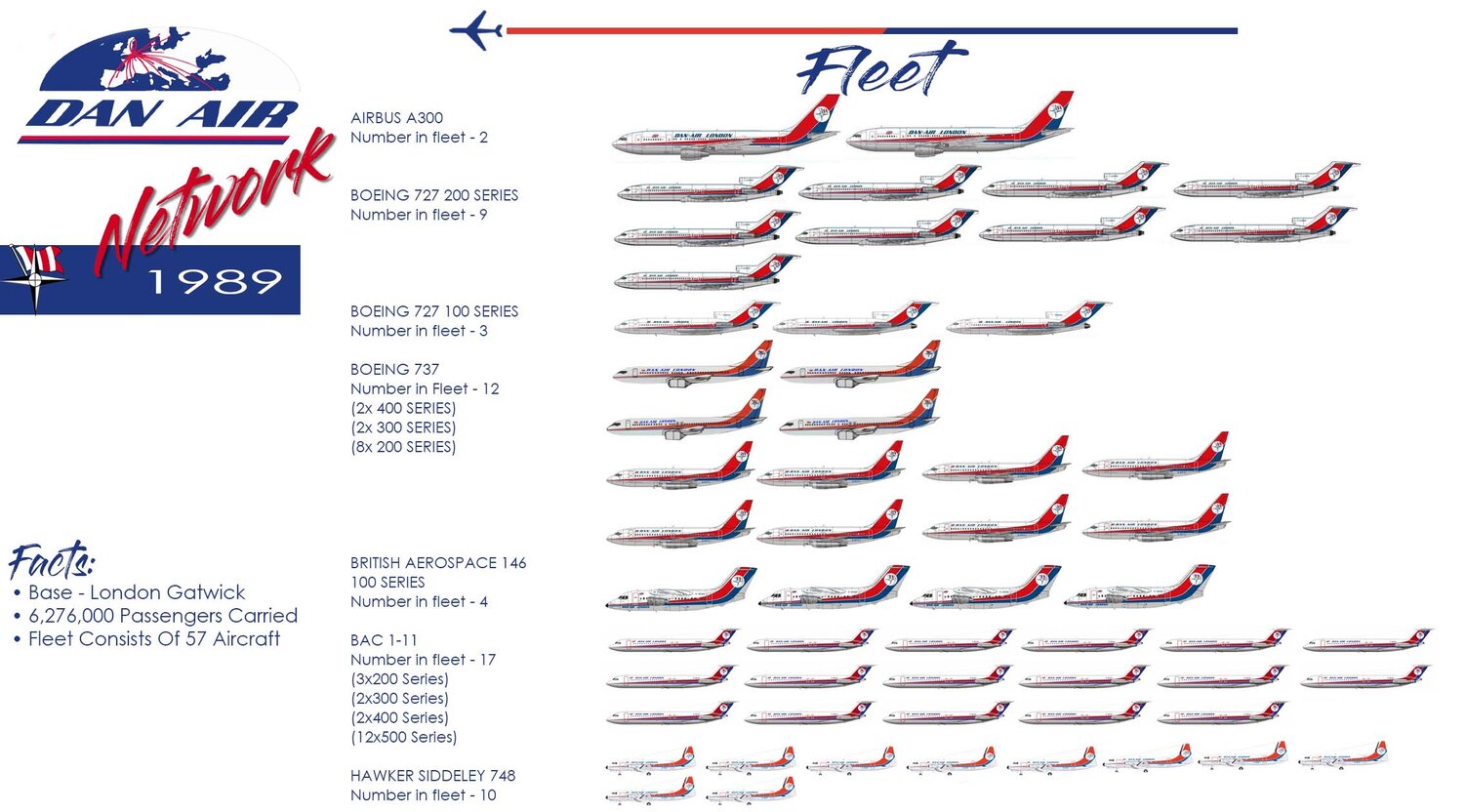
The new year started with a bomb threat on a company Boeing 727 with 170 children aboard. The aircraft was in Geneva about to return to the UK when Geneva Police were notified of the threat. The man who called,claimed to be a member of the IRA. He said the flight had fifteen minutes to evacuate. A second threat was made, resulting in 130 people being taken off a Boeing 737 about to depart for Tunisia. In this instance police sniffer dogs were called and nothing was found. The aircraft took of ninety minutes late. Similar threats had involved Pan Am and Tunis Air. In view of the recent Lockerbie accident which had seen a bomb explode inside the luggage hold of a Pan Am Boeing 747 over Scotland, security had been tightened. The flight was delayed for seven hours.
A second bomb scare, this time at Stansted, occurred in January when a phone called came in from a man claiming that the Tunisia bound aircraft had a bomb in a suitcase. All passengers had to account for their own luggage and specialist crews and sniffer dogs were brought in to search the aircraft. The call was declared a hoax and the flight departed after one-and-a-half-hour later.
A Dan-Air Airbus A300 left Gatwick en route for Tenerife in January with 330 passenger on board. The holiday makers were expecting a delicious cooked breakfast, instead they noticed smoke coming from the galley and a burning smell. The Captain made the decision to turn back to Gatwick where the aircraft was met with a full set of emergency services. The aircraft landed safely and the passengers were evacuated. Upon inspection, a newspaper was discovered behind the electronically heated oven in the galley, which had started to burn as the heat from the oven caught hold. The ovens were supplied to Dan-Air by an outside catering company, and arrived at the plane already filled with passenger meals. A Dan-Air spokesman said the newspaper had not caught fire but had begun to char when the oven was switched on. He added: 'It cost Dan-Air not an inconsiderable sum of money to return to Gatwick, take the passengers off, and fly them out two hours later on the same plane.' He added 'The outside catering company had ordered a full investigation. Fortunately there were no casualties, but if the newspaper had caught fire it might have been a very different story. Especially if the cabin crew were busy with other tasks and were not present in the galley.'
The brand new Boeing 737 400 which had entered service with Dan-Air in December 1988 had to be withdrawn from service on January 9th. A British Midland aircraft of the same type had developed engine problems and crashed just short of the runway at East Midlands. The pilot had been alerted by a warning light and alarm of a problem with one of the engines. The pilot closed down the corresponding engine. It later emerged that wiring inside the flight deck had been incorrectly routed and the warning was alerting the pilot to the wrong engine. By closing down the working engine, the pilot lost considerable power and was flying on the damaged engine alone. The aircraft was just yards from the runway threshold when it came down on an embankment of the motorway. In total forty three people were killed and more than a hundred injured. As a precautionary measure all 737 400s were grounded while checks were carried out. Dan-Air had voluntarily withdrew the 737 400 from service and the aircraft would remain idle for a short time before resuming flying. It had been scheduled to fly to Faro that day. Checks carried out by Dan-Air Engineering found that the aircraft's wiring was in order and the aircraft re-joined the fleet five days later.
In January Burns Night was celebrated on the Inverness to Heathrow flight. Passengers boarded the aircraft to the sound of the Dan-Air Scots Band who's bagpipers played suitable tunes on the tarmac. Passengers on the Burns night service were treated to a haggis supper. The Grampian Initiative, a group of Scottish businesses chose Dan-Air as their prefered carrier at the Grampian Initiative Awards. The problem Dan-Air faced was that there wasn't a 500 series in the fleet that was available to use. Nor could Dan-Air give a firm date for delivery. Passengers were losing out not being able to travel at the time of their choice as the aircraft simply wasn't big enough. Salvation was to come with the cancelled Gatwick - Cork closure. At least some of the flights could be carried out with that aircraft. In the end, the delay was four weeks!
A new start up airline, Scottish European Airways, based in Glasgow applied to the Civil Aviation Authority (CAA) for a host of licences to operate from Newcastle. Dan-Air objected to each application, saying it was standard procedure for airlines to object to newcomers licence applications. Scottish European wished to fly to Brussels, Copenhagen, Frankfurt, Hamburg, Reykjavik, Gothenburg, Milan and Geneva and said 'We can't see why Dan-Air is objecting to our applications, we would not be flying to any destinations that they do, so we wouldn't be treading on their toes. The only reason we can think of is protectionism, they don't want us entering their market. Dan-Air have the licence for Newcastle - Gothenburg, but they haven't flown the service for years.'
A Dan-Air spokesman said 'Although we haven't used the licence to Gothenburg for some time, we might wish to do so in the future, and if we did they would be in direct competition with us. We won that licence against other people and we don't want to lose it to another competitor.'
Dan-Air expressed an interest in operating out of Orkney this year after several complaints about the standard of service with British Airways and their fares. Dan-Air said they had been 'Evaluating whether improved air link between Kirkwall, Wick and Inverness would be a viable proposition, and to this end have been studying a number of options and have also held number of discussions with Loganair. We are awaiting the completion of a feasibility study and engineering assessment, completion of which will put us in a position to confirm whether positive recommendation is to made. If the economic assessment is favourable, it would then he appropriate for Dan-Air to request a meeting with representatives of the Orkney islands Council.'
Councillor Alistair Scholes wanted the issue followed up without delay said the Dan-Air official who had signed the letter, dated in January, had been the chief figure behind the airline's interest in Orkney, but had since left the airline. There were 'slight reservations' at Dan Air, he said, adding; 'They are needing a little encouragement officially'. Councillors agreed that the convener. Councillor Lunson, who described the airline's letter ' encouraging'. should write direct to the Dan-Air chairman.
Timings were changed on Belfast-Gatwick services. Which had grown to a level where the BAC 1-11 with 76 seats needed to be replaced with a larger BAe146. From March Monday to Friday flights from Belfast would depart at 0945 and weekend flights 1100. London-Belfast flights would depart at 0755 week days and 0925 on weekends. There would be evening returns at 1845, giving business men the opportunity to spend the whole day in London.
No other carrier on the route offered tickets at a lower price
The American Federal Aviation Administration called for immediate checks on all Boeing aircraft in February following the British Midland accident. Initial checks had not found anything amiss with any of the Dan-Air aircraft. All UK airlines carried out checks and an Air 2000 model was found to have faults.
A full-scale emergency was called at Manchester Airport when a company Boeing 727 100 series reported problems with the hydraulic system. Fire and emergency crews were on alert as the aircraft carrying 140 passengers landed safely. The pilot had engaged a back up system. The plane was on a return flight from Toulouse when passengers were told to adopt a brace position. No-one was injured.
A company Hawker Siddeley 748 on a scheduled flight (DA141) from Newcastle to Aldergrove Airport at Belfast on March 2nd landed at a disused RAF base a few miles away. An airport spokesman said; 'There was no technical reason for the aircraft landing at the wrong place. There was no emergency, no-one was injured and there was no damage to the aircraft.' But we operate 160 flights a day, so you are bound to get the odd hiccup.' Weather conditions were poor, with severe wind, heavy rain and low cloud. It appeared that in low visibility the pilot mistook the runway for that of Aldergrove, two miles away. An immediate investigation was launched by Dan-Air. Captain Reg Hood taxied the aircraft to a deserted spot. Passengers were looking at fields of cows instead of airport buildings. The passengers sat there in stony silence. Boyd Neely from Belfast told us;
'There was no trouble landing, it was quite safe. I didn't recognise the runway, but the pilot didn't say we were in the wrong place. We sat there for about an hour, the pilot told us he was waiting for clearance to take off again, but he didn't get it. It was probably just one of those hiccups that happen from time to time. The landing was perfect, dead on time, it just came down at the wrong place. .'
Air traffic controllers said that they had the aircraft on screen and then it disappeared. A spokesman said: 'We feared the worst for three minutes and then a radio message came through.' Passengers were treated to a cup of tea and ferried by bus to the correct airport. Two other Dan-Air pilots flew the short hop into Aldergrove where it then returned to Newcaslte.
The disused airport was two miles away from Aldergrove. Captain Hood and his First Officer were summonsed to London for an emergency meeting the following day. Captain Hood was not alone with his mistake, a Spanish pilot made the same error eight years prior. An investigation was launched and whilst Dan-Air initially said the weather was 'hellish' the Meteorological Office said conditions were good. Air traffic control said there were low clouds, but that they had instructed the Captain to wait for a break in the clouds. Dan-Air refused to comment further, but the press revealed Captain Hood had been suspended the day of the incident and was facing the dole queue. A source said: 'Although his dismissal will be subject to appeal, at this stage it is very likely he will get the sack.'
Captain Reg Hood, aged 50, lashed out at the airline in April, saying: 'The company seems to be going over the top and taking a very serious view indeed. I'm not flying and I am on leave until the whole thing has been sorted out. No-one was hurt and the aircraft landed safely, so I am rather surprised at their attitude. There are a number of circumstances surrounding the incident, but at present I am not in a position to talk about what exactly happened.'
Dan-Air responded by saying: 'An internal disciplinary has been held and action has been taken against Captain Hood.'
Horley Town Council were not happy that Dan-Air wanted to expand their Newman House complex to house 150 extra staff. Plan had been submitted to take-over four shops and convert them into office space. The town's planning committee said that this would place stress on the streets as there was already a shortage of car parking. Newman House was already the largest building in Horley, the council had no desire to see its main street be a Dan-Air street. 'Do we really want an employer to be bigger than the town itself?' said Cllr John Meech. The recommended for refusal would go before the town's full planning committee. Permission eventually granted in October 1990!
Charter flights carrying a total of 1,000 football fans took off from Cardiff to Paris for the match between Wales and France. There could have been an extra 400, but the airline had no spare aircraft. Travel agents decided to charter coaches for those people rather than try another airline said Bebbs Tours.
The Gatwick - Cork service was to be discontinued, the company said they could not get the timings and frequencies to enable the route to develop. However, a greater emphasis would be placed on the Gatwick-Dublin service which would see the introduction of the 'Class Elite' service and increase the number of flights between the two cities. Dan-Air said there would be job opportunities at Dublin. One service not at risk of closure was Inverness - Heathrow which had been such a success that the 82 seat BAC 1-11 400 series that carried out the flights was considered too small. The preferred aircraft was the BAC 1-11 500 series traditionally had 119 seats, but this would be reduced to 99, affording passengers greater comfort. The new aircraft delivery was delayed and the airline did not have a spare aircraft. Bookings had been taken for the new aircraft which had so far not arrived. This meant as many as 17 people on each flight would potentially be denied boarding. In some cases passengers were taken to Aberdeen to connect with other Dan-air flights at the airline's expense. Travel agents were disgruntled saying that passengers had been told to re-book or travel via Aberdeen, but that this is 'not the remedy' they said. Dan-Air admitted there had been problems and that the delay would have a knock on effect. Eventually the new aircraft arrived a month late.
Air Europe continued to expand, as well as successfully obtaining a licence to fly between Manchester and Malta, the carrier increased frequency on the Gatwick-Gibraltar service ordering six 400 seat MD11 jets for long haul flights. One of our contributors said;
'Oh my gosh, almost every week they were announcing that they had ordered new aircraft and starting a new service. I had a friend who worked for them and she ribbed me about how big they were going to be, and that I'd be knocking on their door for a job. He had been ex Dans and so he had an insight into how aviation worked. I asked him - where's the money coming from? Aircraft aren't cheap you know. They cost millions each. Air Europe boasted no aircraft was older than two years of age. Then he let slip how they ordered them early and as soon as they got them, they sold them to a leasing company. Then leased them back - the aircraft weren't actually theirs! He said on more than one occasion that they were trying to rub us out. I couldn't understand why - So, one time he tells me that they were opening a new engineering facility to carry out a lot of day to day repairs. Dans had always been their engineers. I thought for the first time - maybe there is something in this.'
Aberdeen was to have renewed links to the Channel Islands from May this year when Dan-Air would be stepping into the breach left by British Airways and would operate flights through the Summer months using jet aircraft. The airport's consultative committee would be writing to the Civil Aviation Authority to stress the importance of Aberdeen Airport and Dan-Air. The link with Manchester Airport was also to be renewed after more than two years. In addition. Inverness - Aberdeen flights will run five days week instead of only two as part of a major move by Dan-Air to ’spread their wings". A choice of Heathrow or Gatwick will also be available to North travellers to London with bigger aircraft available: 'We're investing in the Inverness routes because see tremendous potential in them,' said Dan-Air executive Peter Clegg. The oil downturn was part of the reason for the Inverness-Manchester flights being axed, but not only would they be re-instated from May 1st They will run also Monday to Friday, and carry on to Gatwick. North holidaymakers will thus have the option of a Manchester departure for holiday charter flights and Dan-Air say there is strong demand for flights from Manchester to Inverness for Cairngorm skiing holidays. 'There is such a growth in interlining from Manchester to places like North America that we've had a lot of requests from the Highlands to go back there.' said Mr Clegg. 'Similarly, we've been made aware that two flights a week to Aberdeen from Inverness isn't enough so we'll run daily Monday to Friday,' There will now be 21 flights weekly from Inverness to Heathrow and 10 to Gatwick The 82-seater BAC 1-11 will be replaced from early May by 99-sealer BAe 146 jetliners.
In March, the EEC Commission ruled that price fixing of air fares was illegal. The Court Of Justice in Luxembourg ruled that a West German travel agent could sell tickets they bought abroad cheaper. Sales had been stopped because the fares undercut prices offered by airlines. The courts ruled that airlines which offer price fixing agreements and try to keep out competition are breaking EEC law. The Government said they would study the ruling carefully. The independent airlines welcomed the move that they said could reduce air fares by up to 20%.
The annual survey of airlines carried out by Which Magazine revealed that Air 2000 had rocketed to the top of the list for service. British Airways was in the second division. American giants, TWA and Pan Am were rated the worst. Air 2000 was the only British carrier to make it in the first division, among the likes of Cathay Pacific, Singapore Airlines and Wardair. Dan-Air was rated above average especially on catering, whilst British Airways and Air UK were rated as average. Air Europe and Loganair had slipped to below average. Air Europe announced that they had ordered six MD11 wide-body airliners, and had options for twelve more. The aircraft would be delivered by 1993. Intasun had flown 18,000 passengers on long-haul flights just two years ago and this year they were expected to carry 220,000 long-haul passengers.
In March, more criticism was aimed at Spanish air traffic control after a Dan-Air Boeing 727 with 187 passengers on board came within 300 yards of a Tristar operated by German carrier LTU over Spain. Captain Charles Nash was forced to take the Boeing on a dive after the Tristar had flashed overhead. Dan-Air submitted a report to the Spanish authorities. The incident occurred 80 miles north of Madrid. Captain Nash said he received a 'garbled message' from Spanish controllers. Telling him that if he was at 35,000 feet he should descend to 33,000 feet 'as soon as possible'. Captain Nash immediately pulled the power back and put the air brakes out to get down to the requested flight level. As the plane went down he saw the LTU Tristar 300 yards away passing left to right. A passenger on the flight, Michael Prosser said:
'We were flying along normally when suddenly the aircraft began shuddering and dropped down quite a bit. The pilot then came on the loud-speaker and told us a German plane was on the same flight level as ours, he apologised and said it was Madrid control's fault. He then passed control to the co-pilot and the Captain walked through the plane calming everyone's fears.' Jack Glover, a first time flier aged 76 was aboard and recalled how he had a frightening experience on his debut flight two weeks prior. 'On the way out to Spain from Manchester the pilot told us he was having brake troubles. the stewardess had to go through the emergency landing procedure. That was nothing compared to what happened on the way home. The pilot had to cut his engines and dive to avoid missing the other plane. He told us afterwards that we had missed it by five seconds and that he was able to see the other plane's number, we were very lucky.' His son, Barry said: 'Both planes were flying at 500 mph, so that would have had the velocity of 1000 mph - we would have been obliterated.'
Shop Manager Dave Jackson of Bamber Bridge said: 'It was the most terrifying moment of my life. One minute we were cruising along normally and then suddenly the engines just stopped and the plane just plummeted. It was like being on a roller coaster. People were screaming in panic. The plane was shuddering and the wings were shaking so much we thought they were going to fall off. We had no idea what was happening - it was as if the aircraft was free-falling. It all happened in a split second we had no time to put seat belts on or put cigarettes out. At first we thought there was something wrong with the plane. I was sitting about four rows from the front close to the galley and after we had levelled out I heard the main stewardess telling the others that there had been an incident and to keep everyone calm. Then the pilot Captain Nash came on and told us that Madrid control had set our plane and a Tristar flying towards each other at 500 mph. He said we dived 8,000 feet in ten seconds. We owe our lives to that man - he was brilliant. But for his split-second reaction there would have been a collision at 1,000 mph. Even he said afterwards that he thought his number was up, because we were two seconds away from disaster. He deserves a medal. We had apparently been so close to the German plane that our crew could read the registration. We missed its wing by about 10 feet. The incident shocked the whole plane into silence. Nobody said anything and nobody moved. I think everybody was just stunned. It's put years on me, it's really shook me, it's been preying on my mind ever since I got back. I hadn't been on a plane in fifteen years and I will be very wary of going on one again. I can't stop smoking since I got home. I bought 300 cigarettes and had only 80 left after a few days.'
Jayne Whincup said: 'It was about an hour into the flight. There was a big noise and it just seemed to drop straight down. It was all over in an=bout a minute, but it seemed to be much longer. The thing that frightened everybody was that the stewardesses just ran down the aisle and sat down. People looked very panicked but just remained quiet. There was a horrible eerie silence. I don't think people had time to realise what had happened. If it happened any longer I think there would have been much more panic. After the incident the pilot came around the plane and explained to everyone what had happened. In a desperate bid, he just cut back on all three engines to make the plane drop as quickly as possible.
No-one was hurt in the incident, but a Dan-Air spokesman said: 'Both aircraft would have been been flying in excess of 500 miles per hour and 300 yards at that speed is very close the distance would be covered in split seconds. The message Captain Nash received was unfathomable, the only words the Captain understood were 33,000 feet. It was a brilliant piece of flying by Captain Nash.' Dan-Air made a formal complaint to Spanish Authorities.
Engineering is often overlooked when one is researching for a website, as the summer season was about to get underway people back then seldom gave a thought to the mammoth, painstaking job that went on behind the scenes that kept Dan-Air's fleet running safely. Engineers knew that any bad practice could cost many lives. A huge Rolls Royce engine was in hanger four at the Manchester base of Dan-Air Engineering for a short service in March. That short service would take a number of highly qualified technicians three says to complete. Paul Mahoney, who was 22 in 1989 had completed a four year apprenticeship and was working as a lead mechanic on the verge of being made a supervisor said: 'When it comes to safety, of course it's a responsible job and you never forget. But like everyone else, when a plane crashes you think, what could have happened. In our business there is no room for supposition - you just find out and make sure it doesn't happen again.'
Bob Oulton who was Dan-Air Engineering's deputy production manager went on: 'In our job, millions of lives are in our hands, anyone who doesn't share that view is not in our employ. Unless you are thinking of a wing dropping off,a single failure does not cause an aeroplane to drop out of the sky. The systems on aeroplanes are such that they have a duplicate built in to prevent any one failure causing a mishap. For instance if all regular flight instruments failed, there would be a standby sufficient to fly the plane.'
Hanger four had enough space for four aircraft and had the capability to strip an aircraft down to its bare minimum, with everything from the black box to the toilet being thoroughly examined, and maintained. The work, when completed was checked by an inspector before going onto quality control, who had the final say before an aeroplane was allowed to fly. All the engineers had to be qualified and licensed by the CAA. These licenses were subject to renewal every five years.
On April 18th Princess Alexandra opened Dan-Air's new hanger and associated engineering workshops at Gatwick. The jumbo sized hanger was Dan-Air first at Gatwick and the largest single span hanger ever built at the airport. On arrival, the Princess was met by company Chairman Fred Newman as well as board members and visiting dignitaries. Instead of the traditional red carpet, the Princess walked along a blue one, matched to the stewardesses uniform. A bouquet was presented to her by nine year old Claire Newman, the Chairman's grand-daughter. the new Dan-Air band of Pipes and Drums made its debut at the opening. The hanger, built by James Longley and Company would give Dan-Air Engineering extra capacity for their own Gatwick based fleet and third party engineering work. The £10 million hanger could handle wide-bodied aircraft as large as a Boeing 747. As well as workshops and storage areas the hanger had a medical station and canteen for staff. After a tour of the complex the Princess met some of the 400 staff who would be based at the hanger. She chatted with stewardess Kate Snowden about where Kate's next flight was. Then she met Vic Beddington who was about to retire after 21 years with the company. She inspected an Airbus A300 which was in the hanger for a five day maintenance check. she was given a run-down of the controls in the cockpit by avionics expert Ray Cawood. Finally she had tea in the canteen with staff.
Speaking of the Drum and Pips Band - The world class band registered with the pipes and drum association and would go on to play at events all over the globe. It was a good way of promoting the airline, especially in Scotland. Other sponsorship projects included the Dan-Air Football League and the Dan-Air Youth Tenpin Bowling Leagues.
A faulty light in the flight deck caused a BAe146 to carry out an emergency landing at Newcastle at on March 29th. The light indicated that the undercarriage was not locked. The aircraft landed safely and the light repaired n-site. A spokesman said; ''These things happen from time to time and the crew acted exactly as they were trained to do so.'
Crew training was stretched to its limit the next day when a screaming passenger brought terror to a packed holiday charter flight. The man was said to be shouting and punching a woman sat next to him on a return flight from Tenerife. He then ran up and down the aisle before five passengers jumped on him and tied him to his seat with spare seat belts to await police at Gatwick. Two passengers were injured on what appeared to be an unprovoked attack on the Boeing 737. Passenger John Welsh said: 'The air hostesses seemed to have no idea what to do, two of them were weeping and the others cowering in the galley. It was up to five of the largest passengers to leap on him and restrain him. There was nothing to sedate him on board, so all the air hostesses did was to bring him two aspirins and a glass of water. The man was covered in blood when he left the aircraft with policemen.' A Dan-Air spokesman said: 'It was unlucky there wasn't a male steward on board, but we only started recruiting them last year and haven't many of them on staff. In cases like these it is up to the Captain to use his discretion as to whether to send the First Officer from the cockpit to investigate.'
Clive Huson, 29 year old London man was arrested and charged with endangering an aircraft and its passengers, and he appeared in court the next day.
People in the south of England appeared to be turning their backs on the sun this year, blaming the high cost of mortgages rates for the slump - specifically in the region. Dan-Air's Peter Clegg said his airline had been hit hard by the decrease in charters: 'The economic situation in the south with high mortgages and the air traffic control delays of last summer may have put people off flying.' The company said they were encouraging foreign Tour Operators to fill empty seats by block booking return flights. But sales in the north seem to be booming said Public Relations Officer George Yeomans: 'Perhaps the pendulum has swung the other way.' Both Air Europe and Virgin said the same thing, and Lunn Poly had noticed a definite north south divide.
In May, Sir Ian Pedder became the new Dan-Air Chairman. The 63 year old former Spitfire pilot would replace Fred Newman, who had been at the helm of the company since he founded it in 1953. Those thirty six years had seen the company grow from a single DC3 to Europe's largest holiday airline and Britain's second largest scheduled carrier with a fleet of 57 aircraft. Mr.Newman would remain as Chairman of Parent Company Davies And Newman, Holdings and remained non-executive director of Dan-Air. Michael Newman, Fred's son was appointed deputy chairman. The end of the financial year in April had seen pre tax profits rise slightly from £9.5 million to £9.9 million,but only because of a boost of £1.3 million from the sale of an aircraft. A company spokesman said '1987 had been a particularly good year for Dan-Air, so it was always going to be a challenge to repeat that performance in 1989. The setting up of a new scheduled service to Paris, the opening of a facilities there, and the employment of consultants to the engineering division all involved exceptional costs. The charter division was making around 450 flights a week from all the major UK airports and Berlin to all the popular Mediterranean destinations. Dan Smedvig, the subsidiary company involved in oil drilling and well servicing had a much better year. He said the company's wider interests meant it could mitigate the effects of the continuing downturn in Package Tour holidays. The company share price stayed steady at 845p as Davies and Newman produced a final dividend of 12.5p making a total payout of up 2p to 17p.
RAF Manston in Kent was used by Dan-Air from May to October this year. Cosmos had chartered the BAC 1-11 for a series of flights to Palma and hoped that Tenerife would be added next year. The flights were permitted after the Ministry of Defence relaxed the rules concerning civilian flights operating from RAF airports. Several other airports were being considered. Cosmos Managing Director, Roger Corkhill said; 'We are using Manston because we have been worried about congestion problems at Gatwick and Luton. The bookings for the flights are really good.'
On June 18th all the UK's Boeing 737 400 aircraft were grounded for inspection. They type was the same as the British Midland Airways jet that had crashed in January 1988. This came after a Dan-Air pilot had noticed excessive engine vibration during a flight from Menorca and a British Midland Captain landed on one engine. The grounding of the type caused major delays at airports in the UK and across Europe at the start of the busy summer period. Replacement aircraft were sourced at great inconvenience to airlines and passengers. The Boeing 737 400 was operated by five UK airlines, Air UK Leisure, Dan-Air Novair, British Midland and Air Europe. The charter airlines had responded to Tour Operators slashing the number of holidays they were selling that year by either chartering them to other Tour Operators or reducing their own fleet. Now with the aircraft grounded it was almost impossible to find replacement aircraft at such short notice. However, Dan-Air were able to replace all the affected flights the following day by 'careful planning of our other aircraft', said a company spokesman.
The aircraft were given the all clear on June 22nd after modifications were carried out to the engine fan blades.
The BAC 1-11 500 series aircraft that had been ear-marked for the Inverness - Heathrow service finally arrived at its base on 18th June. The aircraft had been delayed for several weeks due to slippage in the aircraft's supply market. The airliner had been configured to seat 99 passengers, unlike its charter counterpart with 119 seats. The jet would immediately start work as the company had received many complaints about over-booking. The jet's predecessor was a smaller 82 seat 400 series which had struggled to cope with demand. Things were promised to improve, although there was some disquiet in that the aircraft would only be used on the 11:15 am flight, arriving back in Inverness at 2:55 pm. Dan-Air said that it was the only schedule they could provide at the moment due to pressure on other routes. They were confident the 400 series would be able to handle the weekend flights. Highland businessmen were pressing for the larger aircraft to be used on all of the flights. A spokesman for the Highlands and Islands Development Board said they were disappointed that the plane was only being used for the one journey but were hopeful the larger plane would be used more soon, increasing capacity on a popular route.
Dan-Air became the first UK airline to introduce Draegar Oxycrew smoke hoods for cabin crew on all aircraft. The hoods were designed by the company and Dan-Air and could cost the airline £60,000. Once the hoods were placed on the head they would generate oxygen for twenty minutes. This would help cabin crew evacuate an aircraft more effectively and protect them from sparks as well as smoke and toxic gases. The airbus fleet already had a similar product. Britannia Airways and most other airlines made similar orders following Dan-Air's announcement.
The Imperial Air Cruising Company chartered two company Boeing 727 tri-jets for a series of 12 and 30 day air-cruises combining the luxury, service and easy going leisure of bygone days with contemporary travel. The aircraft would be refurbished with four abreast armchair style seats and would carry only 75 passengers as opposed to the 140 the aircraft normally carried. Quality dining and fine wine would be served by cabin crew wearing 1920s style outfits. There would be VIP treatment at airports, staying in the best hotels and visiting the most spectacular sights. The aircraft would accompany the guests throughout their holiday. A seven day cruise 'La Belle Epoque' would take in Paris, Vienna and Moscow. The twelve day Royal Ottoman would visit Vienna, Istanbul, Cairo, Luxor and Rome. The month long 'Imperial Cathay' would visit Cairo, Luxor, Delhi, Bangkok, Peking, Singapore, Phuket, Nepal, Tashkent and Paris. the holidays would be priced between £1499 and £6750. The charters would start in October this year and carry on until May 1990.
In what seemed to be becoming an annual event, Dan-Air and other carriers had to contend with drunken passengers. Certain destinations might appear to be more likely to suffer from this problem. One doesn't expect it on a return flight from Rimini. One expects even less, the culprit to be a 67 year old granny who started slugging it out with her daughter. Sheila Morrissey, from Stretham, began the fight with her daughter, Pat Tate, twenty minutes after the flight had taken off. The BAC 1-11 had to return to Rimini after cabin crew had wrestled Ms Morrissey to her seat. Ms. Morrissey was still in resort the next day, but Dan-Air did not press charges. In further incidents in August, six men were refused boarding after stripping naked in a departure lounge in Malaga in front of other passengers waiting to board a flight to Manchester. The drunken men shouted abuse at airport staff and passengers. Three of the six had their tickets stamped 'refused carriage' and therefore not permitted to fly home on any charter carrier. The other three were being assisted three days later by representatives of Airtours who had chartered the aircraft. The men were from Mansfield, Nottinghamshire. Later, two men were refused travel from Bristol after being drunk and rowdy. At the end of August, 11 passengers had 'refused carriage' stamped on their tickets after drinking all night before heading to Malaga Airport to fly home, again to Manchester. One passenger was unconscious on the floor while the other ten were drunk and rowdy. The consulate in Spain said they would have to purchase new tickets, but this time for rail and sea crossings. In an attempt to stem the drunken behaviour Dan-Air decided to give restraint training to cabin crews. Aircraft would now carry plastic straight jackets. The devices are not as gruesome as would appear. The devices only retrained wrists and were wrapped around arm rests. The more a person struggled, the tighter the straps became! Three Liverpool men who were denied boarding, claimed that they had been the victims of mistaken identity and were seeking compensation from Dan-Air. Both Dan-Air and Air Europe called for rationing of drinks on charter flights. Both carriers called for a limit of two drinks for each passenger. This was a shame on charter flights, as it was a good source of revenue for airlines.
Two Dan-Air BAC 1-11 passenger jets came close to colliding over the South Downs in the Horsham district on July 11th. The aircraft passed only half a nautical mile from each other, after evasive action was taken. A spokesman for the Civil Aviation Authority said flights DA442 from Jersey and DAOSB3 from Aberdeen had been flying at the same height of 10,000 feet. 'Air traffic control gave avoiding action to the Aberdeen aircraft and they passed each other at a distance of about half a nautical mile. The details will be fully investigated by the Independent Joint Air Miss - Working Group and in due course a report will be published.' Peter Clegg, spokesman for Dan Air, said they could make no comment about the reason for the incident. ‘Our two pilots have to write separate reports, then we will file the company report to the CAA,' he added. 'There have been 14 ‘'air miss’ reports made to the CAA so far in 1989. The last one involving Dan Air occurred three months ago, when a German aircraft strayed into the path of one of our aircraft.'
French Radar operators went on strike in July causing chaos at UK airports on July 19th. Dan Air, one of the busiest airlines, said at least 60 per cent of its 250 flights were delayed. At Heathrow and Stansted, passengers had to endure five-hour also because of the air traffic control dispute in France. Most flights to Paris were delayed for two hours, and some flights to Greece and Spain faced a wait of three to four hours. Extra seating had to be brought into Terminals One and Two as queues of passengers stretched the length of the buildings.
British Airways pulled out of the Aberdeen - Jersey route, which would be taken over by Dan-Air in May. The new service was to see the introduction of a jet aircraft, and the Inverness - Manchester service was reintroduced after a two year gap with good yields from the start. Shortly after starting services, the BAC 1-11 400 was replaced by a 500 which saw capacity increased from 89-99. Dan-Air were now offering champagne breakfast on all of their scheduled services, and they were promoting the Class Elite service through press adverts.
Dan-Air suffered negative press when it emerged that one of the Boeing 727 200 in the fleet, which had bought two years previously, had been written off in an accident whilst in the service of Mexicana. The aircraft had suffered a wheels up landing, sliding a mile down the runway before the impact forced two fuel boosters through the fuselage. In July it was grounded when a coach which was picking passengers off the aircraft clipped the wing. The 16 year old aircraft had been fully repaired by Dan-Air Engineering. George Yeoman, head of Public Relations said that it was 'perfectly normal' for airlines to buy aircraft that were due to be written off and 'put them right.' He assured the press that the aircraft had been given 'absolute clearance' from the Civil Aviation Authority. He went on to say ''Dan Air Engineering were second to none. The repair had taken 24,000 man hours. We had bought the aircraft some years ago - The aircraft was featured on ITV's 'World In Action' who did a reasonable hatchet job on the aircraft.' He added 'There are lots of planes flying that have been in crashes. The aviation industry is the most regulated in the world. We don't fly aircraft that are not safe'
The aircraft had carried thousands of Manchester holidaymakers to continental hot-spots. The jet - G-BMLP known affectionately by crews as 'Lumpy Papa' a variation on its official call-sign 'Lima Papa' was built in 1973. Since then it had flown 26,180 flights and spent 40,703 hours in the air. Lima Papa carried out about 17 return flights a week during the busy summer months, carrying in the region of about 6,500 passengers a week. The day the story broke it had taken a full load of 187 passengers to the Greek island of Kefallonia. Dan-Air had nine of the 200 series and three of the 100 series, with three based at Manchester, including Lima Papa.
The Civil Aviation Authority released its first ever league table for delays. It would reveal which airports and airlines were the best and worst. Delays in April, the start of the holiday season went up by 40% compared with out of season flights. Two of the most popular destinations, Palma and Malaga were also two of the most delayed. Worst performing was British Island Airways who's average delay on the Gatwick-Malaga flight was three hours and 12 minutes. The airline also scored badly at Faro in Portugal, where the average delay was four hours and 16 minutes, and Zurich with and average of two hours 23 minutes. The airline said 'It was luck of the draw' and that 'the vast majority of our delays are caused by air traffic control.' The overall average delay for airlines leaving Gatwick for Malaga was one hour 34 minutes. To Faro (8 airlines) 82 minutes and Zurich (10 Airlines) 26 minutes. The report showed that on average 65% of flights were 'on time' that is within 15 minutes (early or late). For Malaga Air Europe had average delays of 69 minutes, while Dan-Air, Britannia, Caledonian and British Airways had 71 minute delays, where a delay occurred. With Faro Air UK leisure 251 minutes, British Island Airways 266 minutes, Britannia 105 minutes, Air Europe 46 minutes, British Airways 43 and Dan-air 25 minutes (charter) Palma saw average delays of 19 minutes with Air Europe, Caledonian 32 minutes, Britannia 33 minutes, British Island Airways 33, and Dan-Air 17 minutes. The UK's worst affected airport was Gatwick.
A chilly, difficult to heat aircraft hanger at Manchester, owned by Dan-Air Engineering was in line for a Norweb Beta Building Efficiency Award in August.
The popular resort of Salou in Spain was hit with a Typhoid outbreak in August, major Tour Operators cancelled bookings to the resort and offered clients the opportunity to transfer bookings at no cost to them. In September,the new 1990 brochures were launched and agents were expecting a price war for the summer of 1990. Thomsons would offer vouchers to holidaymakers to spend on the high street before travel and discounts of up to £60 on early bookings. Intasun's seat only brochure 'Skyworld' were offering 140,000 flights only deals. With a return flight to Palma from only £29. They offered customers 'The lowest possible price or your money back'. Saying that if anyone found the same flight elsewhere within 14 days of booking they could have their money back or have the booking price-matched. Airtours were promising 50% more holidays from Newcastle than 1989. The price war came to an end in September. Thomson Holidays had said 'We didn't want it, we didn't ask fro it, but we couldn't stand by and watch our business get swallowed up' Thomsons were by far the largest Tour Operator in the UK.
Captain Elizabeth Overbury retired in August this year. Captain Overbury flew her last flight aboard a HS 748. when she taxied her aircraft to a halt at Newcastle on August 16th. It brought to an end her distinguished career. she was greeted on the apron by her airline and airport colleagues who had brought her a bouquet of flowers and two of her pet loves - the airport security dogs. When she saw the dogs she brought down two packets of Dan-Air biscuits down the steps. An airport spokesman said; 'Her love of dogs is unmistakable, with many tales of her stroking dogs or patting them before they were placed in the hold.' She had been in the aviation industry since 1957, joining Dan-Air as a First Officer in 1975 before becoming a Captain ten months later. She flew most types, from Tiger Moths to Dakotas, HS 748, BAC 1-11 and Boeing jets. She said; 'I'm looking forward to retiring, but I will miss the comradeship of my colleagues.' I have plans for the future, but said 'I'm not telling what they are.' Dan-Air had a fine reputation with female pilots (in 1988 Lyn Roberts left for British Airways. Captain Yvonne Sintes retired in the early 1981)
A Captain refused to let eleven 'drunken yobs' from Liverpool on his flight from Malaga to Manchester in August. The BAC 1-11 was delayed as the men ripped off their clothes, swore at other passengers and being involved in fighting. Their passports were stamped 'Refused Carriage'. Their Tour Operator, Airtours, said they would have to make their own way back to the UK, by ferry and coach - at their own expense. This was followed the next day with two families who boarded a company Boeing 727 at Bristol for a flight to Malaga. A pub landlord staggered on the aircraft and the Captain ordered him straight back off. His friend stepped in to protest and a scuffle broke out. The Captain then ordered both men, and their wives, 10 year old son and a 15 month old baby off the aircraft. The landlord was arrested and bailed on further investigation. The two families had paid in excess of £1000 for their holidays. The friend said; 'We had a few while we were waiting for the plane I admit. I asked to see the Captain and I was pushed back, so I shoved back. I was then arrested.' The pub landlord said: 'I was drinking before the flight - who doesn't on holiday? We had been delayed for hours in the hot airport, and the baby was already upset.'
The police said: 'We ejected one man who the pilot didn't consider fit to fly, he left the aircraft quietly. his friend took exception to this, there was a heated argument and the man was arrested after a scuffle broke out.'
A Dan-Air spokesman said 'Passenger drunkenness was on the increase and we warn passengers to stay sober or risk not being allowed on the aircraft. We do not want lager louts on our aircraft. It doesn't do our image, or Britain's image any good abroad.'
In September Dan-Air staff were issued plastic straight jackets and given retraining lessons in a attempt to stop loutish behaviour. The jackets would be used to keep a passenger in their seat. It emerged that other carriers had been forced to do the same. All airlines stressed that the devices, as well as plastic hand-cuffs would only be used in the most extreme cases, as a last resort.
Three of the Liverpool men said they were in the process of suing Dan-Air over a case of mistaken identity after being stranded in Spain. They claimed they were looking at 'substantial compensation'.
On September 1st, a Boeing 727 experienced technical difficulties on a charter flight returning to Manchester from Turkey. Passengers claimed they suffered a 'terrible ordeal' as the aircraft with 187 passengers on board 'rocked' from side to side as it jettisoned fuel and 'limped' to Athens on two engine, after the pilot was forced to shut one engine down. It was claimed that one runway at Athens was closed down as emergency vehicles rushed to the jet. Two passengers reported that this was only the start of their nightmare. The passengers were put up in an Athens hotel for the night as the aircraft underwent repairs, the following morning the 187 passengers, mostly from the north west of England were coached to board the same airliner. Just ten minutes into the flight the Captain radioed back to Athens reporting that the same fault had re-occurred and they would be making a second emergency landing. Angry passengers were then put on another aircraft and returned to Manchester. Colette, a 25 year old sales representative said she was in tears as the plane made 'rumbling' noises, saying: 'I've flown many times before, and I have never heard those noises before, I really didn't think we were going to touch the ground again. I will never fly with Dan-Air again, we should never have been put back on that aeroplane. There was no explanation for the noises, like there usually is when you go through turbulence. It was as though the pilot was fighting to keep control of the aircraft. Women all around me were screaming and crying.'
Her 30 year old husband, civil servant Brian, was now pressing the airline for compensation. He was left with just £3 after spending all his Turkish currency, saying: 'We had no money for the airport, it was just terrible. we got an apology from the pilot but haven't heard anything else.'
The aircraft eventually arrived at Manchester 26 hours late and minus three passengers who refused to re-board a Dan-Air replacement plane. They asked for their luggage back and travelled home by bus.
Ron and Pat Sullivan of Wigan said: 'We had no money and there were plenty of others in the same boat. We called the British Embassy and they agreed to cash cheques if we had a banker's card, but it was on the other side of Athens. The travel agent rep wouldn't help and neither would Dan-Air. We are all part of the Common Market, there should be some sort of service for this sort of emergency.'
A spokesman for Dan-Air said: 'At no time was there any danger to the passengers and at no time was there any danger to the engines. The pilot had a fire warning, and because of increased procedures by the Civil Aviation Authority it was necessary to land the jet. The Captain was only following strict procedures.' He added: 'It is not unusual for an engine to be shut down, in fact, the aircraft can land on one engine if necessary.'
Captain Alan Selby told us;
'I don't especially remember that incident, but pilots will all have a similar tale to tell. It sounds to me like the Captain carried out what is standard practice. The flight deck would have all been trained to deal with this eventuality. I would imagine that all was calm on the flight deck as they dealt with the situation in a professional way. Of course, the lady you mentioned said she had flown many times, but I can guarantee that she won't have flown as many as all the crew had. She may have heard noises that were unfamiliar to her, and she may have been alarmed at the turbulence, I can also guarantee that the flight deck crew would not be alarmed. They wouldn't fly through exceptional turbulence, and although it may have appeared to have been rocky to her, the aircraft is perfectly capable of flying in normal turbulence. I can well understand that even as a fairly regular flier, she would be frightened and even tearful, it wouldn't be great if the Captain were to burst into tears or scream! I am certain he felt bad that the passengers were frightened, we never want people to not enjoy their flight. If he apologised to the passengers I am sure he did so in a way that will have assured them. As for putting them in a hotel overnight, it would have been as much an inconvenience to the crew as it was for them. It was unfortunate that the same thing happened after repairs were carried out down route. But would the couple rather the crew carry on as if nothing happened to get them back to Manchester? That would be foolish, and that would be potentially dangerous. Their cash shortage was, sadly their own problem. It might have been a package with one of the Tour Operators who were not particularly generous with refreshments during delays. It would have been Dan-Air who were footing the bill for the hotel, and I cannot imagine that we would have let them starve in the airport or hotel. If the problem was Dan-Air's responsibility then I know we would have done all we could to make them comfortable and safe.'
A few days later a Dan-Air jet took off from Stansted for a holiday flight to Monastir when airport officials were alerted that a bomb had been placed on an aircraft that had taken off at midnight. The only departure at that time was the Dan-Air jet. Air traffic controllers ordered the aircraft to land at Gatwick where it was guided to a safe area away from the terminal. Passengers were ferried to safety while sniffer dogs and bomb squad experts searched the airliner. The team took two hours to thoroughly search the aircraft and found nothing. Passengers were asked to identify their luggage which was then searched. After breakfast the aircraft was given permission to take-off. They reached their destination seven hours late. One of our contributors told us:
'There's bugger all you can do about it, other than to land. You might think that if the caller had an Irish accent or an Arab sounding voice that you would take the call more seriously, but no, it doesn't matter who is calling, you have to act upon it. In most cases you did get warning phone calls. You have to be sure. That said - It would have cost a great deal of money to land at Gatwick, and then have all those security measures. I will never understand why people do that sort of thing. It's not just the cost. Those passengers would have probably all been terrified.'
Intasun had requested that in an effort to speed up turn around times, return flights to the UK would not have allocated seating. This led to many complaints from passengers: Holly Malcross who worked at Manchester Airport told us:
'From what we were told, the seating allocation at Manchester was supposed to apply for the return flight. It might sound trivial, but allocating seats was rather time-consuming. We used to have to do it manually, and then we had computers with printed passes. That wasn't the case in a lot of overseas airports, they still had the stickers on the boarding card. We had people going out of their way when they got back to Manchester to find us and tell us that the whole thing was a farce. People had lost their original passes, and had been given another without any allocation. In my experience too many people make a beeline for an aircraft when it is boarding. It's not like it was likely to leave without them. People who are generally courteous become monsters. Shoving their way forward, the elderly can be worse than the young! The problem is, the young are a lot more able bodied, and those with families tended to get held back because of the way kids are. That would mean that families could be split up. Then the crew would have to start asking people to change seats, which they didn't want to do.Of course, they blamed Dan-Air, but they were just responding to the Tour Operator's requests. One time a woman had her arm broken which was a terrible thing to happen. I think this had come about in 1978 or something like that and had been an on and off thing but it stopped after this year.
The massive expansion by Tour Operators who had offered much larger programmes than ever before for 1990 was brought down to Earth with a bump in late September. Harry Goodman's Intasun and ILG companies axed 200,000 holidays from their 1990 summer programme declaring that it was the end of the damaging holiday price war. He said he was reducing the number to concentrate on providing quality and that last minute bargain discounts would be a thing of the past. He said Intasun holidays would next year rise in price by 9-11%. Thomson Holidays followed suit and announced that they were reducing available holidays by half a million, and Horizon would axe 100,000 holidays.
It soon transpired that Thomson and Horizon Holidays had to drop 800,000 packages from its summer programme. Bookings were down as interest rates soared. Greece and parts of Spain were particularly affected. Some holidays had already been booked. One travel agent in Nottingham had seen forty holidays cancelled. 'It is upsetting for clients, but we are managing to find alternatives. There will be very little by way of late sales this year. Only a few of the forty we have changed have not been happy with the alternatives. Tour Operators were being very generous in recompensing holiday makers by doing things like offering better holidays for the same price they had paid.'
Goodman said that fewer holidays on sale was good news for holidaymakers as having the pick on surplus accommodation would mean higher standards. He said the price war armistice would mean Tour Operators would be able to compete 'On the basis of quality of accommodation and services rather than the price.' Fewer Britons travelled to the Mediterranean hot-spots this summer and that Tour Operators had been concerned over bad publicity about the lack of quality at some resorts.' Goodman's International Leisure Group (ILG) said; 'We are thinking about charging people to take our brochure. They cost about £1 to produce and often it is only one person in fifty who books a holiday.'
Travel Agent Michael Croft told us;
'Intasun had a pretty poor brand image. They made no bones about it, and always aimed their product at the cheap end of the market. I didn't see a problem with that, as their money is as good as anyone else's. Air Europe had a great brand image, which made the two companies quite incompatible. It was a pretty hard sell to shift Intasun holidays when it was well known as a down-market brand. It was never going to be easy to get a Thomson customer to flip to Intasun. As far as Harry's claim that there was not going to be any last minute discounts - that was a load of rubbish. He said they needed to change their image and then Intasun bring out brochures saying 'free insurance' and that they wouldn't be beaten on price. They slagged Dan-Air off and at the same time chartered some flights with a Turkish carrier called Toros Air and we had clients coming into East Midlands who said their kids had no seat-belt and were tied in with string. That passengers were sat for the whole flight in the cockpit, and stewardesses were sat in the aisle. They may have said they wanted to change, as far as I could see that is all they did do - say it. Air Europe was a different thing altogether - they were great. The whole industry was tricky in 1990, I didn't know that ILG was in trouble. But going back to the idea that Intasun was going to re-brand itself was frankly ridiculous.'
Intasun cancelled its contract with the Turkish Airline Toros Air and chartered Dan-Air aircraft instead. Following a series of flights where passengers had complained en masse about the Turkish carrier. Intasun said they were not satisfied that Toros Air can carry out the obligations that we require of them. Most flights had suffered several hours delay, passengers were not allocated seats and many seats did not have life jackets, safety cards or sick-bags. The safety demonstration was rushed and crew were lying in the aisles to rest. Travel Agent Michael Croft picks up the story;
'That is exactly what I was saying. We had read in the travel press that Intasun and their associate companies did not want to charter Dan-Air's old aircraft - yet they were happy to charter a Turkish airline with exactly the same type. There was a feeling, even at branch level that ILG wanted Dan-Air out of the picture. In the case of Toros Air - they were lucky Dan-Air had the available aircraft and skill to get ILG out of a potentially dangerous position.'
With the people who worked on her and loved her over the years, a very unique aircraft gave her final salute to Manchester on October 7th. G-ARAY - known affectionately as Gary was the second prototype of the Hawker Siddeley 748. Built in 1961, she was retired after a final flight carrying enthusiasts from Manchester, where she was based. The aircraft was piloted by Mike Nash who took her over Newcastle,Leeds/Bradford, Woodford, Chadderton and Preston British Aerospace factories. In spite of rain and winds, her fans were there to greet her and were treated to mini displays. The aircraft had survived a fire at Chadderton when the roof fell in on her. In 1971 she was sold to Dan-Air who used her for domestic flights. She also carried Royal Mail. 'Her future is uncertain' said Peter Clegg, dan-Air's spokesman,'Her airworthiness certificate runs out at the end of the month, she could be stripped down for use as a freighter.
Dan-Air Engineering had won a contract to maintain and re-fit a VIP BAC 1-11 against stiff competition from Singapore and the United States. The luxury aircraft was fitted with deep pile carpets, computers, TVs, power room and a well stocked bar and galley. The aircraft would carry up to 21 passengers in luxury, as opposed to the 79 the type normally carried. The mahogany finish completed the look with plush sofas and beds. The £200,000 contract was carried out at the engineering division's Manchester base. Which Brian Ward, Dan-Air Engineering's administration manager said 'is the biggest BAC 1-11 engineering base in the world.' The airline's Boeing and fleet was maintained at Lasham, whilst British Aerospace and HS 748 were maintained at Manchester. The new hanger at Gatwick was equipped to handle all types in the fleet.
There was a sad farewell in October to an aircraft known affectionately by crews as GARY. The moniker came as the aircraft's registration was G-ARAY. The Hawker Siddeley 748 was the second prototype of the aircraft, built at Woodford in 1961. The prop-liner was packed with enthusiasts who were taking a two hours special trip from her owners, Dan-Air, British Aerospace, who built her, and Manchester Airport, where she was based. Piloted by Captain Mike Nash, she was flown over Newcastle, Leeds/Bradford airport, Woodford, Chadderton, and the Preston factories of British Aerospace. In spite of cloud and rain, her fans were there to greet her, and were treated to mini displays. In 1971 she was sold to Dan-Air where she carried out short haul domestic flights and mail from Liverpool. 'Her future is uncertain' Dan-Air's Peter Clegg said, 'Her civil aviation airworthiness certificate runs out at the end of the month. She could be stripped down for use as a freighter, but it is unlikely she will ever become a passenger plane again. Too many expensive modifications are needed. ' The prototype of the 748 crashed, but at the time of her retirement there were 340 of the 368 built were still flying.
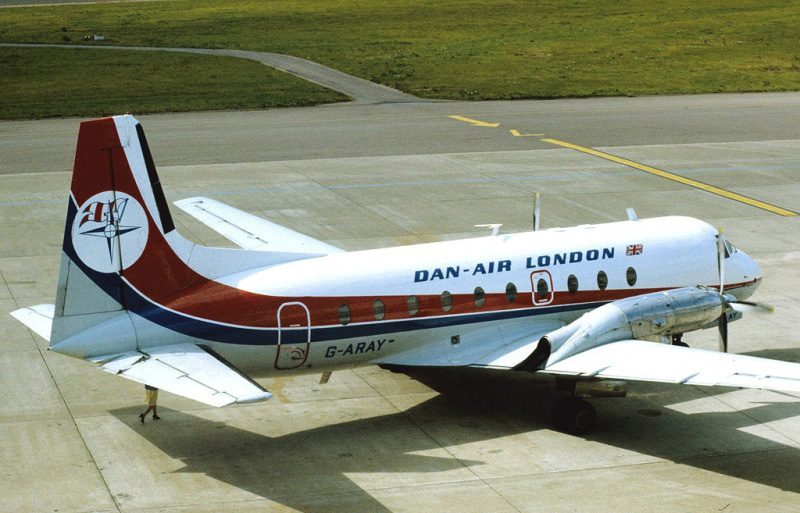
Captain Laurie Buist was awarded the Queen's Commendation for valuable services in the air in October. Captain Buist had been a pilot since 1951 and had flown 18,000 hours.
Proposals to end the sale of duty free goods at airports and on board aircraft would see air-fares rise by as much as 10% airlines claimed in October. Britannia Airways estimated that 400 of its workforce could lose their jobs. Dan-Air's Tony Barnes said;
'The loss of duty-free along together with other costs relating t the internal market programme, could lead to seat price increases of up to 25%. The report,carried out by the Netherlands Economic Institute said that thousands of jobs would be lost if the plans went through. In addition, the manufacturing and distribution centres would be severely affected.'
Group profits for the first half of the year showed a large loss. This was standard within the company, but trading set for the Summer was also down. For the first time, not all of the charter fleet had been fully booked out. Turnover was up 16% at £163 million, whilst losses were at almost £8 million from £1.7 million the previous year. Two of the airline's Airbus A300 were sold at profit over their book price, and one was immediately leased back for the upcoming Summer programme of charter services. The Zurich scheduled service was proving a success and an extra daily service was added bringing the number to three daily. The 'Class Elite' had been launched on the Belfast-Gatwick service and had proven to be a popular product, with 16% of the 28,000 passengers using it.
In December, Chairman of Davies and Newman, Fred Newman categorically denied that Dan-Air was about to merge with Air Europe saying; 'The rumours are absolutely untrue and we don't know who started them.' Nevertheless the city thought something was afoot with Davies and Newman shares rising by 95p.
In November the UK's second largest Tour Operator, Intasun said they were cutting a further 200,000 holidays from their 1990 programme. Intasun had only applied for a six month licence for the period November - April giving them the opportunity to increase flights should there be a reversal of their fortunes.
In November Dan-Air took part in repatriation flights after Paramount Airways went into receivership in November. The airline had panes chartered by several Tour Operators including Redwing, Owners Abroad and Intasun. The airline had demanded advance payment for charters and Tour Operators had refused. The airline had controversially operated a non-smoking policy. They went bankrupt to the tune of £11 million. It was also being investigated by the Serious Fraud Office.
Further problems hampered the Boeing 737 300/400 one example belonging to USAir crashed in America. Boeing asked all operators worldwide to report if there had been any faults. Dan-Air had two such incidents one in mid- air. Now it seemed that not only had there been rewiring issues with engines, but that rudder controls had been installed incorrectly. Dan-Air were able to modify the fault before any further incidents. It did mean that with two aircraft grounded Dan-Air had to sub charter aircraft for the short period.
Although it had been decided that the Boeing 727 should be replaced by the Boeing 737, replacements were not so easy to find, and so, three 727 100 series aircraft continued in service. Further charters fortunately come Dan-Air's way and extra aircraft were quickly needed. This resulted in the addition of two Boeing 727 200 and a further new Boeing 737 400 series that had recently come off the production line. For the first time in the company's history more than six million passengers were flown (6,276,000) 'Class Elite' was rolled out onto more flights, with Dublin, Zurich, Madrid, Toulouse and Lisbon now served. Berne was added to the network, with scheduled flights from Manchester.
The threat posed by Air Europe grew to its highest level this year when its parent company, ILG, announced it was reducing the six aircraft they chartered from Dan-Air to just three. ILG stated in public, that it did not wish to use Dan-Air's "Old, gas guzzling jets". This was a crushing blow to Dan-Air. The Boeing 727 aircraft in question had been time chartered by ILG and carried Intasun and Lancaster Holidays passengers. Time Charters meant that the aircraft were used exclusively for the charter client. Each one was capable of carrying 189 passengers; The six aircraft would usually perform three return flights a day, over a six month summer this could translate as losing almost 500,000 passengers. ILG plunged the knife in further when they stated that they were no longer going to use the services of Dan-Air Engineering.
Air Europe then successfully applied for several routes that British Airways had been forced to drop following the British Caledonian merger. Air Europe were already competing head to head with Dan-Air on the Gatwick-Paris and Jersey services. Now they stated that they wished to operate cut priced scheduled services to the United States, New Zealand and other exotic locations. Dan-Air had been successful with many of their own route applications. But darker times still lay ahead.
NEW ROUTES & ROUTES CHANGES
- Gatwick - Dublin - Increased weekly services from 9 to 12 - March 26th.
- Gatwick - Cork - Service withdrawn
- Manchester-Berne - Weekly service from December 17th - March 18th 1990 for use of winter sports travellers.
NETWORK & PRESS 1989
DISCUSS THIS SUBJECT
0
reviews